
MIT Maker Portfolio: Show How You Built It, Not Just What You Built
On this page
- What Is the MIT Maker Portfolio and Is It Required?
- What MIT Actually Wants to See in a Maker Portfolio Submission
- What the MIT Maker Portfolio Includes: Format, Files, and the SlideRoom Fee
- How to Build and Document an MIT Maker Portfolio Submission
- Should You Submit an MIT Maker Portfolio? How to Decide
- FAQ: MIT Maker Portfolio Questions
- Is MIT Maker Portfolio mandatory?
- Does the MIT Maker portfolio matter?
- What is a MIT Maker portfolio?
- What percent of MIT applicants submit a maker portfolio?
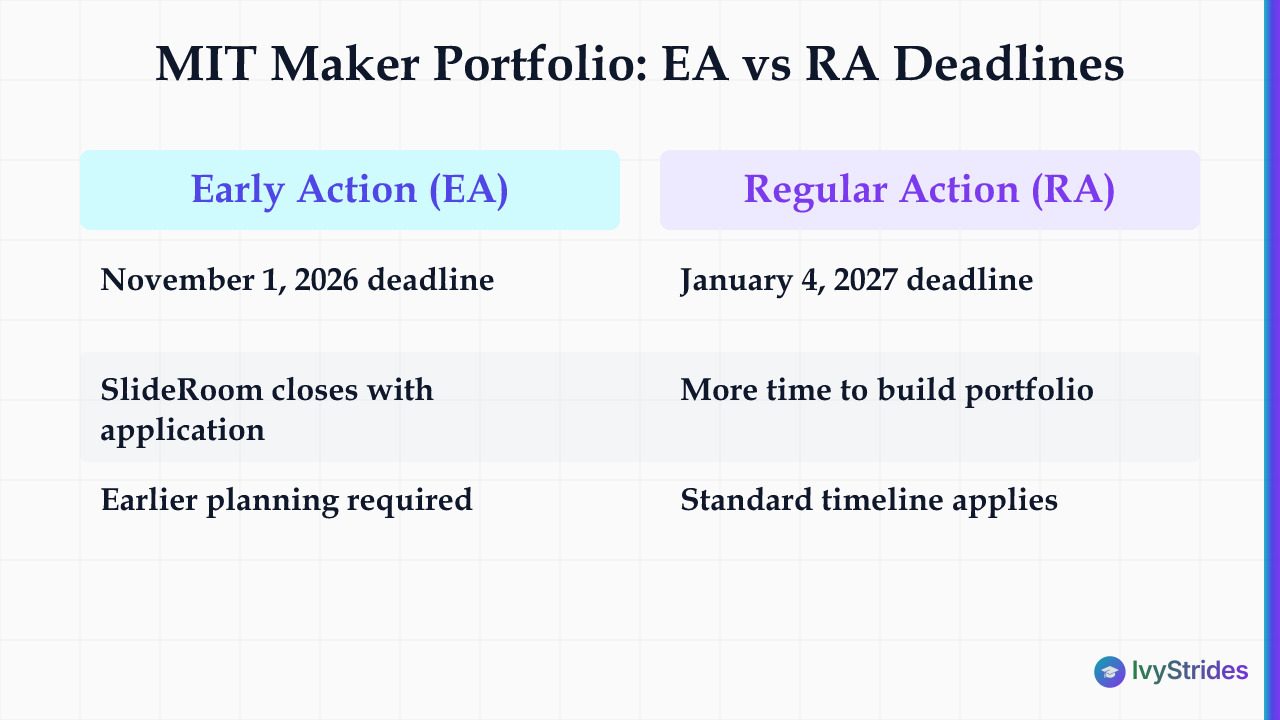
The MIT Maker Portfolio is an optional SlideRoom supplement where applicants document engineering or crafting projects that are substantial, original, and technically creative. It is not required, carries a submission fee, and is due with your application: November 1, 2026 for Early Action or January 4, 2027 for Regular Action. MIT faculty and alumni review it for process, not just product.
Those terms come straight from MIT Admissions' portfolios page. The harder question is not what the portfolio is. It's whether your robotics build, custom keyboard, or self-taught software project clears the bar, and whether a modest submission helps or hurts.
What Is the MIT Maker Portfolio and Is It Required?
The MIT Maker Portfolio is an optional supplement to the MIT first-year application, submitted through SlideRoom, where students document engineering or crafting projects of their own design. MIT does not require it and calls its creative portfolios "truly optional." MIT's portfolios page states that submissions should be substantial, original, and technically creative.
The evaluative lens is mens et manus. That's MIT's motto, Latin for "mind and hand." MIT also looks for alignment with its mission "to use science, technology, and other areas of scholarship to make the world better," per what MIT looks for. A polished gadget with no evidence of thinking behind it misses the point the motto makes.
The portfolio sits inside a review where character counts more than any single credential. For the full picture of what MIT weighs most heavily in its holistic review, scores and essays matter, but so does the initiative a project can show.
| Detail | What You Need to Know |
| Status | Truly optional, per MIT |
| Platform | SlideRoom |
| Deadline (Regular Action) | January 4, 2027 |
| Deadline (Early Action) | November 1, 2026 |
| Reviewed by | A board of MIT faculty and alumni |
| What it rewards | Substantial, original, technically creative work |
What MIT Actually Wants to See in a Maker Portfolio Submission

Photo by Vanessa Loring on Pexels
MIT wants initiative, risk-taking and resilience, hands-on creativity, and a collaborative spirit, shown through the project rather than claimed in a caption. These are the qualities MIT names on its what we look for page.
Character sits at the top of MIT's formal ratings. MIT's 2025-26 Common Data Set rates one factor Very Important: Character/personal qualities. It rates Alumni/ae relation, State residency, Religious affiliation/commitment, and Level of applicant's interest as Not Considered. So demonstrated interest won't move your file. Initiative will.
MIT states that the match matters most: grades and scores show preparedness, but "it's really the match between the applicant and the Institute" that drives selection. A project you built because you couldn't not build it reads as match. A trophy-case entry does not.
Scale is not the bar. MIT says impact can be small: "Tutoring a single kid in math changes the world." For the portfolio itself, MIT says it is "more interested in your build process than your end results." So document the process rather than showcasing a polished product: photograph the failed versions and the fixes, since MIT asks for "plenty of photos of your build process" and can only review projects with "sufficient evidence and documentation" of it.
The portfolio supplements but does not replace MIT's four short-answer essays and four short responses; the short response asking "What do you do just for fun?" is often the natural companion to a maker project. Avoid telling the same story twice: let the portfolio carry the technical depth and the short response carry the personal joy.
| Signal MIT Looks For | What It Looks Like in a Submission |
| Initiative | You started the project without being assigned it |
| Risk-taking and resilience | Visible failed attempts, then the fix |
| Hands-on creativity | You built, not just sketched or theorized |
| Collaborative spirit | Clear account of your role on a team |
| Technically creative | An original design choice, not a kit assembly |
| Mission alignment | The work points at a real problem |
What the MIT Maker Portfolio Includes: Format, Files, and the SlideRoom Fee
The MIT Maker Portfolio opens with a questionnaire about what you make, how you make it, and why. You then upload up to 25 media files with no more than 120 seconds of video in total. MIT's portfolios page sets these limits and says every attachment must include a clear explanation.
Those limits are tighter than they look. Two minutes of video is not a documentary, and MIT says there is "no bonus for submitting a video reel." Use it for the moment a mechanism moves or a program runs, and let captioned photos carry the design reasoning. Each portfolio carries a fee; you may qualify for a hardship waiver by emailing MIT's SlideRoom team with the subject line "SlideRoom Fee Waiver" at least 3 days before your deadline, once the portfolio is in progress.
Early Action applicants face a November 1 portfolio deadline, not January 4; if you're applying EA, the SlideRoom window closes the same day as your application. That parity is worth planning around, and the broader trade-off between an Early Action and a Regular Action timeline shapes when you should start building.
| Component | Rule |
| Questionnaire | Comes first: what, how, and why you make |
| Media files | Up to 25, each clearly explained |
| Video (total across all clips) | No more than 120 seconds |
| Projects with moving parts | Video demonstration required |
| Code projects | Codebase plus a working demo |
| Fee | Charged per portfolio; hardship waivers possible |
| Deadline | November 1, 2026 (EA) or January 4, 2027 (RA) |
MIT's other SlideRoom portfolios (Research, Music and Theater Arts, and Visual Art and Architecture) are separate submissions. The MIT Research Supplement wants a questionnaire, an abstract or poster if available, and a letter from your research mentor, one per applicant. The Music and Theater Arts Portfolio requires an arts teacher letter and a performing-arts resume, with musicians sending two contrasting recordings totaling 10 minutes. A maker project goes in the Maker Portfolio, not any of these.
How to Build and Document an MIT Maker Portfolio Submission
Building an MIT Maker Portfolio means choosing a project, then documenting the decisions behind it in up to 25 media files. MIT sets no rule on how many projects to include, so choose the work that best shows your process, risk-taking and resilience.
Document the process, not the trophy shot. Include the first sketch, the prototype that snapped, the code commit history, the redesign. MIT says it wants applicants "not afraid to fail," so the failure is evidence, not embarrassment.
The four-activity limit on MIT's application means the portfolio can document a project that the activity list can only name. Your activity descriptions have to do a lot with very little room, so let the portfolio carry the depth the activity form can't.
-
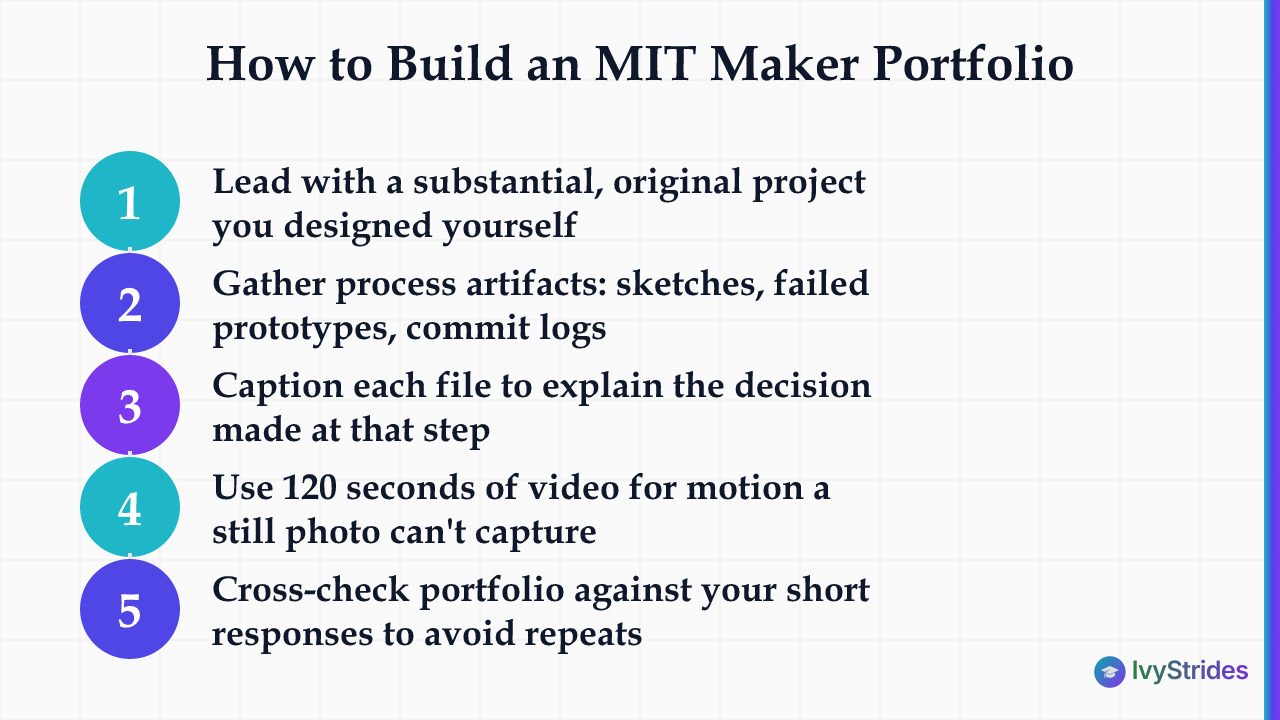
Lead with a substantial, original project you designed yourself, or clarify your exact role if it was a team build.
-
Gather process artifacts: sketches, failed prototypes, iteration photos, commit logs, test data.
-
Caption each file to explain the decision made at that step, not just what the image shows.
-
Use the 120 seconds of video for motion or function a still can't capture; MIT requires a video demonstration for projects with moving parts.
-
For code projects, include the codebase and a working demo, since MIT cannot review a project whose demo it can't access.
-
Cross-check against your short responses so the portfolio and "What do you do just for fun?" don't repeat each other.
The portfolio and the short-answer essays are parts of the same application, which is where essay coaching for MIT's short-answer prompts helps most: a coach can spot where the two pieces overlap and where each needs a distinct signal. Caption writing is its own skill. "Robotic arm, v3" says nothing. "Switched to a worm gear here after v2 kept backdriving under load" shows the mind behind the hand.
Should You Submit an MIT Maker Portfolio? How to Decide
Submit an MIT Maker Portfolio if your project is substantial, original, and technically creative, and if the rest of your application can't adequately show it. Skip it if the project is a class assignment with no independent design, or if it would just duplicate what your essays already cover. On a free call, IvyStrides reviews your project list for the MIT Maker Portfolio against MIT's stated criteria and flags whether it adds a signal your file lacks.
The portfolio rewards documented thinking over a polished finish, and initiative and process over prestige. A self-taught app or a garment sewn from a pattern you drafted can qualify, since MIT encourages crafts beyond engineering but holds them to "the same kinds of critical thinking standards as MIT engineering work." A 2015 MIT Faculty Newsletter article documented a gender gap in who submits maker portfolios, and its authors invited suggestions for making the portfolio more accessible to women.
MIT's own test is whether the work is "both significant to you and relevant to your MIT application," so weigh whether your project shows independent initiative that the four-activity list and essays can't fully capture. For students still deciding whether their project qualifies, a counselor who reviews the full file against the one factor MIT rates Very Important can help judge whether the portfolio adds a missing signal. Admissions outcomes depend on the whole application, not any single component.
| Your Situation | Recommendation | Reason |
| Original project, not shown elsewhere | Submit | Adds a signal the file lacks |
| Project already central to an essay | Lean skip | Risks duplication |
| Class assignment, no independent design | Skip | Shows little initiative |
| Home project with documented iterations | Submit | MIT values build process over end results |
| No qualifying project, little time left | Skip | Portfolios are truly optional |
FAQ: MIT Maker Portfolio Questions
Is MIT Maker Portfolio mandatory?
No. MIT calls its creative portfolios "truly optional" and says to submit one only if it features work that is both significant to you and relevant to your MIT application.
Does the MIT Maker portfolio matter?
Yes, when submitted well. A board of MIT faculty and alumni reviews it, and it's one of the few places where initiative, risk-taking, and hands-on creativity can be shown rather than claimed. MIT says it can only review projects with sufficient process documentation, so a rushed submission adds little; a strong one reinforces the character and personal qualities MIT rates as Very Important.
What is a MIT Maker portfolio?
It's an optional SlideRoom supplement to the MIT first-year application where students document engineering or crafting projects of their own design. It opens with a questionnaire, then allows up to 25 media files and no more than 120 seconds of video. It is due November 1, 2026 for Early Action and January 4, 2027 for Regular Action.
What percent of MIT applicants submit a maker portfolio?
MIT's admissions pages do not give a current submission rate for the Maker Portfolio. The latest public data we found is a 2015 MIT Faculty Newsletter article that reported a single admissions year and showed women submitting at a much lower rate than men. Any percentage circulating online for recent cycles is an estimate, not a verified fact.

Hemant is a seasoned entrepreneur, investor, and growth strategist with deep ground in education and technology-driven learning. His core training is in Mathematics and Physics — he authored Physics for IB Diploma: Ultimate Revision Guide, recognized as a top student resource.