
How Colleges Track Demonstrated Interest, and Whether It Changes Anything
On this page
- What Demonstrated Interest Means in College Admissions (and Why Colleges Care)
- Which Colleges Actually Track Demonstrated Interest (and Which Ones Do Not)
- How Colleges Actually Track Demonstrated Interest: What Gets Logged
- Not sure which of your target schools are watching, or what to do about it?
- How to Show Demonstrated Interest in College Admissions: Actions That Actually Get Recorded
- Demonstrated Interest Checklist: Before You Submit Your Application
- Demonstrated Interest and Your Admissions Strategy: Putting It All Together
- Your supplemental essays are the highest-leverage demonstrated-interest signal you control.
- Frequently Asked Questions: How Colleges Track Demonstrated Interest
- Does UCLA care about demonstrated interest?
- Does Yale care about demonstrated interest?
- Does Duke consider demonstrated interest?
- How do I know if a college is tracking my demonstrated interest?
- Your Next Step on Demonstrated Interest
Demonstrated interest is the measurable evidence that a student genuinely wants to attend a specific college. Roughly 16 percent of colleges assign it considerable importance in admissions decisions, per NACAC survey data. Schools use it to predict yield, the share of admitted students who actually enroll. Some log every portal login, email open, campus visit, and event RSVP. Others, including Harvard, MIT, Stanford, Yale, and UCLA, explicitly do not consider it. Whether it changes your odds depends entirely on which schools sit on your list.
Every college publishes a Common Data Set each year, and one line inside it settles the question for that school. This guide shows you where that line lives, which named schools fall on each side, what actually gets recorded, and the moves worth making before you submit.

What Demonstrated Interest Means in College Admissions (and Why Colleges Care)
Demonstrated interest refers to the trackable signals that tell an admissions office a student is likely to enroll if admitted. Portal logins, opened emails, an information session RSVP, a campus visit, an alumni interview: each is a data point a college can tie back to your file.
The motive is yield rate, the percentage of admitted students who actually enroll. Yield shapes a school's US News ranking and its budgeting. A school that admits 2,000 students expecting 600 to enroll has a problem if only 400 show up.
Schools that track demonstrated interest tend to admit students who look likely to say yes. It isn't a reward for effort; it's a prediction tool.
The spread is wide. Roughly one in six colleges rates level of applicant interest as considerable importance, while a large share mark it "not considered." Where any given school lands is the thing you verify, not assume. If a school is a clear first choice, your strongest single move is often the application round itself; see Early Decision vs Early Action for how timing plays in.
Which Colleges Actually Track Demonstrated Interest (and Which Ones Do Not)
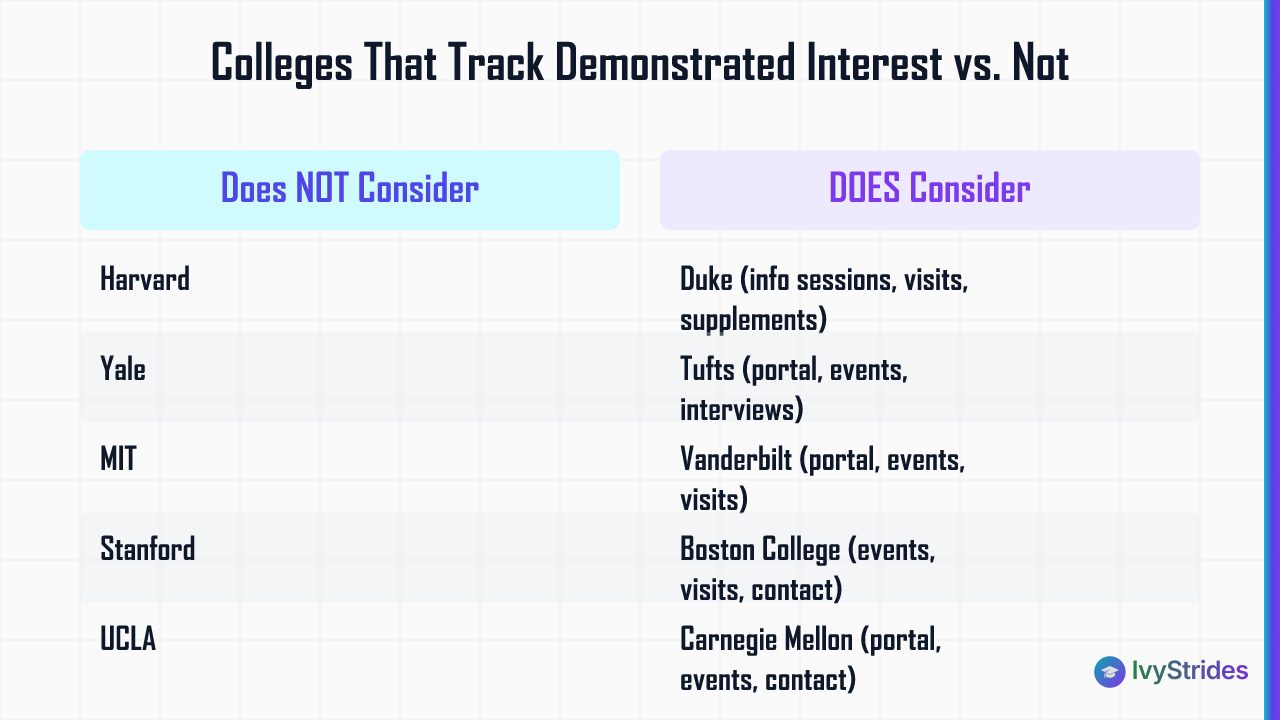
The fastest way to check any school is its Common Data Set, Section C7. That section marks each admissions factor "Very Important," "Important," "Considered," or "Not Considered." Search "Common Data Set [University Name]," open the current year's PDF, and read the row labeled level of applicant's interest.
Here is where a set of well-known schools currently fall. Verify each against the school's own Common Data Set, because these designations can change year to year.
| College | Considers Demonstrated Interest? | How They Track It | Source |
| Harvard | No | N/A | Common Data Set, C7 |
| Yale | No | N/A | Common Data Set, C7 |
| MIT | No | N/A | Common Data Set, C7 |
| Stanford | No | N/A | Common Data Set, C7 |
| Caltech | No | N/A | Common Data Set, C7 |
| UCLA | No | N/A | Common Data Set, C7 |
| Duke | Yes | Info sessions, visits, supplements | Common Data Set, C7 |
| Tufts | Yes | Portal, events, interviews | Common Data Set, C7 |
| Vanderbilt | Yes | Portal, events, visits | Common Data Set, C7 |
| Boston College | Yes | Events, visits, contact | Common Data Set, C7 |
| Carnegie Mellon | Yes | Portal, events, contact | Common Data Set, C7 |
| WashU | Yes (as of April 2026) | Recommends campus visits | WashU admissions announcement |
In April 2026, Washington University in St. Louis announced it now considers demonstrated interest and recommends campus visits. Confirm the current language on WashU's own admissions page before building a plan around it.
At test-optional schools, where a submitted score is absent, readers lean more heavily on every other signal, including demonstrated interest. If you're weighing that decision, read what is test-optional and should you submit SAT scores. Because the highest-impact actions happen months out, map them against your college application timeline early. If your score plan is still unsettled, 1-on-1 SAT prep can firm it up before deadlines close in.
How Colleges Actually Track Demonstrated Interest: What Gets Logged
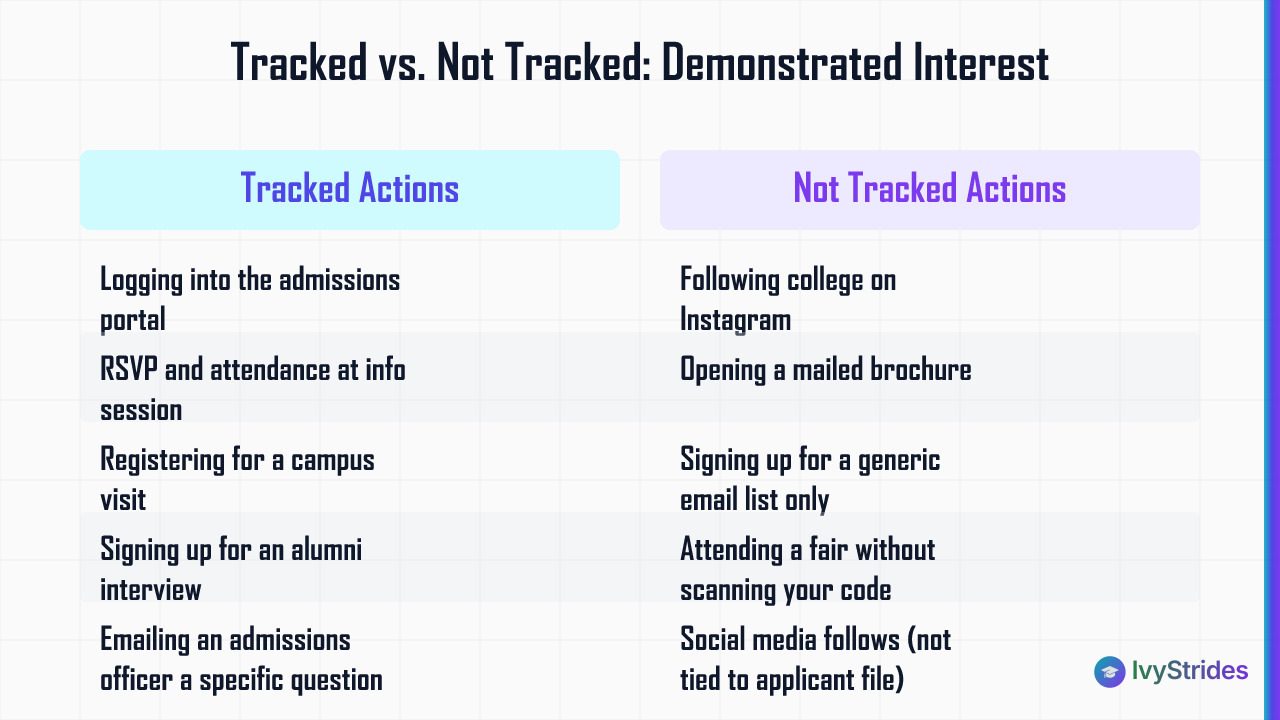
Admissions portals log the actions tied to your name and contact information. Creating an account records logins. Email platforms record opens and clicks. Event pages record RSVPs and attendance. Campus visit forms and alumni interview sign-ups create timestamped entries linked to your applicant record.
An action counts only when the college can verify it and connect it to you.
| Action | Typically Tracked? | Notes |
| Creating and logging into the admissions portal | Yes | Tied to your account |
| Opening or clicking official emails | Yes | Recorded by the mailing platform |
| RSVP and attendance at an info session | Yes | Linked to your contact record |
| Registering for a campus visit | Yes | Timestamped, tied to your name |
| Signing up for an alumni interview | Yes | Strong, proactive signal |
| Emailing an admissions officer a specific question | Often | Noted at schools that track interest |
| Attending a college fair and giving your info | Sometimes | Depends on whether they scan your code |
| Following the college on Instagram | No | Not verifiable, not tied to your file |
| Signing up for a generic email list only | Weak | Passive, low signal |
| Opening a mailed brochure | No | No way to record it |
Following a college on social media almost certainly doesn't count. Admissions offices have no reliable way to connect a public follow to a specific applicant file.
Here's the part most students underweight. In our coaching, students who emailed an admissions officer a specific, thoughtful question before applying to a school that tracks interest reported the interaction was noted in their file. The key word is specific: a question you couldn't answer from the website. When you're ready to turn that engagement into writing, how to write supplemental essays that get you in walks through the mechanics.
Not sure which of your target schools are watching, or what to do about it?
In a free 15-minute strategy call, an IvyStrides coach will review your college list, flag which schools track demonstrated interest, and tell you exactly which actions to prioritize before your deadlines.
How to Show Demonstrated Interest in College Admissions: Actions That Actually Get Recorded
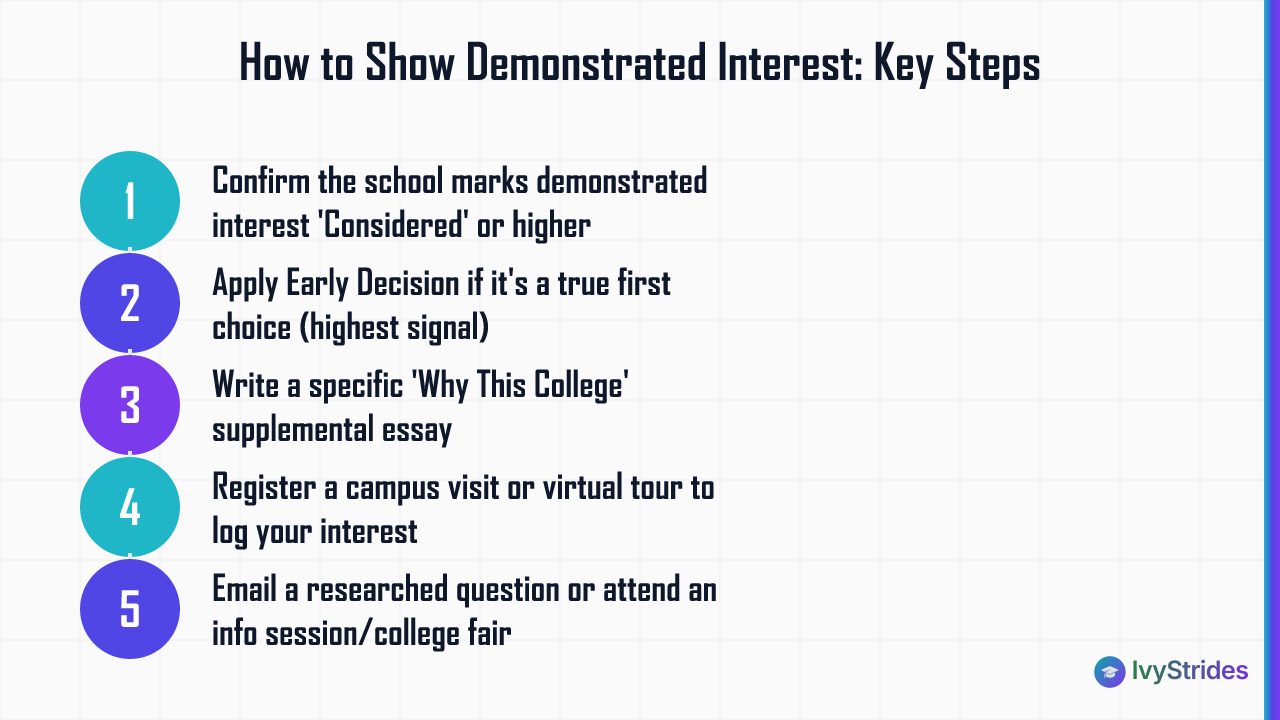
Demonstrated interest is worth acting on only at schools whose Common Data Set marks it "Considered" or higher. Once you've confirmed that, a short, prioritized list beats a scattershot approach.
Demonstrated Interest Checklist: Before You Submit Your Application
| Action | Impact Level | When to Do It |
| Apply Early Decision (if it's a clear first choice) | Highest | By the ED deadline, usually early November |
| Write a specific "Why This College" supplemental essay | Highest | During drafting, roughly 6-8 weeks before deadline |
| Register a campus visit or virtual tour | High | Summer or fall before applying |
| Sign up proactively for an alumni interview | High | When the school opens interview scheduling |
| Attend an info session or college fair | Medium | Junior spring through senior fall |
| Email an officer a specific, researched question | Medium | Well before the deadline, not the week of |
| Create and use the admissions portal | Low-Medium | As soon as it opens |
| Open and click official emails | Low | Ongoing |
Applying Early Decision is the single loudest demonstrated-interest signal available, because it's a binding commitment that removes all ambiguity about enrollment intent. Reserve it for a true first choice. Many schools that track interest report higher admit rates in their ED round, which you can check in that school's Common Data Set. Don't read that gap as pure preference; the ED pool often skews toward stronger, more committed applicants.
The most controllable signal is the supplemental essay: a specific, well-researched "Why This College" response tells an admissions reader you know the school well enough to want it. Naming a particular professor's research, a named program, or a course you'd take beats generic praise.
In our coaching, students who visited campus before applying had a concrete event to reference in their supplemental essay, which strengthened both signals at once. The visit gets logged; the essay proves it meant something. See Why This College essay examples that worked for the specificity benchmark. Check how many supplemental essays you will write to scope the workload.
Demonstrated Interest and Your Admissions Strategy: Putting It All Together
Demonstrated interest is one factor in holistic review, not a substitute for academic strength. At most schools that consider it, it functions as a tiebreaker between similar applicants. Your transcript, course rigor, and test scores still carry the weight.
AP coursework and SAT or ACT scores remain the primary academic signals; demonstrated interest can tip a close decision, but it won't rescue an application short on the academic side. If your testing plan needs work, map it out with our guide to an AP, SAT, and ACT testing plan for high school. Students who want structured support can start with our 1-on-1 tutors.
Admissions outcomes depend on the full application, and a school's weighting can change from one cycle to the next.
So what's the practical move? Audit each target school's Section C7. For the ones that track interest, take the two or three highest-use actions: a campus visit or virtual tour, a genuinely specific supplemental essay, and Early Decision if the school is a clear first choice. In our coaching, for students applying to 8 to 12 schools, time spent on a strong supplemental essay delivers demonstrated interest and a stronger application at once, which makes it the highest-return action on the list.
Your supplemental essays are the highest-leverage demonstrated-interest signal you control.
IvyStrides essay coaches work 1-on-1 with students to write school-specific supplemental essays that show genuine knowledge of each college. Book a free call to see if essay coaching is the right next step for your list, whether you're the student or the parent starting the search.
Frequently Asked Questions: How Colleges Track Demonstrated Interest
Does UCLA care about demonstrated interest?
No. UCLA is a large public university that does not consider demonstrated interest. University of California campuses generally don't track engagement signals, partly because their application volumes make individual tracking impractical. Confirm this in UCLA's current Common Data Set, Section C7, before you plan around it.
Does Yale care about demonstrated interest?
No. Yale explicitly does not consider it. Along with Harvard, MIT, Stanford, Princeton, and Caltech, Yale sits among the most selective schools that have publicly stated they don't use engagement tracking. Their yield rates are high enough that they don't need the signal.
Does Duke consider demonstrated interest?
Yes. Duke is among the selective private universities that do. Attending an information session, registering a campus visit, and writing a specific supplemental essay are all meaningful for Duke applicants. Check Duke's current Common Data Set, Section C7, for the exact weighting in your cycle.
How do I know if a college is tracking my demonstrated interest?
Open the school's most recent Common Data Set and go to Section C7. If level of applicant's interest is marked "Important" or "Considered," the school tracks it. If it reads "Not Considered," engagement signals won't affect your file.
Your Next Step on Demonstrated Interest
Demonstrated interest only matters where the school actually tracks it, and the Common Data Set tells you the truth in one line. Start there, then act where it counts.
- Pull Section C7 for every school on your list and note which ones mark interest "Considered" or higher.
- For those schools, register a campus visit or virtual tour and sign up for any alumni interview offered.
- Draft a "Why This College" supplement that names specific professors, programs, or courses, not generic praise.
- If a school is a clear first choice and you're comfortable with a binding commitment, weigh Early Decision.
- Verify the WashU April 2026 change and any other policy against the school's current admissions page before relying on it.

Award-winning author (South Asian Book Award) and graduate of BITS Pilani and UCLA Luskin School of Public Affairs. Brings a published writer's eye to Common App essays and grammatical precision to SAT and ACT R&W instruction.