
What Is ACT Superscoring? How It Works and Which Colleges Use It
On this page
- What ACT Superscoring Actually Means
- How the ACT Superscore Is Calculated: The Three-Section Formula
- Which Colleges Accept ACT Superscores, and How to Check
- How to Get Your ACT Superscore to Colleges
- FAQ: ACT Superscoring
- Do colleges look at ACT superscores?
- Does the ACT superscore include Science?
- Do Ivy League schools accept ACT superscores?
- How do you get your ACT superscore?
- Your Next Step on ACT Superscoring
An ACT superscore averages your best English, Math, and Reading section scores from separate test sittings into a single composite on the 1-to-36 scale. Science and Writing are excluded, exactly as they are from any single-sitting Composite.
Those three sections come straight from the official Composite definition: ACT, Inc. reports the Composite as the average of English, Math, and Reading, rounded to the nearest whole number (ACT, Inc.). The harder question is not what a superscore is. It's whether your target colleges will actually use one, which decides whether a retake earns its registration fee.

What ACT Superscoring Actually Means
ACT superscoring is the practice of pulling your highest English, Math, and Reading section scores from across multiple sittings and averaging them into one composite. It uses the same three sections as the standard ACT Composite, just drawing each section's best result from whichever test date produced it.
In ACT's words, "The ACT Superscore is the average of a student's best scores from each section across multiple ACT test attempts" (ACT, Inc.). ACT builds it automatically for anyone who has tested more than once since September 2016, and since 2025 its composite uses English, Math, and Reading only. Those best scores can come from any test event, legacy or enhanced (ACT, Inc.), and each sits on the 1-to-36 scale (ACT, Inc.).
Science stays out, and so does Writing. Science is optional, scored separately, and not part of the Composite (ACT, Inc.), and the 2-to-12 Writing score does not affect it either. Neither can lift ACT's Superscore Composite, though both still appear on the Superscore report with their test dates (ACT, Inc.).
So what separates a superscore from a single-sitting composite? A single composite averages three sections from one day; a superscore takes the best of each across days. Once you grasp how the ACT Composite is calculated from three sections, the superscore follows.
| Score Type | English | Math | Reading | Science | Writing |
| Single-sitting Composite | Counts | Counts | Counts | Excluded | Excluded |
| Superscore Composite | Best across sittings | Best across sittings | Best across sittings | Excluded | Excluded |
| Reported scale | 1-36 | 1-36 | 1-36 | 1-36 (separate) | 2-12 (separate) |
How the ACT Superscore Is Calculated: The Three-Section Formula
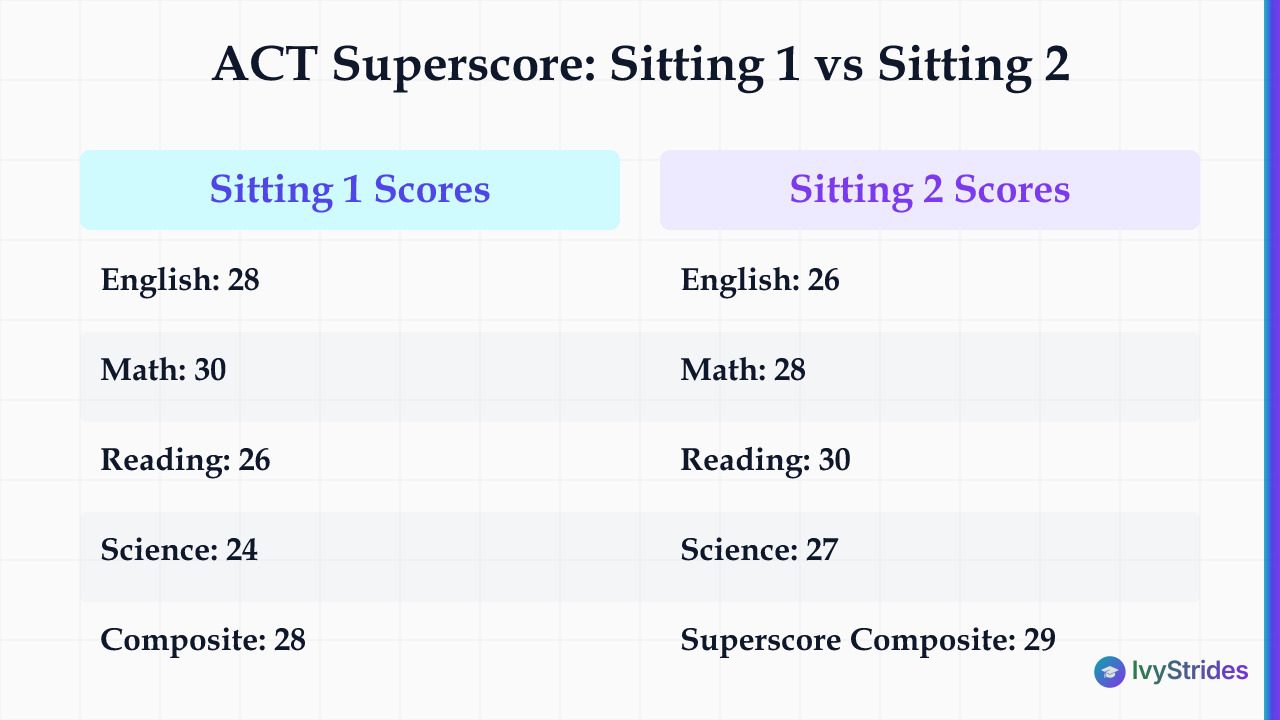
The ACT superscore formula is simple: take your best English, your best Math, and your best Reading across all sittings, add them, divide by three, and round to the nearest whole number.
Here's a worked example. Say you scored 28 English, 30 Math, 26 Reading on your first sitting, then 26 English, 28 Math, 30 Reading on your second. Your best English is 28, best Math is 30, best Reading is 30. Those three add to 88, and 88 divided by 3 is 29.33. ACT rounds fractions under one-half down, so the Superscore Composite is 29. Neither single sitting produced a 29 on its own; each averages exactly 28.
| Section | Sitting 1 | Sitting 2 | Best Score Used |
| English | 28 | 26 | 28 |
| Math | 30 | 28 | 30 |
| Reading | 26 | 30 | 30 |
| Science | 24 | 27 | Not used |
| Composite | 28 | 28 | 29 (superscore) |
Notice that Science shifted from 24 to 27 and changed nothing. That's the exclusion in action: the 27 still shows on the Superscore report as your best Science score, but ACT's Superscore Composite stays at 29.
You can run this math yourself. Three best scores, one sum, one division, one round, or ACT's free Superscore Calculator does it for you.
Knowing what each ACT section actually tests and how it is scored helps you decide which section a retake should target. English runs 50 questions in 35 minutes with 40 scored; Math, 45 questions in 50 minutes with 41 scored; Reading, 36 questions in 40 minutes with 27 scored (ACT, Inc.). Science, when you take it, is 40 questions in 40 minutes with 34 scored, and it stays out of ACT's Superscore Composite.
Which Colleges Accept ACT Superscores, and How to Check
Not every college superscores the ACT (ACT, Inc.), and the ones that do set their own rules. Here is how seven admissions offices state theirs for fall 2027 entry:
| College | Superscores the ACT? | Rule on its admissions page |
| Brown | Yes | Report your highest English, Math, and Reading scores |
| Cornell | Yes | Use ACT's superscore option when sending official scores |
| Dartmouth | Yes | Superscores multiple sittings automatically |
| Johns Hopkins | Yes | Science and Writing are not superscored |
| MIT | Yes | Self-report every sitting; MIT considers the superscore |
| Vanderbilt | Yes | Scores optional for fall 2027 and 2028 entry; adds Science only if it raises the superscore |
| UT Austin | No | Uses the highest score from one test date |
IvyStrides' comparison of these seven admissions pages shows why "superscores the ACT" is never the whole answer: six do, yet Cornell, MIT, and Vanderbilt each handle it differently. At UT Austin, one test date has to carry your best English, Math, and Reading together, which changes how many sittings are worth planning.
Superscoring changes the retake calculus: instead of needing every section to rise on the same day, you can aim one sitting's prep at the section pulling your Composite down, but only at colleges that superscore.
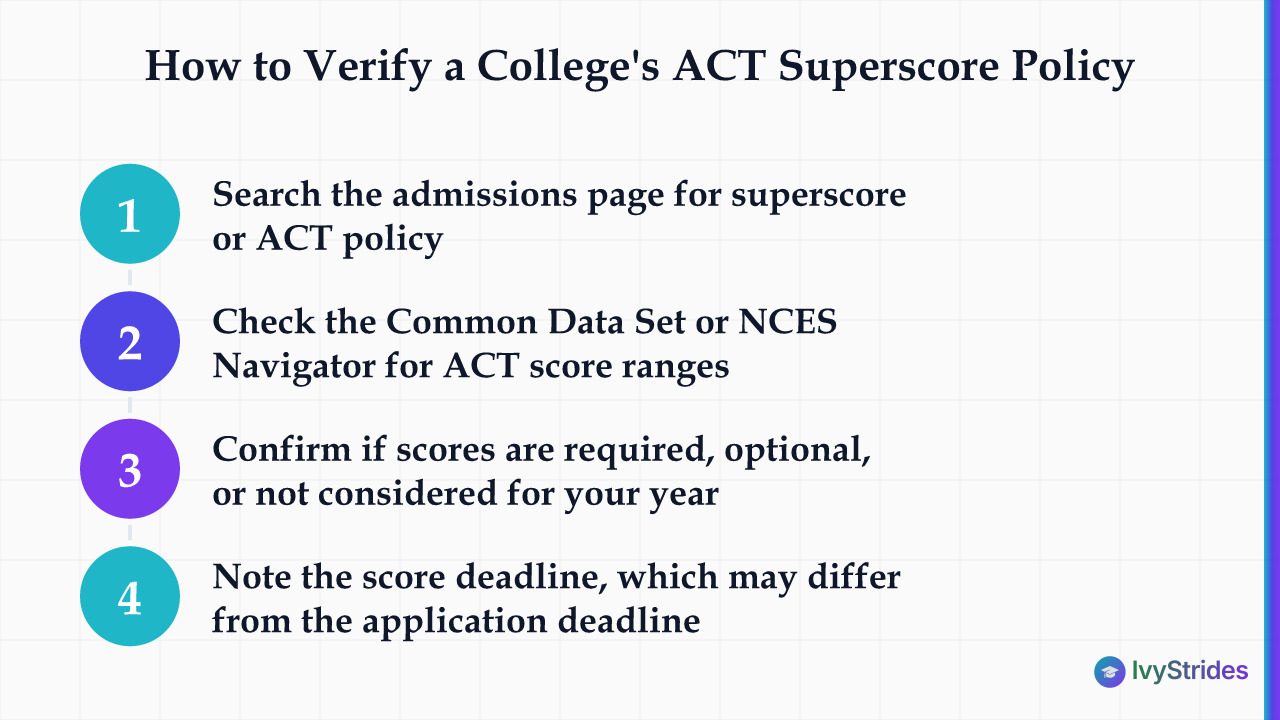
Verify, don't assume. Here's how to confirm a school's policy for the fall 2027 cycle:
Get your Daily IV Dose on Instagram: quick study tips and test-day advice for high school students. Follow @ivy.strides.
-
Open the college's undergraduate admissions page, search "superscore" or "ACT policy," and check whether it combines section scores across test dates.
-
Find the school's Common Data Set or its NCES College Navigator profile to see the ACT Composite range of enrolled first-time students who submitted scores.
-
Confirm whether the school requires scores, makes them optional, or does not consider them for fall 2027 entry, since testing policies vary by school and year.
-
Note the deadline for scores to arrive, which may differ from your application deadline.
Knowing the ACT score ranges at top colleges shows how far a one-point superscore gain moves you inside a school's middle-50% range, which describes enrolled students who sent a score, not everyone admitted. Read it as context, not a cutoff, since admissions outcomes depend on the full application.
One weak section changes the math. When one section is clearly your weak point, the prep before your next sitting can center on it instead of spreading hours evenly across all three. IvyStrides' ACT 1-on-1 prep builds every hour around the student's own baseline and target, starting with a diagnostic test and a custom ACT roadmap that set the focus areas. An expert instructor teaches the live sessions on a flexible 12 to 16 week schedule paced to the student's retake window or target test date.
How to Get Your ACT Superscore to Colleges
To get a superscore applied, the college has to receive it. In MyACT you can send your Superscore or a single test date's scores (ACT, Inc.). A Superscore report carries your Superscore Composite, your highest score in each section with its test date, and the full reports from the test events behind those scores and your highest Composite (ACT, Inc.), so even a school that does not superscore can review them under its own policy.
Some colleges let you self-report first: Brown, Cornell, and MIT take self-reported scores and require official ones from students who enroll. If you send single test dates, you choose which sittings each college sees, but leaving out a date that holds one of your best section scores shrinks the superscore the college can build. Managing which sittings colleges see when you send ACT scores is the step that decides whether the policy helps you.
Budget the sending cost. Your test fee covers reports to up to four colleges if you give their codes when you register; after that, each additional score report costs $20 (ACT, Inc.). ACT charges per test date, per report (ACT, Inc.), so plan the list before you order.
For planning a section-focused retake, ACT's 2026-27 schedule has seven national test dates (ACT, Inc.). The two nearest dates still open, with both deadlines:
| Test date | Regular registration deadline | Late registration deadline |
| December 12, 2026 | November 9, 2026 | November 29, 2026 |
| February 27, 2027 | January 22, 2027 | February 9, 2027 |
Register in the late period, between those two deadlines, and ACT adds a $42 late fee (ACT, Inc.), so pick a date that leaves real prep time. Once you fix the date, the next job is protecting the hours, and finding ACT prep hours inside a junior year schedule turns that date into a weekly plan.
Steps to make sure colleges can apply your superscore:
-
Confirm each target school superscores the ACT for your cycle.
-
Identify the single section pulling your composite down.
-
Register for a date that leaves enough prep weeks for that section.
-
After the retake, send your Superscore, or every sitting that holds one of your best section scores.
-
Double-check the college received all reports before the deadline.
FAQ: ACT Superscoring
Do colleges look at ACT superscores?
Many do, though not all. Dartmouth, Johns Hopkins, and Vanderbilt superscore the ACT, while UT Austin uses the highest score from one test date. Confirm each school's policy, and whether it requires scores at all, on its admissions page for fall 2027 entry.
Does the ACT superscore include Science?
Not in ACT's own Superscore Composite, which averages only your best English, Math, and Reading section scores across sittings. Your best Science score still appears on the Superscore report and counts toward the STEM score with Math. A college can set its own rule, though: Vanderbilt's ACT superscore includes Science when Science raises it.
Do Ivy League schools accept ACT superscores?
Brown, Cornell, and Dartmouth do, each in its own way: Dartmouth superscores automatically, Cornell asks you to use ACT's superscore option when sending, and Brown asks for your highest English, Math, and Reading scores. Check every other Ivy on your list on its own admissions site, and remember that admissions outcomes rest on the whole application, not the superscore alone.
How do you get your ACT superscore?
ACT creates it automatically once you have tested more than once since September 2016, and you can send it to colleges from your MyACT account. You can also compute it yourself: add your best English, Math, and Reading section scores, divide by three, and round to the nearest whole number.
Your Next Step on ACT Superscoring
You now know how the superscore is built, what stays out of it, and that a retake aimed at one section counts in full only where your colleges superscore. Turn that into action:
- Calculate your current superscore from the sittings you already have.
- Check each target school's superscore policy and score deadline for fall 2027 entry.
- Pick a test date that leaves enough weeks to move your weakest section.
Daily SAT and ACT prep on YouTube: short strategy videos from IvyStrides. Subscribe to IvyStrides on YouTube.

Hemant is a seasoned entrepreneur, investor, and growth strategist with deep ground in education and technology-driven learning. His core training is in Mathematics and Physics — he authored Physics for IB Diploma: Ultimate Revision Guide, recognized as a top student resource.