
Group ACT Class or 1-on-1 Tutoring: Which Fits Your Score Gap?
On this page
- What a Group ACT Class Covers (and Where It Stops Working)
- What a Group ACT Class Can and Cannot Fix in Your Composite
- How to Decide: Group ACT Class or 1-on-1 Tutoring?
- Is an ACT Prep Class Worth It for a Student Already Scoring 30?
- FAQ: Group ACT Class and 1-on-1 Tutoring
- Is ACT prep class worth it?
- Is it better to take an ACT prep class or get a tutor?
- What is the most effective way to study for the ACT?
- How much does a group ACT class cost compared to a tutor?
- Your Next Step on the Group-or-1-on-1 Decision
A group ACT class is a cohort-based, fixed-schedule prep format that covers all tested content in sequence. It fits best when your gap is broad and a steady calendar helps you work; 1-on-1 tutoring fits best when your points leak from one section or one habit. If you're at a 30 aiming for a 34, the choice turns on where your missing points sit and how you learn.
Whether a class is enough depends on where your points are being lost. On the national ranks ACT uses for tests from September 2026 through August 2027, a composite of 30 carries a national rank of 94, the percentage of test takers who earned that score or lower, and a 34 carries a rank of 99. Your three section scores show whether the distance between them is spread out or sits in one section, and that answers the format question.

What a Group ACT Class Covers (and Where It Stops Working)
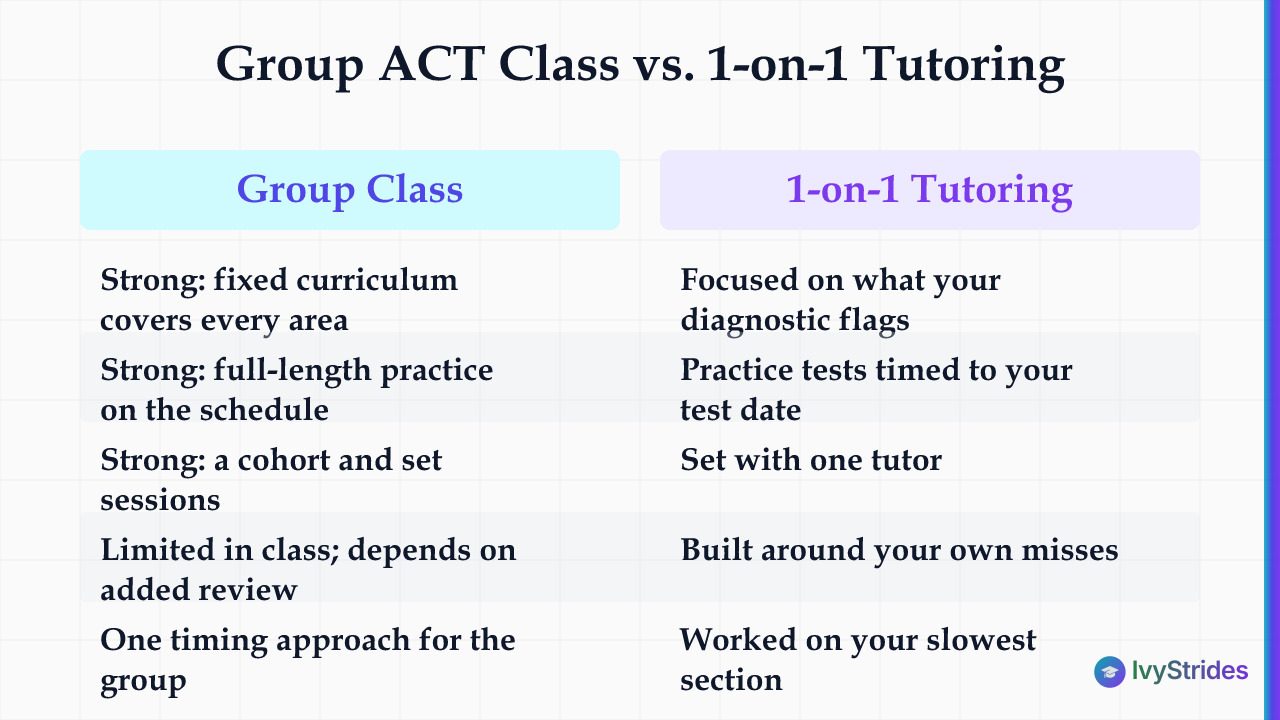
A group ACT class delivers the full tested content of the enhanced ACT on a fixed schedule to a cohort of students at once. It covers what everyone in the room shares: grammar and rhetorical skills for the English section, pre-algebra through trigonometry for the Math section, passage strategy for the Reading section, and a pacing overview for each.
The enhanced ACT runs 50 English questions in 35 minutes, 45 Math questions in 50 minutes, and 36 Reading questions in 40 minutes, a core of 131 questions in 125 minutes, with Science and Writing optional. That is about 57 seconds per question on average, though the pace differs by section. Since a class paces all three on one calendar, knowing how each enhanced ACT section is built and timed shows you where your own time runs short.
Where it holds. A class is strong when the gap is broad. A student who still has Math topics left to learn, or who keeps missing the same punctuation rules across the English section, gets real value from structured review and a cohort that keeps the schedule honest. That includes a student at 30 whose misses are spread across all three sections.
Where it stops. A class moves at the pace of the curriculum, not your error log, so time on the exact Reading question types you miss, or on your pacing in one section, is limited. Individual feedback depends on what the program adds around the classes, such as a 1-on-1 review of your diagnostic.
| Prep need | Group class | 1-on-1 tutoring |
| Content review across all sections | Strong: a fixed curriculum covers every area | Focused on what your diagnostic flags |
| Test familiarity and format rehearsal | Strong: full-length practice on the schedule | Practice tests timed to your test date |
| Accountability and a steady cadence | Strong: a cohort and set sessions | Set with one tutor |
| Individual error-pattern analysis | Limited in class; depends on added review | Built around your own misses |
| Section-specific pacing fixes | One timing approach for the group | Worked on your slowest section |
What a Group ACT Class Can and Cannot Fix in Your Composite
The ACT composite is the average of your English, Math, and Reading scores, rounded to the nearest whole number; Science and Writing are reported separately and stay out of the composite. Because the composite is built from only three section scores, one weak section pulls the whole number down.
The distance from a composite of 30 to a 34 can sit in one of two places. Either it spreads thinly across all three sections, or it concentrates in one section while the other two already sit near target. A group class is built for the first case. In the second, the weak section needs targeted work, from a tutor or from individual review alongside a class.
The superscore changes your retake math. If you've taken the ACT more than once since September 2016, ACT automatically creates a superscore from your highest English, Math, and Reading scores across test dates, though not every college superscores. A retake that raises your weakest section can lift that superscore even if the other two dip, which rewards focused work on that one section.
Before you pick a format, run a timed practice test. A diagnostic shows what your section scores reveal about where the gap actually sits, spread or concentrated.
Get your Daily IV Dose on Instagram: quick study tips and test-day advice for high school students. Follow @ivy.strides.
| Gap type | What it looks like | Usual better fit |
| Broad content gap | All three sections below target by similar amounts | Group class |
| Single-section gap | Two sections near target, one well below | 1-on-1 tutoring, or a class plus targeted work on that section |
| Pacing gap | Content solid, scores drop on the back half of one section | 1-on-1 tutoring |
How to Decide: Group ACT Class or 1-on-1 Tutoring?

Photo by Kaboompics.com on Pexels
Start from a timed, full-length diagnostic that shows which section is holding your composite down, then weigh it alongside how you learn and when you plan to test.
When one section accounts for most of the gap, 1-on-1 tutoring can spend most of its session time on that section's question types, while a class keeps moving through all three on its schedule. When the gap is spread out, a class's full curriculum covers that ground with a steady cadence. In 1-on-1 work, the tutor turns your diagnostic into a section plan and drills the question types you miss.
IvyStrides runs both formats, a group ACT class and 1-on-1 tutoring. Its live online small-group ACT batch, the ACT Winter Batch, began October 24, 2026 and is timed for the February 27, 2027 ACT, with two live sessions per week; students who join after the start catch up from the session recordings. The batch includes a full ACT diagnostic with a 1-on-1 expert review that sets the baseline and focus areas.
1-on-1 ACT tutoring pairs the student with a dedicated tutor and a custom roadmap, with session frequency and section emphasis set by the diagnostic and tuned weekly. Which one fits depends on where your missing points sit and whether you work better in a cohort or on your own schedule.
| Situation | Better fit |
| New to the ACT, broad content to learn | Group class |
| Scores below target in all three sections | Group class |
| Learns well in a cohort and wants a fixed schedule | Group class |
| One section well below the other two | 1-on-1 tutoring |
| Plateaued after steady practice | 1-on-1 tutoring |
| Pacing collapses on one section only | 1-on-1 tutoring |
| Specific, repeating error pattern | 1-on-1 tutoring |
| Needs a schedule built around a different test date | 1-on-1 tutoring |
Is an ACT Prep Class Worth It for a Student Already Scoring 30?
A group ACT class is worth it for a student at 30 when the gap is broad, and less so when it sits in one section. With a 30 at a national rank of 94 and a 34 at 99, the remaining climb is about finding the specific points you still lose, wherever they sit.
A class gives you structured review, accountability, and the rhythm of full-length practice. Work on your own errors, or on the pacing of the one section that keeps dropping you, depends on what the program adds beyond class time. If your 30 comes from a Reading section that falls apart in the final passages, general content review alone won't fix it.
Sequence, don't choose. A class first, then targeted 1-on-1 work on the remaining section, is a legitimate path for a broad gap that narrows as you go. If a class is your starting point, pairing it with a week-by-week ACT plan for a two-month window between sessions keeps the weeks productive. And for students weighing a class against studying alone, the real variable is whether a fixed schedule creates accountability or just pressure, which is the heart of live online ACT prep against self-paced study.
Whichever format you choose, how far your composite can move depends on your time before test day, your starting section scores, and your work, not on the format label alone.
| Student profile | What a group class adds | What it misses | Recommended next step |
| Broad gap, all three sections low | Full content review, cadence | Little, format fits | Enroll, add self-study |
| One section well below the rest | General review, rhythm | Time on the weak section | Targeted work on that section |
| Highly self-directed, plateaued | Accountability | Error-pattern analysis | Diagnostic, then 1-on-1 |
FAQ: Group ACT Class and 1-on-1 Tutoring
Is ACT prep class worth it?
A group ACT class is worth it for students with broad content gaps who benefit from structure and accountability. For a student whose missing points sit mostly in one section, a class works best paired with targeted work on that section. Run a diagnostic first, then decide.
Is it better to take an ACT prep class or get a tutor?
A class fits students who need content coverage across all three composite sections. A tutor fits students who have a single section pulling the composite down. The right answer depends on what a timed diagnostic shows about where the points are being lost, not on price.
What is the most effective way to study for the ACT?
Start with a timed, full-length practice test to find which section is suppressing your composite. Then match your format to that gap: a group class for broad content needs, targeted 1-on-1 work for a section-specific error pattern, and a later practice test to confirm progress. Where colleges superscore, raising your weakest section on a later test date lifts your superscore.
How much does a group ACT class cost compared to a tutor?
Group ACT classes usually cost less than 1-on-1 tutoring because a cohort shares the instructor's time. Fit matters as much as price: the format that works on the section costing you points is the better use of your money and time.
Your Next Step on the Group-or-1-on-1 Decision
The format question answers itself once you know where your points are going. Treat it as a short sequence, not a guess.
- Take one timed, full-length ACT under real conditions and record your English, Math, and Reading section scores.
- Find the single section furthest from your 34 target; that is where the composite is leaking.
- If all three sit below target by similar amounts, a group class is a reasonable start. If one section is well below the others, put targeted work on it, through 1-on-1 tutoring or individual review alongside a class.
- Plan a retake that lifts your weakest section, since ACT's Superscore is the average of your best English, Math, and Reading scores across test attempts, and many colleges accept it.
Watch the method, then try it: IvyStrides explains SAT and ACT question types on YouTube.

Hemant is a seasoned entrepreneur, investor, and growth strategist with deep ground in education and technology-driven learning. His core training is in Mathematics and Physics — he authored Physics for IB Diploma: Ultimate Revision Guide, recognized as a top student resource.