
Live Online ACT Prep vs. Self-Paced: Which Raises Your Composite More?
On this page
- Live Online vs. Self-Paced ACT Prep: What the Format Comparison Actually Shows
- What Free ACT Prep Online Can and Cannot Do for Your Composite
- Why Some Students Struggle to Raise Their ACT Composite with Self-Paced Prep Alone
- Which ACT Prep Format Fits Your Score Gap and Schedule?
- FAQ: Live Online and Self-Paced ACT Prep
- Is the ACT self-paced course worth it?
- What is the best free online resource for ACT prep?
- Which online ACT prep program is the best?
- Is 27 out of 36 a good ACT score?
ACT's own research does not show either format raising a composite more, so the answer depends on you. Live online ACT prep supplies fixed sessions and real-time feedback, which helps if you need outside structure. Self-paced prep fits a student who already keeps a schedule and sits timed tests. ACT's review of its 2014-2021 studies, all before the enhanced format, found that students who prep tend to see about a 1-point composite gain (ACT Research).
Live online ACT prep is scheduled, synchronous instruction with a teacher present in real time, while self-paced prep is asynchronous video and question-bank work the student runs alone. The deciding variables are your current section scores, your available weeks, and your honesty about your own discipline.

Live Online vs. Self-Paced ACT Prep: What the Format Comparison Actually Shows
For live online and self-paced prep alike, the real target is the ACT composite, the average of your English, Math, and Reading scores, rounded to the nearest whole number. Science and Writing are optional and excluded (ACT, Inc.).
That three-section math matters because of pacing. The enhanced ACT core runs 131 questions in 125 minutes: English 50 questions in 35 minutes, Math 45 in 50, Reading 36 in 40 (ACT, Inc.). ACT's design report puts that at about 57 seconds per question overall, with English at 42 seconds and Math and Reading at 67 each (ACT Research).
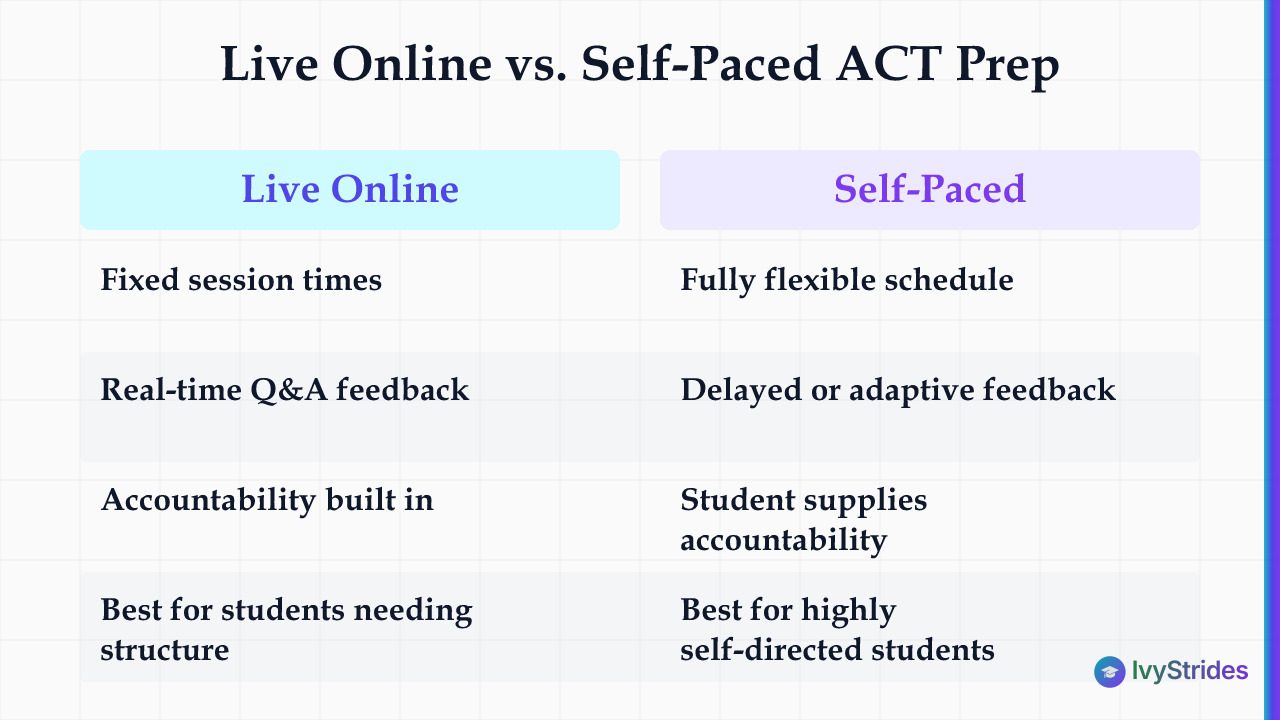
Where the two formats differ. Read this table against your own schedule.
| Feature | Live Online | Self-Paced |
| Schedule | Fixed session times | Fully flexible |
| Feedback | Real-time Q&A | Delayed; adaptive feedback in some tools |
| Accountability | Built into set times | Student supplies it |
| Error diagnosis | Teacher walks through reasoning | Answer explanations; you find the pattern |
| Pacing coaching | Teacher-led, per section | Self-assessed |
| Best fit | Needs structure | Highly self-directed |
For context on where any single score sits, the national mean composite is 19.1 among ACT-tested high school graduates of 2024, 2025, and 2026, on ACT's 2026-27 national ranks (ACT, Inc.).
What ACT's research shows. The 1-point estimate comes from ACT's September 2023 review of its own 2014-2021 studies, all on the test before the enhanced format. It spans tools that vary by delivery, implementation, and quality, and ACT says the benefit differs with a student's motivation, effort, and context (ACT Research).
One ACT study did compare formats: a 2020 brief on 4,572 students registered for the February 2016 ACT and surveyed about their prep. It found no significant effect of in-person, self-paced, or other prep on the composite for the total sample, which its authors say does not align with past research. Only 1.5% reported online prep in small-group, large-group, or one-on-one formats, so it cannot rank live online against self-paced (ACT Research).
What Free ACT Prep Online Can and Cannot Do for Your Composite
Free ACT prep online can get you content exposure and real full-length practice; what practice materials alone cannot give you is a person working through your errors in real time. ACT, Inc. publishes free full-length practice tests and prep resources directly at act.org (ACT, Inc.), with practice forms timed to the current enhanced format. That is the right first stop for anyone.
If you have not yet committed to the ACT over the SAT, that decision comes before the format question. Free resources anchor any plan in full-length practice tests that simulate the enhanced ACT accurately, but they hand you no structure. You supply the schedule, the review, and the diagnosis of why you keep missing the same Reading inference questions.
A composite of 24 carries a national rank of 80, a 27 a rank of 89, a 30 a rank of 94, and a 33 a rank of 98; ACT defines a rank as the percentage of test takers who earned your score or lower (ACT, Inc.). Moving between those points is the kind of targeted work free tests expose but do not coach.
Is free prep enough for you? Run this quick check.
| Condition | Free prep likely sufficient? |
| You sit timed full-length tests and review every miss | More likely |
| You finish lessons but skip timed tests | Less likely |
| You build and keep your own schedule | More likely |
| You cannot explain why you miss questions | Less likely |
| Your score has stalled on the same question types | Less likely |
A self-directed student with a modest score gap can build a full routine from official practice and a two-month ACT plan built around weekly milestones. The student who completes videos but never sits a timed test is where free prep quietly fails.
Why Some Students Struggle to Raise Their ACT Composite with Self-Paced Prep Alone
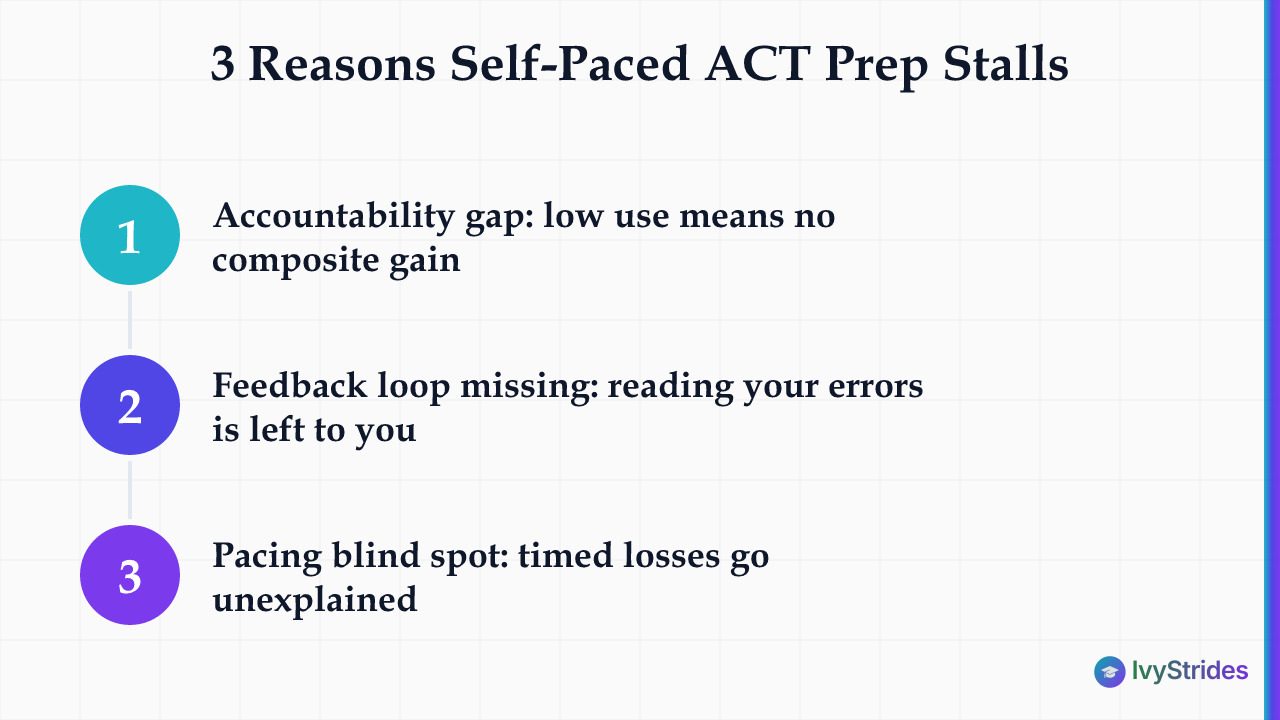
Self-paced ACT prep can stall for three reasons: no accountability structure, no real-time feedback loop, and no one to read pacing under pressure. The composite averages three sections into one number, so your weakest of English, Math, and Reading pulls the whole score down in any format.
The accountability gap comes first. In a randomized ACT experiment ahead of the October 2016 and April 2017 test dates, 2,553 retesting students who had asked for free access to a self-paced online course received it, and another 2,553 formed the control group. Only 45% were active in the course, and the group did not score differently from the control group on the composite; the authors point to low use as the most likely reason (ACT Research).
Treat timed full-length tests as a fixed commitment, because a recorded lesson can feel like progress without showing your pace. Sit at least two under real conditions before deciding which section to target.
Then the feedback loop. In IvyStrides' live ACT prep, in small batches or 1-on-1, a tutor teaches in real time and takes questions as you work. A self-paced course leaves that read of your errors to you.
One ACT finding touches individual attention: in a 2019 study of students retesting in 2012 and 2013, only hours with a private tutor or consultant added to the overall effect of prep, and only at 11 or more hours, a group of 106 of the 280 students who used one (ACT Research). That finding covers one-on-one time, not live online classes.
Pacing is the third. At about 57 seconds per question across the core, a student who runs short of time in one section loses points there, and a question bank may log your time without explaining why. If your score has stalled on self-paced work, a fresh diagnostic read is part of what breaking an ACT score plateau actually requires.
| Student Profile | Self-Paced Likely Works | Live Online Likely Needed |
| Small gap, keeps own timed-test schedule | Yes | Optional |
| One weak section, needs diagnosis | Less likely | Likely |
| Plateaued on free resources | Less likely | Likely |
| Needs reasoning walked live | Less likely | Likely |
Which ACT Prep Format Fits Your Score Gap and Schedule?
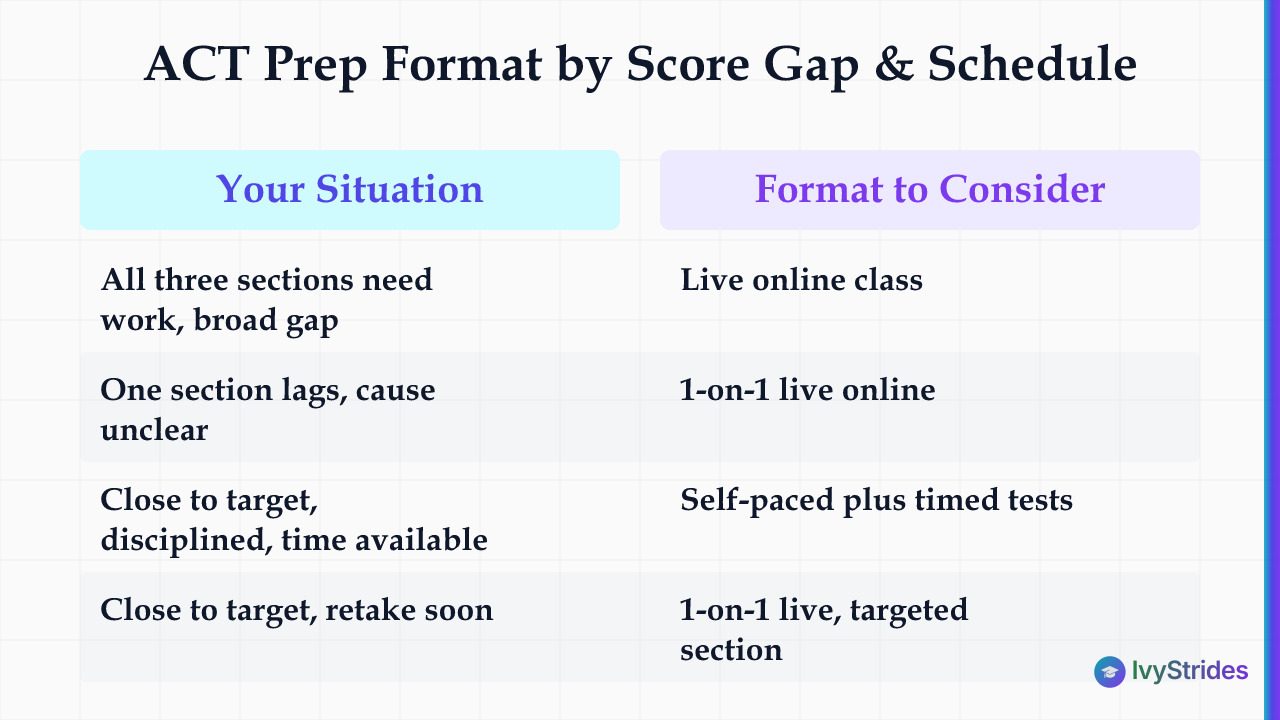
The right ACT prep format is the one matched to your score gap, your available weeks, and the section holding your composite down. Whichever format you choose, the decision sits inside a larger question: whether the provider's coaches have section-specific ACT expertise or cover all subjects as generalists.
At IvyStrides, every ACT prep plan starts from a diagnostic that identifies which of the three composite sections is capping the score. For the planning side of that work, map out a study plan built around your weakest section before you commit to any format.
Use your superscore strategy. You qualify for an ACT superscore once you have tested more than once since September 2016, and on the enhanced ACT it averages your best English, Math, and Reading across sittings, with Science and Writing left out (ACT, Inc.). Each retest can target one weak section without risking your best marks. Not every college superscores the ACT, so check each school's test score policy first.
| What Your Diagnostic Shows | Score Gap | Time Before Your Test | Format to Consider |
| All three sections need work | Broad | Room for a full course | Live online class |
| One section lags, cause unclear | Concentrated | Either | 1-on-1 live online |
| Close to target, disciplined review | Small | Plenty | Self-paced plus timed tests |
| Close to target, retake soon | Small | Tight | 1-on-1 live, targeted section |
Inside any live format, ask who is teaching and what they teach. Our coaches list the ACT sections they teach, and any provider you compare should be able to tell you the same.
If live instruction fits, the next decision is between ACT prep classes or 1-on-1 tutoring, which turns on how your score gap is spread across sections and how much time you have. Test-optional policies vary by school and year, and a strong composite is one part of a full application.
Your next step. Match your situation to one profile and move.
- Sit a timed full-length ACT under real conditions to find which section caps your composite.
- If your score gap is small and you keep your own schedule, start with official practice and self-paced work.
- If your gap is spread across sections, or you plateau alone, choose live instruction.
FAQ: Live Online and Self-Paced ACT Prep
Is the ACT self-paced course worth it?
A self-paced ACT course is worth it for students who are highly self-directed and will commit to timed full-length tests on their own. Students who register for the ACT with a fee waiver get ACT's official self-paced course free (ACT, Inc.). If you need feedback on why you miss questions in a specific section, a live format lets a coach work through those errors with you.
What is the best free online resource for ACT prep?
The best free starting point is the official practice material at act.org, which includes full-length tests built to the current enhanced format (ACT, Inc.). Free resources leave the error analysis and pacing review to you.
Which online ACT prep program is the best?
The best online ACT prep program is the one whose instructors have section-specific expertise in the section holding your composite down, and whose structure matches your accountability needs. A student whose Reading score lags needs a different program than one chasing a last Math point. Delivery format is one criterion; coach quality and diagnostic depth are the others to ask about.
Is 27 out of 36 a good ACT score?
A composite of 27 carries a national rank of 89 on ACT's 2026-27 table (ACT, Inc.). ACT defines that rank as the percentage of test takers who earned your score or lower, based on ACT-tested high school graduates of 2024, 2025, and 2026. Whether 27 is enough depends on the specific colleges on your list, so compare it with each school's published ACT range.

Rajesh is a technology leader, entrepreneur, and angel investor with 28+ years in Business & Technology Leadership and Product & Solution Engineering. He is passionate about education, mentoring, and driving digital transformation.