
ACT Prep Classes or 1-on-1 Tutoring: Which Fits Your Score Gap?
On this page
- What the Enhanced ACT Format Means for Your Prep Plan
- Which ACT Prep Format Fits Your Score Gap?
- Is 2 Months Enough Time to Prep for the ACT?
- FAQ: ACT Prep Classes vs. 1-on-1 Tutoring
- Are ACT prep classes worth it?
- Is 2 months enough to study for ACT?
- What is the best prep for the ACT?
- Your Next Step on ACT Prep Format
An ACT prep class is a structured group course covering English, Math, and Reading on a fixed schedule. In our view, it suits a broad, moderate gap (roughly 2 to 4 Composite points spread across sections) with at least 8 weeks before your test date. Private 1-on-1 tutoring fits a specific section weakness, a larger gap, or a tight timeline.
Your score gap drives the decision, not the provider nearest you. What follows maps the enhanced ACT format, the format-fit criteria, and a 2-month timeline against the 2026-27 test dates.

What the Enhanced ACT Format Means for Your Prep Plan
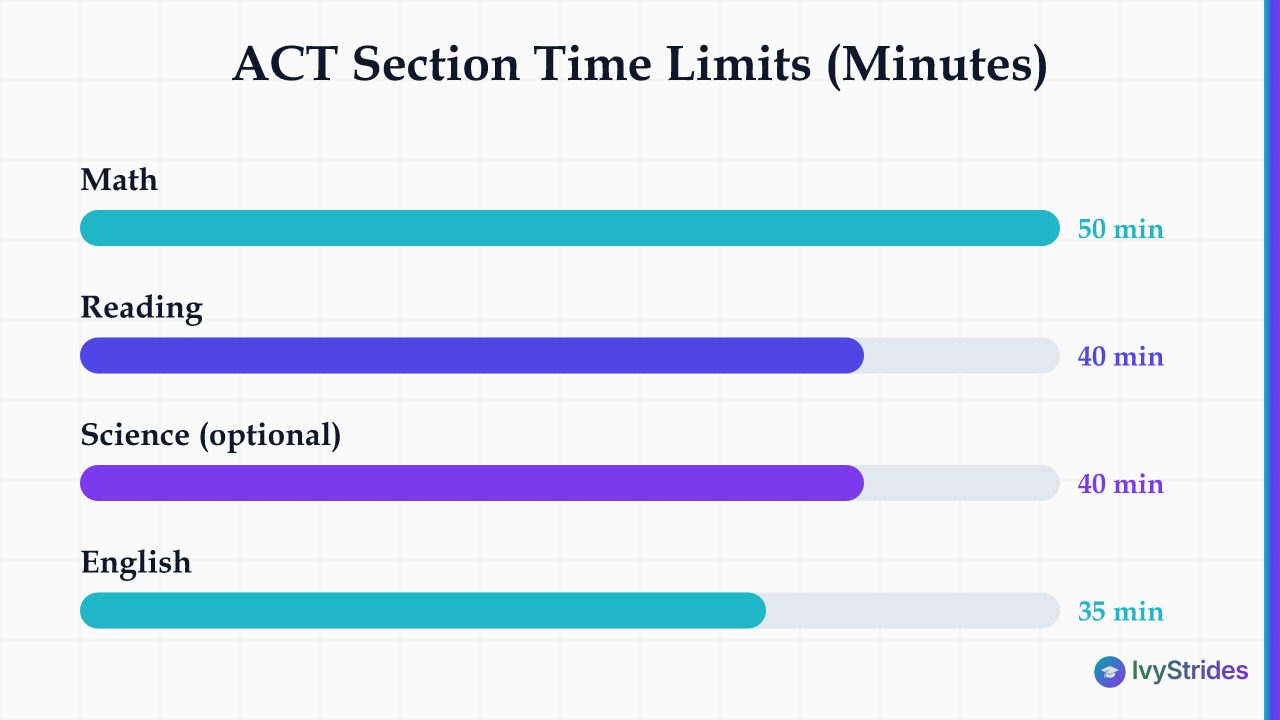
The enhanced ACT core is 131 questions in 125 minutes across English, Math, and Reading (ACT, Inc.). Any prep format you choose has to cover that content and train that pacing, so the structure comes before the format question.
The ACT Composite is the average of the English, Math, and Reading section scores, rounded to the nearest whole number, reported on a 1 to 36 scale (ACT, Inc.). Science and Writing are optional. Science is reported separately alongside a STEM score, and neither counts toward the Composite. That one fact reshapes prep priorities: if the Composite is your target metric, Science review competes with three sections that actually move it.
Pacing is tight by design. ACT, Inc. publishes 131 questions and 125 minutes for the core; IvyStrides divides the two to get about 57 seconds per question on average. English runs fastest at 50 questions in 35 minutes, so pacing drills there matter more than content review for most students already near target.
| Section | Total Questions | Scored Questions | Time (minutes) | Counts Toward Composite? |
| English | 50 | 40 | 35 | Yes |
| Math | 45 | 41 | 50 | Yes |
| Reading | 36 | 27 | 40 | Yes |
| Science (optional) | 40 | 34 | 40 | No |
| Core total | 131 | 108 | 125 | English, Math, Reading |
The unscored items are unlabeled embedded field-test questions, so you can't tell which ones count. Math now offers four answer choices instead of five, which changes the odds on blanks you have to guess. For every timing and question count section by section, see the enhanced ACT format: sections, timing, and question counts.
Which ACT Prep Format Fits Your Score Gap?

Photo by https://kaboompics.com/ on Pexels
Your score gap is the difference between your current diagnostic Composite and your target, and it decides the format.
As a rule of thumb we use, a broad gap of 2 to 4 points spread across sections favors a group class; a 5-plus-point gap or a single weak section favors 1-on-1 tutoring. Before you commit, it helps to know what gain is realistic for your starting point and timeline.
A group class delivers a fixed curriculum across all content areas at cohort pacing, meaning it moves at the group's average speed. That works when your weaknesses are spread evenly. In our view, structure helps, and the wrong structure wastes hours.
One weak section changes the math. In our coaching, every plan starts by checking whether a single section is holding the Composite down, often Reading or English, while Math already sits near target. A group class spends equal time on all three, so a student in that spot pays for content review they don't need. Private tutoring starts from a diagnostic practice test, then targets the specific question types costing points.
| Your Situation | Better Fit | Why |
| Gap of 2 to 4 points, spread across sections | Group class | Structured coverage of all content areas |
| One weak section, others near target | 1-on-1 tutoring | Hours go only to the weak question types |
| Gap of 5 or more points | 1-on-1 tutoring | Larger gap needs targeted, faster work |
| Strong self-discipline, moderate gap | Group class | Cohort pacing keeps you accountable |
| Tight timeline under 8 weeks | 1-on-1 tutoring | Plan built around your test date |
| Already near target, polishing pacing | 1-on-1 tutoring | Pacing drills on your slowest section |
For context on how big a jump is reasonable, read how much you can realistically improve your ACT. If you haven't committed to the ACT over the SAT yet, the ACT vs. SAT comparison of which test suits which student covers the format differences that shape that call.
IvyStrides 1-on-1 ACT prep answers the format question directly: every plan starts with a timed diagnostic that names the exact question types holding the Composite down, before anyone builds a study plan.
Is 2 Months Enough Time to Prep for the ACT?
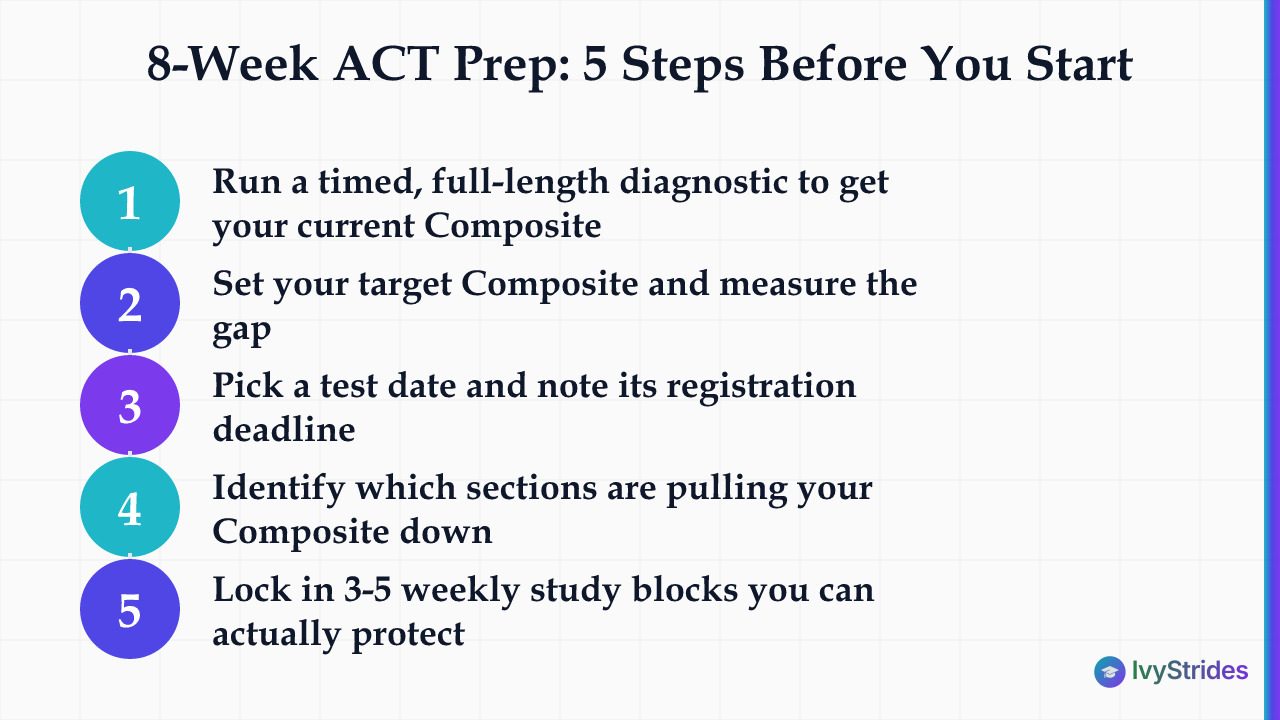
Two months is enough time to run a timed diagnostic, work on your weakest question types, and sit at least one more full practice test, if you protect 3 to 5 focused sessions a week.
Eight weeks maps cleanly to the 2026-27 test calendar, which runs seven national dates from September 19, 2026 through July 10, 2027 (ACT, Inc.). That window is the same whether you pick a group class or 1-on-1, but it covers different ground in each.
Those seven dates anchor the format decision; a prep plan without a target date drifts, and effort is easier to hold when a real deadline sits on the calendar.
A group class in 8 weeks covers the full curriculum once. A 1-on-1 plan in the same window runs the diagnostic, then spends every session on your two weakest question types and pacing. In our coaching, students who arrive at a group class without a diagnostic often spend the first 2 to 3 weeks on content they already know, which compresses time for their actual weak areas.
| 2026-27 ACT Date | Regular Registration Deadline |
| September 19, 2026 | August 14, 2026 |
| October 17, 2026 | September 11, 2026 |
| December 12, 2026 | November 6, 2026 |
| February 27, 2027 | January 22, 2027 |
| April 10, 2027 | March 5, 2027 |
| June 12, 2027 | May 7, 2027 |
| July 10, 2027 | June 4, 2027 |
Starting in mid-October gives you a full 8-week window before the December 12, 2026 date, with a regular registration deadline of November 6, 2026. Confirm these before you build a schedule:
- Your current Composite from a timed, full-length diagnostic
- Your target Composite and the gap between them
- A chosen test date and its registration deadline
- Which sections hold the Composite down
- Whether Science or Writing matters for your colleges
- 3 to 5 weekly study blocks you can actually protect
Once you've chosen a format, the next step is a section-by-section plan: the week-by-week ACT study plan for a 2-month window lays out each phase. If a 28 is your goal, what a 28 means in ACT percentile terms calibrates that target. Students whose timeline won't fit a fixed group schedule often need ACT prep built around your own test date instead.
FAQ: ACT Prep Classes vs. 1-on-1 Tutoring
Are ACT prep classes worth it?
In our view, ACT prep classes are worth it when a student has a broad score gap of roughly 2 to 4 Composite points and time for a structured 6 to 10 week course. A student with one weak section usually gets more from targeted 1-on-1 work than a class covering everything equally.
Is 2 months enough to study for ACT?
Two months is enough time for a focused plan: a timed diagnostic, then 3 to 5 sessions a week on your weakest question types. How many points that is worth depends on your starting score and how many sections are weak; for a large gap across several sections, 2 months is tight. The December 12, 2026 date has a regular deadline of November 6, 2026 (ACT, Inc.).
What is the best prep for the ACT?
The best ACT prep format is the one matched to your score gap: a group class for broad, moderate gaps on a structured timeline, and 1-on-1 tutoring for a specific section weakness or a larger gap. Both formats work best anchored to a timed diagnostic practice test that shows exactly which question types cost points, rather than reviewing all content equally.
Your Next Step on ACT Prep Format
The format that closes your gap depends on three numbers you can gather this week: your current Composite, your target, and your test date. Pin those down, then match them to the criteria above.
- Sit a timed, full-length diagnostic to fix your current Composite
- Subtract it from your target to size the gap
- Choose a group class for a broad 2 to 4 point gap, 1-on-1 for a weak section or a 5-plus gap
- Lock a test date and work backward from its registration deadline

Award-winning author (South Asian Book Award) and graduate of BITS Pilani and UCLA Luskin School of Public Affairs. Brings a published writer's eye to Common App essays and grammatical precision to SAT and ACT R&W instruction.