
Where Do ACT Prep Hours Come From in a Junior Year Schedule?
On this page
- How Many ACT Study Hours Does a Junior Year Schedule Actually Need?
- Where a Junior Finds ACT Study Hours in a Packed School Calendar
- How to Structure Each ACT Study Session by Section
- Which ACT Test Date Should a Junior Target in 2026-27?
- FAQ: ACT Study Schedule Hours and Timing
- How much time to study for ACT?
- Is 3 months enough to study for ACT?
- Is 2 weeks enough to study for the ACT?
- Is 1 month enough to study for ACT?
- Your Next Step on an ACT Study Schedule
An ACT study schedule is a week-by-week plan that maps a junior's limited prep hours onto a specific test date. Plan a steady weekly block, such as 3 to 5 hours split across two or three sessions. Start with a timed diagnostic, then work backward from a registration deadline.
That diagnostic comes first for a reason. Until you have a real section breakdown, you are guessing which of the three composite sections, English, Math, or Reading, is actually costing you points, and a guess sends your hours to the wrong place. The ACT composite is the average of English, Math, and Reading only, scored on a 1 to 36 scale (ACT). Science and Writing stay separate.

How Many ACT Study Hours Does a Junior Year Schedule Actually Need?
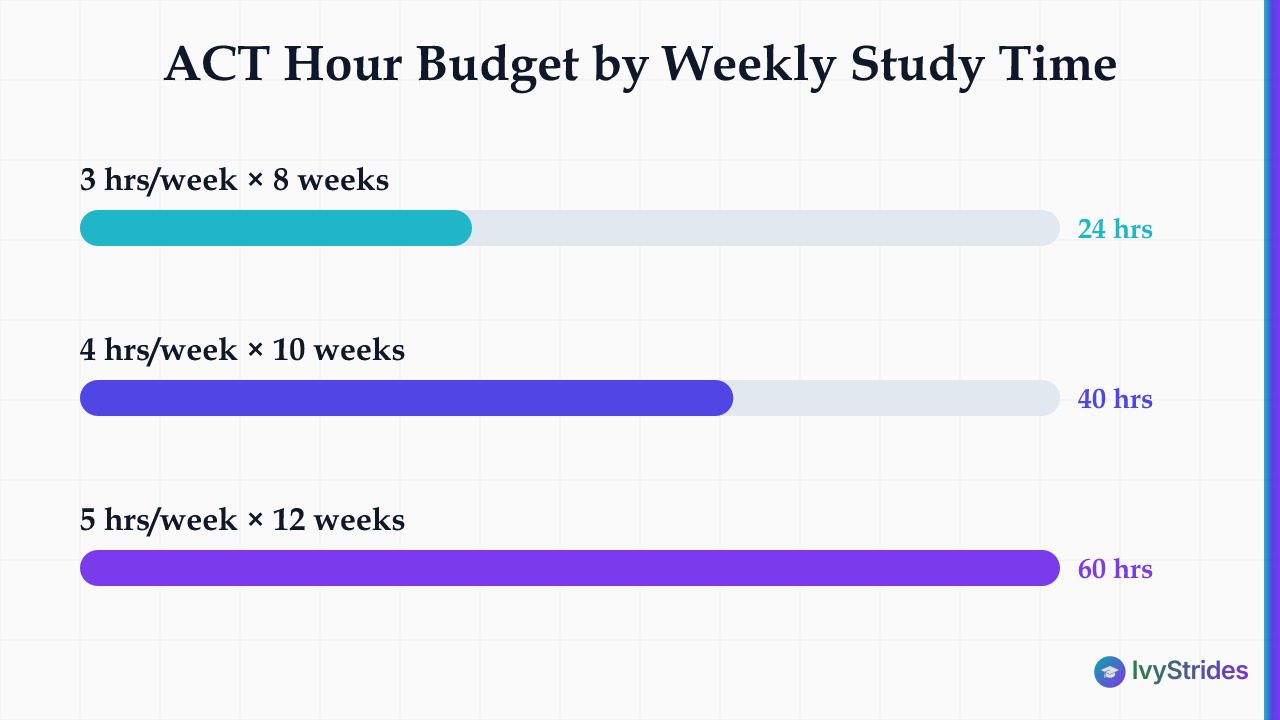
Your ACT prep hours come from your calendar, so count weeks before you count content. Multiply the weekly hours you can protect by the weeks left before your test date, and that is your hour budget. The enhanced ACT core, the version every junior sits now, is 131 questions in 125 minutes of section time, not counting breaks (ACT), so a chunk of those hours goes to pacing, not content.
| Weekly hours you can protect | Weeks until your test date | Hour budget |
| 3 | 8 | 24 |
| 4 | 10 | 40 |
| 5 | 12 | 60 |
IvyStrides' analysis of ACT's published core timing, 125 minutes across 131 questions, puts the average at about 57 seconds per question, including any time spent reading passages. Pacing is a trainable skill, and it eats hours that pure content review never touches.
Turn that average into a section pace. ACT's own advice is to subtract the minutes you expect to spend reading passages from a section's time limit, then divide what remains by the number of questions.
Skip the diagnostic and jump straight into content review, and you are guessing how much of your gap lives in one section. The fix is cheap: one timed full-length practice test shows where you lost points. If your test date is 8 weeks out, a structured week-by-week ACT prep plan maps each session in detail.
A weekly session block of 3 to 5 hours, split across two or three sittings, holds up across a school year better than one long Saturday grind. Shorter, repeated exposure is how pacing becomes automatic.
Where a Junior Finds ACT Study Hours in a Packed School Calendar

Photo by RDNE Stock project on Pexels
ACT prep hours hide in the low-conflict weeks of junior year, not in the obvious ones. Junior year is the highest-stakes prep window because it leaves room for a retake before senior-year applications open. The calendar fights you in predictable spots, though: PSAT/NMSQT lands in October (College Board), and the 2027 AP Exams run over two weeks, May 3 to 14 (College Board), compressing spring prep right when you need it.
Set your weekly hours month by month, because a target that fits a light September may not survive midterms or spring AP coursework. Plan around the crunch, not through it.
Schools may also offer the PSAT/NMSQT on Saturday, Oct 17, 2026, the same day as the October ACT national test date, but ACT's late registration deadline for that sitting was September 29, so plan your next ACT sitting for December or later.
| Month | School Calendar Event | Sample Weekly Prep Hours | Recommended Focus |
| September | Term starts, light load | about 4 to 5 | Diagnostic, weakest section |
| October | PSAT/NMSQT | about 3 | Pacing drills |
| November | Midterms | about 2 to 3 | Error log review |
| December | First ACT sitting (Dec 12) | about 4 | Final full-length practice test before test day |
| January | Term reset | about 4 to 5 | Second-weakest section |
| February | Second ACT sitting | about 3 to 4 | Timed sections |
| March to April | AP ramp-up | about 2 | Maintenance only |
| Summer | No school | 8+ | Retake prep if needed |
Weekday versus weekend. Short weekday sessions, roughly 45 to 60 minutes, suit drills and error-log work. Save full-length timed tests for weekend mornings, since ACT's practice guidance budgets 2 hours 20 minutes for the three core sections in one sitting with a 10-to-15-minute break, or 3 hours with Science. ACT offers seven national test dates in 2026-27 (ACT), so you have room to place both a first sitting and a retake inside this window.
Finding hours is only half the problem. The other half is spending them on sections you already handle. IvyStrides' ACT coaches start every plan from a diagnostic and build the weekly session mix around the student's real calendar, so a plan built around your actual commitments sends time to the section driving the gap rather than the one that feels comfortable.
How to Structure Each ACT Study Session by Section
Every ACT study session follows the same loop: timed set, score, error log, retest. The enhanced ACT splits into three composite sections with different pacing demands, and your session plan should mirror them. Before building anything, confirm you are working from the enhanced ACT section counts and timings, not the legacy format that older guides still quote.
Here's what each section actually asks of you.
| Section | Questions | Time | Scored Questions |
| English | 50 | 35 min | 40 |
| Math | 45 | 50 min | 41 |
| Reading | 36 | 40 min | 27 |
| Science (optional) | 40 | 40 min | 34 |
All four rows come from ACT's official section-structure page. Of 36 Reading questions, only 27 are scored; the rest are unlabeled field-test items you cannot spot, so you answer every one as if it counts. Math questions carry four answer choices, not five, which changes how aggressively you can eliminate.
The session template, in order:
-
Take a timed section set under real conditions, no pausing the clock.
-
Score it and tag every miss by type, not just right or wrong.
-
Log each error with the reason you missed it in a running error log.
-
Review every wrong answer before touching new material.
-
Redo the missed question types cold, 48 hours later.
-
Run a full-length practice test every 2 to 3 weeks to track pacing.
The error log is the connective tissue between sessions. Review every wrong answer before moving on, because spaced retesting only works when you know what to retest. In our coaching, every ACT plan at IvyStrides starts from a timed diagnostic that shows which composite section is driving the gap, so session time goes to the questions that move the score.
Once the schedule is running, section-level tactics for English, Math, and Reading slot into this same loop rather than replacing it. If your diagnostic shows one section driving most of the gap, one-on-one ACT coaching that starts from a diagnostic builds each hour around your baseline and target.
Which ACT Test Date Should a Junior Target in 2026-27?
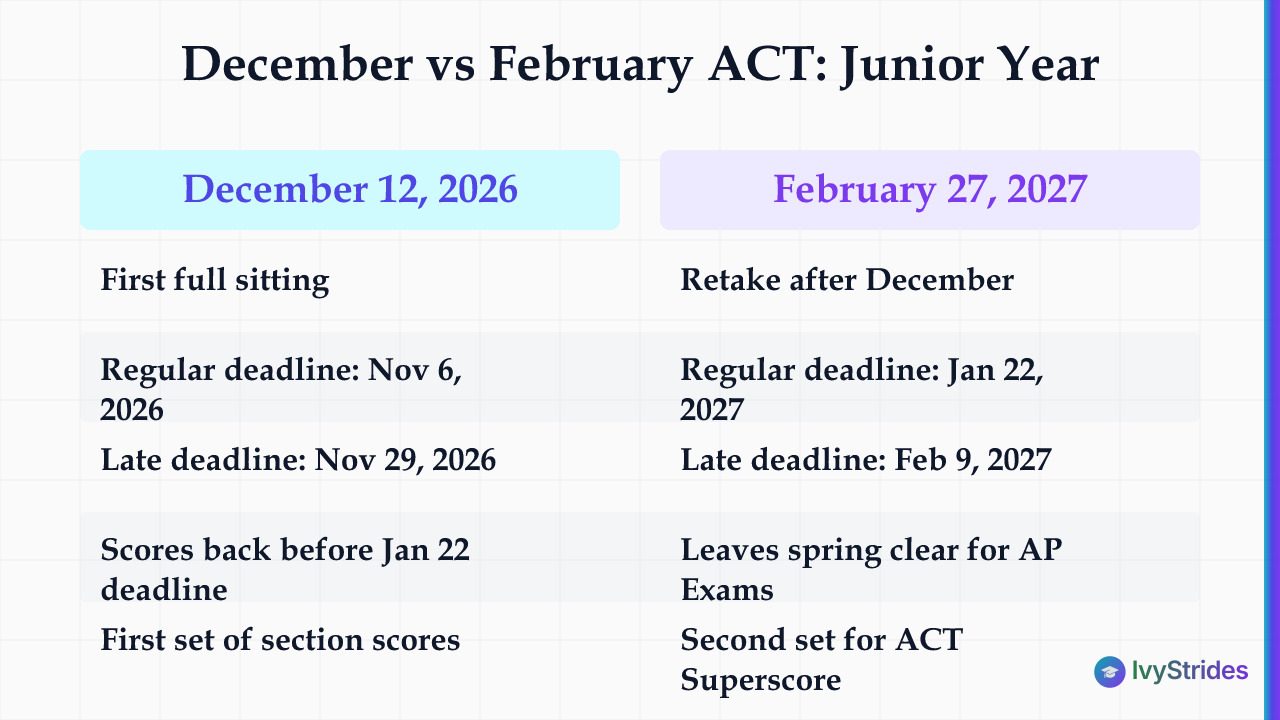
Target the December sitting for a first score, then hold February in reserve for a retake. The test date you pick sets your registration deadline and your prep window, so choose it before you build the weekly plan. If you have tested more than once since September 2016, ACT automatically creates a Superscore, and since 2025 it averages your highest English, Math, and Reading scores across test dates. Many colleges accept Superscores, so a retake is another chance to raise an individual section.
Every 2026-27 ACT date carries its own regular deadline and score release window, so check each sitting's registration deadline and score date before you commit. Miss a regular deadline and late registration adds a $42 surcharge (ACT).
| Test Date | Regular Deadline | Late Deadline | Best For |
| Sept 19, 2026 | Aug 14, 2026 | Sep 1, 2026 | Registration closed |
| Oct 17, 2026 | Sep 11, 2026 | Sep 29, 2026 | Registration closed |
| Dec 12, 2026 | Nov 6, 2026 | Nov 29, 2026 | First full sitting |
| Feb 27, 2027 | Jan 22, 2027 | Feb 9, 2027 | Retake after December |
| Apr 10, 2027 | Mar 5, 2027 | Mar 23, 2027 | Second retake |
| Jun 12, 2027 | May 7, 2027 | May 25, 2027 | Late-cycle sitting |
| Jul 10, 2027 | Jun 4, 2027 | Jun 22, 2027 | Summer retake |
A December first sitting plus a February retake gives you two sets of section scores for ACT's Superscore while leaving spring clear for AP Exams. ACT says scores are released approximately 2 to 4 weeks after each test, so December results should be back before the January 22 registration deadline for February.
One caveat worth holding. Whether you send a score at all depends on each college's policy, and test-optional rules vary by school and year. College Board's own list of colleges currently or soon requiring the SAT or ACT names 21 private and 42 public institutions, and that list changes frequently, so confirm on each college's admissions site. Once your first score is back, whether a second sitting is worth the prep hours has its own framework.
FAQ: ACT Study Schedule Hours and Timing
How much time to study for ACT?
There is no single hour count that fits every student, so build the answer from your own calendar: count the weeks to your test date and multiply by the weekly hours you can protect. Start with a timed diagnostic so those hours go to the section costing you points before you commit to a timeline.
Is 3 months enough to study for ACT?
Three months is long enough for a diagnostic, steady weekly sessions, and a full-length practice test every 2 to 3 weeks; whether it is enough for your target depends on the hours your calendar can hold. The key is starting with a diagnostic rather than generic review, so every session targets a real weakness instead of ground you already hold.
Is 2 weeks enough to study for the ACT?
Two weeks works as a final review window if you already know the format and have a clear error pattern from a recent practice test. It won't build new skills from scratch. Use the two weeks for targeted section review and one full-length timed practice test, not broad content study.
Is 1 month enough to study for ACT?
One month is workable for focused review if you protect 5 to 6 hours per week and spend them on your two weakest composite sections. If your target needs more work than a month allows, plan a second sitting and treat the first test as a real-conditions diagnostic.
Your Next Step on an ACT Study Schedule
You now have a weekly hour budget built from your calendar, a month-by-month view of the weeks worth protecting, and a test date that sets your deadline. The work from here is sequencing, not guessing.
- Take a timed full-length practice test this week to get a real section breakdown.
- Pick a test date from the 2026-27 calendar and note its regular registration deadline.
- Block two or three weekly sessions and start the timed-set, error-log, retest loop.
- Schedule your next full-length practice tests for weekend mornings, every 2 to 3 weeks.

Rajesh is a technology leader, entrepreneur, and angel investor with 28+ years in Business & Technology Leadership and Product & Solution Engineering. He is passionate about education, mentoring, and driving digital transformation.