
How Is the ACT Composite Calculated? The Three-Section Formula
On this page
- How the ACT Composite Score Is Calculated: The Three-Section Formula
- What ACT Science and Writing Actually Contribute to Your Score
- How the ACT Superscore Uses the Same Composite Formula
- What Your ACT Composite Means for College Admissions
- FAQ: ACT Composite Score Questions
- What percentile is a 28 composite on the ACT?
- Do colleges look at subscores on ACT?
- Is a 1350 SAT or a 29 ACT better?
- How are composite scores calculated?
The ACT composite is the average of your English, Math, and Reading section scores, each on a 1-to-36 scale, rounded to the nearest whole number. That three-section formula applies to every ACT taken since September 2025. Science and Writing are scored separately and do not touch it. Add the three, divide by three, round: a fraction of one-half or more rounds up.
Those rules come from ACT's Understanding Your ACT Scores. On those tests, a high Science score cannot raise the composite at all, so a strong Science day can leave the headline number flat.
How the ACT Composite Score Is Calculated: The Three-Section Formula

Photo by Kaboompics.com on Pexels
The ACT composite is the rounded average of three section scores: English, Math, and Reading. ACT reports section scores and the Composite on a 1 to 36 scale, and Science stays out of the average.
Three steps, every time:
-
Add your English, Math, and Reading section scores.
-
Divide the sum by three.
-
Round to the nearest whole number. In ACT's words: "Fractions less than one-half are rounded down; fractions one-half or more are rounded up."
A worked example. Say you score English 28, Math 25, Reading 30. The sum is 83. Divide by three to get 27.67, which rounds up to a 28 composite.
Watch the rounding boundary, because one point can decide it. English 28, Math 27, Reading 27 sums to 82, or 27.33, which rounds down to 27. Raise Math one point to 28 and the sum is 83, or 27.67, which rounds up to 28. One more point, Math 29, makes 84 and a clean 28, so that point leaves the composite where it was.
An average of three whole numbers ends in a clean number, one-third, or two-thirds, and one added point moves the composite only when it takes the average from one-third to two-thirds.
Scored versus total questions. Each multiple-choice section carries unscored field-test items mixed in, so your raw score comes from fewer questions than the section shows. On the English section, only 40 of the 50 questions are scored; the other 10 are field-test items you can't identify while testing. The table below gives the enhanced ACT breakdown, from ACT's exam sections and structure page.
| Section | Questions | Scored Questions | Time | Feeds Composite? |
| English | 50 | 40 | 35 min | Yes |
| Math | 45 | 41 | 50 min | Yes |
| Reading | 36 | 27 | 40 min | Yes |
| Science (optional) | 40 | 34 | 40 min | No |
| Writing (optional) | 1 essay | n/a | 40 min | No |
IvyStrides' analysis of ACT's published section timing for the enhanced ACT core, 125 minutes for 131 questions across those three composite sections, puts the average pace at about 57 seconds per question.
Which tests use this formula. The enhanced format changed the formula too. ACT began phasing Science out of the Composite on National online tests in April 2025, and in September 2025 all ACT tests used the updated calculation, across National, International, and State and District testing. A composite from an earlier legacy test was the rounded average of English, Math, Reading, and Science, and that score will not change. ACT reports both versions with no label and no conversion, so your test date tells you which one you have.
What ACT Science and Writing Actually Contribute to Your Score
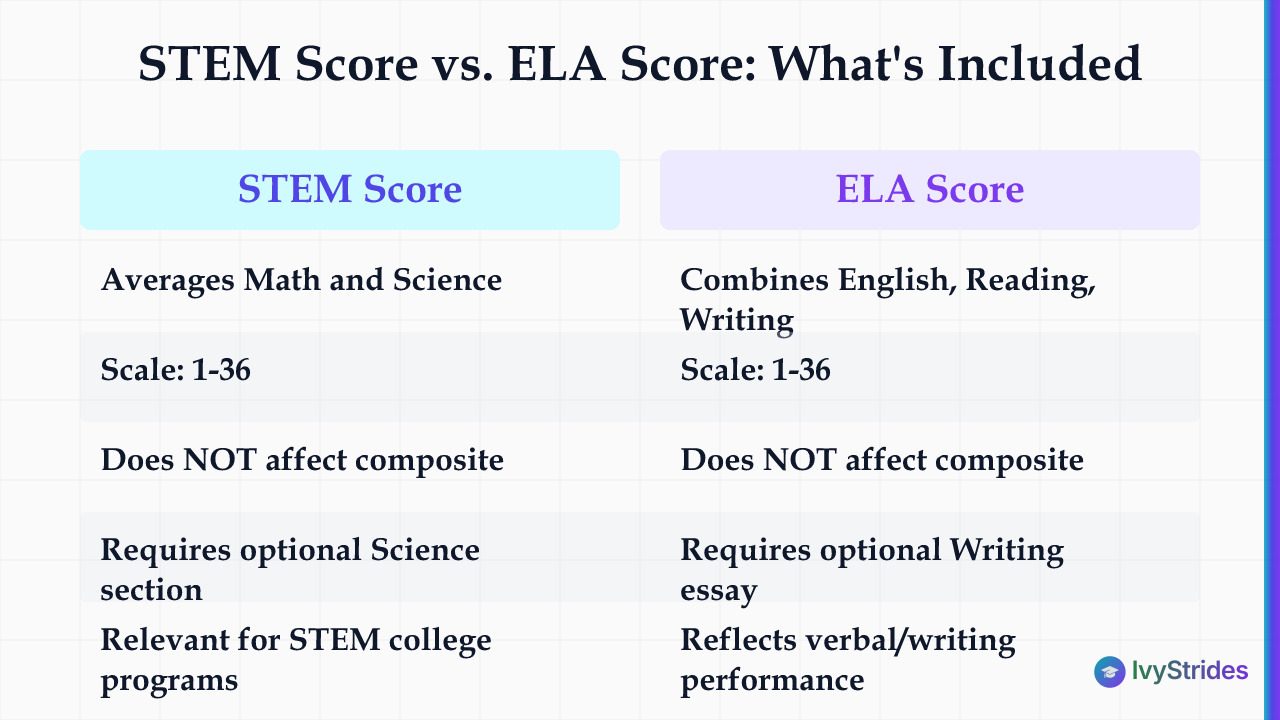
ACT Science and Writing produce their own scores and feed the separate STEM and ELA scores, but neither enters the three-section composite average. A student can skip the optional Science section entirely and still receive a full composite from English, Math, and Reading, though without a Science score there is no STEM score. On a school-day ACT, the state or district chooses whether to offer Science.
What each optional section does instead. Science, scored 1 to 36, feeds the STEM score, which averages Math and Science from the same test date. Writing, one essay scored on a 2 to 12 scale, feeds the ELA score, which combines English, Reading, and Writing from the same test date.
| Score Type | Sections Included | Scale | Affects Composite? |
| Composite | English, Math, Reading | 1-36 | This is the composite |
| STEM | Math, Science | 1-36 | No |
| ELA | English, Reading, Writing | 1-36 | No |
| Science | Science only | 1-36 | No |
| Writing | Writing essay only | 2-12 | No |
This is where the misconception bites. A student scores a 33 on Science, then sees a 28 composite and can't work out why. The composite never looked at the Science number.
Where Science still matters. ACT's 2026-27 User Handbook says some institutions may require or prefer a Science score, so whether to sit the optional Science section depends on your target colleges and majors, not on your composite. In our coaching, when a student is set on a STEM program, we keep Science in the plan for the STEM score while being clear it won't lift the headline number.
Which section to raise first. The three sections carry equal weight, so one added point moves the unrounded average by a third of a point wherever it lands, and Science moves it by nothing. What differs is how much room each section has.
At IvyStrides, ACT coaches start every plan by finding which of the three composite sections has the largest gap between a student's current scale score and their target. When reviewing a score report, we check whether one outlier section is holding the composite down rather than uniform weakness across all three, and we build the plan around closing that outlier.
How the ACT Superscore Uses the Same Composite Formula
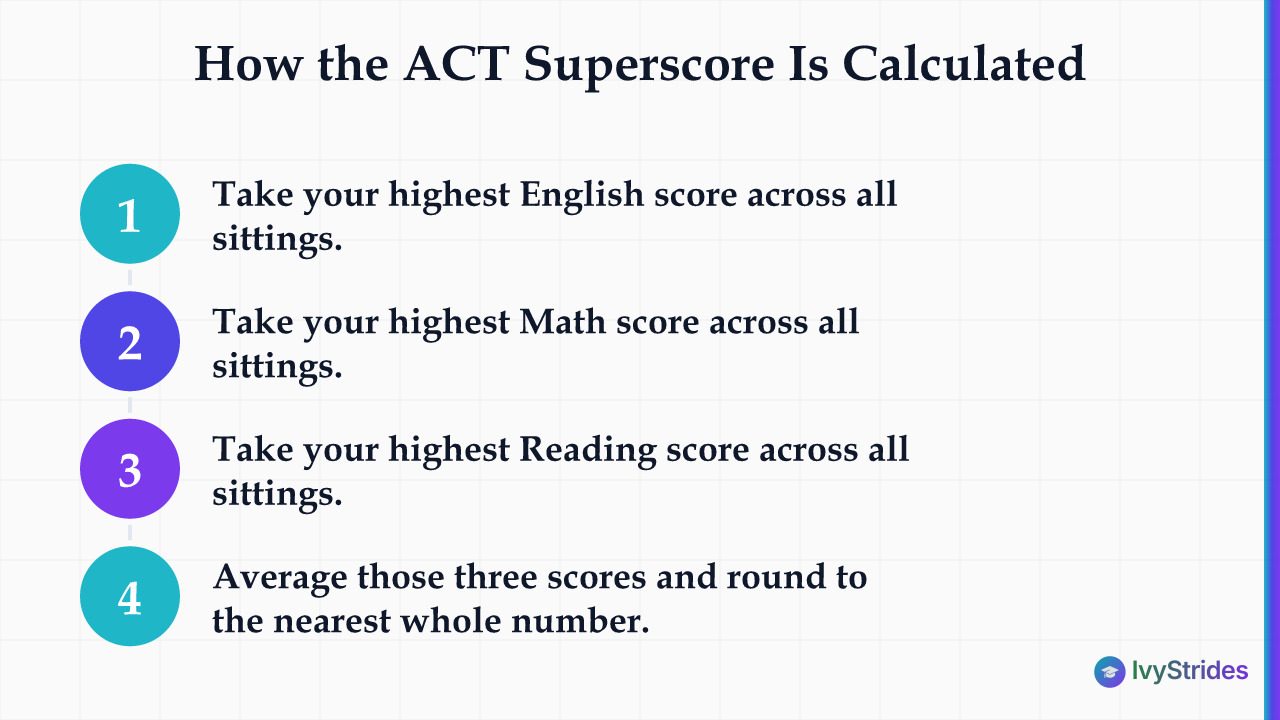
The ACT superscore applies the same three-section average, but across multiple test dates. In ACT's words, it is "the average of a student's highest score on the English, math, and reading sections across all the ACT tests the student has taken," rounded to the nearest whole number. ACT introduced that calculation in April 2025 for students who took the enhanced ACT, and it applies to all students who take an ACT test in or after September 2025.
Science is left out of the Superscore Composite, though your report still lists your best Science score and a STEM Superscore if you took Science. ACT calculates a superscore automatically once you have tested more than once since September 2016, and your best section scores can come from legacy or enhanced test dates.
Here is how that plays out when you sit the ACT twice:
-
Take your highest English score across all sittings.
-
Take your highest Math score across all sittings.
-
Take your highest Reading score across all sittings.
-
Average those three and round to the nearest whole number.
A worked superscore. Sitting 1: English 28, Math 25, Reading 30. Sitting 2: English 26, Math 29, Reading 28. The superscore pulls English 28, Math 29, Reading 30, which sum to 87 and average to exactly 29. Each sitting alone sums to 83 and rounds to a 28 composite, so the superscore sits a point above either one at any college that uses it.
Not every college superscores the ACT, and policies change, so how colleges handle multiple ACT sittings is worth confirming on each school's admissions site before you decide how often to test. Some schools use your most recent or single best composite; some superscore; some want every score sent.
What Your ACT Composite Means for College Admissions
Your ACT composite plays a part in decisions at many colleges and scholarship programs, and its national rank tells you where you stand: the percent of recent ACT-tested graduates who scored at or below your composite. The mean composite is 19.1 on ACT's 2026-27 national ranks, which draw on ACT-tested high school graduates from 2024-2026 and apply to tests taken September 2026 through August 2027.
| Composite Score | National Percentile Rank |
| 20 | 63 |
| 24 | 80 |
| 28 | 91 |
| 30 | 94 |
| 32 | 97 |
| 33 | 98 |
| 34 | 99 |
| 35 | 99 |
| 36 | 100 |
Where a scholarship sets its bar on the composite, a lower Science score on that sitting does not pull you below it. Each institution sets its own award bands, which is why how ACT scores affect merit scholarship thresholds varies from one college to the next rather than following a national table.
Test-optional policies vary by school and by year, and FairTest lists 2,021+ test-optional or test-free schools for fall 2027, so a strong composite helps where it's submitted but isn't required everywhere. College Board's own list of colleges that currently or soon will require SAT or ACT scores names 21 private colleges and 42 public colleges, and warns the list changes frequently. Colleges read the full application, not a single number.
If you have a target school, compare your composite against the score ranges at selective colleges those schools publish, keeping in mind a middle-50% range describes enrolled students who sent a score, not every admitted student.
Closing a gap starts with how the enhanced ACT format divides questions and minutes across English, Math, and Reading, because the three carry equal weight but not equal pacing. With your composite and target in hand, building a prep plan around your composite gap with an expert instructor ties the work to a specific test date.
FAQ: ACT Composite Score Questions
What percentile is a 28 composite on the ACT?
A composite of 28 sits at the 91st national percentile rank on ACT's 2026-27 table, meaning 91% of recent ACT-tested graduates scored 28 or lower. A 30 reaches the 94th and a 32 reaches the 97th. The mean composite on that table is 19.1.
Do colleges look at subscores on ACT?
Some do; ACT now calls these section scores. ACT reports no one-size-fits-all approach: some institutions use a most recent Composite score for admission, placement, and scholarship decisions, while others look at select section scores. The Common Data Set template collects ACT percentile scores for the Composite and for each section, so read both where a college publishes them.
Is a 1350 SAT or a 29 ACT better?
Neither is clearly better. On the 2018 ACT/SAT concordance tables, a 1350 SAT corresponds to a 29 ACT composite, so the two are comparable, though the tables do not equate scores. ACT says colleges can keep using those tables with the three-section composite. The stronger choice is whichever score sits higher within the school's published middle-50% range.
How are composite scores calculated?
On every ACT since September 2025, the composite is the average of the English, Math, and Reading section scores, each on a 1-to-36 scale, rounded to the nearest whole number. Add the three scores, divide by three, and round: a fraction of one-half or more rounds up, anything less rounds down. Science and Writing stay out of it, though earlier legacy tests averaged Science in.

Rajesh is a technology leader, entrepreneur, and angel investor with 28+ years in Business & Technology Leadership and Product & Solution Engineering. He is passionate about education, mentoring, and driving digital transformation.