
How Colleges Read Your Transcript: GPA, Rigour, and What Counts Most
On this page
- How Admissions Officers Actually Read a High School Transcript
- How Colleges Weigh GPA and Course Rigour Against Each Other
- Not Sure Your Course Load Looks Rigorous Enough to the Schools on Your List?
- What Grade Trends on Your Transcript Actually Signal to Admissions Officers
- What Students and Parents Can Do Right Now to Strengthen the Transcript
- Transcript Audit Done. Now Find Out Where the Gaps Actually Are.
- FAQ: How Colleges Read Your Transcript
- How do I read my transcript?
- Do colleges actually see your entire four-year transcript?
- How do colleges compare transcripts from different high schools?
- Is a 2.7 GPA bad for college admissions?
- Your Next Step on the Transcript
A high school transcript is the term-by-term record of your courses, grades, and credit hours, and admissions officers read it in a set order. They open the school profile first, scan your course list for rigour, check grades, and read GPA last. Junior year carries the most weight.
Those figures come from admissions professionals who describe the reading order out loud. The point most families miss: a B in the hardest available course reads better than an A in an easy elective, because context shapes every judgment.

How Admissions Officers Actually Read a High School Transcript
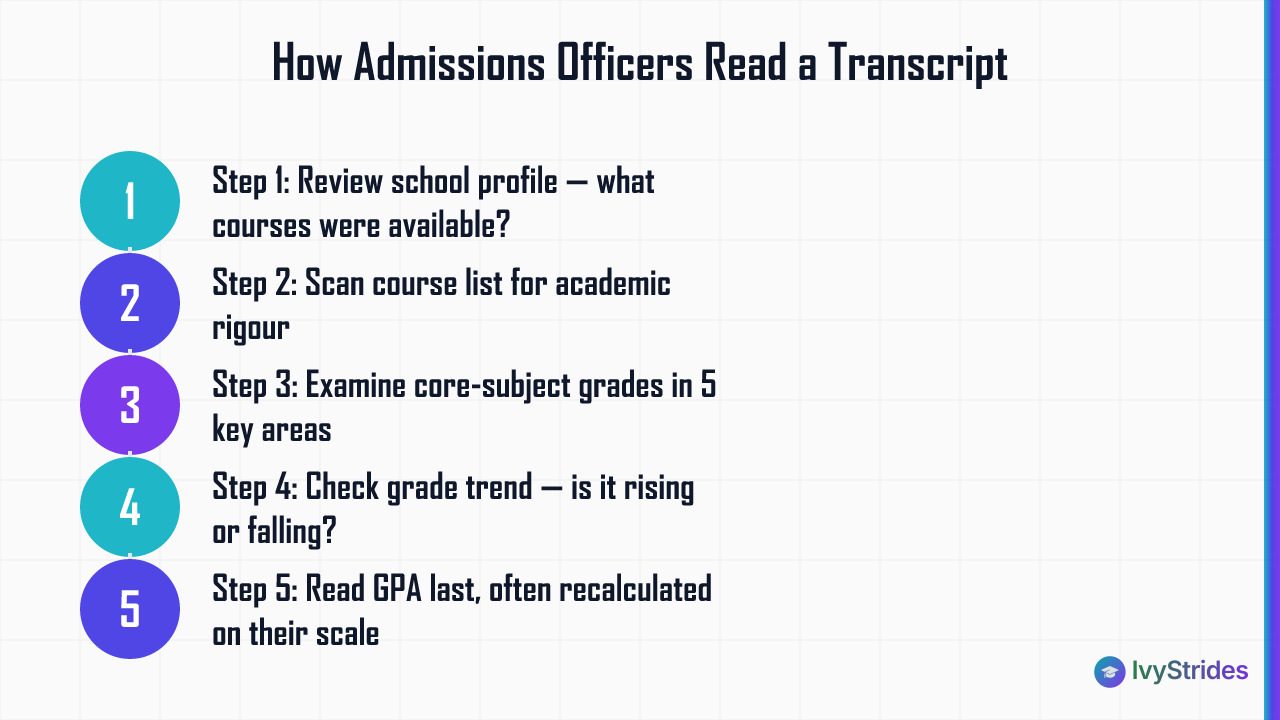
An admissions officer does not read your GPA first. The high school transcript records your courses, grades, and credit hours by term, and the officer works through it in a fixed sequence that puts GPA dead last. That surprises most students who spent four years watching a single number.
The school profile opens first. Every high school sends a school profile alongside your transcript. It lists the grading scale, the advanced courses actually offered, and the class rank policy. The officer needs this before any grade means something, because a 3.8 at a school with three AP options signals differently than a 3.8 at a school with twenty-five.
Next comes the course list, read for rigour. Then the grades, weighted toward the core five: math, English, science, social studies, and world language. The GPA, the number families argue about at the kitchen table, gets read last and often gets recalculated.
| Step | What They Look At | What They Are Asking |
| 1 | School profile | What was actually available here? |
| 2 | Course list | Did this student take the hard classes? |
| 3 | Core-subject grades | How did they perform in real academics? |
| 4 | Grade trend | Is the line going up or down? |
| 5 | GPA (recalculated) | What does the number mean on our scale? |
Why this order matters to you. If AP courses are the rigour signal officers scan for at step two, then your course-selection form outweighs your report card. For whether that signal actually moves outcomes, see does AP help with college admission.
How Colleges Weigh GPA and Course Rigour Against Each Other
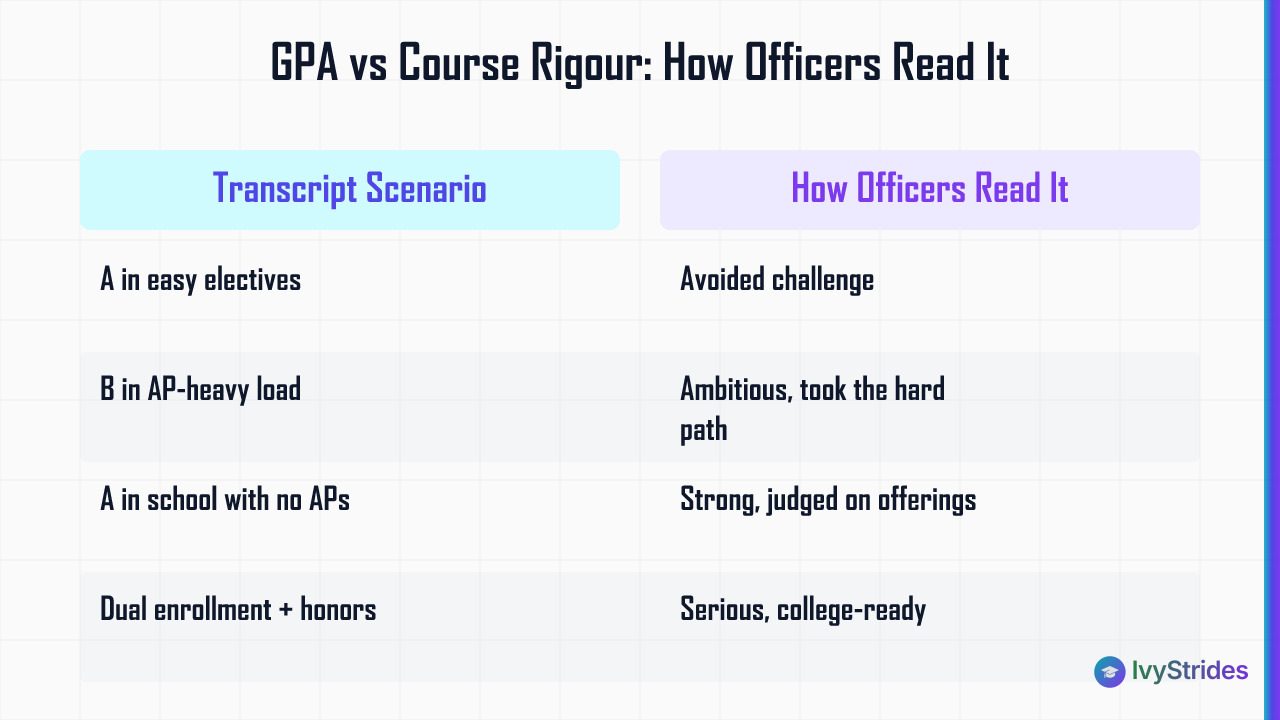
Course rigour and GPA travel together, and rigour is measured against what your school offers rather than a national standard. A B in an AP or honors course typically reads stronger than an A in a standard-level version of the same subject. Selective colleges push this further, recalculating your GPA on their own uniform unweighted scale to strip out grade inflation.
Weighted versus unweighted, and why it matters less than you think. Your weighted GPA adds a bump for AP, IB, and honors courses. Your unweighted GPA sits on a plain 4.0 scale. Because many selective colleges recalculate the number themselves, the figure your school prints is secondary at those schools. Your core GPA, drawn from the five academic subjects, matters more than a weighted number padded by electives.
| Scenario | What the Transcript Shows | How Officers Typically Read It |
| A in easy electives | High weighted GPA, thin rigour | Avoided challenge |
| B in AP-heavy load | Lower GPA, strong rigour | Ambitious, took the hard path |
| A in a school with no APs | High GPA, no advanced options | Strong, judged on offerings |
| Dual enrollment + honors | Mixed grades, real rigour | Serious, college-ready |
Because AP course grades appear directly on the transcript, choosing the right number of AP classes and earning strong grades in them is one of the highest-use decisions a student makes before senior year. In our coaching with students aiming at highly selective schools, the transcripts that clear the bar usually carry roughly 8 to 12 AP courses across four years, though the right count depends on what your school offers. For the specific benchmarks, see how many AP classes for Ivy League.
AP course grade and AP exam score differ. The grade you earn in the class lives on your transcript. The exam score, per the College Board AP Program, is a separate report colleges receive directly. The course grade signals academic ambition; the exam score signals mastery. A single B in an otherwise rigorous course load rarely changes an admissions outcome, but the context around it matters, which is exactly the worry we address in will one B ruin a 4.0 GPA.
At test-optional schools, a transcript with strong rigour and consistent grades carries even more weight because it becomes the primary quantitative signal in the file. Whether a given school stays test-optional varies by school and year, so check each target directly. To see the actual GPA ranges of admitted students at a named college, search that school's Common Data Set.
Not Sure Your Course Load Looks Rigorous Enough to the Schools on Your List?
You have the framework: rigour is relative to your school's offerings, and selective colleges recalculate GPA on their own scale. Knowing whether your specific transcript clears the bar at each target school takes a short, focused talk. A free 15-minute call reviews your course load, maps it against your target colleges, and shows where the gaps sit before course selection closes.
What Grade Trends on Your Transcript Actually Signal to Admissions Officers
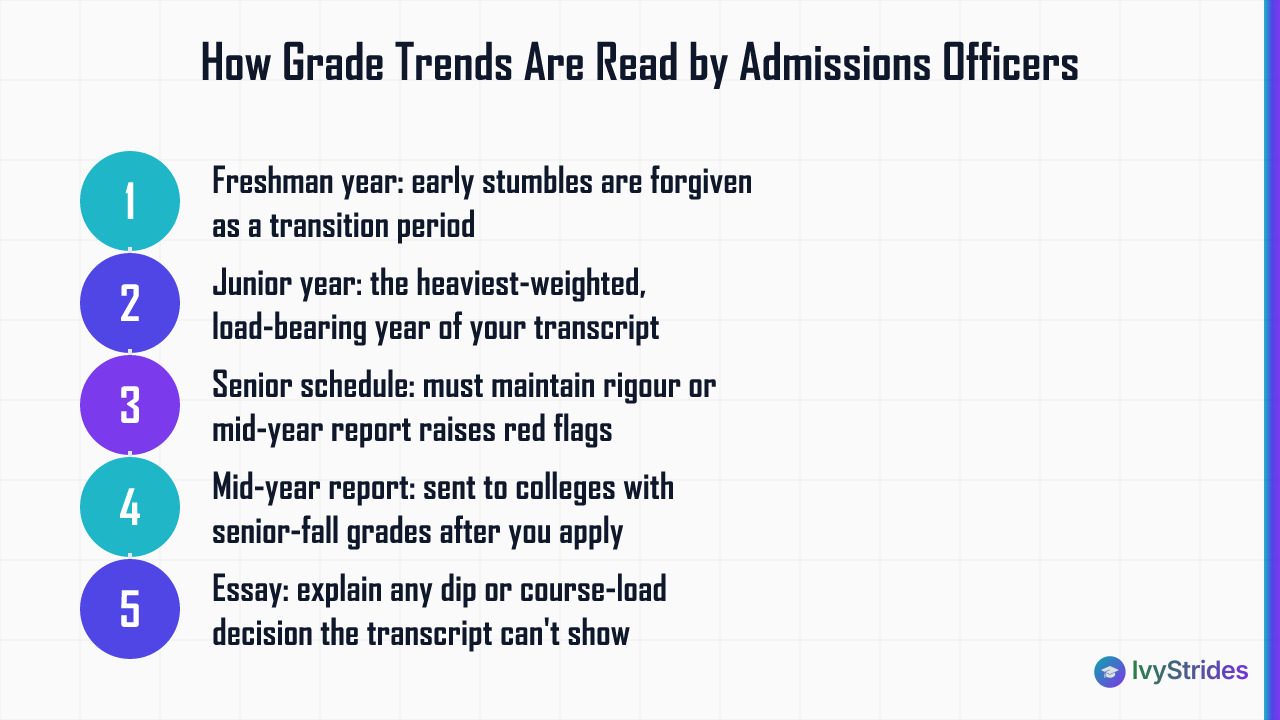
Grade trends tell an admissions officer whether your line climbs or drops, and junior year carries the heaviest weight because it is the most recent full year of advanced coursework before you apply. An upward path from a rough freshman start to a strong junior year reads as adaptability and maturity. A downward slide, especially into senior year, reads as a red flag.
Junior year is the load-bearing year. Officers know ninth grade is a transition and the hardest classes usually land in eleventh. So a student who stumbled early and then climbed sends a stronger signal than one who coasted. We have seen admissions outcomes shift when a student can point to that upward trend from a difficult 9th-grade semester to a strong junior year.
The mid-year report keeps the story going. Your school sends this updated transcript, with senior-fall grades and your current schedule, straight to colleges after you submit. Across hundreds of application reviews, the most common transcript mistake is taking an easy senior schedule after a strong junior year, which triggers concern in the mid-year report and, in rare cases, a rescinded offer.
The admissions essay is the place to explain a grade dip or a course-load decision that the transcript cannot explain on its own. A transcript shows what happened; it never shows why. If a semester went sideways for a real reason, our college essay coaching helps you frame that context without excuse-making.
Run this quick audit before you apply:
- Is your junior-year GPA equal to or higher than your sophomore year?
- Does your senior schedule keep rigour rather than drop it?
- Are your core-subject grades stronger than your elective grades?
- Does any single dip have a clear, honest explanation?
- Is your upward trend visible across all four years, not just one term?
- Have you checked what your mid-year report will show colleges?
What Students and Parents Can Do Right Now to Strengthen the Transcript
You can still shape the transcript an officer will read, and the highest-value moves are auditing your course load and protecting junior-year grades. The transcript never stands alone; test scores and essays work alongside it as a connected admissions strategy, and each is a lever you control in the semesters you have left.
In our coaching, students who audit their course load against the school profile in 10th grade consistently gain more room to add rigour before the junior year that matters most. Start there. Then decide how AP courses fit, remembering that the course grade goes on the transcript while the exam score is sent separately and that AP credit and placement policies vary by college.
-
Audit your current courses against every advanced class your school actually offers.
-
Protect junior-year grades above all else, since they carry the most weight.
-
Choose AP or honors courses strategically, matching rigour to your target schools.
-
Line up your test-score and essay plan so the whole file tells one story.
Where test scores fit. Because test-optional policies vary by school and year, decide submission school by school; a strong score usually supports a transcript rather than replacing it. For the fuller decision, see what is test-optional and should you submit SAT scores. And because AP, SAT, and ACT decisions interlock across grades 9 to 12, map them together with AP, SAT, and ACT: how to build a winning high school testing plan. Admissions outcomes depend on the full application, not the transcript alone.
Transcript Audit Done. Now Find Out Where the Gaps Actually Are.
You have the reading sequence, the rigour framework, and the grade-trend checklist. Turning those into a course plan tied to your specific school profile and target college list rewards a single focused session. A free 15-minute call reviews your transcript, names the two or three changes worth making before junior year, and shows how your test scores and essays fit the picture.
FAQ: How Colleges Read Your Transcript
How do I read my transcript?
A high school transcript lists your courses by year, with a grade and credit hours for each. Your cumulative GPA appears at the bottom. Look for the grading-scale note, usually printed in the header or footer, to learn what each letter grade means at your school. The term-by-term layout shows course names, grades, and credits in rows, with GPA blocks after each term.
Do colleges actually see your entire four-year transcript?
Yes. Colleges receive all four years of grades, though junior year carries the most weight. Freshman grades matter less at most schools, but a strong upward trend from 9th to 11th grade signals well. A downward senior-year trend can trigger a rescinded offer, so the mid-year report still counts.
How do colleges compare transcripts from different high schools?
Admissions officers use the school profile to contextualise every grade. A 3.7 GPA at a school with no AP offerings reads differently than a 3.7 at a school offering twenty AP courses. Selective colleges also recalculate GPA on their own uniform unweighted scale to remove grade inflation, so the number your school prints is not always the number they use.
Is a 2.7 GPA bad for college admissions?
A 2.7 GPA limits options at selective colleges but does not close every door. Context matters: a 2.7 earned in a rigorous AP-heavy schedule reads differently than a 2.7 in standard courses. Strong test scores, an upward grade trend, and a compelling essay can partially offset a lower GPA at many schools.
Your Next Step on the Transcript
You now know the order an officer follows, why junior year carries the most weight, and how rigour is judged against your own school's offerings. The transcript stays open until you submit, so use the time you have.
- Pull your current transcript and check the grade trend across all four years.
- List every advanced course your school offers, then compare it to what you took.
- Decide which one or two rigour additions are realistic before junior year ends.
- Map your AP, test-score, and essay plan as a single connected strategy.

Award-winning author (South Asian Book Award) and graduate of BITS Pilani and UCLA Luskin School of Public Affairs. Brings a published writer's eye to Common App essays and grammatical precision to SAT and ACT R&W instruction.