
Do US Colleges Convert Non-US Grades to a GPA? How They Read Yours
On this page
- How US Colleges Actually Read a Non-US Transcript
- Common International Grading Systems and Their US Context
- What to Submit on Your Application When Your School Does Not Use GPA
- When US Colleges Do Ask for a Formal International Grade Evaluation
- FAQ: International Grade Conversion for US Admissions
- Do other countries use GPA?
- How do I convert my Indian GPA to a US GPA?
- How to calculate international GPA?
- How do I convert my A-level grades to GPA for US college applications?
- Your Next Step on International Transcript Submission
US colleges generally do not expect international students to convert their grades to a 4.0 GPA themselves. At colleges such as Cornell, transcript evaluation is the admissions office's job: officers read a percentage, an A-level result, or an IB score in its original format. Your transcript goes in as your school issued it.
Some colleges do require a formal credential evaluation, even from first-year applicants at Florida Atlantic University, and that requirement varies by institution. The rest of this page walks through what happens to your transcript inside the office, how each grading system is read, what to put in the Common App GPA field, and when a NACES-member evaluation actually applies.

How US Colleges Actually Read a Non-US Transcript
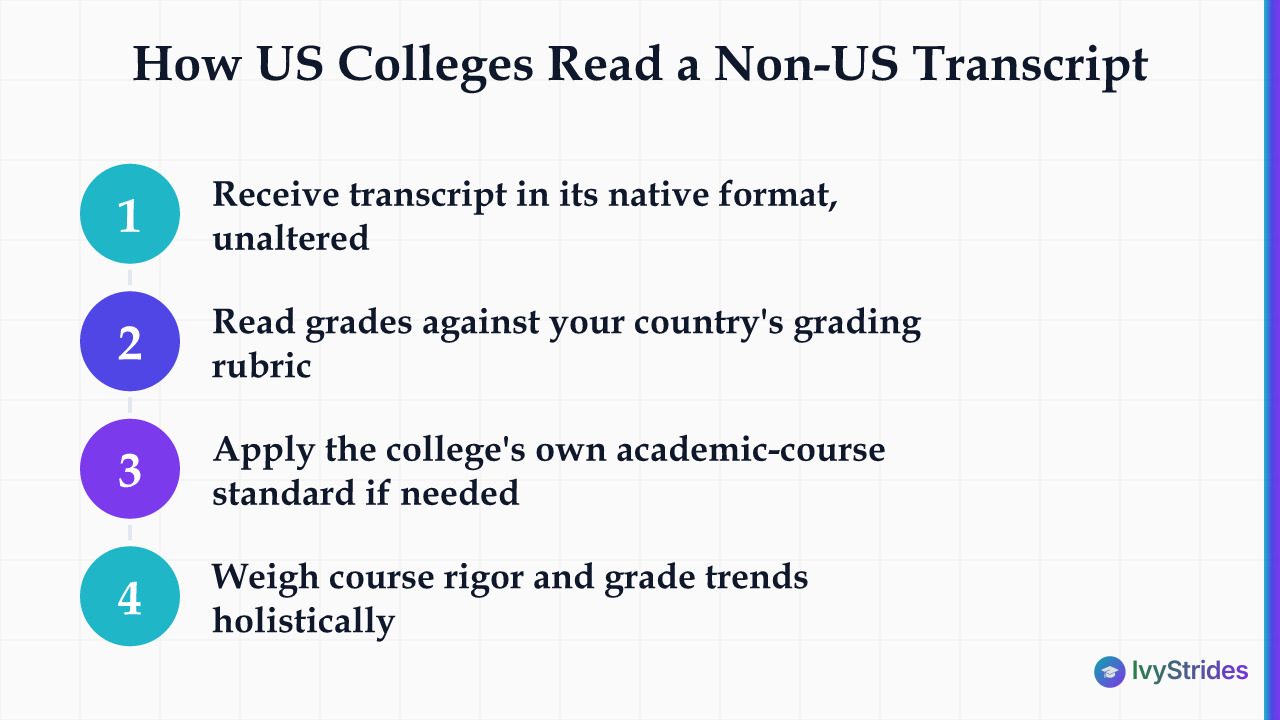
At colleges such as Cornell, admissions officers read a non-US transcript through in-context review, not a conversion formula. Cornell says it is familiar with all educational systems and evaluates the classes you took and the grades you earned rather than an overall GPA, so a CBSE percentage or Cambridge A grades are read against the system that issued them.
No universal formula exists. You cannot divide a foreign grade by its maximum and land on a reliable US GPA, because that shortcut ignores where each country puts its pass mark and top band, and the same number can be a top grade in one country and a fail in another (gpacalculator.net).
Some colleges then apply their own academic-course standard, much like how colleges recalculate your GPA from core subjects for US applicants. The University of California asks international first-year applicants to record marks exactly as their school reports them and requires those applicants to complete 15 year-long academic courses with a 3.4 GPA. The grading context comes first; any calculation follows.
Course rigor and grade trends matter alongside the grades themselves, which is why context-reading goes beyond a single number. Admissions officers judge the difficulty of your curriculum, a holistic read that the factors admissions officers weigh when reading your transcript spells out in full. An upward trend in a demanding subject load reads better than a flat line of easy courses.
| Step | What the College Does | What You Need to Do |
| 1 | Receives your transcript in its native format | Have your school send its official copy, unaltered |
| 2 | Reads grades against your country's rubric | Add a certified English translation if needed |
| 3 | May apply its own academic-course standard | Nothing, unless the college asks for an outside evaluation |
| 4 | Weighs rigor and grade trends holistically | Report your curriculum accurately |
Common International Grading Systems and Their US Context
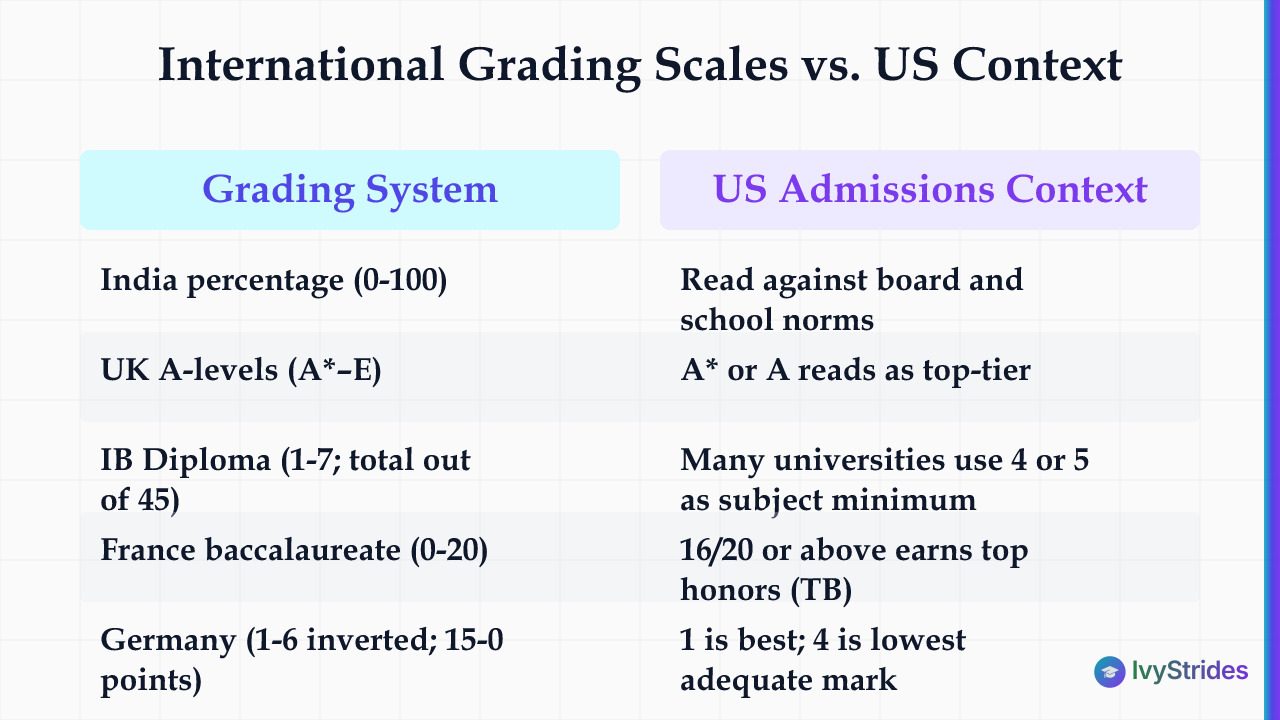
Each major non-US grading system carries a known context that admissions officers apply during transcript evaluation. The table below maps the most common systems to how they are read, not to a fixed GPA. Treat every entry as a contextual benchmark, never a formula.
A few points the table cannot hold. The German scale runs inverted: 1 means very good and 6 very poor, with 4 the lowest adequate mark, so a low German number signals strong work; the final two Gymnasium years also use a 15-to-0 point scale. ECTS letter grades, with A the highest, are used by many European universities rather than secondary schools, so they appear mainly on transfer applicants' records (IFMA Foundation). The IB Diploma scores each subject 1 to 7, with the diploma total out of 45, and the IB sets no pass mark for single subjects.
The percentage trap. Grade-conversion tools themselves warn that bands and pass marks can vary by university, so your transcript's grading key wins (gpacalculator.net), and that their results are for informational use only (myiee.org). The same percentage can reflect different standing at different schools, so resist the instinct to call your 90% a 3.7.
| Country / System | Scale | Top Grade | US Admissions Context |
| India (percentage) | 0–100 | 100% | Read against board and school norms |
| India (CGPA, university records) | 0–10 | 10 | Read on its own 10-point scale |
| Europe (ECTS, university records) | A–F | A | Mainly on transfer applicants' records |
| UK (A-levels) | A*–E | A* | A* or A reads as top-tier |
| IB Diploma | 1–7 per subject; diploma total out of 45 | 7 per subject | Many universities use 4 or 5 as a subject minimum |
| France | 0–20 | 20 | A baccalaureate average of 16/20 or above earns the top honors (TB) |
| Germany | 1–6 (inverted) or 15–0 points | 1 (15 points) | 1 is best; 4 is the lowest adequate mark |
What to Submit on Your Application When Your School Does Not Use GPA
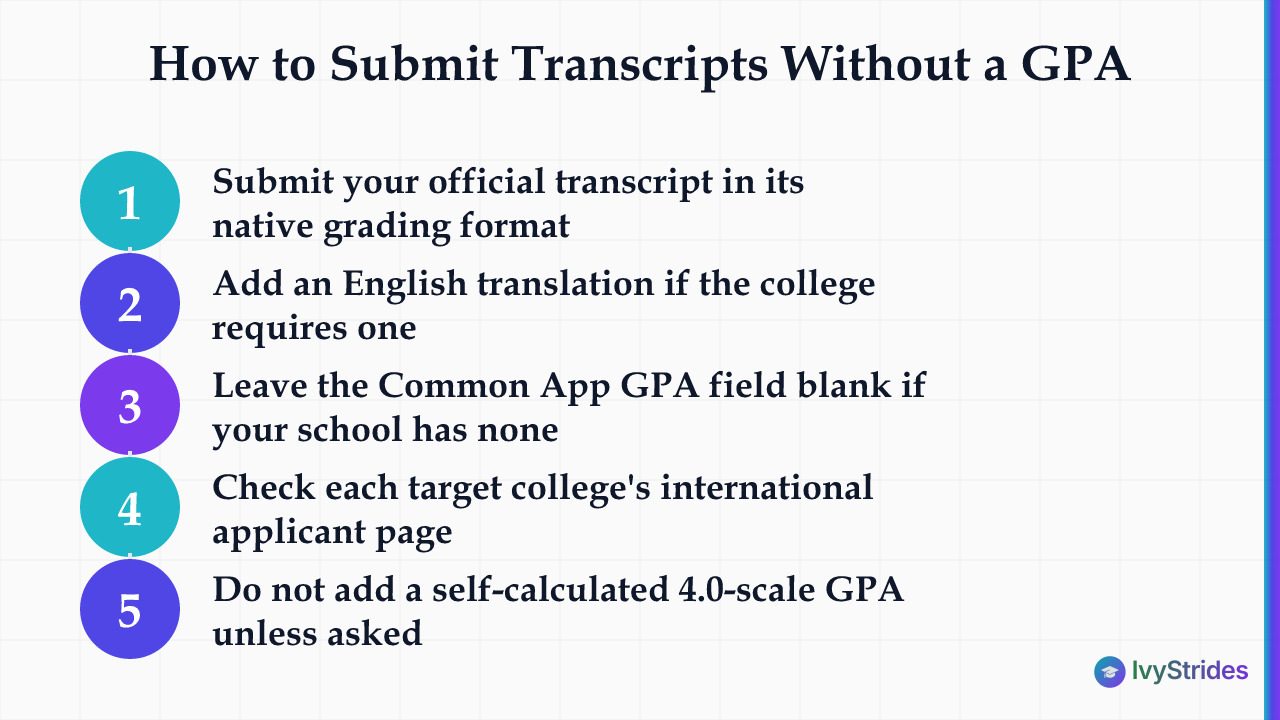
Your counselor attaches your official transcript to the Common App school report. If your school does not calculate a cumulative numerical GPA, Common App says to leave the Cumulative GPA field blank. The Common App serves more than 1,200 member colleges for 2026-27 and does not force international students to invent a 4.0-scale number (Common App). Self-converting is the error, not the fix.
Entering a self-calculated 4.0-scale GPA that the college never asked for can create inconsistencies between the application form and the official transcript. The transcript is the source of truth. A guessed GPA that conflicts with it only raises questions.
Translation, when your transcript is not in English. Where a college requires a translation, it goes alongside the original-language record, not in place of it. Rules differ: Cornell requires all transcripts translated into English, while the University of California generally asks for official translations of secondary records only when they use a non-Roman alphabet.
IvyStrides counselors review each student's transcript format and target college list to confirm what to submit and whether any translation or evaluation step is needed before the deadline. That coordination is the work of a counselor who checks each college's international applicant instructions against your documents.
Knowing what to submit is one step; knowing when each document is due is another, and the two decisions belong in the same planning window. That is why mapping each college's deadline onto a month-by-month application timeline belongs on the same page of your notes.
For context on the platform itself: the Common App's seven personal essay prompts are unchanged for 2026-27 (Common App).
International Applicant Transcript Submission Checklist:
- Official transcript in its native grading format, sent by your school
- English translation, if the college requires one and the transcript is not in English
- Common App Cumulative GPA field left blank if your school does not calculate one
- Curriculum and course list reported accurately
- Each target college's international applicant page checked for extra requirements
- No self-calculated 4.0-scale GPA added unless a college asks
When US Colleges Do Ask for a Formal International Grade Evaluation
Whether a formal credential evaluation is required depends on the college and on your applicant type. Cornell says your transcripts do not need one. Florida International University requires a course-by-course evaluation with a GPA from a NACES member for transfer applicants' non-US college coursework. Florida Atlantic University requires first-year applicants not educated in a US-based curriculum to have their high school records evaluated by a NACES agency.
NACES, the National Association of Credential Evaluation Services, describes itself as a trade association of US-based, independent, nongovernmental evaluation services. Its members include WES (World Education Services), whose iGPA Calculator returns a 4.0-scale GPA (WES), and International Education Evaluations (myiee.org). No single agency is endorsed over the others; the college decides which it accepts.
Always check the specific college. Requirements differ by institution and by program level, so verify each target college's international applicant requirements page before you order anything. If you are unsure whether your grades will be understood, the college's own page settles it: when it asks only for your school's transcript, that is all you send.
IvyStrides college admissions counseling reviews each college's international applicant requirements as part of building the application plan, including whether any evaluation step is required. For international applicants, whether a strong SAT or ACT score changes how colleges weigh your transcript depends on each school's testing policy, which varies by institution and year; the University of California, for one, does not consider SAT or ACT scores when making admissions decisions.
| Application Type | Credential Evaluation Required? | Who Evaluates |
| First-year at Cornell | No | Cornell's admissions office |
| First-year at Florida Atlantic University | Yes, unless educated in a US-based curriculum | A NACES agency |
| Transfer at Florida International University | Yes, for non-US college coursework | Any NACES member |
| Any program, confirmed on college page | As the college states | As the college specifies |
FAQ: International Grade Conversion for US Admissions
Do other countries use GPA?
Many school systems outside the US do not use a 4.0 GPA scale. Common alternatives include percentage marks in India, A-levels in the UK, and the IB 1-7 scale, while universities may report a 10-point CGPA (India) or ECTS letter grades (Europe). Colleges such as Cornell read these in their original grading system.
How do I convert my Indian GPA to a US GPA?
You generally do not need to convert your Indian percentage or CGPA to a US GPA for undergraduate applications. The University of California, for example, asks you to report your Class X and XII state board or CBSE subjects and marks on the International Exams page of its application and requires average marks above 60. If a college requires a formal evaluation, as Florida Atlantic University does for first-year applicants, use a service that college accepts.
How to calculate international GPA?
There is no single formula for an international GPA, because grading systems differ too much by country and institution. Where a college wants a US-style figure, it either sets its own standard, as the University of California does with its 3.4 GPA requirement for international first-year applicants, or requires an outside evaluation that includes a US GPA, as Florida Atlantic University does. Cornell asks that grades not be converted at all.
How do I convert my A-level grades to GPA for US college applications?
A-level grades do not need converting for US undergraduate applications. Admissions officers read A through E in their Cambridge or Edexcel context, and an A or A in a rigorous subject reads as top-tier performance. On the Common App, leave Cumulative GPA blank if your school calculates none, and list your A-level results in the Senior Secondary Leaving Examinations subsection, which opens in the Testing section once you answer Yes to the leaving-examinations question. Do not attempt a 4.0 conversion.
Your Next Step on International Transcript Submission
The short version holds from the first line to the last: you submit your grades as your school issued them, and the college does the reading. No formula, no self-converted 4.0, and an agency evaluation only where a college's own page requires one.
- Have your school send your official transcript in its native grading format.
- Add an English translation if the college requires one and your transcript is not in English.
- Leave the Common App Cumulative GPA field blank if your school does not calculate one.
- Check each target college's international applicant page for any evaluation requirement, since policies vary by institution and program level.

Hemant is a seasoned entrepreneur, investor, and growth strategist with deep ground in education and technology-driven learning. His core training is in Mathematics and Physics — he authored Physics for IB Diploma: Ultimate Revision Guide, recognized as a top student resource.