
How Much Does the SAT Matter for College Admission in 2026?
On this page
- The Short Answer: Yes, the SAT Still Matters in 2026
- Test-Optional in 2026: What It Really Means for Your Application
- What SAT Score Do You Actually Need? Benchmarks by School Tier
- The Financial Case for a Strong SAT Score: Scholarships and Merit Aid
- SAT or ACT: Which Test Should You Take in 2026?
- How the SAT Fits Into Your Full Admissions Picture
- How to Improve Your SAT Score: The Methodology That Moves the Needle
- For International Students: Does the SAT Matter the Same Way?
- FAQ
- Is a 1400 SAT score good enough for Ivy League admission?
- Is a 1300 SAT score a bad score?
- Is a 1600 SAT better than a 36 ACT?
- Do SAT scores expire, and can colleges see all your SAT scores?
- Is it okay not to take the SAT at all?
- Do SAT scores matter for community college?
- Where This Leaves You
Yes, the SAT matters for college admission in 2026, and its weight has increased at selective schools. Harvard, Yale, and MIT have reinstated SAT or ACT requirements after years of test-optional policies, and Dartmouth, Brown, and Caltech have followed. The national average SAT score is approximately 1050; a 1350 or higher places a student in roughly the top 10% of test-takers. For most students aiming at four-year colleges, taking the SAT at least once is the strategically safer choice, even if you never submit the score.
Those benchmarks come from College Board's Digital SAT program data and each school's own admissions announcements, cited in context below. The harder question isn't whether the SAT matters, but by how much for your specific school list, and whether a score you already have is worth submitting. That's what the rest of this article resolves.

The Short Answer: Yes, the SAT Still Matters in 2026
Here's the state of play. The Digital SAT, in place since March 2024, is a two-section, adaptive test scored 400-1600 and administered in 2 hours 14 minutes, per the College Board. Section one is Reading and Writing (R&W); section two is Math. Each section has an adaptive two-module structure: Module 1 is standard difficulty for everyone, and Module 2's difficulty adjusts based on Module 1 performance. Your final section score reflects both what you got right and which module tier you unlocked.
On outcomes: as of the 2024 admissions cycle, more than 80% of US colleges did not require SAT or ACT scores, per Harvard Graduate School of Education research on test-optional adoption. That has shifted. Harvard reinstated the requirement for Class of 2030 applicants (students applying in the 2025-2026 cycle). Yale did the same. MIT never dropped it; scores have been required there since 2022. Brown, Dartmouth, Caltech, and Cornell (for most of its colleges) have joined the reinstatement list. College Board's BigFuture currently identifies roughly 21 private and 42 public colleges that require or will require SAT or ACT scores for upcoming cycles.
The national average sits near 1050. A 1350 puts a student around the top 10%. A 1500 begins to compete at highly selective schools. And critically: at schools that remain test-optional, submitting a strong score almost always helps the application. Test-optional is a permission, not a preference. For a calendar of upcoming test administrations, see SAT test dates 2026.
Test-Optional in 2026: What It Really Means for Your Application
This is where most families get the calculus wrong. Test-optional does not mean scores are ignored. It means you choose whether to submit. If you submit, the score is reviewed. If a school is genuinely test-blind, submitted scores are not reviewed even if sent, and that's a different policy entirely. The University of California system is the highest-profile test-blind example. FairTest maintains a running list of test-optional institutions, but the caveat matters: policies change year to year, and the only authoritative source for any given school is that school's current admissions page.
So when does submitting help, and when does withholding help?
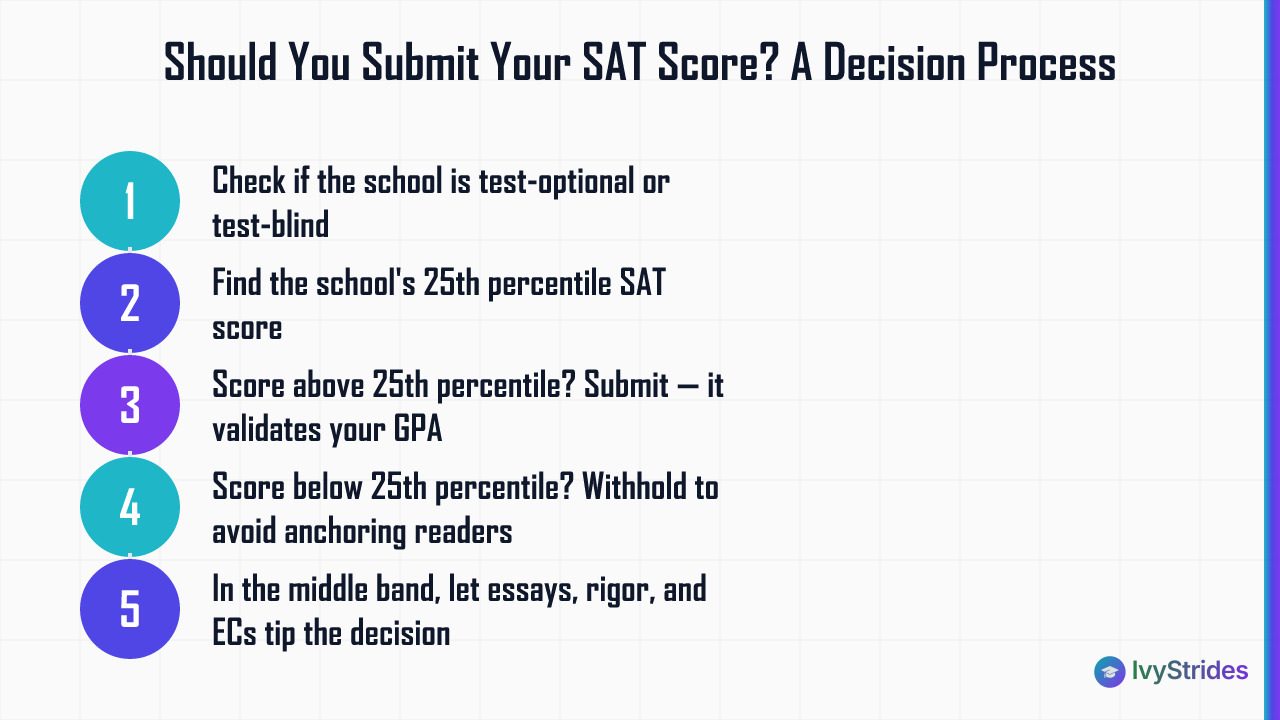
Here's the working rule. If your score is at or above the school's 25th percentile (the bottom edge of the middle 50% range), submitting typically strengthens your application. It gives the admissions officer an independent, standardized data point that validates your GPA and confirms academic readiness. If your score is below the 25th percentile, withholding under test-optional policy is a legitimate score submission strategy, because a low score can become the anchor number the reader remembers. In the middle band, roughly the 25th to 50th percentile, it comes down to judgment calls, and the rest of your application (essays, rigor, extracurricular depth) tips the decision.
If you're a sophomore or junior, the PSAT/NMSQT is worth taking seriously as a practice run and as the entry point to the National Merit Scholarship pathway. In our coaching with students in the 1100-1200 SAT band, the most common pattern is strong Module 1 R&W performance followed by a difficulty spike in Module 2 that catches the student off guard. If you know that pattern from a PSAT diagnostic, you can address it before it costs you real points. See how to use your PSAT score to set an SAT goal for the score-band walkthrough. Our SAT prep overview for the full program.
One more caveat worth stating plainly: test-optional policy is not permanent. Harvard, Yale, and Brown all demonstrate that policies revert. The safest posture for a current sophomore or junior is to take the SAT at least once, keep the option to submit, and decide later.
What SAT Score Do You Actually Need? Benchmarks by School Tier
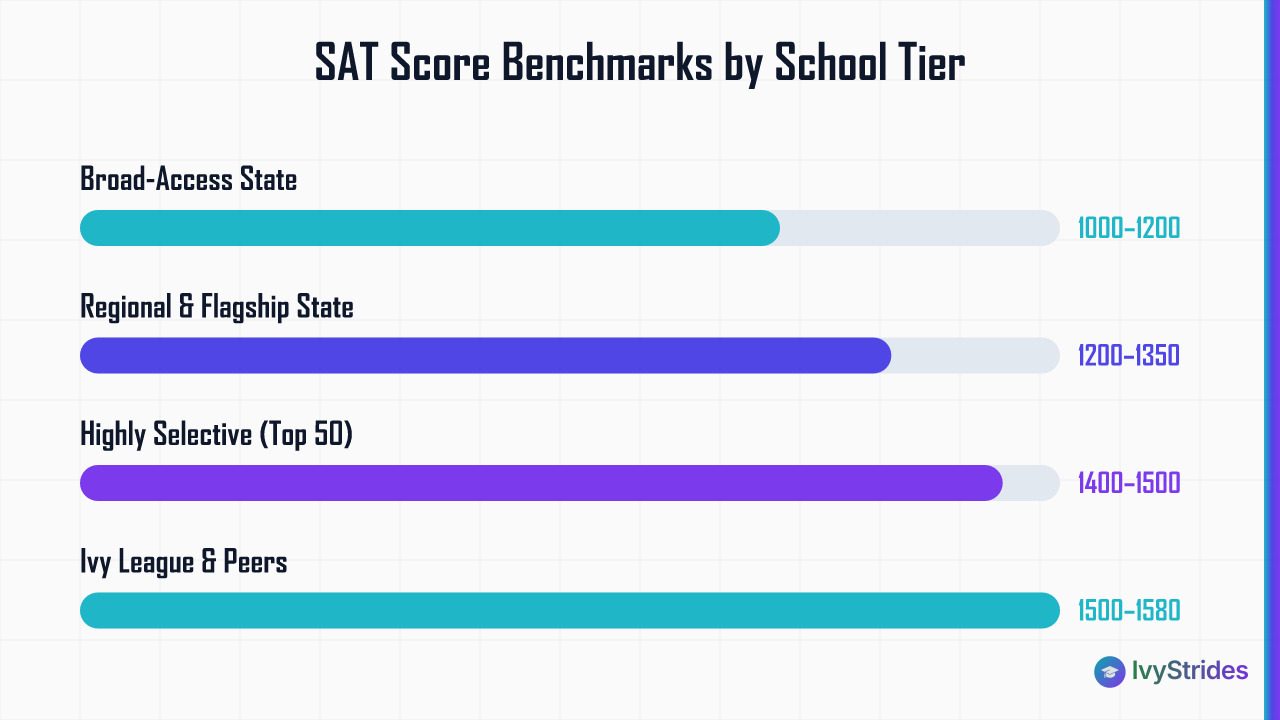
Once you know the SAT matters, the next question is how high your score needs to be for your specific target schools, which depends entirely on where you're applying. Here are the working score benchmarks by tier. Verify each against the school's current Common Data Set before locking a target.
Community colleges and open-enrollment schools. Scores are usually not required for admission. Some use SAT or ACT for course placement only, letting strong scorers skip developmental (non-credit) coursework.
Broad-access state universities. Competitive range roughly 1000-1200. Around the national average, a student is generally admissible; above 1200, they move toward the upper half of the applicant pool.
Strong regional and flagship state schools. Competitive range roughly 1200-1350. The 1350 top-10% threshold is meaningful here; it signals a top-tier applicant at most public flagships outside the very most competitive (Michigan, UNC-Chapel Hill, UVA, UT Austin, Georgia Tech, which run higher).
Highly selective schools (top 50 national universities). Competitive range roughly 1400-1500. A 1400 clears the bar at many; a 1500 clears it at nearly all.
Ivy League and peer institutions. Middle 50% typically 1500-1580 across the eight Ivies, Stanford, MIT, Duke, and Chicago, based on published Common Data Sets. A 1400 falls below the 25th percentile at all eight Ivy League schools. This is the fact that most surprises families: a 1400, which places a student around the 95th percentile nationally, is a below-median score for Ivy applicants.
For a deeper look at specific score bands, see is 1300 a good SAT score and 1540 SAT score. For the general framework, read our good SAT score 2026 guide.
A 1600 is a perfect score. It's rare, a few hundred per administration nationally. It's also not required for Ivy admission; a 1540 fits comfortably within the reported ranges at Harvard, Yale, and Princeton.
The Financial Case for a Strong SAT Score: Scholarships and Merit Aid
Beyond admissions, a strong SAT score can directly affect how much a college costs, because many universities use score thresholds to award merit aid. This is the dimension families most often miss when weighing whether prep is "worth it."
Many public flagships and mid-tier private universities publish explicit SAT score thresholds for automatic merit scholarship consideration. Alabama, for example, has historically used tiered SAT and GPA cutoffs to award scholarships ranging from partial tuition to full tuition plus stipend. Similar structures exist at Arizona, Arizona State, Miami, and dozens of others. Verify current thresholds on each school's financial aid page; they change annually.
The National Merit Scholarship pathway is a separate channel. It begins with the PSAT/NMSQT in the junior year, uses a Selection Index with cutoffs that vary by state, and awards recognition and scholarships to roughly the top 1% of test-takers per state. National Merit Finalist status opens additional institutional aid at many universities, some of which offer full tuition to Finalists who enroll.
Merit aid packages at score-driven schools commonly range from roughly $5,000 per year to full tuition. Over four years, that's the difference between a $20,000 outcome and a $200,000+ outcome. In our coaching with students targeting merit aid, we often find that a 50-100 point score delta in a specific section is the difference between qualifying for a scholarship tier and missing it. A student sitting at 1290 who reaches 1350 hasn't just moved percentile bands, they've crossed the eligibility line at a number of programs.
Caveat: merit aid policies vary by institution and application year. Always verify on the school's financial aid page before you plan around a specific threshold. If you want a structured plan for closing that 50-100 point gap, start with our SAT study plan. To pressure-test your baseline, run a full-length Official SAT practice test.
SAT or ACT: Which Test Should You Take in 2026?
Before committing to SAT prep, it's worth confirming the SAT is the right test for you, because some students score meaningfully higher on the ACT after a single diagnostic test.
Every US college that accepts standardized tests accepts both. Neither is preferred. A 36 ACT composite and a 1600 SAT are treated as equivalent perfect scores. The choice is about which format plays to your strengths, not which score sends a stronger signal.
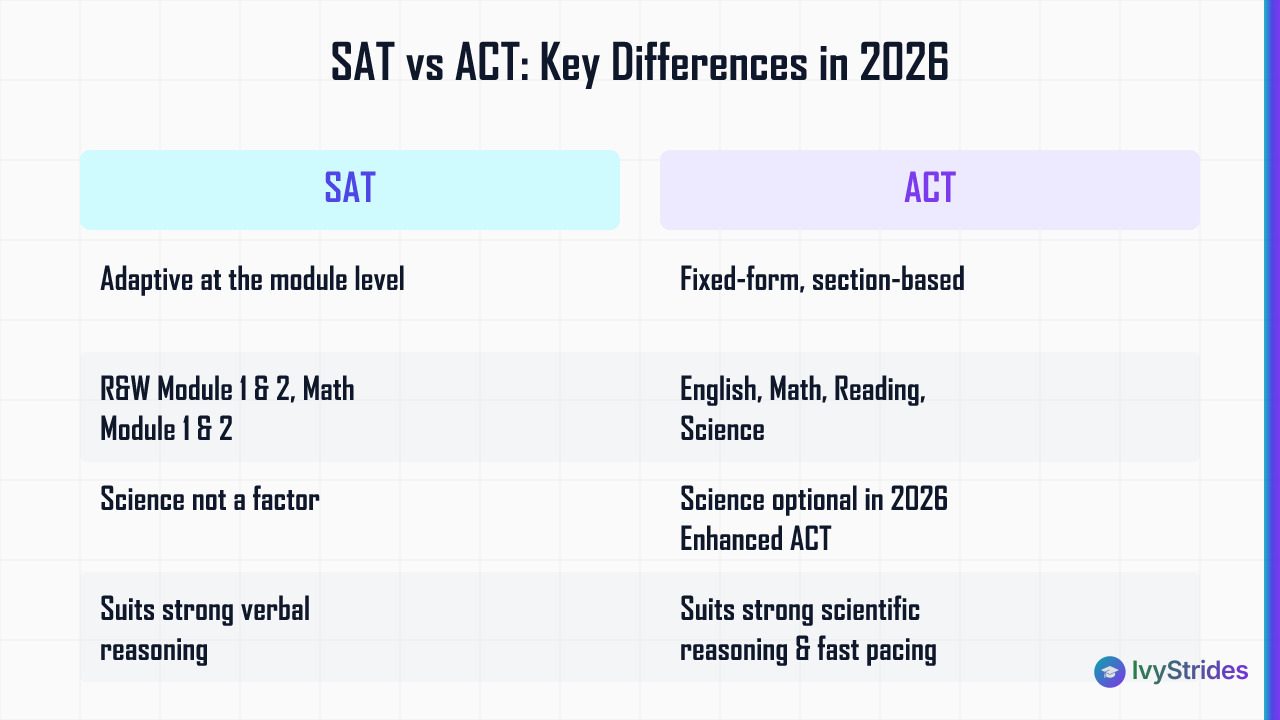
The tests differ structurally. The SAT is adaptive at the module level: R&W Module 1 and Module 2, then Math Module 1 and Module 2, with Module 2 difficulty scaling to your Module 1 performance. The ACT is fixed-form and section-based: English, Math, Reading, and Science, with an optional Writing section. The Enhanced ACT rolling out in 2026 shortens the test and makes Science optional for most students, per ACT, Inc.. That last change matters. Students with weaker science reasoning who previously avoided the ACT for that reason now have a cleaner path in.
Broadly: students with strong verbal reasoning and comfort with adaptive testing tend to score higher on the SAT R&W. Students with strong scientific reasoning, faster pacing, and comfort with straightforward question progressions often score higher on the ACT.
The only reliable way to know is a diagnostic. In our coaching, we run a full-length diagnostic of both before recommending which test a student should focus on, because roughly one in three students we see scores meaningfully higher on the ACT than a converted SAT score would predict. For more on the format shift, see what is the enhanced ACT. To model score outcomes before your first real sitting, try our digital sat calculator.
How the SAT Fits Into Your Full Admissions Picture
The SAT is one number among many. Selective admissions use holistic review: GPA and course rigor, standardized test scores, essays, recommendations, extracurricular depth, demonstrated interest at some schools, and context. Your test score's job is to be the independent, standardized data point that lets an admissions officer compare you across the thousands of different high schools they read.
Here's the practical implication. A high GPA with a low SAT can raise grade inflation questions, especially at less-well-known high schools. A strong SAT validates the GPA. A strong SAT with a lower GPA can signal untapped potential in some cases, though GPA carries more weight in most holistic reviews because it reflects four years of sustained work rather than one morning. Some colleges will superscore SAT results across test dates, taking the highest R&W and highest Math from separate sittings; policies vary, so confirm on each school's page.
A strong SAT score does not replace a compelling personal statement; the two work together, and a score near your target school's median frees your essay to do the storytelling work. If your score anchors you comfortably inside a school's middle 50%, the reader stops evaluating whether you're academically prepared and starts evaluating who you are. For the essay side of that equation, see what is the college application essay. And plan backward from college application deadlines so your prep timeline doesn't collide with essay season.
AP scores serve a different but complementary role: they signal subject-matter depth and can earn college credit, while the SAT signals overall academic readiness. A student with a 1450 SAT and five 5s on AP exams presents a very different profile from a student with the same SAT and no APs, even to the same admissions committee. AP credit policies vary by college; the SAT does not earn credit but does influence admission.
Caveat worth stating plainly: college admissions outcomes depend on the full application, not test scores alone. No score guarantees admission anywhere.
How to Improve Your SAT Score: The Methodology That Moves the Needle
If your diagnostic sits below your target and you have a real timeline of about 10 or more weeks, score improvement is a solvable problem. It requires the right method, not more hours.
The IvyStrides methodology has four stages. First, a full-length diagnostic test establishes a real baseline, not a guess. Second, a section-specialist coach (a dedicated SAT R&W coach or SAT Math coach, not a generalist) identifies specific weakness patterns: which question types the student misses, which module tier they unlock, where pacing breaks down. Third, targeted practice closes those specific gaps, working from College Board's Bluebook question bank and released practice tests. Fourth, spaced retesting under timed conditions confirms retention.
The tactical depth matters. SAT Math covers four domains per College Board's framework: algebra, advanced math, problem-solving and data analysis, and geometry and trigonometry. A student losing points in advanced math (quadratics, exponentials, polynomial identities) needs different work from a student losing points in problem-solving and data analysis (rates, ratios, percentages, data interpretation). Grouping them into "SAT Math prep" misses the actual weakness. Our breakdown of SAT Math topics walks through each domain.
Same logic applies to R&W. Module 2 of R&W is where the difficulty spike hits, and students who read broadly but haven't practiced the specific Digital SAT question archetypes (words in context, text structure and purpose, cross-text connections, transitions, rhetorical synthesis) lose points not to the reading itself but to unfamiliarity with the question forms.
For students completing the IvyStrides 1-on-1 SAT program, a 200+ point gain from baseline to final test is typical. In our coaching with students at the 1100-1200 band, a realistic path to 1350+ commonly takes roughly 60-80 hours of targeted prep across about 10-14 weeks. Students who plateau between weeks 4 and 6 are usually repeating the same two or three error types across sessions, which is when the specialist coach's error-pattern log matters most. If you're deciding between self-study and structured coaching, 1-on-1 SAT prep is the service most students in that band choose. For students prepping alongside a winter test date, our SAT winter batch enrollment opens each cycle.
For International Students: Does the SAT Matter the Same Way?
For international applicants to US colleges, the SAT often carries more weight, not less. US admissions officers are generally less familiar with grading scales, course rigor conventions, and academic culture across the world's education systems. The SAT is a shared standard that lets them compare a student from Seoul or São Paulo to a student from Boston on the same axis.
Practical points. Every US college that accepts SAT scores applies the same standards to international applicants as to domestic ones. Test center availability and registration deadlines differ from US administrations; international students should register early via satsuite.collegeboard.org to secure a seat. Some schools have specific international applicant policies (additional required documents, English proficiency tests like TOEFL or IELTS alongside the SAT); always verify on each school's international admissions page.
IvyStrides serves students worldwide through online-only delivery, so international students access the same section-specialist coaches as US-based students, on schedules that fit their time zone. For the international-specific version of this framework, see SAT for international students. You can also read more on the about IvyStrides page.
FAQ
Is a 1400 SAT score good enough for Ivy League admission?
A 1400 SAT is a strong score nationally, around the 95th percentile, but it falls below the 25th percentile at all eight Ivy League schools, where the middle 50% typically runs 1500-1580. Submitting a 1400 to an Ivy under test-optional policy would likely not strengthen the application. Students targeting Ivy-level schools should aim for at least 1500, with 1550+ being more competitive. Verify the current Common Data Set for each specific school.
Is a 1300 SAT score a bad score?
A 1300 SAT is not a bad score. It's well above the national average of approximately 1050 and sits around the 87th percentile. It's competitive at many broad-access state universities and some regional schools. However, it falls below the 25th percentile at highly selective schools (top 50 national universities), where competitive applicants typically score 1400 or higher. Whether a 1300 is "good enough" depends entirely on your target school list.
Is a 1600 SAT better than a 36 ACT?
A 1600 SAT and a 36 ACT are both perfect scores on their respective tests, and US colleges treat them as equivalent. Neither is better in admissions. If you have achieved a perfect score on either test, submitting it will be viewed the same way by admissions officers. The choice of which test to take should be based on which format plays to your strengths, determined by a diagnostic, not by which score looks more impressive.
Do SAT scores expire, and can colleges see all your SAT scores?
SAT scores do not expire, though most colleges focus on scores from the past five years. Whether colleges see all your scores depends on the school's score reporting policy. Many schools use Score Choice, which lets you select which test dates to send. Some require all scores from all test dates. Always check the specific school's score reporting policy before registering for additional test dates.
Is it okay not to take the SAT at all?
For students applying exclusively to test-blind schools (where scores aren't reviewed even if submitted), skipping the SAT is a defensible choice. For most students, the safer strategy is to take the SAT at least once, even if you plan to apply test-optional, so you preserve the option to submit a strong score. A strong score can only help; you're never required to submit it. Skipping the test entirely removes that option permanently, and given how quickly test-optional policies have reverted since 2024, keeping the option open costs little and protects a lot.
Do SAT scores matter for community college?
Most community colleges are open-enrollment and don't use SAT scores for admissions. Some use SAT or ACT scores for course placement, potentially letting students with strong scores skip developmental (non-credit) coursework. If you plan to transfer from a community college to a four-year university, the four-year school's SAT requirements will apply at the point of transfer, not at initial community college enrollment.
Where This Leaves You
The SAT matters in 2026, meaningfully at selective schools and increasingly again after the 2024-2025 policy reversals. The right question isn't whether to prep, but what your specific target score is, given your school list, and how many weeks you have to get there. Start with a diagnostic. Everything else follows from it.

Award-winning author (South Asian Book Award) and graduate of BITS Pilani and UCLA Luskin School of Public Affairs. Brings a published writer's eye to Common App essays and grammatical precision to SAT and ACT R&W instruction.