
UT Austin vs Texas A&M: Which Admissions Process Fits Your Profile?

On this page
- How UT Austin and Texas A&M Admissions Processes Actually Differ
- Essays and Short Answers: What Each School Actually Reads
- Which Texas Majors Have Extra Admissions Gates at UT Austin and A&M
- Which School Fits Your Profile: A Decision Framework
- FAQ: UT Austin vs Texas A&M Admissions
- Which one is better, UT Austin or Texas A&M?
- Is it harder to get into A&M or UT?
- What is the automatic admission rule at UT Austin?
- Is Texas A&M better than UT Austin for engineering?
- Your Next Step on the UT Austin vs Texas A&M Decision
For fall 2027, UT Austin is test-required and Texas A&M is test-optional. UT Austin reads SAT or ACT scores, class rank, and a calculus-readiness gate for several STEM majors. Texas A&M reviews without required scores but asks for more writing. Your score, rank, and intended major decide which process favors you.
UT Austin and Texas A&M are the flagship campuses of the University of Texas and Texas A&M systems, and both admit students through two tracks: automatic admission for Texas students with a high enough class rank, and holistic review for everyone else.
How UT Austin and Texas A&M Admissions Processes Actually Differ
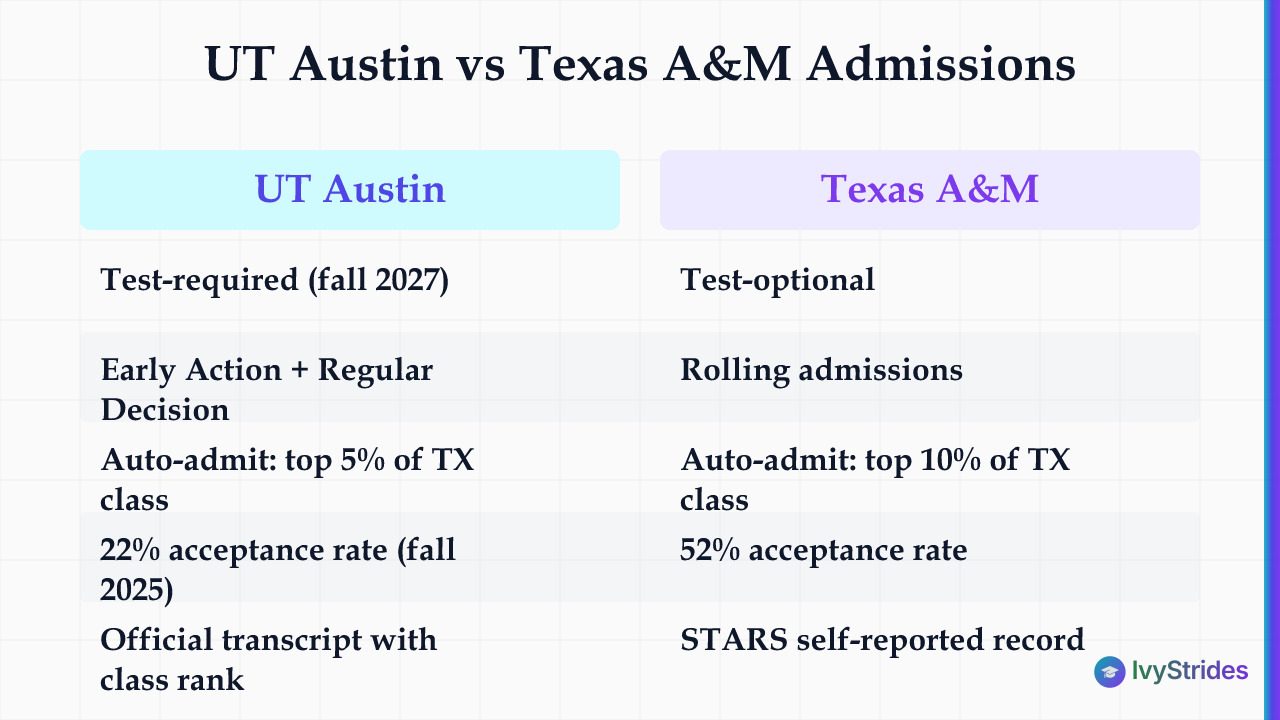
UT Austin requires an SAT or ACT score for fall 2027; Texas A&M does not. UT tells freshman applicants to send at least one official score straight from the testing agency, SAT code 6882 or ACT code 4240. A&M's Common Data Set 2025-26, section C8A marks the SAT or ACT as not required for admission but considered if submitted.
Both schools run holistic review, meaning a reader weighs the whole file rather than a formula. UT Austin's review process names class rank, academic background, test scores, achievements, essays, short answers, and competitiveness of the major. A&M's CDS rates course rigor, class rank, academic GPA, extracurricular activities, and talent/ability as Very Important.
Deadlines split sharply. UT runs two rounds. A&M runs rolling admissions with a single hard close.
| Factor | UT Austin | Texas A&M |
| Test policy (fall 2027) | Test-required | Test-optional |
| Application platforms | Common App or ApplyTexas | Common App or ApplyTexas |
| Early round | Early Action: apply Oct 15, materials Oct 22 | Rolling; applications open Aug 1, close Dec 1 |
| Regular deadline | Dec 1, materials Dec 10 | Dec 1, documents Dec 15 |
| Decisions | EA by Jan 15, RD by Feb 15, 2027 | Rolling from late September |
| Academic record | High school transcript with class rank | STARS self-reported record |
| Auto-admit pathway | Top 5% of Texas class (fall 2027) | Top 10% of Texas class |
| Optional letters | Up to two | Up to two (first two count) |
UT Austin's acceptance rate is 22% for fall 2025: it admitted 20,154 of 90,690 first-year applicants, per its Common Data Set 2025-26. Residency changes the picture. IvyStrides calculates from the same counts that UT admitted about 36% of Texas applicants and 7.5% of out-of-state applicants, so the holistic factors above carry real weight outside the automatic track.
Class rank drives Texas A&M's 52% acceptance rate: the top-10% automatic-admission pathway bypasses holistic review for the admission decision itself.
Platform choice doesn't matter. Both schools accept the Common App or ApplyTexas and say the platform does not affect the decision.
Essays and Short Answers: What Each School Actually Reads
UT Austin asks for one essay and two required short answers; Texas A&M asks for one essay and five short answers. A&M is the heavier writing lift.
UT's required essay runs 500 to 650 words on any topic, and the Common App personal statement satisfies it. Two required short answers follow, each capped at about 250 to 300 words or 40 lines: why your first-choice major, and the one activity you are most proud of.
A&M's required essay runs up to 750 words on the opportunities or challenges that shaped you. Five short answers follow: one 250-word response on a life event that prepared you for college, plus four 100-word answers on life goals, why the major, why Texas A&M, and plans beyond the bachelor's.
| Prompt | UT Austin | Texas A&M |
| Main essay | 500-650 words, any topic | Up to 750 words, opportunities/challenges |
| Required short answers | Two (250-300 words each) | Five (one 250-word, four 100-word) |
| Optional short answer | One | One (250 words) |
| Common App essay accepted | Yes | Separate TAMU essay required |
| Total required writing | Up to ~1,250 words | Up to ~1,400 words |
Each school lists its per-prompt limits separately; IvyStrides sums them for this comparison.
Voice matters more than polish at A&M. Its essay advice is concrete: build the response around one specific instance, explain how it changed you, and don't repeat what appears elsewhere in the file. In our essay coaching, students applying to both schools often treat A&M's five responses as an afterthought, when they demand as much planning as a full supplemental set.
Both schools ask why you chose your major, but UT allows about 300 words and A&M allows 100. Answering "why this major" with specifics works at either length. Students who want a second reader across both sets can look at one-on-one college essay coaching.
Which Texas Majors Have Extra Admissions Gates at UT Austin and A&M
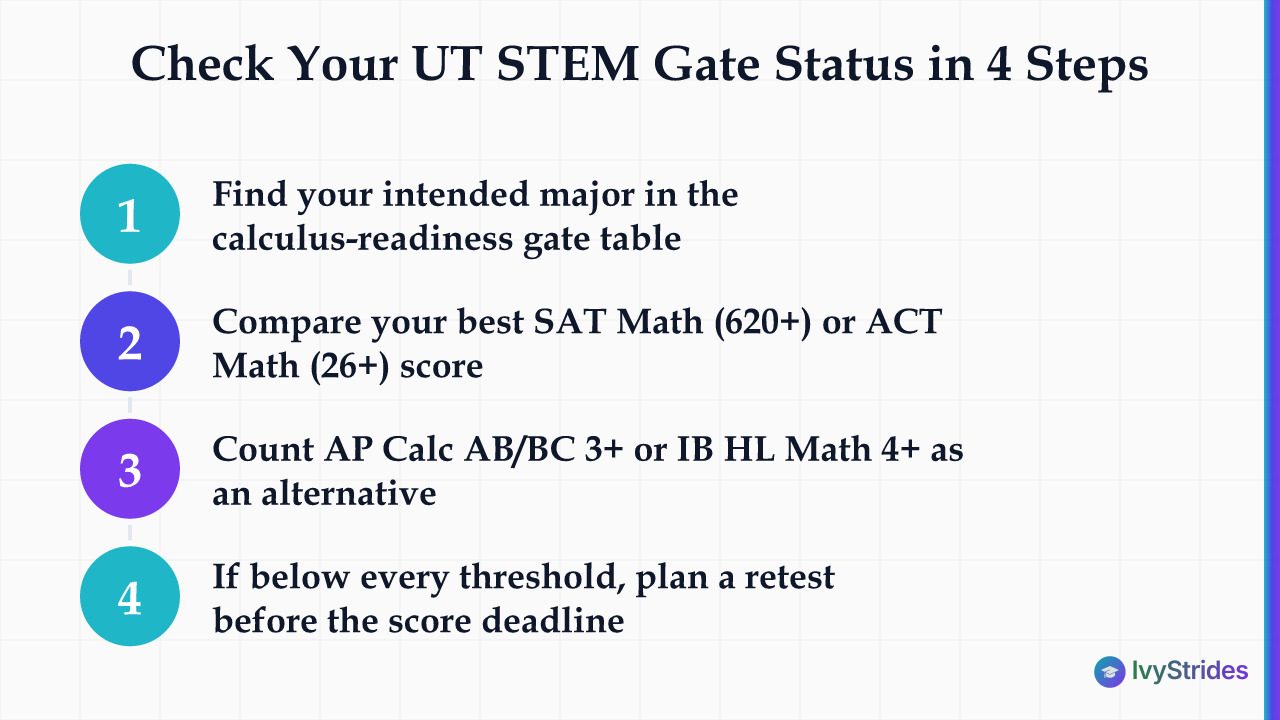
You must clear UT Austin's calculus-readiness gate before UT will consider you for several STEM majors; A&M publishes no equivalent score gate. That rule changes which school is harder for a specific applicant: a strong-GPA student with a borderline SAT Math score can be blocked at UT while staying competitive at Texas A&M.
The gate covers the majors below. Any one credential clears it: SAT Math 620+, ACT Math 26+, AP Calculus AB or BC 3+, IB HL Math 4+, or the CLT Math equivalent.
| Major group | Calculus-readiness gate |
| Cockrell Engineering (all majors) | Required |
| Jackson Geosciences (all majors) | Required |
| Environmental Science (both majors) | Required |
| Computer Science and combined CS majors | Required |
| Liberal arts, business, most others | Not required |
The gate is not an admission decision. It is a threshold for consideration. UT still runs holistic review on the rest of the file, and how much your SAT score weighs in admissions depends on the whole application, not one number.
Check your gate status before you pick a UT major:
-
Find your intended major in the table above.
-
If it is gated, compare your best SAT Math or ACT Math score with 620 or 26.
-
Count an AP Calculus AB or BC score of 3+ or IB HL Math 4+ as an alternative.
-
If you sit below every threshold, plan a retest before UT's score deadline: Oct 22 for Early Action, Dec 10 for regular.
Major order matters too. UT's School of Architecture reviews only students who list it first. UT may consider auto-admit students for their second-choice major if they are not admitted to their first; some majors look only at first-choice applicants. A&M spells out a fuller first- and second-choice sequence: A&M offers a competitive applicant shut out of a restricted first choice the second, and if that is full too, the student picks an alternate major after admission.
STARS is A&M's hidden time cost. Every A&M freshman except GED graduates must complete the Self-reported Transcript and Academic Record System, which takes 2 to 6 hours and must link to the application by Dec 15. Top-10% applicants also verify rank with an official transcript.
In our coaching, students targeting UT STEM majors sometimes discover the gate only after submitting, when a borderline SAT Math score is too late to fix. If your score sits just under 620, targeted SAT Math prep before the score deadline gives you a concrete target.
Which School Fits Your Profile: A Decision Framework
Your test score, class rank, and intended major decide which application deserves more of your fall.
| Your profile | UT Austin fit | Texas A&M fit |
| Top 5% of a Texas class, strong score | Auto-admit; major still decided in review | Auto-admit (top 10%) |
| No score, high GPA and rank, non-STEM | Weaker; score required | Competitive; scores optional |
| Borderline SAT Math, wants CS or engineering | Risky; gate applies | No score gate |
| Deep activities, average rank | Moderate | Strong; depth valued |
| Applying to both | Submit Early Action by Oct 15 | Submit after UT, by Dec 1 |
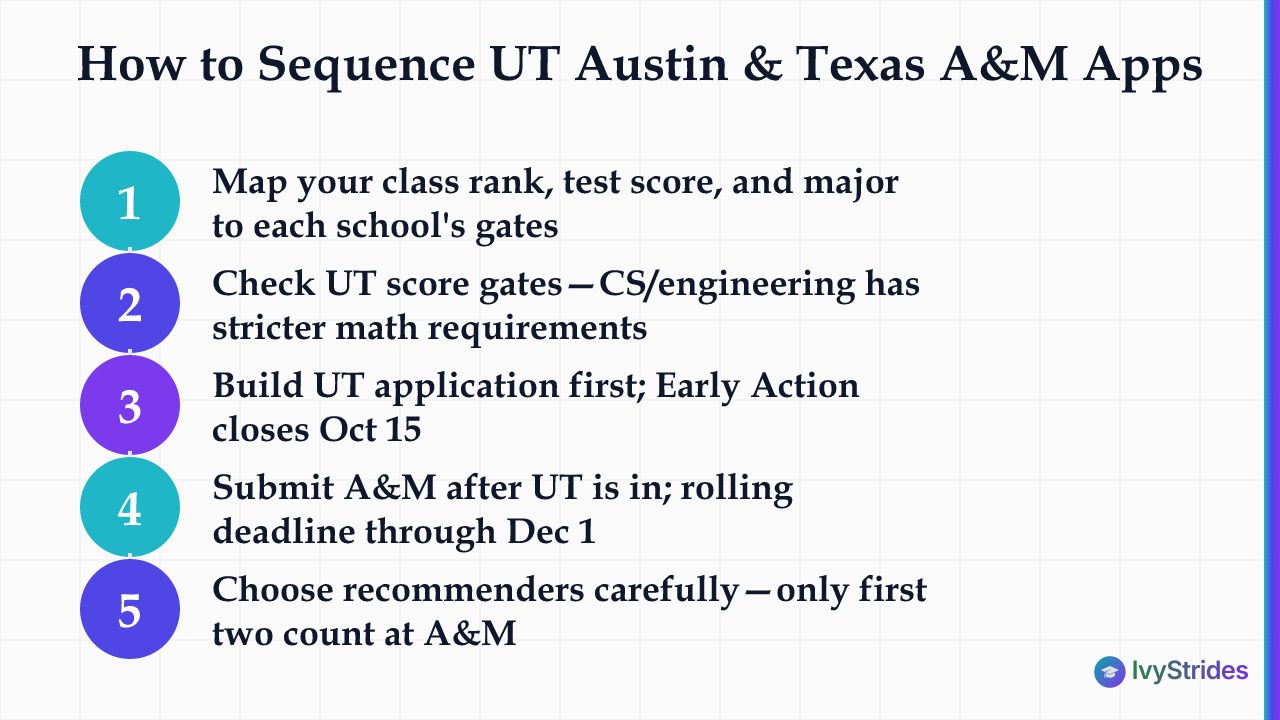
If you are applying to both, sequence it. UT's Early Action round closes Oct 15 with materials due Oct 22, so build that application first. UT says Early Action is non-binding and gives no advantage in review, so the point of hitting it is a January answer, not a leg up. A&M's rolling window stays open through Dec 1, so you can finish it after UT is in.
Letters are optional at both, with different preferences. UT encourages writers from outside your high school. A&M wants people who know you well and can speak to leadership or special circumstances, and only the first two received count. Who writes yours matters more than how many, and choosing the right recommenders covers the trade-offs.
Mapping your class rank, test score, and intended major against both schools' gates is the profile analysis a counselor who sequences both applications runs first. One caveat throughout: test policies and gates can change each year, AP credit varies by college within each university, and admission depends on the full application, never one number.
FAQ: UT Austin vs Texas A&M Admissions
Which one is better, UT Austin or Texas A&M?
Neither is better for everyone; it depends on your major, test score, and class rank. UT Austin is more selective and test-required. Texas A&M is test-optional for fall 2027 and admits Texas top-10% graduates automatically.
Is it harder to get into A&M or UT?
UT Austin is harder overall: it admitted 22% of fall 2025 applicants versus A&M's 52%, and UT requires a test score. For UT's gated STEM majors, the calculus-readiness requirement (SAT Math 620+ or ACT Math 26+) adds a hurdle A&M does not have.
What is the automatic admission rule at UT Austin?
UT Austin automatically admits students in the top 5% of their Texas high school class for summer and fall 2027 entry, per its review and decision page. UT sets the cutoff so automatic admits fill 75% of its Texas-resident spaces and announces it to high schools each fall. UT still reviews auto-admits to decide their major, so automatic admission does not guarantee computer science or another competitive major.
Is Texas A&M better than UT Austin for engineering?
The better choice depends on your scores, because the entry rules differ. UT Austin's Cockrell School requires the calculus-readiness gate (SAT Math 620+ or ACT Math 26+) for consideration. Texas A&M is test-optional for fall 2027 and rates class rank and GPA as Very Important.
Your Next Step on the UT Austin vs Texas A&M Decision
Map your profile before you spend hours on either essay set.
- Confirm whether your intended UT major sits behind the calculus-readiness gate, and check your SAT or ACT Math against 620 or 26.
- Count your writing load: IvyStrides totals it at about 1,250 words for UT and 1,400 for A&M.
- Build UT's Early Action application first if you apply to both, aiming at Oct 15.
- Block 2 to 6 hours for A&M's STARS record well before Dec 15.

Hemant is a seasoned entrepreneur, investor, and growth strategist with deep ground in education and technology-driven learning. His core training is in Mathematics and Physics — he authored Physics for IB Diploma: Ultimate Revision Guide, recognized as a top student resource.