
How to Answer the 'Why This Major?' Essay (With Examples)

On this page
- What Real "Why This Major?" Essay Prompts Actually Ask
- How to Build a "Why This Major?" Essay Step by Step
- Two "Why This Major?" Essay Examples, Annotated
- What to Write in a "Why This Major?" Essay When You Are Undecided
- FAQ: The "Why This Major?" Essay
- How to answer why did you choose this major?
- Why did you choose this major?
- How do you write a "Why This Major?" essay if you just like the subject but have no dramatic story?
- How long should a "Why This Major?" essay be?
- Your Next Step on the "Why This Major?" Essay
To answer the "Why This Major?" essay, open with a specific moment that sparked your interest, trace how that interest deepened, then name one or two concrete offerings at the target school. The "Why This Major?" essay is a short supplemental essay, usually 150 to 300 words, that asks you to explain your intellectual interest in a chosen field.
Skip the broad opener like "I have always loved biology." Specificity is the difference between a forgettable and a memorable answer, and an admissions reader can spot a generic passion statement in the first line. The rest of this article gives you the structure, two annotated models, and a plan for the undecided case.
What Real "Why This Major?" Essay Prompts Actually Ask
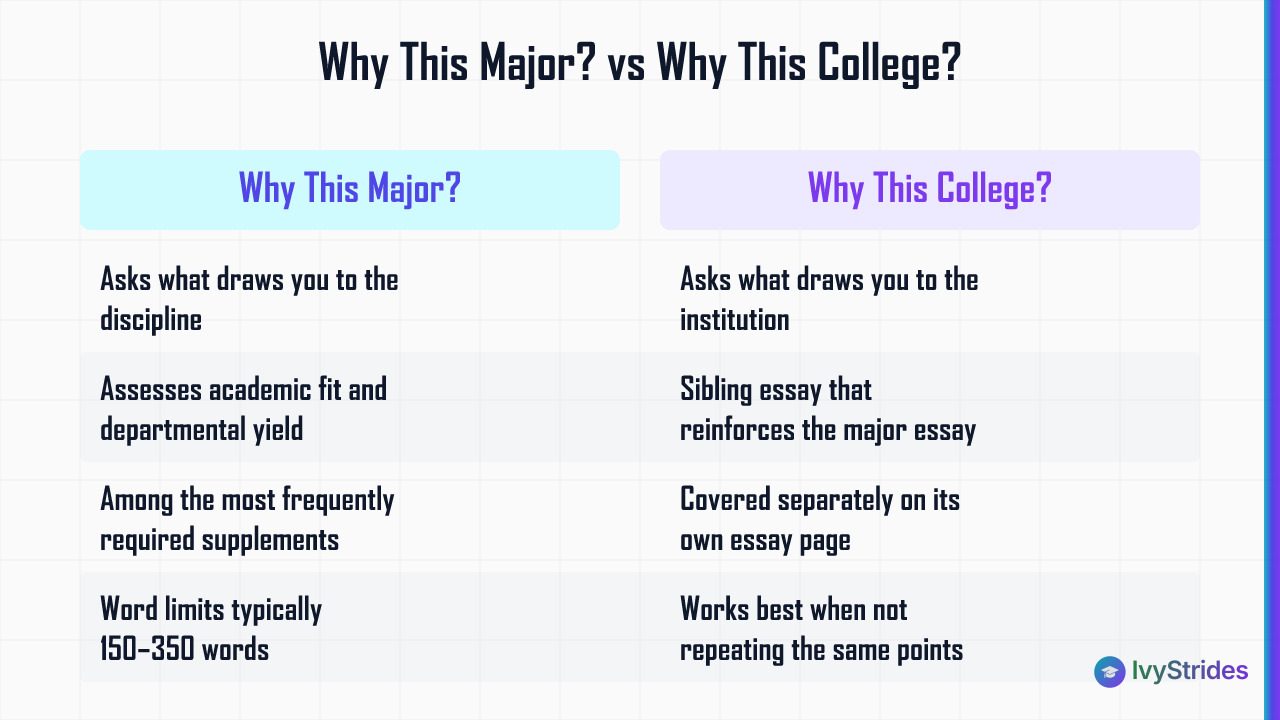
The "Why This Major?" supplemental essay asks one underlying question: is your interest in this field specific, sustained, and academically serious enough that you'll enroll and thrive in the department? Admissions readers use it to assess academic fit and, quietly, departmental yield, the odds you'll actually attend if admitted.
Schools set their own supplemental prompts and word limits through the Common App, and the phrasings vary widely. Some ask you to name an academic interest and explain it. Some ask what excites you about the field. Word limits for why-major essays typically run from 150 to 350 words, per Common App supplemental policies, and prompt wording changes each cycle, so verify the current version at commonapp.org before you draft.
One prompt, two documents. The "Why This College?" essay asks what draws you to the institution; the "Why This Major?" essay asks what draws you to the discipline, and the two work best when they reinforce each other rather than repeat the same points.
Most students applying to eight to twelve schools write fifteen to thirty supplemental essays in total, and the why-major prompt is among the most frequently required. To see how these fit together, our supplemental essays library shows annotated models across prompt types. The 'Why This College?' essay page covers its sibling.
| School | Prompt phrasing (paraphrased) | Typical word limit |
| MIT | Describe your field and why it appeals to you | ~100 words |
| Cornell | Explain your interest in your college and major | ~650 words |
| USC | Describe your academic interests and goals | ~250 words |
| UT Austin | Why this major, and how it fits your goals | ~300 words |
| Georgia Tech | Why you want to study your chosen major | ~300 words |
Prompt wording and limits above are paraphrased and change annually; confirm each at the school's application portal or commonapp.org.
How to Build a "Why This Major?" Essay Step by Step
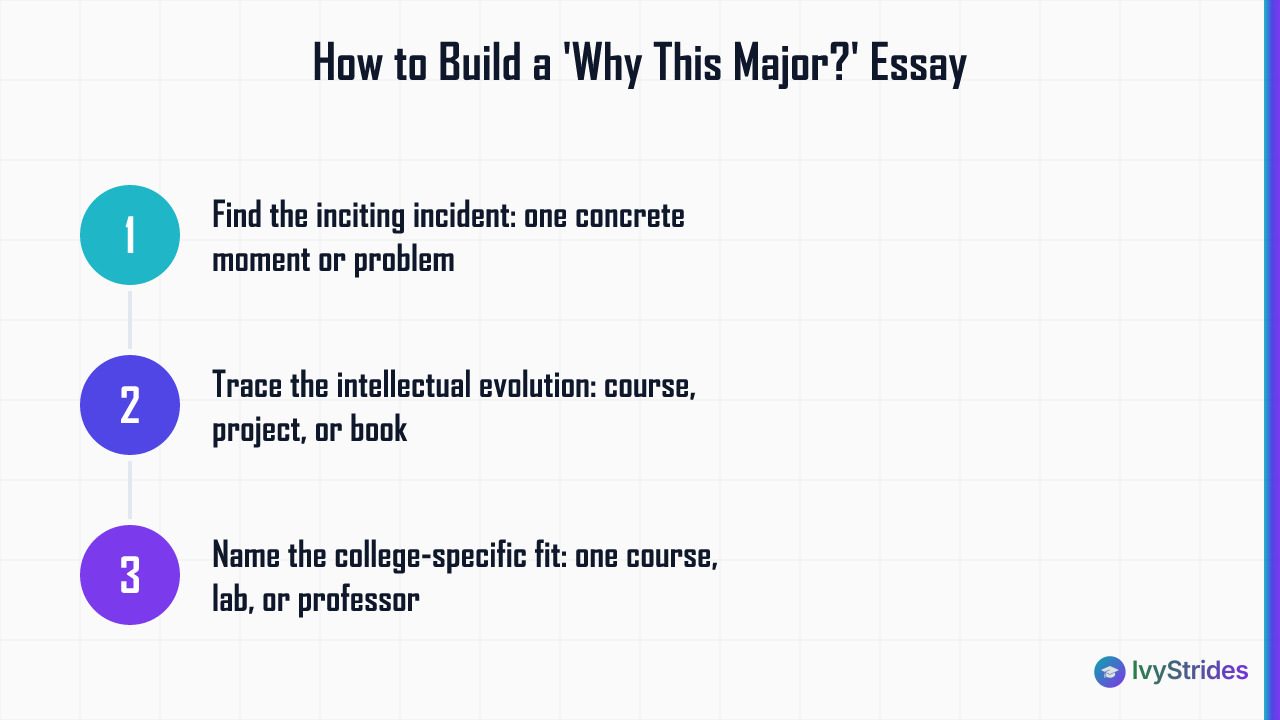
A strong "Why This Major?" essay follows a three-part structure: inciting incident, intellectual evolution, and college-specific fit. The inciting incident is a specific moment, project, or experience that sparked your interest. The intellectual evolution is how that spark deepened through coursework, research, reading, or an activity. The college-specific fit names one or two concrete offerings at the target school that connect to your academic direction.
That structure turns a resume bullet into a story. In our coaching with students drafting supplemental essays, the most common first-draft problem is an opening that names a subject rather than a moment. Compare these two openings.
Generic: "I have always been fascinated by chemistry."
Specific: "The first time I watched a titration endpoint flip from pink to clear, I wanted to know exactly why that half-drop mattered."
The second version shows a scene. The inciting-incident opening works only when it shows a scene rather than summarising a feeling, which is the whole logic behind show, don't tell in college essays.
-
Find the inciting incident. Pick one concrete moment. A problem set that took three hours. A question you couldn't drop. Pull it from your activities list if you're stuck, since that section already documents your real engagement.
-
Trace the intellectual evolution. Show how the spark led somewhere: a course, an independent project, a book you read outside class. This is where you prove the interest has a history, not just a feeling.
-
Name the college-specific fit. Name one course, one lab, or one professor whose work connects to yours. One specific offering beats a list of five vague ones every time.
Budget your words. For a 250-word essay, allocate roughly 80 words to the inciting incident, 100 to the intellectual evolution, and 70 to college-specific fit. Common App sets the 250-word limit; IvyStrides derives that per-part split from the three-part structure.
Don't echo your personal statement. The why-major essay reinforces your application, it doesn't repeat it. If your personal statement already tells your robotics story, use a different entry point here. In our coaching, students who name a specific professor or course consistently produce drafts that read as more credible than those praising a school's "excellent faculty" in general terms. If your draft reads more like a resume bullet than a story, college essay coaching can identify the specific moment worth expanding before your earliest deadline.
Two "Why This Major?" Essay Examples, Annotated

Photo by RDNE Stock project on Pexels
These two "Why This Major?" essay examples, one engineering and one social science, show the three-part structure in practice. Each runs about 200 to 250 words, sized for a typical 250-word limit. They're illustrative, written for this article; your own prompt and word limit will differ, so check the current supplement at commonapp.org.
Example 1: Computer Science. "In tenth grade I wrote a Python script to sort my brother's baseball cards by market value, and it broke every time two cards shared a price. Debugging that edge case at midnight, I realized the interesting part wasn't the cards. It was the logic of how systems handle collisions."
The essay then traces the evolution: "That question followed me into an AP Computer Science project on hash tables and, later, a summer spent building a small recommendation model that kept ranking the same three songs. I want to study computer science to understand why algorithms behave the way they do, not just to make them run. At Georgia Tech, the Machine Learning specialization and Professor Isbell's work on interactive systems connect to the ranking problem I've been circling for two years."
The opening scene is the inciting incident. The AP project and the summer model are the intellectual evolution, showing sustained engagement. The named specialization and professor are the college-specific fit, and they tie back to the exact problem the opening raised. That thematic thread, systems and collisions, runs start to finish.
Example 2: Economics. "I started tracking my town's farmers' market prices for a school stats project, expecting neat supply-and-demand curves. Instead, tomato prices spiked the week a food blogger posted about one vendor. That gap between the model and the messy reality is why I want to study economics."
The evolution and fit follow: "I chased it through a behavioral econ reading list and a debate case on minimum-wage effects that forced me to argue both sides. At USC, the PPE program and the Schaeffer Center's health-policy research would let me keep testing where clean models meet human behavior."
Same structure: a concrete scene, a documented evolution, and one named program plus one research center rather than a vague nod to "great resources." After you've drafted your own, our guide on how to get feedback on your college essay walks through what to fix first.
| Example | Major | Word count |
| 1 | Computer Science | ~145 |
| 2 | Economics | ~110 |
| Target | Any | 250 max |
| Note | Illustrative only | Prompts vary |
What to Write in a "Why This Major?" Essay When You Are Undecided
If you're genuinely undecided, the "Why This Major?" essay changes shape: you replace the single origin story with an intellectual thread that connects two or three related fields. Most schools let you list "undecided" on the application without an admissions penalty, though policies vary by school and cycle, so confirm with each one. Some schools even ask you to describe interest across several possible majors directly.
The move that works is naming the question that crosses fields rather than listing majors side by side. One sentence example: "I'm drawn to both economics and computer science through the same question, how algorithmic systems shape market behavior." That single thread does what an inciting incident does for a committed applicant. It shows your curiosity has a direction, even without a declared major.
In our coaching, undecided essays that work best identify one crossing question and then point to the school's interdisciplinary offerings, a joint major, a shared research center, a flexible core. Research those the same way you'd research a single department.
Applying to several schools with different supplemental prompts means adapting this thread across each one; our guide on how to reuse essays across applications shows how to do that without submitting a generic essay to everyone. When the multi-school coordination gets complicated, college admissions counseling maps your full essay sequence across your list.
- Verify the policy. Confirm the school accepts "undecided" without penalty this cycle.
- Name the thread. Write the one question that connects your fields in a single sentence.
- Match the offerings. Point to a real interdisciplinary program, not the school's name alone.
No essay structure guarantees admission; your outcome depends on the full application, not this one supplement.
FAQ: The "Why This Major?" Essay
How to answer why did you choose this major?
Open with a specific moment or project that first sparked your interest, not a general statement about liking the subject. Then trace how that interest developed through coursework or activities. Close by naming one concrete offering at the target school that connects to your academic direction.
Why did you choose this major?
Admissions readers ask this to assess academic fit and gauge whether you're likely to enroll and thrive in the department. A strong answer demonstrates sustained, specific engagement with the field, not just enthusiasm. The goal is to show your interest has a history and a direction, not just a feeling.
How do you write a "Why This Major?" essay if you just like the subject but have no dramatic story?
You don't need a dramatic story. A question you couldn't stop thinking about, a problem set that took three hours, or a book you read outside class all count as inciting incidents. The requirement is specificity, not drama. Pick the most concrete moment you can recall and build from there.
How long should a "Why This Major?" essay be?
Most schools set the limit between 150 and 350 words; check each school's Common App supplement for the exact figure. At 250 words, allocate roughly 80 words to the inciting incident, 100 to intellectual evolution, and 70 to college-specific fit. Never exceed the stated limit.
Your Next Step on the "Why This Major?" Essay
You now have the structure, two models, and a plan for the undecided case. The essay that lands is the one that trades a broad passion statement for a specific moment and a named offering. Start with your own draft and do three things:
- Circle the one concrete moment in your experience that could open the essay as a scene.
- Map your draft to the three parts and check the word split against your school's limit.
- Name at least one real course, lab, or program at each target school, and verify the current prompt at commonapp.org.

Award-winning author (South Asian Book Award) and graduate of BITS Pilani and UCLA Luskin School of Public Affairs. Brings a published writer's eye to Common App essays and grammatical precision to SAT and ACT R&W instruction.