
Why Texas A&M's 52% Acceptance Rate Hinges on Your Class Rank

On this page
- Texas A&M's 52% Acceptance Rate: Two Tracks, Not One Number
- Texas A&M Acceptance Rate by Residency and Major
- What Texas A&M's Holistic Review Actually Weighs Beyond Class Rank
- Texas A&M Holistic Review Checklist: What Reviewers Look For
- How to Apply to Texas A&M: Platforms, Deadlines, and the STARS Transcript
- FAQ: Texas A&M Acceptance Rate and Admissions
- What GPA do you need to get into Texas A&M?
- Is a 1300 a good SAT score for A&M?
- Is A&M harder to get into than UT?
- Is A&M a top 20 college?
- Your Next Step Toward a Texas A&M Application
Texas A&M University (College Station) is a public flagship that admits about 52% of applicants. That number hides two tracks: Texas A&M automatically admits Texas residents in the top 10% of their class, while admissions officers route everyone else, including all out-of-state applicants, into holistic review.
Those figures come from Texas A&M's own Common Data Set for fall 2025, which reports 62,967 applicants and 32,531 admitted, a rate of 51.7%, and from TAMU's own admissions pages, cited throughout below. The harder question is which track you fall into, because the two feel like two different colleges when you are the one applying.
Texas A&M's 52% Acceptance Rate: Two Tracks, Not One Number
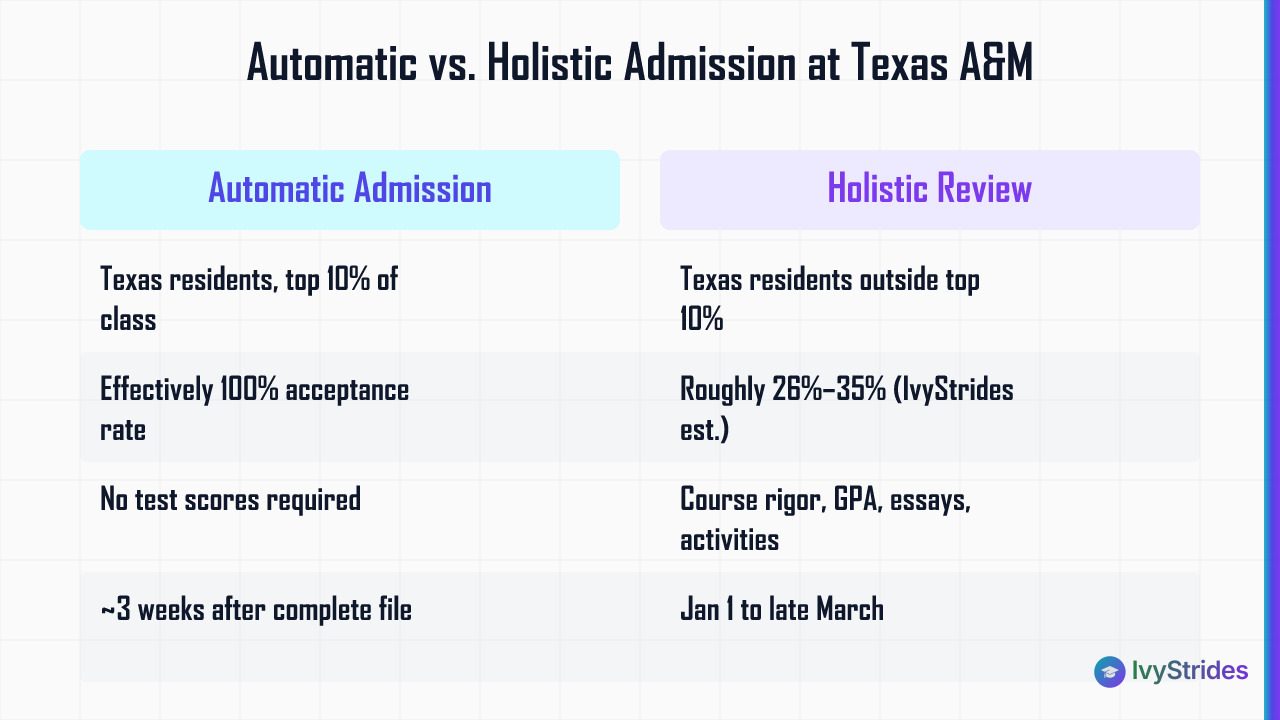
Texas A&M averages together two admission pathways that do not resemble each other. The top-10% rule guarantees admission to College Station for any Texas resident graduating in the top decile of their high school class, regardless of test scores. Everyone else enters holistic review.
Holistic review is the file-by-file track. TAMU evaluates course rigor, GPA, class rank, activities, and essays one applicant at a time. It runs meaningfully more selective than the headline suggests, because automatic admits fill a large share of the class before admissions officers weigh holistic files. TAMU does not publish a separate holistic-review admit rate, so there is no figure to quote for it; plan against the published overall rate and the rank rule instead.
Check the current year. Texas A&M's Common Data Set puts the fall 2025 rate at 51.7%, and the rate moves from year to year, so plan against the current year's Common Data Set rather than an older number.
| Applicant Track | Who Qualifies | Approximate Rate | Decision Timeline |
| Automatic admission | Texas residents, top 10% | Effectively 100% | ~3 weeks after complete file |
| Holistic (in-state) | Texas residents outside top 10% | Not published by TAMU | Jan 1 to late March |
| Holistic (out-of-state) | All non-Texas applicants | Lower than 52% | Jan 1 to late March |
If you want the fuller picture of how selective schools weigh a whole file, our post on what do colleges look for in students expands on the criteria beyond grades.
Texas A&M Acceptance Rate by Residency and Major
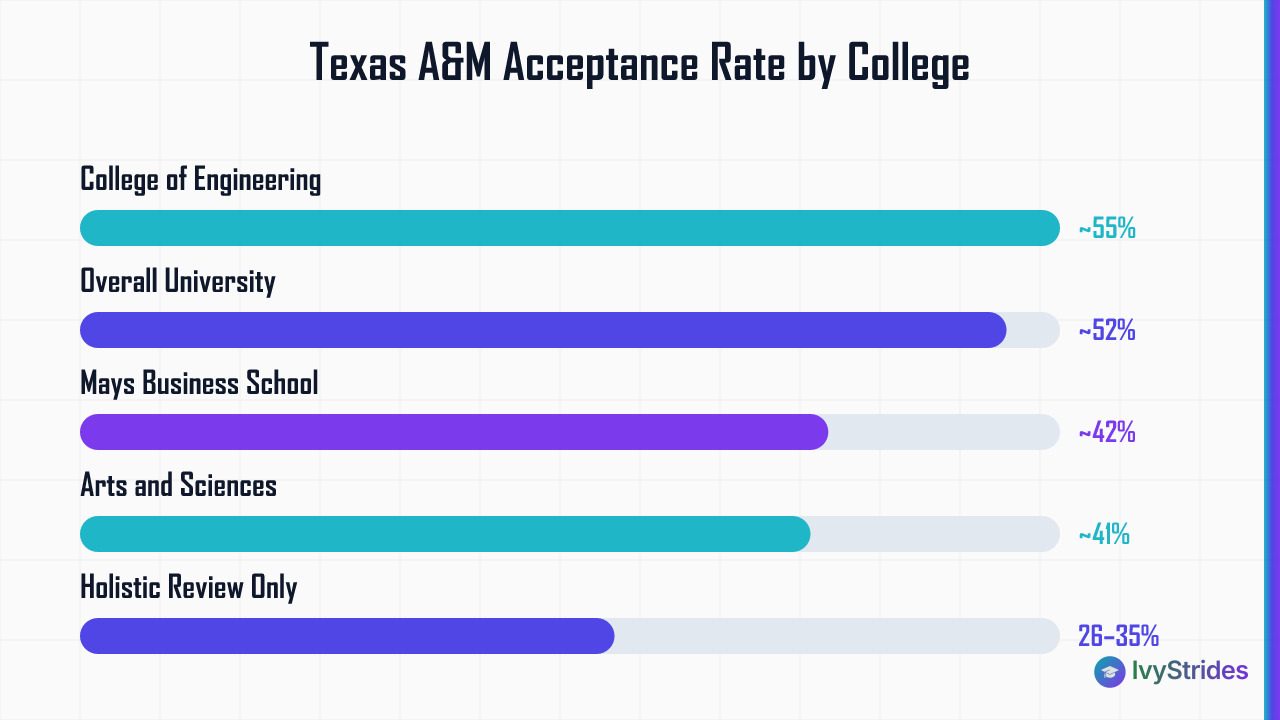
Class rank sets one door; residency sets how many doors you have. Texas A&M's acceptance rate by major and residency shifts your odds well away from the 52% average. No automatic-admission pathway exists for out-of-state applicants. Every non-Texas resident enters holistic review only, which makes the out-of-state pool the more competitive one. In-state applicants get two doors; out-of-state applicants get one.
Every figure cited here comes from TAMU's publicly available Common Data Set, the same document admissions offices use to report their own statistics. For comparison, UT Austin's overall acceptance rate sits around 22%, making TAMU meaningfully more accessible for students who fall outside the top 10% of their class. You can read our full breakdown of the UT Austin acceptance rate for the head-to-head.
Acceptance rate by major matters too. TAMU does not publish official per-college rates, but institutional data circulating through aggregated sources points to real spread across programs. Treat these as approximate.
| College / School | Approximate Rate | Notes |
| College of Engineering | About 55% | High volume; restricted-enrollment majors |
| Mays Business School | About 42% | Competitive; second-choice major matters |
| Arts and Sciences | About 41% | Directional institutional figure |
| Overall university | 51.7% | TAMU Common Data Set, fall 2025 |
| Holistic review only | Not published by TAMU | IvyStrides estimate |
TAMU considers applicants for their first and second choice majors in College Station before any alternative pathway, so a strong second choice is a real hedge if your first is a restricted-enrollment program. Want to check these numbers yourself? Our guide to the Common Data Set explained walks through how to read each section.
What Texas A&M's Holistic Review Actually Weighs Beyond Class Rank
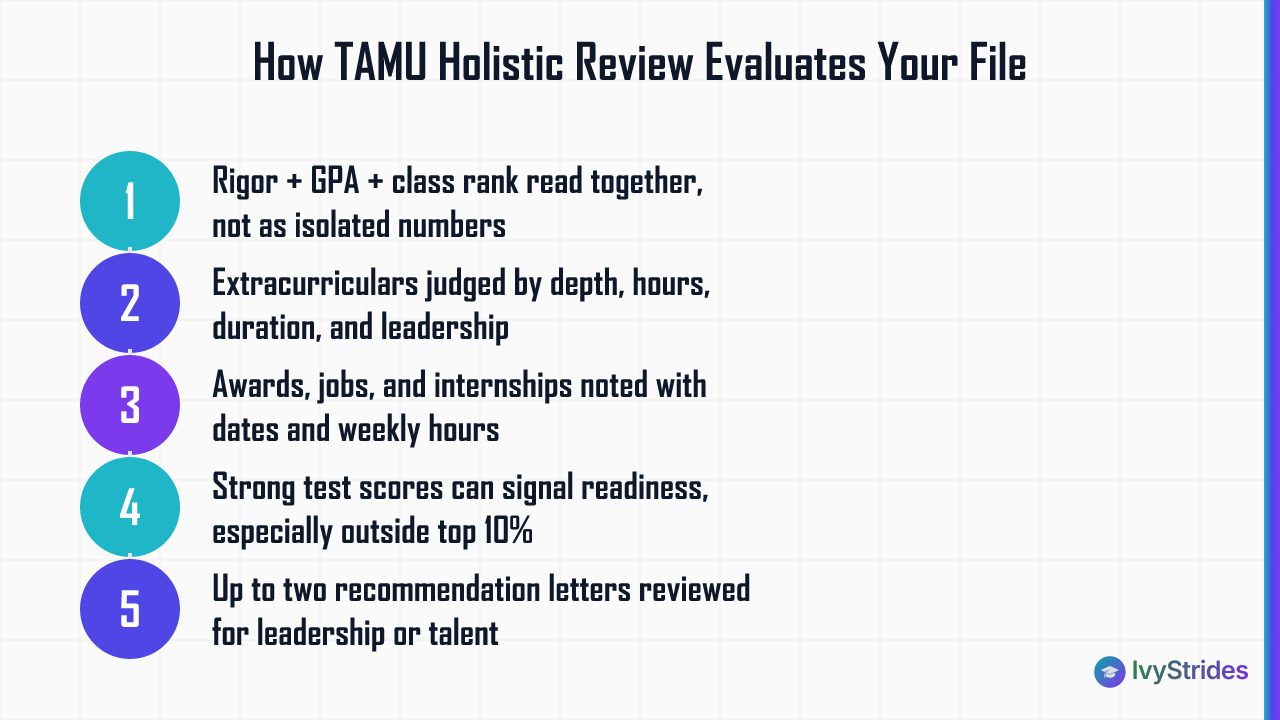
Those major-level rates all sit inside holistic review, so what does that review actually measure? Texas A&M rates five factors "Very Important" in its 2025-26 Common Data Set, section C7: rigor of secondary school record, class rank, academic GPA, extracurricular activities, and talent/ability. That same document lists interview, alumni relation, and religious affiliation as Not Considered. So no, an interview will not move your file.
Grades read in context. On the academic side, reviewers read every high school course you attempted and the grade you earned, alongside course rigor, GPA, and class rank. A single GPA number is not the whole story. A rigorous transcript with a slightly lower GPA can read stronger than an easy transcript with a higher one.
TAMU says depth beats breadth plainly. Its own college readiness guidance favors major impact in a few organizations over light involvement in many. Reviewers note time commitment and duration for activities, leadership or exceptional talent, awards, and jobs or internships with dates and weekly hours, per the undergraduate catalog. Our post on how to write strong activities list descriptions shows how to translate that into the application.
TAMU is test-optional for fall 2027 entry, but submitting a strong SAT or ACT score can still signal academic readiness in holistic review, particularly for applicants outside the top 10%. TAMU states that submitting gives no unfair advantage or disadvantage, and it does not penalize low or missing scores. In our coaching, applicants outside the top 10% who submit strong scores in a test-optional cycle tend to strengthen their file, especially when course rigor is already high.
Texas A&M Holistic Review Checklist: What Reviewers Look For
| Factor | What TAMU Reviewers Note |
| Course rigor | Every course attempted and grade earned |
| Class rank | Numeric rank; top-10% verified separately |
| Academic GPA | Read in context of rigor, not alone |
| Extracurriculars | Time commitment, duration, weekly hours |
| Leadership | Roles, initiative, exceptional talent |
| Awards and work | Jobs and internships with dates and hours |
| Context factors | Family background, household income and size |
| Recommendation letters | Optional; only the first two received count |
Recommendation letters stay optional at TAMU, and only the first two received count. The most useful ones speak to leadership, exceptional talent, or special circumstances. If you want a second read on which gaps in your profile to close first, our college admissions counseling team maps a full application against a specific school's criteria.
How to Apply to Texas A&M: Platforms, Deadlines, and the STARS Transcript
Knowing what the review weighs only helps if you clear the logistics that gate it. Texas A&M accepts applications through Common App or ApplyTexas, one application per student, and the platform does not affect the decision. ApplyTexas applicants also complete a separate Extracurricular Activities Form. Either door assembles the same holistic file, so pick whichever platform you already use for other schools.
Two deadlines, not one. Applications open August 1 and close December 1, 2026, with supporting documents due December 15, 2026, for fall 2027 entry. If you submit test scores, TAMU's College Readiness FAQ accepts December scores received by the December 15 document deadline. TAMU uses rolling admissions: decisions start in late September, top-10% applicants usually hear within about three weeks of a complete file, and most holistic-review applicants hear between January 1 and late March. TAMU keeps no waitlist, per CDS C2.
Budget time for STARS. The STARS self-reported transcript is required for all freshman applicants except GED graduates, takes 2 to 6 hours to complete, and you must submit and link it to your application by December 15. Top-10% applicants must also verify rank with an official transcript showing a numeric rank. Do not leave this for the last week; it runs longer than most students expect.
| Milestone | Date | Notes |
| Applications open | August 1, 2026 | Common App or ApplyTexas |
| Application deadline | December 1, 2026 | Same for both tracks |
| Documents and STARS due | December 15, 2026 | STARS takes 2 to 6 hours |
| Score deadline | December 15, 2026 | Per Readiness FAQ; optional |
| Decisions begin | Late September 2026 | Rolling |
| Top-10% decisions | ~3 weeks after complete file | Fastest track |
| Holistic decisions | Jan 1 to late March 2027 | No waitlist |
The 750-word Essay Topic A is the single longest piece of writing in the TAMU application and the clearest place to show reviewers something the transcript cannot. It asks you to tell your story: the unique opportunities or challenges during high school that shaped who you are. Alongside it sit one required 250-word answer about a life event that prepared you for college, and four 100-word answers on your life goals, your major, why Texas A&M, and your plans beyond the bachelor's degree.
TAMU's essay advice is specific. Build the response around one specific instance, explain how it changed you, write in your own voice, and do not repeat what already appears elsewhere in the application. Students who treat Essay Topic A as a narrative about a single defining moment, rather than a summary of achievements, consistently produce more compelling drafts in our essay coaching work. A résumé is optional and belongs only if the application runs out of space.
For the full multi-school view, see our college application timeline 2026-27. If the essay is where you feel least sure, our admissions essay coaching works line by line on Essay Topic A and the four short answers.
FAQ: Texas A&M Acceptance Rate and Admissions
What GPA do you need to get into Texas A&M?
TAMU does not publish a minimum GPA cutoff. In holistic review, reviewers read every course you attempted and the grade you earned alongside course rigor and class rank, so a strong GPA in a rigorous load matters more than any single number. TAMU admits top-10% Texas residents automatically, regardless of GPA.
Is a 1300 a good SAT score for A&M?
TAMU is test-optional for fall 2027 entry, so a 1300 will not disqualify you. If you submit, admissions officers consider scores alongside your full file. For holistic-review applicants, a score below the school's mid-50% range may be better left unsubmitted, while a score at or above the 75th percentile adds a positive data point.
Is A&M harder to get into than UT?
By overall acceptance rate, TAMU (about 52%) is more accessible than UT Austin (about 22%). But TAMU's top-10% automatic admission inflates that headline. For students outside the top 10% going through holistic review, the effective rate at TAMU runs meaningfully lower than 52%.
Is A&M a top 20 college?
Texas A&M consistently ranks in the top 60 to 70 nationally in US News and is a top-tier public research university. It is not typically listed in the overall top 20, but it ranks highly for specific programs including engineering, agriculture, and veterinary medicine.
Your Next Step Toward a Texas A&M Application
Where you stand at TAMU comes down to one question first: are you a top-10% Texas resident, or a holistic-review applicant? Everything else follows from that answer, and the December 1, 2026 deadline sets the clock.
- Confirm your class rank against the top-10% threshold, and if you are close, verify your numeric rank early.
- Decide whether to submit SAT or ACT scores; test-optional is confirmed for fall 2027, but verify future cycles at admissions.tamu.edu.
- Start STARS well before December 15; it takes 2 to 6 hours.
- Draft the 750-word Essay Topic A around one specific moment, in your own voice.

Hemant is a seasoned entrepreneur, investor, and growth strategist with deep ground in education and technology-driven learning. His core training is in Mathematics and Physics — he authored Physics for IB Diploma: Ultimate Revision Guide, recognized as a top student resource.