
College Application Help for International Students: What a US Admissions Counselor Does
On this page
- Is It Harder for International Students to Get Into US Colleges?
- What a US Admissions Counselor Does for International Applicants
- How an Admissions Counselor Helps International Students Write the College Essay
- How a Balanced College List Changes When You Apply from Abroad
- FAQ: College Application Help for International Students
- Can you hire someone to help with a college application?
- Is it harder for international students to get into US colleges?
- How do international students apply to US colleges?
- Does FAFSA help international students pay for US college?
- Your Next Step on International College Applications
Yes, you can hire a US admissions counselor to help with a college application. A US admissions counselor is a private advisor who sets realistic score targets, helps you translate a non-US academic story into the Common App personal statement, builds a college list around each school's aid policy for students from abroad, and manages the whole application timeline.
Those four tasks weigh more for an applicant abroad, where a school counselor may never have sent a student to an American university. This page explains what the role involves, where international applicants lose ground, and what to do next.
Is It Harder for International Students to Get Into US Colleges?
At some selective US colleges, yes, and each college's own published figures show where. MIT's statistics for the Class of 2029 show 136 of 6,926 international applicants admitted, against 1,198 of 22,355 US citizens and permanent residents. Harvard, by contrast, considers all students in the same pool regardless of citizenship, with no quotas. Selective colleges use holistic review, weighing grades, rigor, essays, activities and scores together, so no single number decides the outcome.
| College | What its own pages say about international applicants |
| Harvard | One pool for all places, no quotas by citizenship, and decisions made without regard to an aid application |
| Princeton | Every application reviewed the same way, regardless of citizenship; admission is need-blind |
| Cornell | Need-aware for international students: need for aid is one factor among many |
| Northwestern | Need-aware for international students: an aid request may factor into the decision |
Score benchmarks work as a range, not a cutoff. A college's Common Data Set reports the SAT and ACT 25th-75th percentile range of enrolled first-year students who sent a score; those ranges describe enrolled students, not admitted ones, and shift year to year.
Transcript evaluation works differently than you expect. Princeton, for example, evaluates your academic record within the context of your educational system and school curriculum, so your grades go in as your school issued them rather than converted to a US grade point average.
Test-optional policies vary by school and year, so check the FairTest tracker and the college's own admissions page before you assume a test is skippable. If the Ivy League is on your list, run the same checks school by school, because each Ivy sets its own testing and aid policies for international applicants.
What a US Admissions Counselor Does for International Applicants
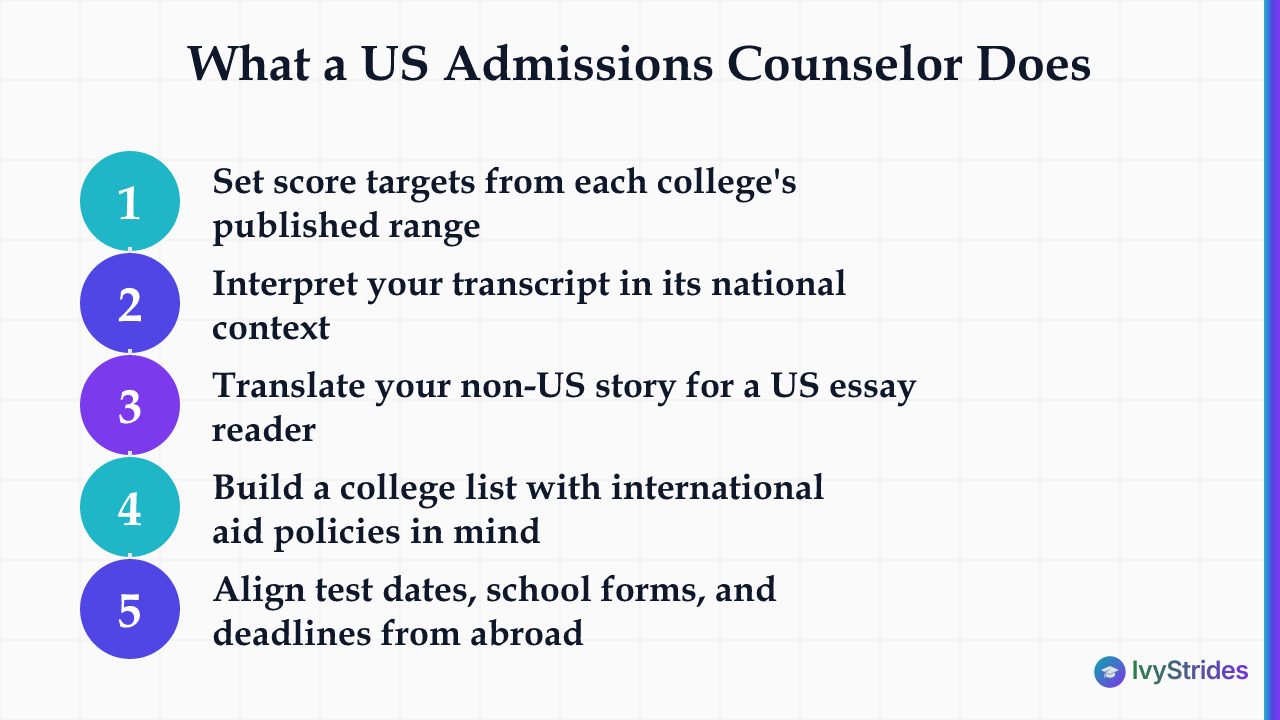
A US admissions counselor delivers four concrete things for an international applicant: score target setting, transcript and context interpretation, essay strategy, and a balanced college list. Each one answers a gap that opens when your school has no counselor with US admissions experience.
The school-counselor gap is the sharpest part. If no one at your school has sent a student to a US university, you face a specific Common App hurdle: naming a school report contact when your school has no US-experienced counselor. A counselor helps you settle that early instead of leaving the section half-finished.
One plan, not six services. IvyStrides college admissions counseling for grades 9 through 12 runs on one month-by-month plan, from the summer before grade 9 to the deposit deadline: a counselor plans courses, activities, testing, the college list and the essays, and test prep plugs in where the plan needs it. Students who start in grade 11 or 12 join a program built for the application years. No counselor can promise admission; outcomes depend on the full application and the pool in a given year.
| Deliverable | Why it matters from abroad |
| Score target setting | A target set from each college's published range tells you how much testing time to plan |
| Transcript interpretation | Your grades must read correctly in their own national context |
| Essay context translation | A non-US story has to land with a US reader |
| Supplemental essay strategy | Each school asks different, school-specific prompts |
| College list building | Aid policy for international students differs from college to college |
| Application timeline | Test dates, school forms and each deadline have to line up from abroad |
Setting a score target comes first. If a test-required school sits on your list, knowing the realistic target early tells you whether the SAT or ACT needs serious prep time before your first sitting, or whether a test-optional path fits your profile better.
How an Admissions Counselor Helps International Students Write the College Essay

Photo by Kaboompics.com on Pexels
An admissions counselor helps international students shape a non-US story into the Common App personal statement without flattening the voice that makes it theirs. The personal statement has a 650-word maximum, and the seven prompts are unchanged for 2026-27 and identical for every applicant worldwide. What differs for international students is translation.
A reader in an American admissions office may not know your national exam system, your school's ranking conventions, or the social weight of a choice you describe. Essay context translation means making that legible without turning your essay into a glossary.
Daily SAT and ACT prep on YouTube: short strategy videos from IvyStrides. Subscribe to IvyStrides on YouTube.
Translation, not simplification. The goal is never to Americanize the story; it is to supply the two or three lines of context a US reader needs, then get out of the way.
IvyStrides essay coaching is one-on-one: a coach works with the student from the first brainstorm to the final draft, the student writes each draft, and the coach reads every one. Before any of that, it helps to know how to answer each of the seven Common App prompts so you pick the one your story actually fits.
| Challenge | What it looks like in a draft | What a counselor does about it |
| Unfamiliar school system | Jargon and exam names with no context | Asks for a short bridge a US reader can follow |
| Over-explained culture | Half the essay spent defining background | Points to the moment that carries the story |
| Lost voice in translation | Stiff, formal English that hides the student | Asks for the student's own phrasing and specifics |
| Generic "diversity" framing | Nationality stated, not shown | Pushes for one concrete scene |
| Prompt mismatch | Strong story, wrong prompt | Matches the story to the prompt it fits |
Supplemental essays raise the stakes again, since each school asks its own prompts and word limits. A counselor keeps your core narrative consistent across them while answering what each college actually asked.
How a Balanced College List Changes When You Apply from Abroad

Photo by Andrea Piacquadio on Pexels
A balanced college list built from abroad looks different from one built in the US: test-optional policies, need-blind versus need-aware financial aid for international students, and the international applicant pool all shift which schools belong in each tier. The reach, target and likely labels still apply, but the inputs behind them change, and a list that ignores aid and testing policy is not actually balanced.
Financial aid is the factor to check first. Harvard and Princeton decide without regard to an aid request, even from an international applicant; Cornell and Northwestern are need-aware for international students, so they can weigh it, which reshapes your tiers directly. US federal aid is off the table: it requires US citizenship or eligible noncitizen status, and students on an F-1, F-2, M-1, J-1 or J-2 visa cannot receive federal student aid. College aid for international students follows each college's own policy, so research it school by school.
| Factor | How it affects domestic applicants | How it affects international applicants |
| Financial aid | Federal aid through the FAFSA, plus each college's own aid | No federal aid; only each college's own aid, need-blind at some colleges and need-aware at others |
| Test policy | Set by each college for each cycle | The same check, plus test dates and centers abroad to plan around |
| Deadlines | Common App: 11:59 pm in the applicant's local time zone | The same rule: 11:59 pm your time, not the college's |
Timing is the quiet third factor. On the Common App, a deadline means 11:59 pm in your local time zone, not the college's, so plan backward from your own clock and leave a margin for school forms sent from abroad. List size follows from access, not ambition: the right number depends on how many colleges stay genuinely reachable from abroad once aid and testing policy filter the field.
FAQ: College Application Help for International Students
Can you hire someone to help with a college application?
Yes. Independent college admissions counselors work privately with students on college lists, essays, and application strategy. For international applicants, the help that matters most covers score targets, essay context translation, and a list built around each college's aid policy for students from abroad. A counselor cannot promise admission; the full application and the year's pool decide that.
Is it harder for international students to get into US colleges?
At some selective colleges, yes. MIT admitted 136 of 6,926 international applicants for the Class of 2029, against 1,198 of 22,355 US citizens and permanent residents. Harvard considers everyone in one pool, while at need-aware colleges such as Cornell and Northwestern an international student's aid request can factor into the decision.
How do international students apply to US colleges?
Many international students apply through the Common App, which serves over 1,200 member colleges and lets you add up to 20 of them. It asks for a personal statement of up to 650 words, supplemental essays, transcripts, test scores where a college requires them, and recommendation letters. Each deadline closes at 11:59 pm your local time.
Does FAFSA help international students pay for US college?
No. Federal student aid requires US citizenship or eligible noncitizen status, and students on F-1, F-2, M-1, J-1 or J-2 visas do not qualify. For aid from the college itself, check each college's aid page for whether it is need-blind or need-aware for students from abroad.
Your Next Step on International College Applications
Your next step is a short audit of four things: your score target, your transcript's context, your essay and your college list. Those are the four gaps a US admissions counselor works on, and if your school has no US-experienced counselor, they are where the process feels like a black box.
Start here:
- Pull two or three target colleges' Common Data Set score ranges and current test policy.
- Check each school's international aid page for need-blind or need-aware status.
- Note your earliest application deadline in your own time zone, not US time.
- Draft one Common App prompt response and read it as a US reader who does not know your school, the way an online essay review from outside the US reads it.
College admissions insights on LinkedIn: follow IvyStrides for application guidance and counseling updates.

Rajesh is a technology leader, entrepreneur, and angel investor with 28+ years in Business & Technology Leadership and Product & Solution Engineering. He is passionate about education, mentoring, and driving digital transformation.