
UT Austin Acceptance Rate: 22% Overall, 36% In State, 7.5% Out

On this page
- What the UT Austin Acceptance Rate Looks Like by Residency and Major
- UT Austin SAT and GPA Requirements: What the Admitted Class Looks Like
- How UT Austin Holistic Review Actually Works
- How to Build a UT Austin Application That Competes in Holistic Review
- FAQ: UT Austin Acceptance Rate, GPA, and Scores
- What GPA do you need to get into UT Austin?
- Is 1440 a good SAT score for UT Austin?
- Is UT Austin a new ivy?
- Why is it so hard to get into UT Austin?
- Your Next Step on the UT Austin Acceptance Rate
UT Austin's undergraduate acceptance rate is roughly 22% overall. The University of Texas at Austin is a test-required flagship for fall 2027 entry: Texas residents are admitted at about 36%, boosted by top-5% automatic admission, while out-of-state applicants face closer to 7.5%.
That out-of-state figure is not a number UT publishes on its own. It follows from two facts UT does publish: an overall rate around 22% and a state law reserving 90% of seats for Texas residents. IvyStrides derives the out-of-state estimate from those inputs.
What the UT Austin Acceptance Rate Looks Like by Residency and Major
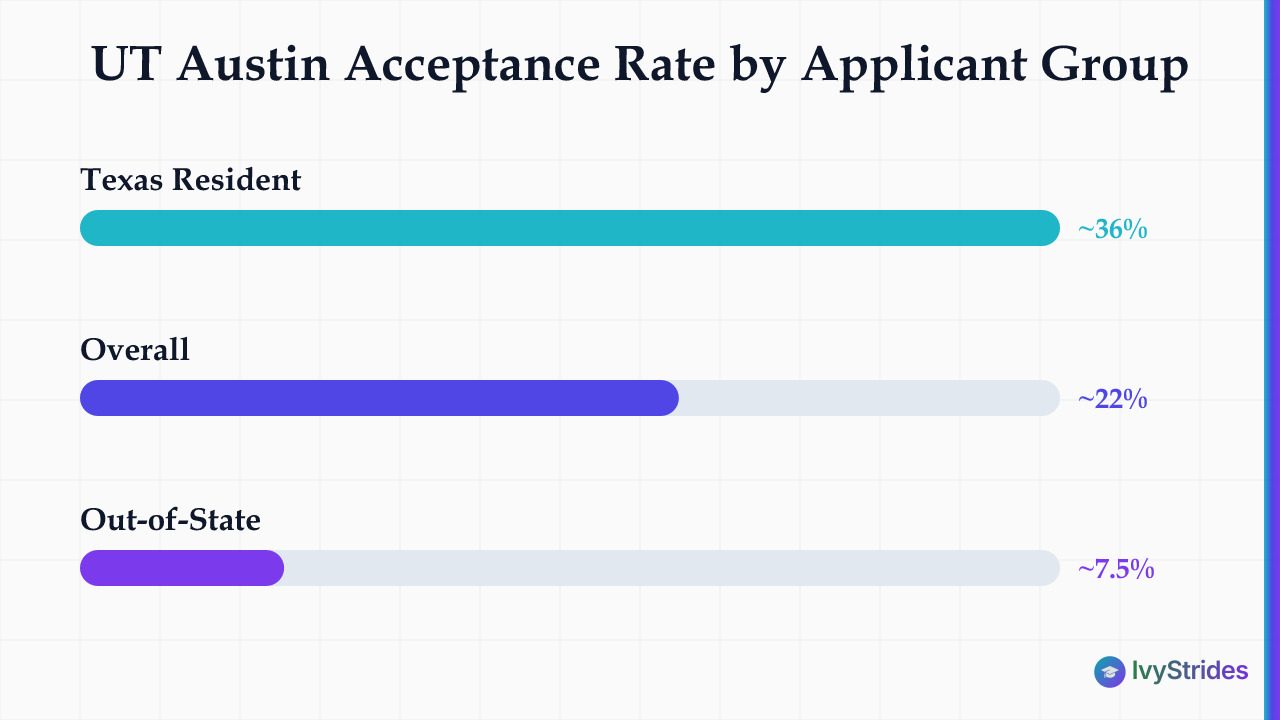
UT Austin acceptance rate splits sharply by residency: about 22% overall, roughly 36% in-state, and near 7.5% out of state. The University of Texas at Austin admits most of its in-state class through Texas automatic admission before holistic review begins, which is why a Texas resident and an out-of-state applicant with identical files can see completely different odds.
Two structural rules drive the gap. First, state law caps non-resident enrollment, so roughly 90% of seats go to Texas residents. Second, UT grants automatic admission to Texas students in the top 5% of their graduating class for summer and fall 2026 and 2027 entry, per UT's Review and Decision Process. That fills a large block of in-state seats first.
Major choice moves the odds too. UT names "competitiveness of the major" as a review factor, so an engineering or computer science applicant competes in a tighter pool than a liberal arts applicant with the same scores. Your first-choice major is part of the decision itself.
| Applicant Group | Approximate Acceptance Rate | Key Driver |
| Overall | ~22% | Published federal baseline |
| Texas resident | ~36% | Automatic admission for top 5% |
| Out-of-state | ~7.5% | 90% resident cap (IvyStrides) |
| High-competition major | Below group rate | Major competitiveness a named factor |
| Auto-admit (top 5%) | Guaranteed admission | State automatic-admission law |
Timing is the last variable, and it is not a lever. UT Austin's Early Action round carries no review advantage and is non-binding, so the decision to apply early is purely a timeline choice, not a strategic lever. Early Action closes Oct 15 with materials due Oct 22 and a decision or deferral by Jan 15, 2027; Regular Decision closes Dec 1 with materials due Dec 10 and decisions by Feb 15, 2027. For context on what selective schools weigh, see what do colleges look for in students.
UT Austin SAT and GPA Requirements: What the Admitted Class Looks Like
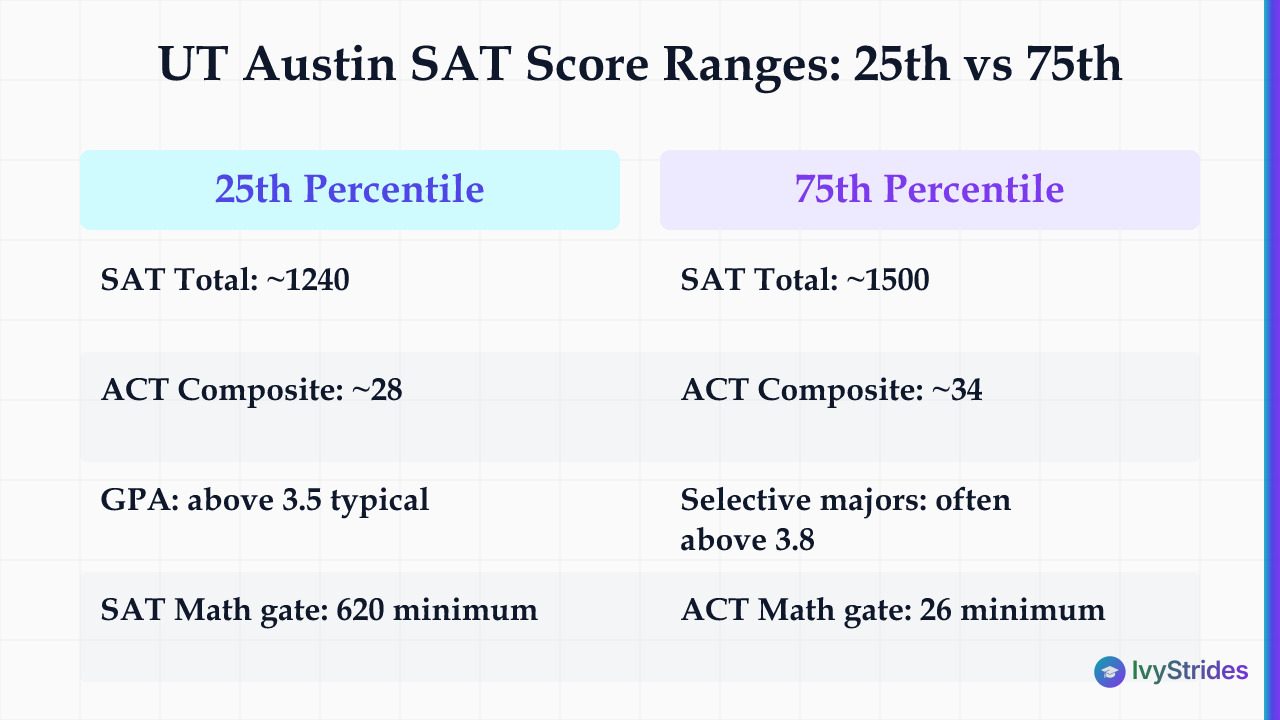
UT Austin is test-required for fall 2027, and admitted students typically score in the mid-1300s to mid-1400s on the SAT. The University of Texas at Austin wants at least one official SAT or ACT score sent straight from the testing agency, using SAT code 6882 or ACT code 4240, per its freshman admissions page. Official scores are due Oct 22 for Early Action and Dec 10 for Regular Decision.
That test-required status is the sharp break from many peers, and it changes your planning. Because UT Austin is test-required and sets a calculus-readiness gate of SAT Math 620 or ACT Math 26 for engineering and CS majors, your score target is not just about competitiveness, it is about eligibility.
| Metric | 25th Percentile | 75th Percentile | Notes |
| SAT total | ~1240 | ~1500 | Per NCES, recent collection |
| ACT composite | ~28 | ~34 | Scored on English, Math, Reading |
| SAT Math (gated majors) | 620 minimum | , | Eligibility gate, not a target |
| Unweighted GPA | Above 3.5 typical | , | UT publishes no minimum cutoff |
The calculus-readiness gate is the surprise. In our coaching with students applying to UT Austin, this is the most common eligibility miss: a student targeting Cockrell Engineering with a strong overall SAT but a Math section below 620 is not considered for that major regardless of other factors.
UT's high school prerequisites page lists the gate for all Cockrell Engineering majors, all Jackson Geosciences majors, both Environmental Science majors, and Computer Science plus its combined CS majors. Any one of these clears it: SAT Math 620+, ACT Math 26+, AP Calculus AB or BC 3+, or IB HL Math 4+.
GPA context. UT publishes no minimum GPA. Admitted students in holistic review typically carry unweighted GPAs above 3.5, and applicants to selective majors often sit above 3.8. For Texas students, class rank does more work than raw GPA, since the top 5% clears the automatic bar outright. To compare this range against other schools on your list, our breakdown of SAT score ranges for top colleges is a useful cross-check. Score planning tied to a specific major is what our college admissions counseling handles.
How UT Austin Holistic Review Actually Works
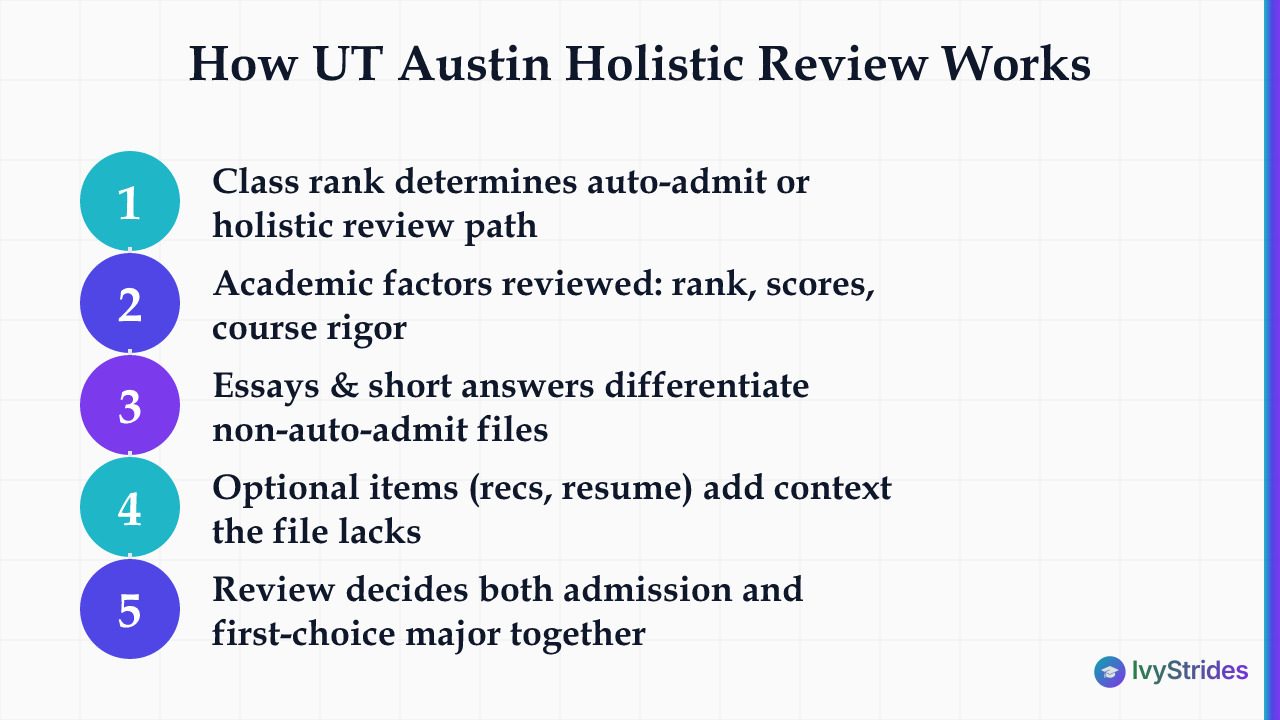
UT Austin holistic review weighs class rank, academic background, test scores, essays, short answers, activities, and major competitiveness together, with no single factor guaranteeing admission except Texas automatic admission. The University of Texas at Austin gives every freshman file an individualized read that decides both admission and the major, per its Review and Decision Process.
That last point, the major, connects straight to the competitiveness factor above: for non-auto-admit files, the review decides admission and major together, and for auto-admit files it decides only the major. The 2026-27 catalog adds special circumstances that put achievements in context: socioeconomic status, growing up in a single-parent home, family responsibilities, and overcoming adversity.
Essays are where you differentiate. The open-topic essay (500-650 words, satisfiable by the Common App personal statement) and the two required short answers are the primary places where non-auto-admit applicants can differentiate themselves in holistic review. UT reviews only what it requires and will not read your other Common App essays.
UT Austin Application Checklist: What Holistic Review Weighs
| Item | Required or Optional | Word or Format Limit |
| Open-topic essay | Required | 500-650 words |
| Short answer: first-choice major | Required | ~250-300 words / 40 lines |
| Short answer: proudest activity | Required | ~250-300 words / 40 lines |
| Third short answer | Optional | ~250-300 words / 40 lines |
| Letters of recommendation | Optional | Up to two, not from family |
| Resume | Optional (freshmen) | Hours/week, weeks/year |
| Test scores | Required | SAT 6882 / ACT 4240 |
| Class rank | Reviewed | From transcript |
Required short answer one asks why you are interested in your first-choice major. Required short answer two asks which activity you are most proud of, and UT counts a club, volunteering, a job, or a family responsibility. In our coaching, students who treat these as mini-essays and include specific hours-per-week figures and concrete activity detail consistently produce stronger files than those who write general descriptions. For the tactical framework on these prompts, see how to write supplemental essays.
Optional letters, used well, add something the file lacks. UT wants information the rest of the application does not show: leadership, persistence through challenges, and preparation for your first-choice major, and it encourages writers from outside your high school. This is the controllable ground our college admissions essay coaching works on.
How to Build a UT Austin Application That Competes in Holistic Review
A competitive UT Austin application clears the score gate for your major, names a first-choice major aligned with genuine interest, and answers the short answers with specific detail. The University of Texas at Austin builds every non-auto-admit decision from the full file, so no single number carries it, and no single number sinks it either.
Because holistic review weighs everything together, the work splits into a few concrete moves. UT tells students to pick a first-choice major aligned with their interests and strengths, not just a hoped-for career, and notes that a major won't necessarily decide a later career.
-
Set your score target by major. Aim for a broadly competitive SAT, and if you are applying to a calculus-gated major, treat SAT Math 620 or ACT Math 26 as a hard eligibility line, not a nice-to-have. Our 1-on-1 SAT prep closes that specific Math-section gap.
-
Choose your first-choice major honestly. It drives the competitiveness factor and, for some units, whether you are read at all.
-
Write short answers with detail. Name the activity, the hours per week, and the weeks per year. General descriptions read as filler.
-
Build the optional resume if it adds facts. UT says format and length have no effect on review, and you may list family responsibilities.
-
Line up optional letters early. Writers outside your high school are encouraged, and some honors programs require a teacher letter, with Turing and CNS Honors asking specifically for a math or science teacher.
One caveat holds through all of it: admission depends on the full application, not any single factor, and test-required policies can change by cycle, so confirm current rules before you submit. For grade-aware planning across scores, majors, and essays, our college counseling for grades 11 and 12 maps the whole sequence to the December 1 deadline.
FAQ: UT Austin Acceptance Rate, GPA, and Scores
What GPA do you need to get into UT Austin?
UT Austin does not publish a minimum GPA cutoff. Admitted students in holistic review typically carry unweighted GPAs above 3.5, and competitive applicants for selective majors like engineering and CS often sit above 3.8. Class rank matters more than GPA alone: Texas students in the top 5% of their class receive automatic admission regardless of GPA.
Is 1440 a good SAT score for UT Austin?
A 1440 SAT is competitive for most UT Austin majors and sits near the upper end of the admitted class range. For calculus-gated majors like engineering, CS, and geosciences, the threshold that matters is SAT Math 620 or higher, which a 1440 scorer almost certainly clears. A 1440 strengthens a holistic file; it does not guarantee admission.
Is UT Austin a new ivy?
UT Austin is not an Ivy League school and is not formally part of any designation. It is a flagship public research university ranked among the top schools nationally. Its out-of-state acceptance rate of roughly 7.5% makes it highly selective for non-Texas applicants, which is why the comparison comes up.
Why is it so hard to get into UT Austin?
Two structural factors drive the selectivity. State law requires about 90% of the class to be Texas residents, leaving roughly 10% of seats for everyone else. And automatic admission for the top 5% of Texas high school graduates fills a large share of in-state seats before holistic review begins, concentrating competition in the pool that remains.
Your Next Step on the UT Austin Acceptance Rate
The rate you actually face depends on where you sit: Texas resident or out-of-state, auto-admit or holistic, gated major or open one. Sort that first, then plan the file.
- Confirm which pathway applies: top 5% automatic admission, or holistic review.
- Check whether your first-choice major has a calculus-readiness gate.
- Set an SAT or ACT target, clearing SAT Math 620 if your major is gated.
- Draft the open-topic essay and both required short answers with concrete detail.
- Mark the deadlines: Oct 15 Early Action, Dec 1 Regular Decision.

Rajesh is a technology leader, entrepreneur, and angel investor with 28+ years in Business & Technology Leadership and Product & Solution Engineering. He is passionate about education, mentoring, and driving digital transformation.