
Is There a Dartmouth Acceptance Rate by Major? Why Majors Come Later
On this page
- Does Dartmouth Admit by Major? What the Published Data Actually Shows
- What Dartmouth Actually Weighs: The Eight Very Important Factors
- Dartmouth ED vs. RD: The One Rate Gap That Actually Matters
- What a Competitive Dartmouth File Looks Like Without a Major Shortcut
- FAQ: Dartmouth Admissions by Major
- What is the most popular major at Dartmouth?
- Does Dartmouth admit based on major?
- Can you get into Dartmouth with a 1440 SAT?
- Can I get into Dartmouth with a 3.5 GPA?
- Your Next Step on the Dartmouth Major Question
Dartmouth College does not publish acceptance rates by major. Its overall rate was 5.8% for the Class of 2030. For the previous class, the Class of 2029 that entered in fall 2025, its Common Data Set puts Early Decision at about 21.6%. Dartmouth uses holistic review and does not sort applicants by intended major at the point of admission.
Neither rate is broken out by major, and what Dartmouth's review weighs is the set of factors it rates Very Important in its Common Data Set. The major you list is not one of them. So if you plan to switch your intended field to game the system, spend that time on the eight factors below instead.
Does Dartmouth Admit by Major? What the Published Data Actually Shows
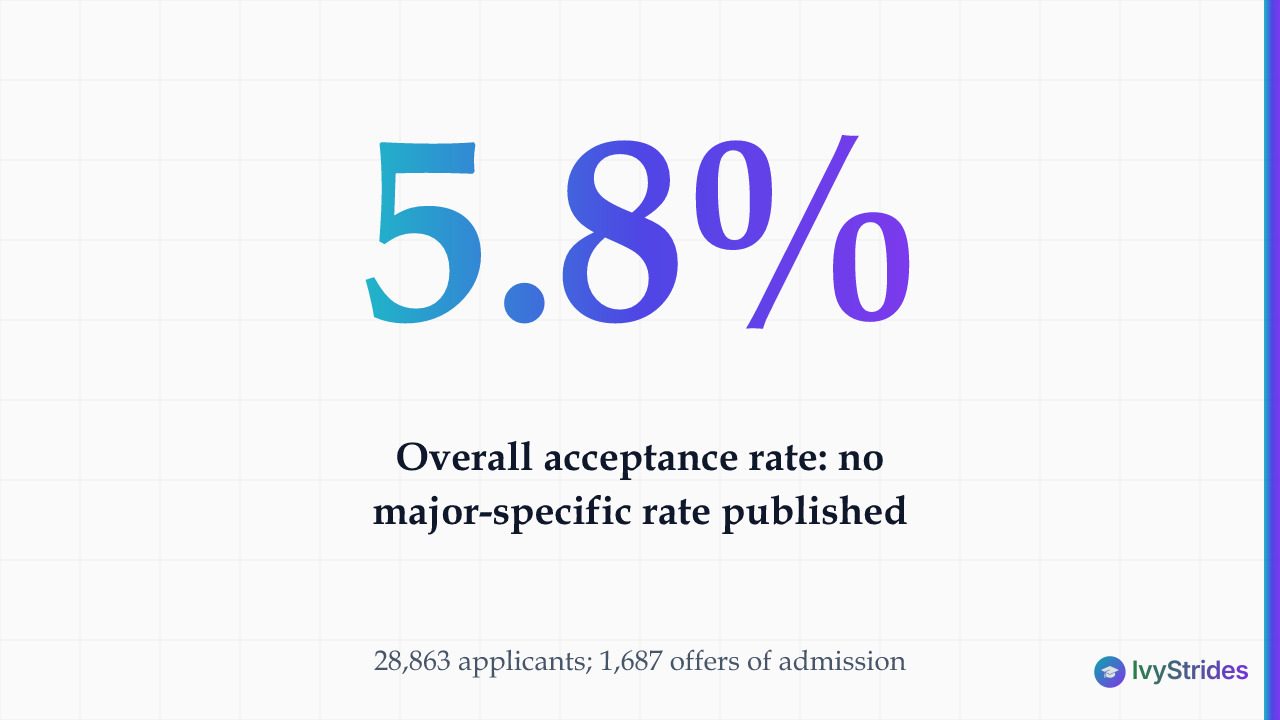
Dartmouth College does not admit by major, and it does not publish a major-specific acceptance rate. Its published admission figures cover the whole applicant pool, with Early Decision counts reported separately in its Common Data Set. For the Class of 2030, Dartmouth received 28,863 applications, the second-largest undergraduate applicant pool in Dartmouth's history, and issued 1,687 offers of admission, a 5.8% acceptance rate.
Why no department gate exists. Dartmouth puts the liberal arts at the core of its undergraduate program, admits each student to the College without a major designation, and does not require a declared major until sophomore year. The range of majors and minors is wide, but none of it works as a separate admissions track. Contrast that with universities that run college-by-college admission, where applying to engineering is a different decision than applying to arts and sciences. Dartmouth has no such split, even for engineering: Thayer School of Engineering has no direct application for high school students, who apply through Dartmouth Undergraduate Admissions.
That matters for how you read any rate you find online. When a page claims a "Dartmouth acceptance rate engineering" figure, that number is not one Dartmouth publishes. Dartmouth's Common Data Set reports applicant and admit counts for the whole first-year pool and for Early Decision. Nothing per major.
| Applicant Pool | Applicants | Acceptance Rate |
| Class of 2030 (all rounds, March 2026 release) | 28,863 | 5.8% |
| Early Decision (Fall 2025, CDS C21, Class of 2029) | 3,552 | approximately 21.6% |
Because the review reads the whole file rather than routing you through a department, the more useful question is whether Dartmouth fits what you want from college, not which major to list.
What Dartmouth Actually Weighs: The Eight Very Important Factors

Photo by https://kaboompics.com/ on Pexels
Dartmouth's holistic review rates eight factors "Very Important" in its Common Data Set 2025-26, section C7. These are the factors it weighs most, and intended major appears nowhere in the C7 list. Replace the major question with this list.
| Factor | What Dartmouth Looks For |
| Rigor of secondary school record | Most demanding curriculum your school offers |
| Class rank | Standing within your class |
| Academic GPA | Strong grades, read in school context |
| Standardized test scores | SAT or ACT, read against your school |
| Application essay | What no other applicant brings |
| Recommendations | Two teacher evaluations, a counselor evaluation, and a strongly encouraged peer recommendation |
| Extracurricular activities | How you spend your time outside class |
| Character and personal qualities | Qualities, experiences and point of view no other student duplicates |
Scores are required, and read in context. Dartmouth is test-required for fall 2027 applicants, with no preference between the SAT and ACT. Ivy League testing rules differ school by school: Princeton and Columbia, for example, remain test-optional for fall 2027 before requiring scores from fall 2028, so confirm each school's own policy before you build a list. Dartmouth states its own research found scores help it identify capable students from under-resourced schools, and it assesses every score against the local norms at the applicant's own high school.
The supplement is where fit shows. Dartmouth's writing supplement, updated July 22, 2026 for the Class of 2031, has three required responses: a why-Dartmouth answer in 100 words or fewer, then two answers of 250 words or fewer, one chosen from two prompts and one chosen from six. Confirm the exact prompt wording on the official page before you draft. The same discipline that makes a longer why-this-college essay show genuine fit applies in miniature here. The why-Dartmouth prompt asks which aspects of Dartmouth's academic program, community or campus environment attract you, so name specific ones rather than offering general praise.
Dartmouth also strongly encourages a peer recommendation from anyone not in a supervisory or oversight role in your life, invited through the Common App or Dartmouth's Application Portal. The two factors it rates "Not Considered" are state residency and religious affiliation/commitment. Admissions outcomes depend on the full file, not any single factor.
Asking about major-specific rates optimizes the wrong variable, which is why aligning course rigor, GPA trajectory, and essay framing against all eight factors is where the real work sits. On the Dartmouth acceptance rate by major question, IvyStrides counselors review your schedule, test score, and essay drafts against Dartmouth's eight Very Important factors and name the one component to fix before November 1.
Dartmouth ED vs. RD: The One Rate Gap That Actually Matters
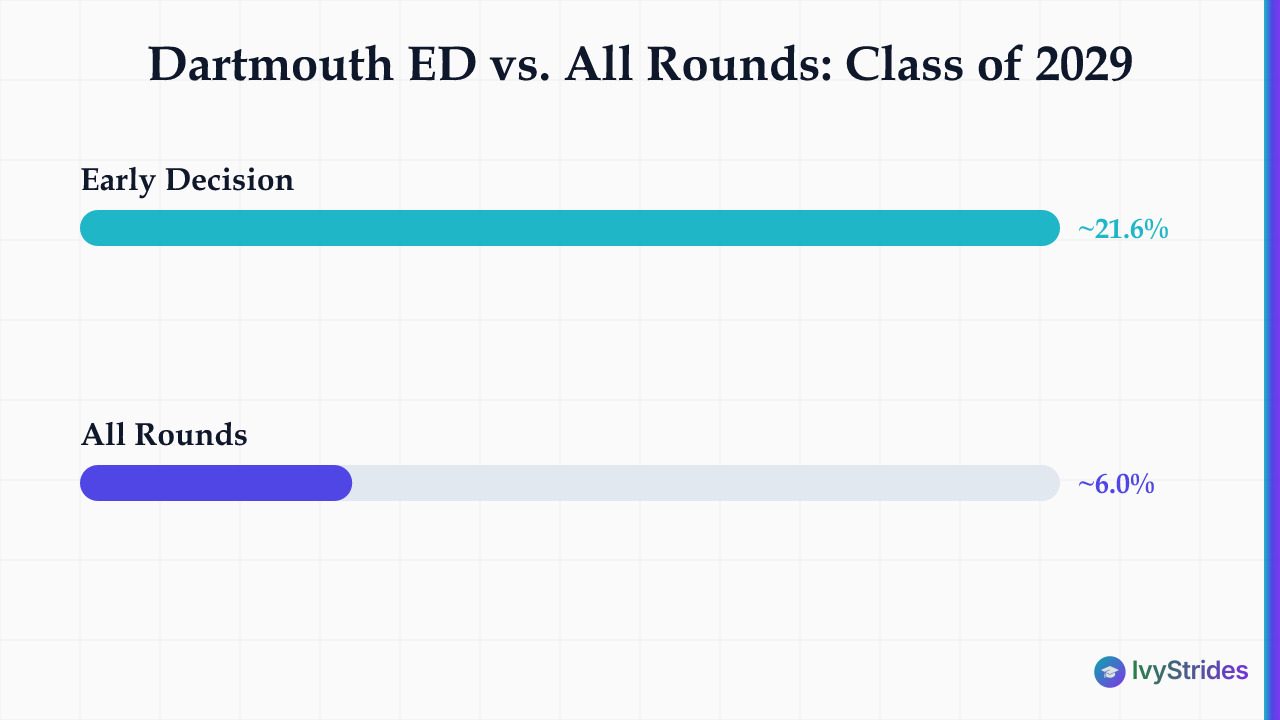
Your application round, not your major, is the choice where Dartmouth's published counts show a different admission rate. IvyStrides' analysis of Dartmouth's Fall 2025 CDS counts (Class of 2029), 768 admitted from 3,552 Early Decision applicants, puts the binding Early Decision acceptance rate at approximately 21.6%.
For the same class, the Common Data Set shows 1,699 admitted from 28,230 applicants across all rounds, about 6.0%. The higher Early Decision rate comes with a binding commitment. The same Very Important factors apply to your file in either round.
| Round | Applicants | Admitted | Acceptance Rate |
| Early Decision (Fall 2025, CDS C21, Class of 2029) | 3,552 | 768 | approximately 21.6% |
| All rounds (Fall 2025, CDS C1, Class of 2029) | 28,230 | 1,699 | about 6.0% |
ED is binding, with a November 1 deadline. Dartmouth's Early Decision deadline is November 1, with decisions by mid-December. If admitted, you withdraw other applications, though you may use other colleges' early plans that are neither binding nor restrictive. For families who need to compare aid offers, that commitment is the catch. Think hard about whether Early Decision is workable when you need financial aid before you commit.
The waitlist is large and uncertain. For Fall 2025, Dartmouth offered 2,497 applicants a waitlist place, and the CDS did not report how many it later admitted from that list.
Alumni interviews are optional, evaluative, and by invitation, and not having one does not hurt you. Students whose SAT or ACT is still below target face a genuine timing call, and applying Early Decision with a borderline test score is its own decision. Building the right file, from rigor to essay framing to ED timing, is the kind of multi-component planning that benefits from a structured counseling process starting no later than junior year.
What a Competitive Dartmouth File Looks Like Without a Major Shortcut
A competitive Dartmouth file reads deliberately across every Very Important factor, not as a bet on the "least competitive major." Dartmouth publishes no average GPA by major (its Common Data Set leaves the high school GPA sections blank), and its SAT range is reported for the entering class as a whole, not by major, so chase neither a per-major GPA nor a magic score. Chase the file.
Rigor first, judged against your school. Dartmouth looks for the most demanding curriculum available at your school, with grade trends that show direction over time. Dartmouth says its Admissions Committee takes the context of the school curriculum into consideration and reads each school profile to understand what your school offers.
| Factor | What Dartmouth Looks For | Common Gap |
| Course rigor | Hardest load your school offers | Dropping to easier classes senior year |
| Academic GPA | Strong grades and their trend over time | Flat or declining junior year |
| Standardized test scores | SAT or ACT, in school context | Submitting below a realistic target |
| Application essay | What no other applicant brings | Generic, resume-restating draft |
| Extracurricular activities | How you spend your time outside class | A long list with no depth |
| Character | Qualities and point of view no other student duplicates | No clear through-line |
The essay carries what numbers cannot. Dartmouth states it reads every application as a whole and that an application is more than its numbers, and it wants each admit to add something no other student brings. If you do name an intended major, Dartmouth's supplement has no why-major prompt, so let that interest show in your why-Dartmouth answer, drawing on the same intellectual history that goes into answering the "why this major" essay. And because Dartmouth rates extracurriculars Very Important, understanding what extracurricular depth looks like for Ivy review matters more than adding another club.
The aim is a file in which every Very Important factor is addressed on purpose, not left to chance.
FAQ: Dartmouth Admissions by Major
What is the most popular major at Dartmouth?
Dartmouth's current Common Data Set reports bachelor's degrees by broad field rather than by individual major, so it does not name a single most popular major. For degrees conferred between July 1, 2024 and June 30, 2025, the social sciences made up the largest share at 30%, followed by computer and information sciences at 10%. Students do not need to declare a major until sophomore year. The major you list at application does not determine admission.
Does Dartmouth admit based on major?
No. Dartmouth uses holistic review and does not route applicants through department-level admissions. Its published acceptance rate, 5.8% for the Class of 2030, covers the whole applicant pool rather than any one intended major. Students typically declare a major after enrolling, so the major on your application is not a sorting mechanism.
Can you get into Dartmouth with a 1440 SAT?
Dartmouth is test-required for fall 2027 applicants and reads scores against your school. Whether a 1440 is competitive at Dartmouth depends on the full file, including course rigor, GPA trend, essays, and recommendations. For reference, Dartmouth's Common Data Set 2025-26 puts the middle 50% SAT range of fall 2025 first-years who sent an SAT at 1440 to 1550, so a 1440 matches that group's 25th percentile.
Can I get into Dartmouth with a 3.5 GPA?
Dartmouth publishes no minimum GPA and does not admit by GPA alone. It looks for the most demanding curriculum your school offers and reads grade trends over time. A 3.5 in a rigorous load with an upward trend reads differently than a 3.5 in a lighter schedule. The full file, including essays and extracurriculars, determines competitiveness.
Your Next Step on the Dartmouth Major Question
Stop optimizing a variable that does not exist. Dartmouth admits one pool, not one per major, and the eight Very Important factors are where your effort belongs.
- Pull up your transcript and confirm you are taking the hardest load your school offers.
- Draft the 100-word why-Dartmouth response with one specific program or community detail.
- Decide, honestly, whether a binding November 1 Early Decision commitment fits your aid situation.
- Confirm Dartmouth's current testing policy on its admissions site before you submit.

Hemant is a seasoned entrepreneur, investor, and growth strategist with deep ground in education and technology-driven learning. His core training is in Mathematics and Physics — he authored Physics for IB Diploma: Ultimate Revision Guide, recognized as a top student resource.