
UCLA vs Berkeley: Same UC App, Different Rules on Majors and Supplements
On this page
- How Hard Is It to Get Into UCLA vs Berkeley
- What UCLA and Berkeley Both Weigh: PIQs, GPA, and Course Rigor
- Where UCLA and Berkeley Diverge: Letters, Majors, and Supplementals
- Should You Apply to UCLA, Berkeley, or Both?
- FAQ: UCLA vs Berkeley Admissions
- What's harder, Berkeley or UCLA?
- What is UCLA's acceptance rate for fall 2026 entry?
- Is UCLA harder to get into than Berkeley?
- Is UC Berkeley a little ivy?
UCLA and Berkeley share one UC application, one set of four Personal Insight Question answers, and the same test-free policy for fall 2027 entry. Neither campus takes letters of recommendation through the UC application. They split on majors and supplements: Berkeley reviews you for your primary major, while UCLA stays major-neutral in Letters and Science.
UCLA vs Berkeley is a choice between two campuses of the same public university system, so the harder question is whether applying to both means meaningfully more work. The answer depends almost entirely on the major you list.

How Hard Is It to Get Into UCLA vs Berkeley
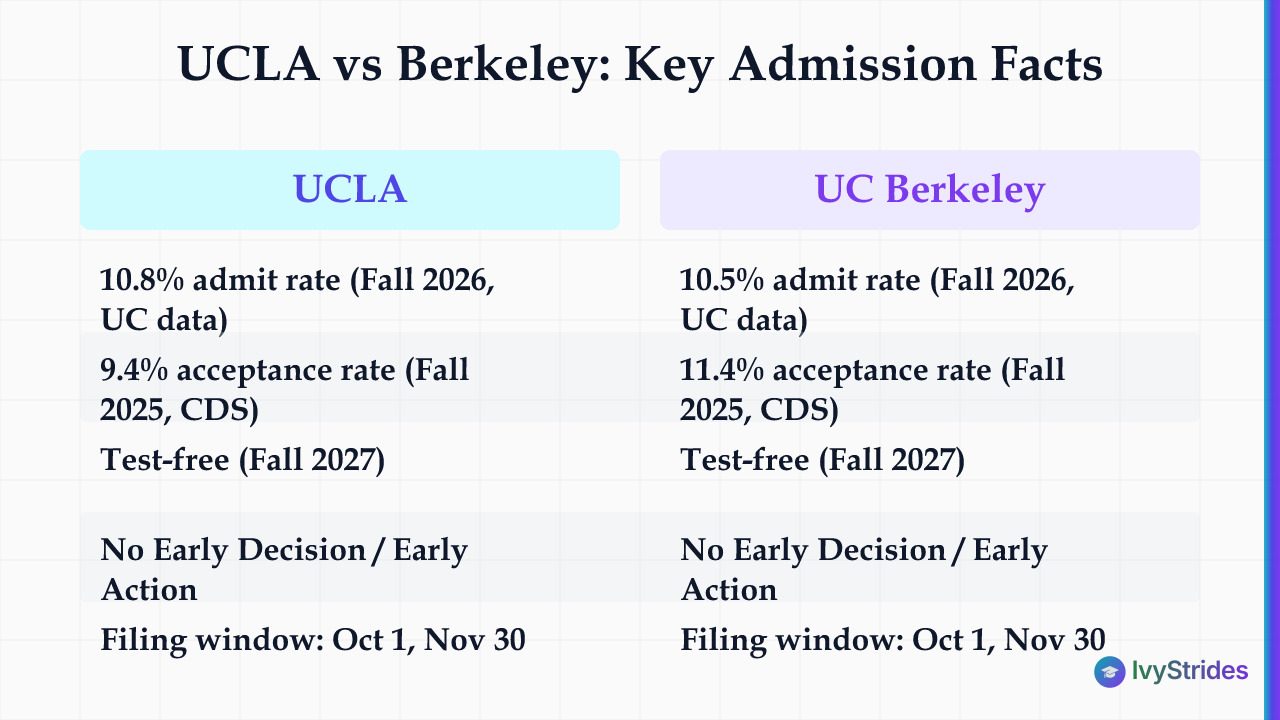
The two campuses admit a similar share of applicants, and which one is lower depends on the year. For fall 2026, UC reports that UCLA admitted 15,903 of 146,692 first-year applicants (10.8%) and Berkeley admitted 13,967 of 133,154 (10.5%). IvyStrides' analysis of each campus's fall 2025 Common Data Set puts UCLA's first-year acceptance rate at 9.4% (13,659 admitted from 145,086 applicants) and Berkeley's at 11.4% (14,524 admitted from 126,864).
So neither campus is clearly harder by the headline number, and neither figure is a lever a student can pull. Both UCLA and Berkeley stay test-free for the 2026-27 cycle, so neither considers SAT or ACT scores in admission or scholarship decisions for fall 2027 entry. Scores you choose to submit can count only toward minimum eligibility, or toward placement and subject credit after you enroll.
No early rounds, either way. Neither school offers Early Decision or Early Action. The UC filing window runs October 1 to November 30, decisions release by March 31, and the reply deadline is May 1 at both campuses.
| Feature | UCLA | UC Berkeley |
| Fall 2026 admit rate (UC data) | 10.8% | 10.5% |
| Fall 2025 acceptance rate (CDS) | 9.4% | 11.4% |
| Test policy (fall 2027) | Test-free | Test-free |
| Early Decision / Early Action | Neither | Neither |
| Application | UC application | UC application |
| Filing window | Oct 1 – Nov 30 | Oct 1 – Nov 30 |
| Decisions released | By March 31 | By end of March |
| Reply deadline | May 1 | May 1 |
With scores off the table, UCLA weighs your academic record and personal qualities instead, and Berkeley reads the same kinds of evidence.
What UCLA and Berkeley Both Weigh: PIQs, GPA, and Course Rigor
UCLA and Berkeley rate the same three factors "Very Important" in their 2025-26 Common Data Sets: rigor of secondary school record, academic GPA, and the application essay. One rigorous transcript and one strong set of essays therefore serve both files at once.
The essay, for both schools, means the UC Personal Insight Questions. Applicants answer 4 of 8 prompts, up to 350 words each, and UC says all questions get equal consideration. For most applicants, those four responses are the only essays either campus reads.
Equal weight, so choose deliberately. Since no prompt counts more than another, choosing which four PIQs to answer is a strategic decision that shapes how both campuses see you. UCLA adds that there is no advantage or disadvantage to submitting earlier or later between October 1 and November 30.
Both schools also read the same context factors: hardships and how you responded, linguistic background, parental education, and the support available at home. UCLA reads every application twice, in its entirety, by professionally trained readers; Berkeley uses holistic review where criteria carry no pre-assigned weights.
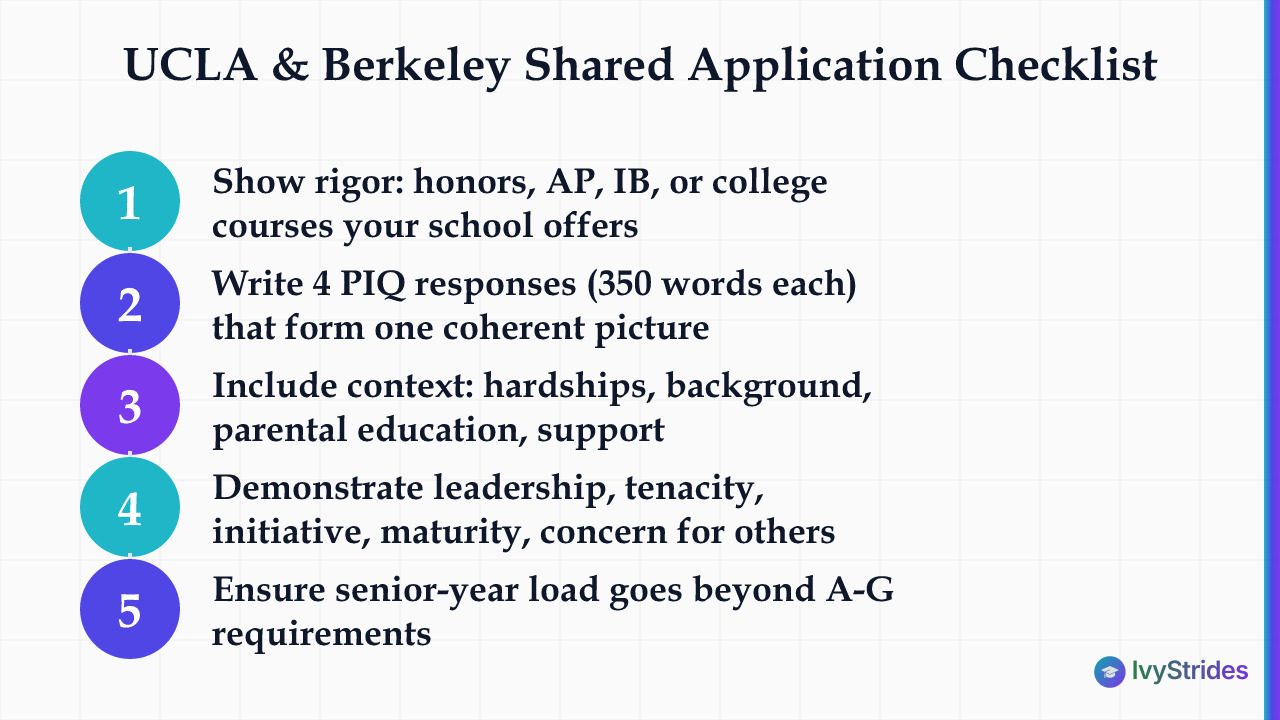
Use this as a shared starting checklist before you split the applications apart:
- A transcript showing work beyond the A-G requirements and a strong senior-year load
- Performance in honors, AP, IB, or college courses where your school offers them
- Four PIQ responses that read as one coherent picture of you
- Evidence of the personal qualities both name: leadership, tenacity, initiative, maturity, concern for others
- Context your reader needs to judge your record fairly
Both campuses read your AP and honors coursework against what your own school offers, so rigor is measured by the options you had.
Daily SAT and ACT prep on YouTube: short strategy videos from IvyStrides. Subscribe to IvyStrides on YouTube.
Where UCLA and Berkeley Diverge: Letters, Majors, and Supplementals
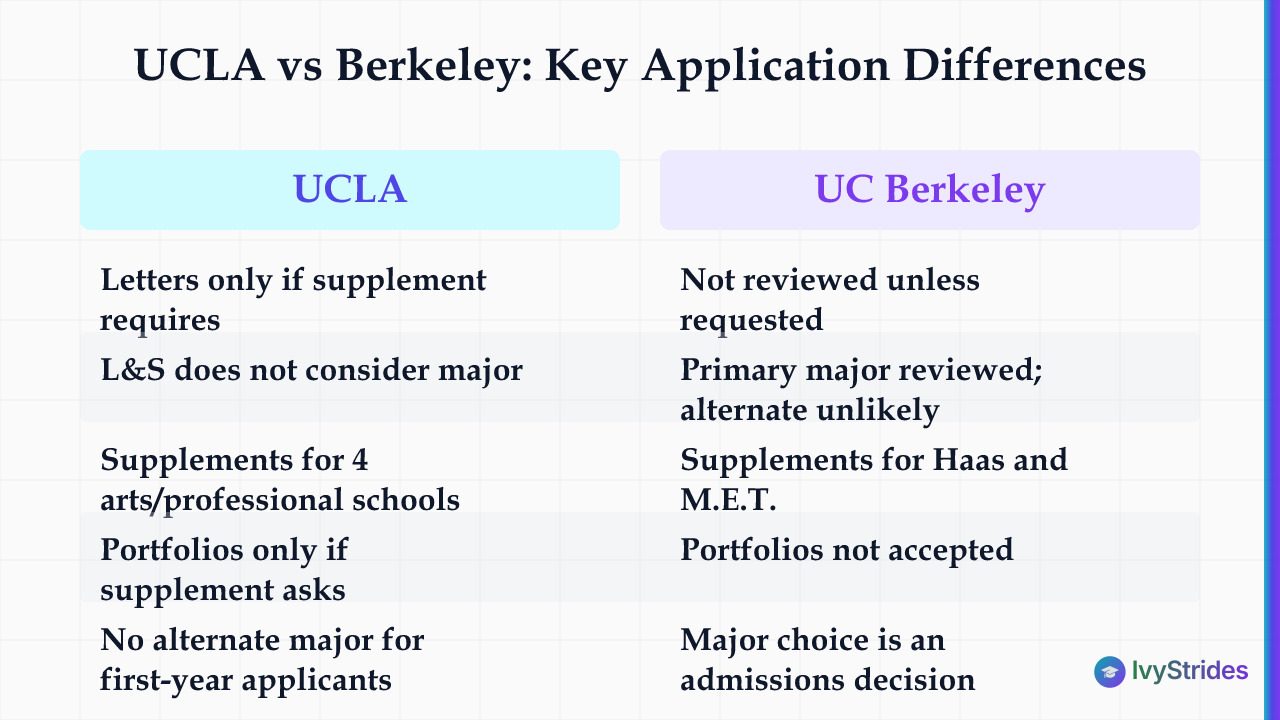
Beyond the shared PIQs and transcript, UCLA and Berkeley part ways on how each reviews your major and which supplemental applications you owe, and each states its own rules on letters of recommendation.
Letters. The UC application takes no letters of recommendation and has no interviews. UCLA accepts letters or resumes only when a specialty-school supplemental application requires them. Berkeley reviews no unsolicited materials, though it may ask select groups of students for more information, and UC policy limits letter requests to a few cases, such as applicants a campus selects for augmented review. That sets both apart from the many private colleges that ask every applicant for teacher and counselor recommendations.
Major review. UCLA's College of Letters and Science does not consider your major. Its specialty schools do: Samueli Engineering, Arts and Architecture, Herb Alpert Music, and Theater Film and Television admit by declared major, and Nursing considers major too. UCLA does not consider alternate majors for first-year applicants.
At Berkeley you apply to a major inside one of its colleges, such as Letters and Science, Engineering, Chemistry, or Computing, Data Science, and Society. Berkeley guarantees review only of your primary major, and you are likely not reviewed for an alternate, so your major choice there is an admissions decision. The PIQ about an academic subject that inspires you is a natural place to show the evidence behind that choice.
Supplementals. UCLA requires supplemental applications for majors in four schools: Herb Alpert Music, Arts and Architecture, Nursing, and Theater Film and Television. For fall 2027 the deadlines run from early December to late January, and some majors add auditions or portfolios. At Berkeley, the Haas Spieker Undergraduate Business Program supplement (an essay plus a video interview upload) arrives by email from the admissions office within 5 to 7 business days after you submit the UC application, and Spieker review requires it. Berkeley's rule is that an applicant not selected for Spieker is not considered for admission to UC Berkeley at all.
Berkeley's M.E.T. supplement is a written essay of up to 350 words plus a video essay, due 11:59 pm PT on December 14, 2026; miss it and you lose M.E.T. consideration, though Engineering still reviews you.
| Application Element | UCLA | UC Berkeley |
| Letters of recommendation | Only if a supplement requires them | Not reviewed unless requested |
| Interviews | None | None |
| Major review (L&S) | Not considered | Primary major reviewed |
| Specialty supplements | 4 arts/professional schools | Haas, M.E.T. |
| Portfolios | Only for majors whose supplement asks | Not accepted |
A common pattern we see: students targeting Berkeley's Haas program underestimate the supplement, because its request arrives by email after the UC submission rather than inside the application. Mapping a college admissions strategy that accounts for each school's requirements against the November 30 UC deadline and the December 14 M.E.T. cutoff is what keeps a strong applicant from losing a program on a technicality.
Should You Apply to UCLA, Berkeley, or Both?
For most Letters and Science applicants, applying to both UCLA and Berkeley adds almost no extra work beyond the four shared PIQs. The decision turns on your major and your appetite for supplements, not on the narrow acceptance-rate gap between the two campuses.
If you want business, Berkeley's Haas supplement and primary-major review make the major choice decisive, and a Spieker applicant not selected for Haas is not considered for the rest of Berkeley. Berkeley's campus-wide acceptance rate blends every college and major into one number, while your file is read for one primary major. If you want an arts, music, theater, or nursing program, UCLA's supplemental applications add their own deadlines.
| Your Situation | Lean UCLA | Lean Berkeley | Apply to Both |
| General Letters & Science major | ✓ | ✓ | ✓ |
| Business as primary major | ✓ (Haas) | ||
| Engineering plus business (M.E.T.) | ✓ | ||
| Arts or music program | ✓ | ✓ |
With the UC application due November 30 and Berkeley's M.E.T. supplement due December 14, map both against your essay drafting schedule now. Admissions outcomes depend on the full application, not any single factor.
The applications share a spine and split at the edges:
College admissions insights on LinkedIn: follow IvyStrides for application guidance and counseling updates.
- Confirm whether your Berkeley primary major triggers a Haas or M.E.T. supplement.
- Check whether your UCLA major sits in a specialty school that requires a supplemental application.
- Draft four PIQ responses that read as one coherent file for both campuses.
- If you want a high-demand Letters and Science major at Berkeley, select it on the application: applicants who select a high-demand major and are admitted to L&S are guaranteed a spot once they finish its prerequisites, stay in good standing, and file a declaration, while students who did not select one go through a comprehensive review to declare it.
In our college counseling work, students applying to both UCLA and Berkeley typically need one strong set of four PIQs and a clear plan for any Berkeley supplements well before November 30. On the UCLA vs Berkeley decision specifically, IvyStrides' counselors map each campus's supplement deadlines against your intended major and review your four PIQ topics as part of college list and essay work with 11th and 12th graders.
FAQ: UCLA vs Berkeley Admissions
What's harder, Berkeley or UCLA?
By admit rate they trade places: UC reports 10.5% at Berkeley and 10.8% at UCLA for fall 2026, while each campus's Common Data Set shows 9.4% at UCLA and 11.4% at Berkeley for fall 2025. Neither school uses SAT or ACT scores for fall 2027 entry, so the differentiator is the strength of your academic record, your PIQs, and, at Berkeley, your primary major.
What is UCLA's acceptance rate for fall 2026 entry?
UC reports that UCLA admitted 15,903 of 146,692 first-year applicants for fall 2026, a 10.8% admit rate. For fall 2025, UCLA's Common Data Set shows 13,659 admitted from 145,086 applicants, or 9.4%. Students applying now, for fall 2027 entry, file between October 1 and November 30, 2026.
Is UCLA harder to get into than Berkeley?
Not consistently. UCLA's rate was lower for fall 2025 (9.4% against 11.4%), but Berkeley's was slightly lower for fall 2026 (10.5% against 10.8%). Both use holistic review with no pre-assigned weights. The more meaningful difference is that Berkeley reviews you for your primary major, so the college and program you list shape your review there.
Is UC Berkeley a little ivy?
No. UC Berkeley is a public research university in the University of California system, not a member of the Ivy League, and "Little Ivy" usually describes small private liberal arts colleges. Its admissions model also differs from private colleges: one UC application, no SAT or ACT for fall 2027 entry, and review by primary major.

Hemant is a seasoned entrepreneur, investor, and growth strategist with deep ground in education and technology-driven learning. His core training is in Mathematics and Physics — he authored Physics for IB Diploma: Ultimate Revision Guide, recognized as a top student resource.