
UC PIQs: How to Choose 4 of 8 When Every Question Counts Equally

On this page
- What Are the 8 UC PIQ Prompts for 2026-27?
- Why UC PIQs Carry More Weight at Berkeley and UCLA in 2026-27
- How to Choose 4 UC PIQ Prompts Using the Coverage-Gap Framework
- How to Write Each UC PIQ Response in 350 Words
- FAQ: UC PIQ Questions, Word Limit, and Selection
- Do UC essays have to be 350 words?
- Which UC PIQ should I choose?
- Can you use AI for PIQ?
- What are the 8 PIQ questions?
- Your Next Step on the UC PIQs
UC first-year applicants choose 4 of 8 Personal Insight Questions (PIQs) and answer each in up to 350 words. The PIQs are the essay component of the UC application, and all 8 carry equal weight. The filing window runs October 1 to November 30, 2026.
Because no prompt scores higher than another, the real decision is not "which prompt is best" but "which 4 together show the most range." One UC application covers every campus you apply to, so the same 4 responses reach the University of California, Berkeley, the University of California, Los Angeles, and every other UC on your list.
What Are the 8 UC PIQ Prompts for 2026-27?
The 8 UC PIQ prompts are the essay questions inside the UC application, and first-year applicants answer any 4 in up to 350 words each. UC Admissions gives all eight equal consideration and states there is no preferred combination. The application opens August 1, and the filing window runs October 1 to November 30.
Here are the eight prompts, paraphrased, with a quick read on who each one suits.
| Prompt # | Theme | Core question (paraphrased) | Best for students who... |
| 1 | Leadership | Describe a leadership experience | led a team, resolved a conflict, or influenced others |
| 2 | Creativity | Describe your creative side | make, design, or solve problems in original ways |
| 3 | Talent or skill | Your greatest talent or skill | developed one ability deeply over time |
| 4 | Educational opportunity or barrier | An opportunity you seized or a barrier you faced | took advantage of a program, or overcame an obstacle |
| 5 | Significant challenge | Your most significant challenge | worked through a real difficulty that shaped them |
| 6 | Academic subject | A subject that inspires you | pursue an academic interest beyond the classroom |
| 7 | Community | How you made your school or community better | acted to improve a group they belong to |
| 8 | Strong candidate | Anything else that makes you a strong candidate | have a story the other seven prompts miss |
One application, one set of four. You do not write different PIQs for Berkeley and UCLA. The four you pick go to every UC campus on your list, which raises the cost of a weak or repetitive selection. Non-academic sections, including the PIQs, cannot be updated after you submit, so submission (by November 30) is your last edit point. A college admissions counseling plan maps which prompts fit the rest of your file before that deadline.
Why UC PIQs Carry More Weight at Berkeley and UCLA in 2026-27
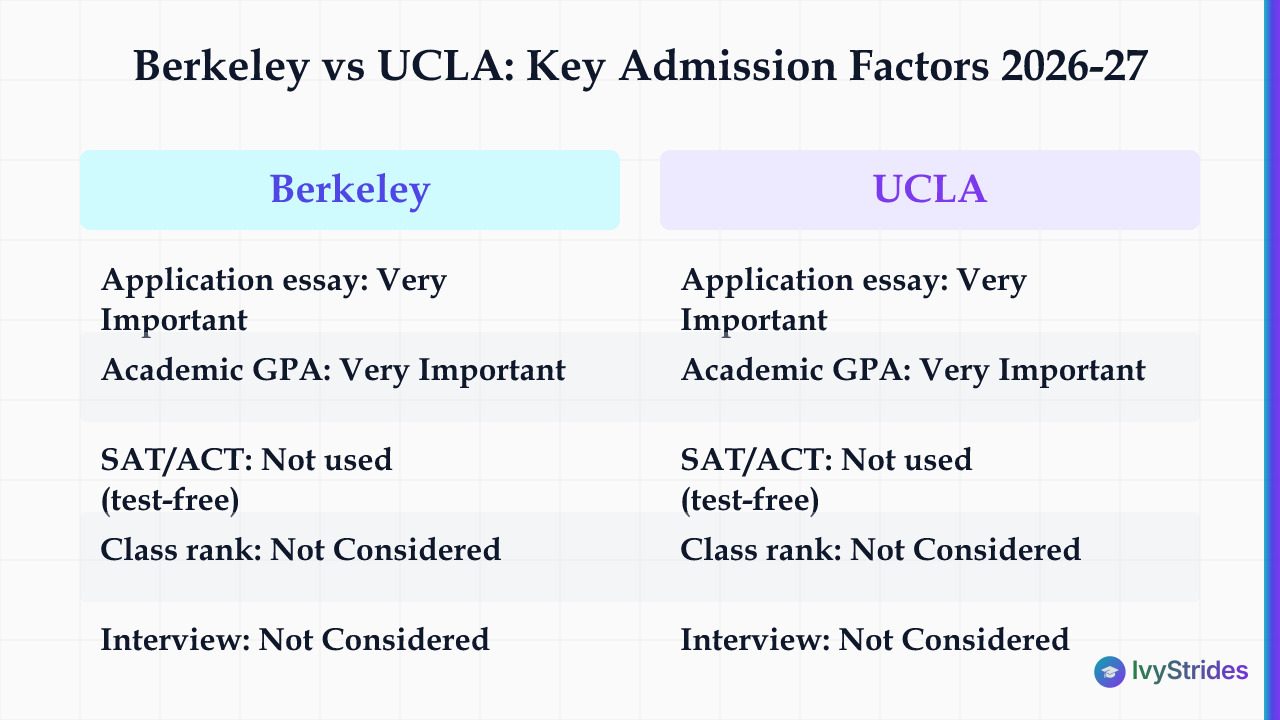
At Berkeley and UCLA, the UC PIQs carry outsized weight because both campuses are test-free for the 2026-27 cycle (entry fall 2027) and both rate the application essay Very Important. With no SAT or ACT score in the file, the PIQs become the primary place a reader hears your voice.
That test-free setup changes what your four responses have to do. Berkeley does not use SAT or ACT scores anywhere in admission decisions this cycle, and UCLA does not consider them either. Scores you submit can only meet minimum eligibility or place you in courses after you enroll.
| Factor | Berkeley rating | UCLA rating |
| Application essay | Very Important | Very Important |
| Academic GPA | Very Important | Very Important |
| Rigor of secondary record | Very Important | Very Important |
| SAT/ACT in admission | Not used (test-free) | Not used (test-free) |
| Class rank | Not Considered | Not Considered |
| Interview | Not Considered | Not Considered |
No interviews anywhere. Berkeley states plainly that it holds no interviews, so the application is the only evidence a reader has. UCLA reads every application twice, in full, by trained readers, and its criteria carry no pre-assigned weights. Both campuses name the same personal qualities: leadership ability, character, motivation, insight, tenacity, initiative, originality, intellectual independence, responsibility, maturity, and demonstrated concern for others and the community. UCLA adds creativity to that list.
Because Berkeley admits by college and primary major, the personal qualities your PIQs convey matter alongside the academic record your transcript shows. If Berkeley is a target, the UC Berkeley acceptance rate and primary major picture is worth understanding first. Students weighing UCLA against a similar Los Angeles option often look at USC and UCLA side by side. Admission still depends on the full application, not the PIQs alone.
How to Choose 4 UC PIQ Prompts Using the Coverage-Gap Framework
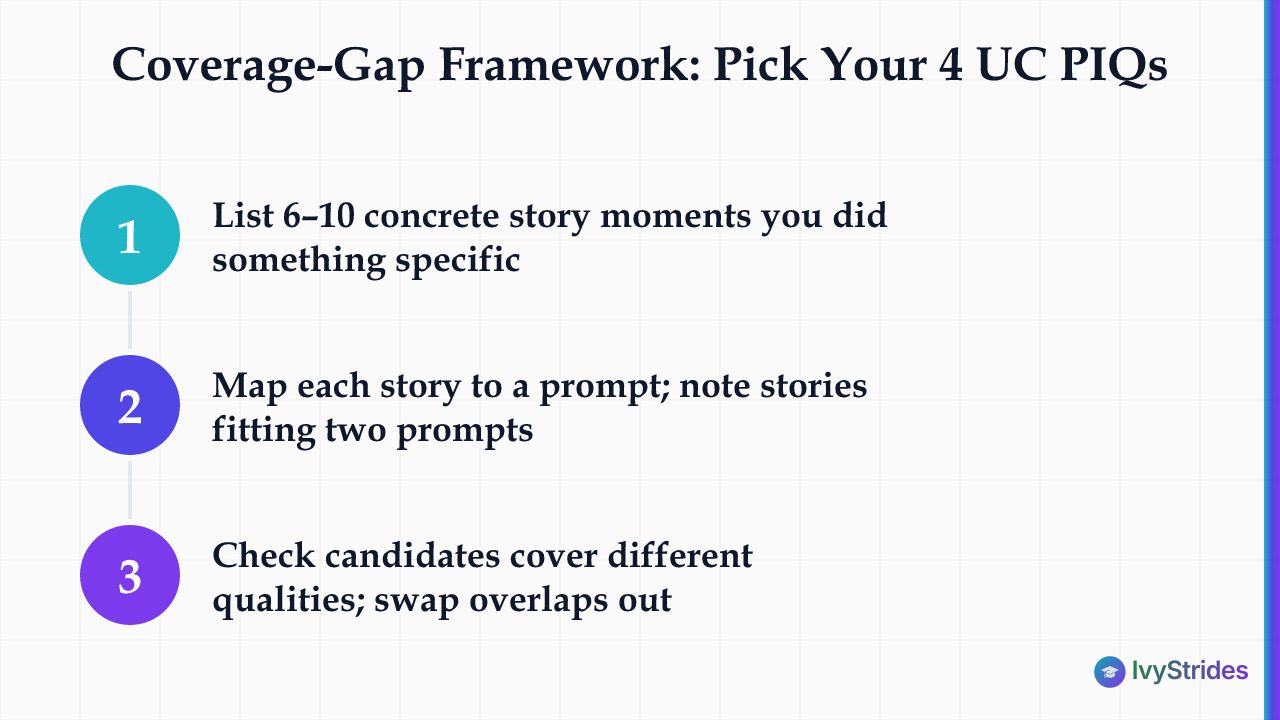
The coverage-gap framework picks your 4 UC PIQ prompts by mapping your strongest stories to the personal qualities readers look for, then filling the gaps. Because all 8 prompts carry equal weight, the best four are the ones that let you be specific across different dimensions, not the four that feel easiest to write.
With no score to lean on, four overlapping responses waste your best evidence. Work the framework in three steps.
-
List your strongest stories. Write down 6 to 10 concrete moments where you did something specific, not qualities you think you have. Brainstorming college essay ideas with a timed list surfaces them faster.
-
Map each story to a prompt. Match your moments to the eight themes. Some stories fit two prompts; note that, because it signals overlap risk.
-
Check for coverage gaps. Look at your four candidates together. Do they show different qualities, leadership in one, intellectual independence in another? If three lean on the same activity, swap one out.
The repetition trap is real. In our essay coaching, a common PIQ mistake is choosing four prompts that all draw on the same activity or theme, leaving readers with no sense of the student's range. A soccer captain who answers the leadership, challenge, and talent prompts all about soccer has written one PIQ three times.
Thin-topic caution, not a banned list. Trophy lists, mission trips with no reflection, and generic "I learned teamwork" endings tend to read flat because they report rather than reveal. Berkeley's guidance is that your PIQs should show who you are as a student, learner, and community member, and its readers name insight and originality, so the reflection carries the response.
One more rule from UC: your answers must be your own ideas, written by you alone. Family, teachers, and friends can offer suggestions, but you may not use anyone else's words. UC's PIQ page does not name AI tools, so do not assume a specific detection system; write authentically because the equal-weight file demands your real voice.
Mapping stories to prompts is harder alone than it looks. In our admissions essay coaching, a coach reviews your story inventory, maps it against all eight prompts, and flags the four that create the widest coverage across the qualities UC readers name.
How to Write Each UC PIQ Response in 350 Words
A UC PIQ response is a direct short answer of up to 350 words, not a narrative essay with a hook and a slow build. Answer the prompt in the first sentence, give one specific example, and reflect on what it meant. Treat each PIQ like a written interview: clear, direct, and personal rather than heavily metaphorical.
Each 350-word response follows the same principles as any supplemental essay, specificity and your own voice, but its shape differs sharply from the Common App essay.
| Feature | UC PIQ | Common App Personal Essay |
| Word limit | 350 words maximum | 650 words maximum |
| Format | Direct short answer | Narrative essay |
| Opening | Answer the prompt | Hook or scene |
| Count | 4 responses | 1 essay |
| Reach | All UC campuses | All Common App colleges |
Open with the answer, then the moment. At 350 words, you cannot spend 80 on atmosphere. Name what you did in sentence one, then earn it. In our essay coaching, PIQ responses built on a specific moment tend to read more compellingly than those built on a general statement about a quality.
One example, not a highlight reel. Pick a single moment and make it vivid. The show, don't tell in college essays technique matters more here than in any longer essay, because the word count punishes lists. Reserve your last 60 to 80 words for reflection: what changed, what you understood, why it matters.
Then cut to the limit. Read each draft aloud. If a sentence adds no new information, delete it. Trimming to 350 without flattening the voice is its own skill, covered in editing a college essay without losing your voice. IvyStrides' math: a student who answers 4 PIQs at 350 words each submits up to 1,400 words of personal writing to every UC campus they apply to from one application. That is your entire voice in a test-free file.
FAQ: UC PIQ Questions, Word Limit, and Selection
Do UC essays have to be 350 words?
Each UC PIQ response has a 350-word maximum. UC does not publish a minimum. IvyStrides' guidance is to aim for roughly 300 to 350 words so you use the space without padding.
Which UC PIQ should I choose?
Choose the 4 prompts where you have the most specific, concrete story to tell, then check that your four choices together cover different personal qualities. Because UC Admissions states all 8 carry equal weight, the strongest prompt is simply the one that lets you be most specific and authentic.
Can you use AI for PIQ?
UC states your answers must be your own ideas, written by you alone. Family, teachers, and friends can offer suggestions, but you must not plagiarize or use anyone else's words. UC's PIQ page does not address AI tools by name, so do not assume UC runs a specific detection system. Write in your own voice because the equal-weight file rests on it.
What are the 8 PIQ questions?
UC's PIQ page lists eight prompts: (1) leadership, (2) your creative side, (3) greatest talent or skill, (4) a significant educational opportunity or barrier, (5) your most significant challenge, (6) an academic subject that inspires you, (7) making your school or community better, and (8) what makes you a strong candidate. You answer any four.
Your Next Step on the UC PIQs
The PIQs are the clearest voice in a test-free UC file, and choosing four that cover different sides of who you are matters more than choosing the four that feel easy.
Some programs, like Berkeley's Haas Spieker business program and the M.E.T. program (its supplement is due December 14, 2026), require separate materials, so check each program's own deadlines. The Haas Spieker deadline for Fall 2027 had not been posted when we checked in September, so check haas.berkeley.edu directly.
Before you submit, do this:
- List 6 to 10 specific moments from your life, not qualities.
- Map each moment to one of the eight prompts.
- Pick four that show different personal qualities, then check for overlap.
- Draft a one-sentence answer to each of your four before you write full responses.

Award-winning author (South Asian Book Award) and graduate of BITS Pilani and UCLA Luskin School of Public Affairs. Brings a published writer's eye to Common App essays and grammatical precision to SAT and ACT R&W instruction.