
UC Berkeley Acceptance Rate Is 10.5%: Why Your Primary Major Matters
On this page
- UC Berkeley Acceptance Rate for Fall 2026: The Number and the Trend
- UC Berkeley Acceptance Rate by College and Major: Where the Real Variation Lives
- What UC Berkeley Actually Weighs: GPA, Rigor, and Personal Qualities
- UC Berkeley Application Deadlines, Supplements, and the Major-Selection Rule
- FAQ: UC Berkeley Acceptance Rate and Admissions
- What GPA do you need to get into UC Berkeley?
- Is Berkeley or UCLA harder to get into?
- Does UC Berkeley have early decision or early action?
- Is 1480 SAT good for UC Berkeley?
- Your Next Step Toward Berkeley
UC Berkeley's first-year acceptance rate is 10.5% for fall 2026: 13,992 admits from 133,157 applicants, an IvyStrides calculation from Berkeley's own counts. UC Berkeley is a public research university in the University of California system, and it is test-free for fall 2027, so SAT and ACT scores play no role. Your real odds depend on the one primary major you list.
The counts come from Berkeley's Office of Undergraduate Admissions student profile, which labels them an estimate as of August 2026 and rounds the rate to 11%.
UC Berkeley Acceptance Rate for Fall 2026: The Number and the Trend
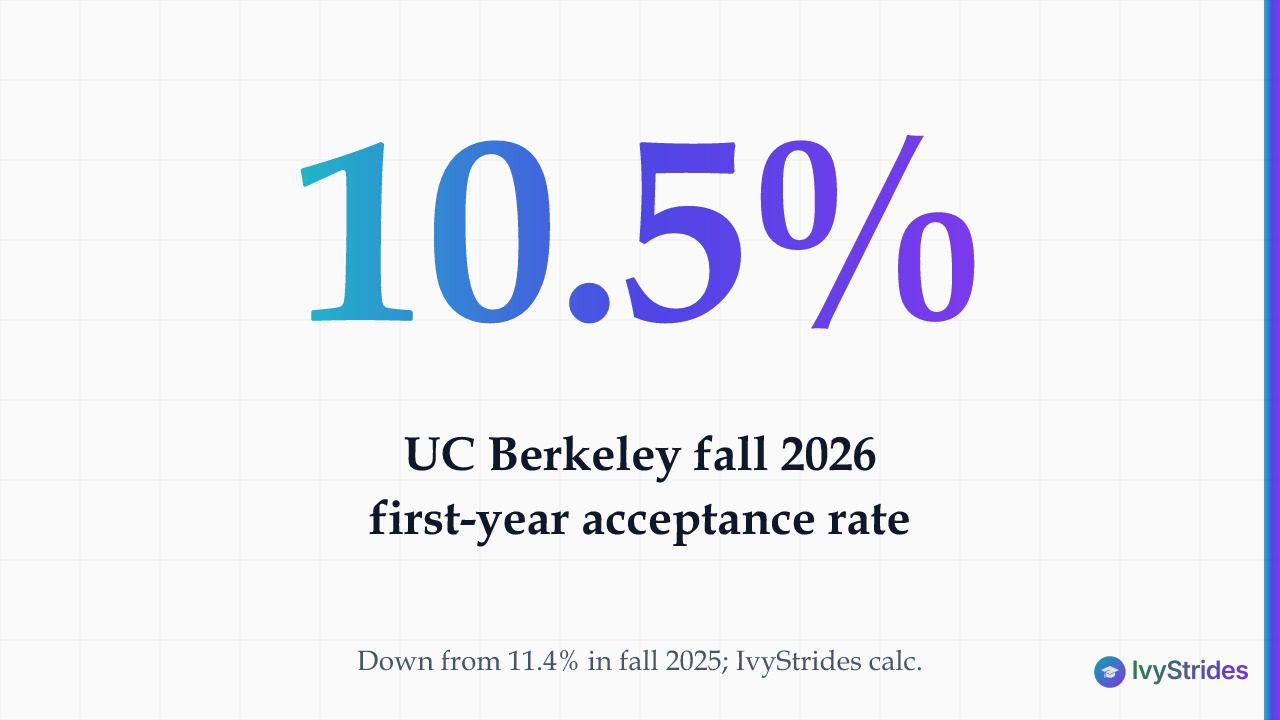
Berkeley admitted 10.5% of first-year applicants for fall 2026, IvyStrides' calculation from the admissions office's August 2026 estimate of 13,992 admits and 133,157 applicants. For fall 2025, Berkeley's Common Data Set 2025-26 publishes 14,524 admits of 126,864 applicants in section C1, from which IvyStrides computes 11.4%. Applications rose and admits fell, so the rate tightened.
Test-free for fall 2027. Per Berkeley's policy page updated June 2026, the campus does not use SAT or ACT scores in admission decisions or scholarship awards. Scores you choose to submit can only meet minimum eligibility or place you into courses after you enroll.
No early round, one deadline. Berkeley's Common Data Set answers "No" to both early decision and early action. Every applicant files between October 1 and November 30, 2026, and Berkeley sends decisions by March 31. Set Berkeley's date beside the rest of your fall 2027 application deadlines before you plan your essay calendar.
| Cycle | Applicants | Admits | Admit Rate | Source |
| Fall 2025 | 126,864 | 14,524 | 11.4% | CDS 2025-26, C1 |
| Fall 2026 | 133,157 | 13,992 | 10.5% (est.) | Admissions profile, Aug 2026 |
IvyStrides calculated both admit rates from Berkeley's published counts. Berkeley's student profile rounds the fall 2026 rate to 11%; 13,992 / 133,157 = 10.51%.
UC Berkeley Acceptance Rate by College and Major: Where the Real Variation Lives
Berkeley reviews only your primary major, so the 10.5% headline hides wide variation. Per Berkeley's application tips page, the campus guarantees review of your primary major only and likely won't review an alternate. List EECS or Haas as primary and you enter a far tighter pool than the campus-wide rate suggests.
Berkeley offers more than 100 majors across Letters and Science (L&S), Engineering, Chemistry, Natural Resources, Environmental Design, Computing/Data Science/Society (CDSS), and Haas. In our work with students applying to UC campuses, the most common application error is listing a high-demand major like EECS or Haas as primary without understanding that Berkeley reviews only that one major.
Tiers are directional. Berkeley does not publish admit rates by major, so read the table below as competitiveness tiers, not percentages. Some high-demand L&S majors admit first-years directly. The L&S high-demand majors page, last updated August 1, 2024, lists Art Practice, Operations Research and Management Science (Analytics), Political Economy, Public Health, and Social Welfare.
| College / Program | Competitiveness Tier | Supplement Required? | Key Note |
| L&S (undeclared) | Broad pool | No | Enter undeclared if no major listed |
| L&S high-demand | High | No | Direct admission if selected |
| Engineering (EECS) | Very high | No | Among the most selective programs |
| Haas (Spieker program) | Very high | Yes | Missing supplement = Haas denial |
| M.E.T. | Very high | Yes | Supplement due Dec 14, 2026 |
| CDSS | High | No | Newer, competitive program |
Course rigor separates applicants inside competitive majors. Selective programs read how many AP courses you took against what your school actually offered, not against a fixed number. Rigor then sits beside the other qualities selective colleges look for in a whole file.
What UC Berkeley Actually Weighs: GPA, Rigor, and Personal Qualities
Berkeley rates three factors "Very Important": rigor of secondary school record, academic GPA, and the application essay. That comes from section C7 of Berkeley's Common Data Set 2025-26, its most recent published data.
Not considered. The same section marks class rank, interview, alumni relation, geographical residence, religious affiliation, and level of applicant's interest as "Not Considered." Berkeley does not track demonstrated interest, so campus visits and email opens won't move your file.
Holistic review means no pre-assigned weights. Per Berkeley's selection process page, readers judge every achievement against the opportunities you actually had.
Academic review, in detail. Readers look at your GPA in UC-approved 10th and 11th grade courses, your planned senior-year courses, grade patterns, and AP/IB/honors rigor relative to peers at your school.
Berkeley's academic review explicitly includes AP and IB exam scores as evidence of achievement, so strong AP results remain relevant even in a test-free admissions environment. The grades and course choices on your transcript tell readers more than any single number.
Berkeley names the personal qualities its readers look for: leadership, character, motivation, insight, tenacity, initiative, originality, intellectual independence, responsibility, maturity, and concern for others and the community. Readers also weigh context: hardships and how you responded, linguistic background, parental education, and support at home.
| Factor | What Berkeley Looks At |
| Rigor (Very Important) | AP/IB/honors relative to your school |
| Academic GPA (Very Important) | UC-approved 10th and 11th grade courses |
| Application essay (Very Important) | The four PIQs |
| Grade patterns | Trend across terms |
| AP/IB exam scores | Evidence of achievement |
| Personal qualities | Leadership, initiative, tenacity |
| Context | Hardships, parental education, support at home |
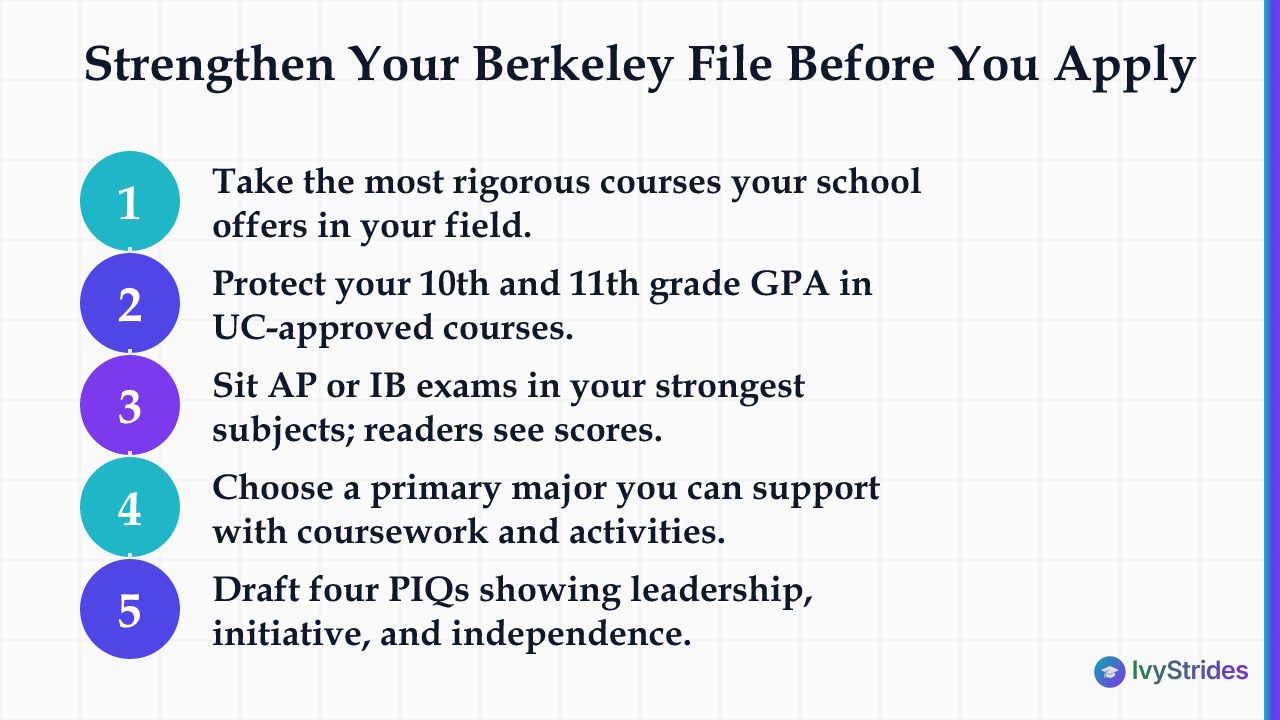
Berkeley holistic review: what to strengthen before you apply
- Take the most rigorous courses your school offers in your intended field.
- Protect your 10th and 11th grade GPA in UC-approved courses.
- Sit AP or IB exams in your strongest subjects; readers see the scores.
- Choose a primary major you can support with coursework and activities.
- Draft four PIQs that show leadership, initiative, and intellectual independence.
Because Berkeley has no interviews, the four PIQs are the only place an applicant can show who they are as a learner and community member, making essay quality the single most controllable variable in the file. Choosing the right primary major and crafting PIQs that show leadership and intellectual independence are exactly the kind of decisions a college counselor works through with students in 11th and 12th grade.
UC Berkeley Application Deadlines, Supplements, and the Major-Selection Rule

Photo by https://kaboompics.com/ on Pexels
Berkeley has one filing window and no early round: the UC application opens August 1 for drafting and accepts submissions from October 1 to November 30, 2026. With a single November 30 deadline and no early round, Berkeley applicants need their PIQs, major selection, and any required supplements finalized before the window closes.
Per UC admissions, you answer 4 of 8 Personal Insight Questions (PIQs), up to 350 words each, and UC gives all four equal consideration.
Haas adds a supplement. Per the Haas Spieker Undergraduate Business Program page, you must list business as your primary major. Haas emails a supplement, an essay plus a video interview upload, 5 to 7 business days after you submit. Skip it and Haas denies admission. The page still showed the fall 2026 deadline when checked, so confirm the fall 2027 date yourself.
M.E.T. has its own deadline. Per the M.E.T. program page, the Management, Entrepreneurship and Technology supplement pairs a written essay of up to 350 words with a video essay, due 11:59 pm PT on December 14, 2026. Miss it and Engineering still reviews you, but M.E.T. does not.
Letters are invitation-only. Berkeley invites selected applicants to send up to two letters, at least one from a core academic teacher. They are voluntary, due January 10, and Berkeley turns away unsolicited letters, so don't chase them the way you would for a private university.
| Milestone | Date / Requirement | Notes |
| UC application opens | August 1 | Covers all UC campuses |
| Submission window | Oct 1 to Nov 30, 2026 | No ED, no EA |
| PIQs | 4 of 8, 350 words each | Equal consideration |
| M.E.T. supplement | Dec 14, 2026, 11:59 pm PT | Essay plus video |
| Haas supplement | Emailed 5-7 business days after submitting | Fall 2027 date unconfirmed |
| Letters (if invited) | Due January 10 | Voluntary, one from a core teacher |
| Decisions / reply | By March 31 / May 1 | Regular round only |
Write the PIQs as one narrative. PIQ quality is the most controllable variable in a Berkeley file, and in our experience four answers that tell one story about your curiosity and community impact read stronger than four isolated responses.
The PIQs and the Haas and M.E.T. supplements all ask why you chose a field, so a convincing answer to why this major carries across all three. To check any school's numbers yourself, read a college's Common Data Set line by line.
FAQ: UC Berkeley Acceptance Rate and Admissions
What GPA do you need to get into UC Berkeley?
Berkeley publishes no minimum GPA cutoff, and its Common Data Set lists none. Academic review focuses on GPA in UC-approved 10th and 11th grade courses, grade trends, and rigor relative to what your school offers. Berkeley judges grades against each applicant's school and opportunities.
Is Berkeley or UCLA harder to get into?
Both rank among the most selective public universities, and both use holistic review without SAT or ACT scores. Berkeley's fall 2026 rate is 10.5% (estimate as of August 2026); check UCLA's own Common Data Set before you compare the two. The more useful comparison is by major, since EECS and Haas pools at Berkeley likely run tighter than its campus-wide rate.
Does UC Berkeley have early decision or early action?
No. Berkeley offers no early decision and no early action for fall 2027. The UC filing window runs October 1 to November 30, 2026, and everyone competes in the same regular round. Berkeley sends decisions by March 31, with a May 1 reply deadline.
Is 1480 SAT good for UC Berkeley?
For fall 2027 entry, UC Berkeley is test-free: it does not use SAT or ACT scores in admission decisions or scholarship awards. You may submit scores for course placement after you enroll, but they carry no weight in review. Put your energy into GPA, course rigor, and your four Personal Insight Questions.
Your Next Step Toward Berkeley
Berkeley's 10.5% rate is only the starting frame. Your real odds turn on the primary major you list, the rigor and grades behind your GPA, and how well your four PIQs show the personal qualities Berkeley names. Outcomes depend on the full application and each year's pool, so build the file you control.
- Decide your primary major early, knowing Berkeley reviews only that one.
- Verify the L&S high-demand list (updated August 1, 2024) and any Haas or M.E.T. supplement deadline.
- Draft the four PIQs as one connected narrative, not four separate answers.
- Keep AP course choices strong; exam scores still count in academic review.

Rajesh is a technology leader, entrepreneur, and angel investor with 28+ years in Business & Technology Leadership and Product & Solution Engineering. He is passionate about education, mentoring, and driving digital transformation.