
Does the Common App Essay Need MLA Format? What the Box Allows
On this page
- What the Common App Text Box Actually Renders
- What MLA Format Actually Requires (and Why the Common App Essay Is Not That)
- Common App Essay Formatting Checklist Before You Submit
- Does Word Count Matter More Than Format for the Common App Essay?
- FAQ: Common App Essay Formatting and Word Count
- What format should the Common App essay be in?
- Should I write my college application essay in MLA format?
- Do common app essays need to be indented?
- Is it bad if my Common App essay is 550 words?
- Your Next Step on Common App Essay Formatting
No, the Common App essay does not need MLA format. The personal essay box keeps bold, italic, and underline; margins, running headers, and page numbers don't exist inside it, and tab indents may not survive a paste. Use a blank line between paragraphs, skip the title and Works Cited, and stay within the 650-word maximum.
The Common App personal essay is a single text-box response of up to 650 words, a ceiling that comes straight from the Common App first-year application guide. The real trap is not format at all. It is what happens when you paste a Google Docs draft into a plain-text environment and every carefully indented paragraph slams together into one block.
What the Common App Text Box Actually Renders
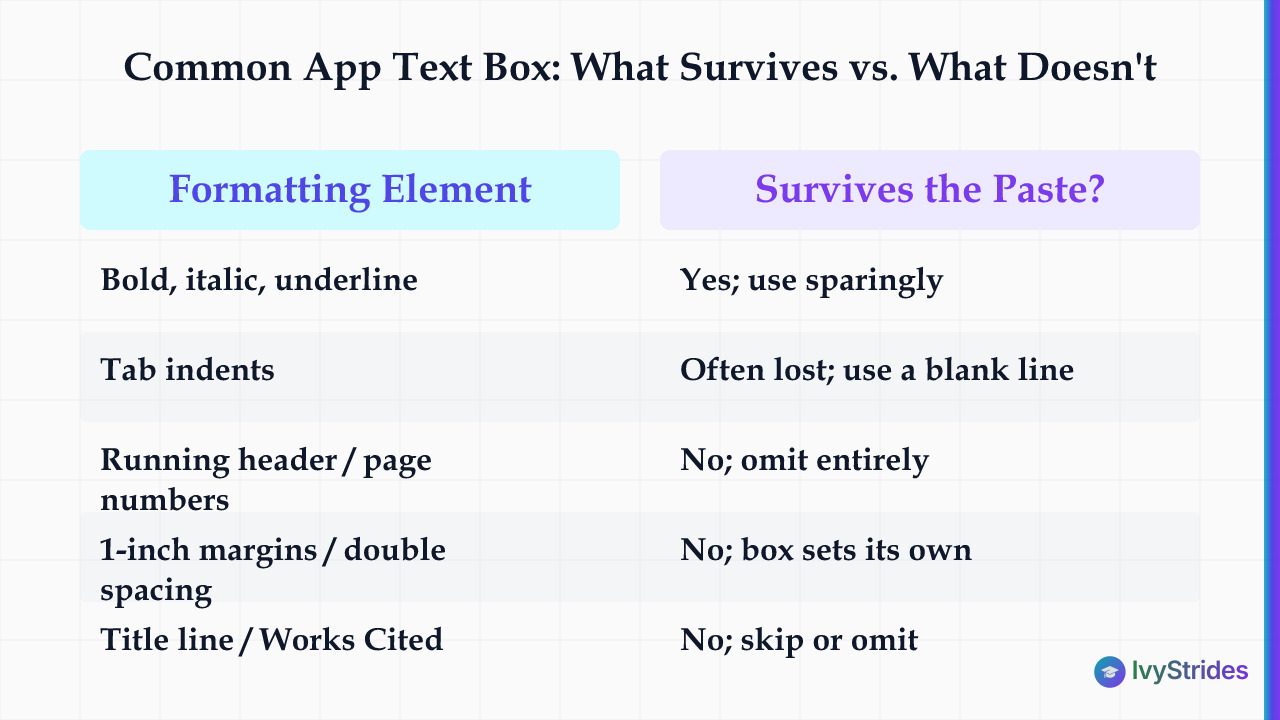
Three styles survive, nothing structural does. Per Common App's copy-and-paste guidance, you can bold, underline, and italicize text, but formatting like linked text will not work. IvyStrides summarizes Common App's guidance this way: the text box supports three inline formatting options (bold, italic, underline) and no structural ones.
When you paste from Word or Google Docs, layout can break, and paragraph breaks built with a tab key are the usual casualty. Common App suggests pasting into a plain notes app first, such as Notepad or TextEdit, then copying from there. That is the single most common paste-and-submit error we see in our essay coaching: a student copies from Google Docs, relies on tab indents for paragraph breaks, and watches all of them disappear on paste.
Block paragraphs, not indents. To separate paragraphs, press Enter twice so a blank line sits between them. This is block paragraph format, and it is the only paragraph separation the text box displays reliably across devices and browsers.
The 650-word ceiling is the one hard constraint the platform enforces automatically, and how you use that space matters far more than any formatting choice. Once you submit your first application, Common App allows unlimited edits to the personal essay, so a formatting slip you catch later is still fixable. Catch it before you submit anyway.
Required or optional, same rules. Each college decides whether the personal essay is required or optional, and you may submit it to any college regardless. The formatting stays identical either way.
| Formatting element | Does it survive the paste? | What to do instead |
| Bold, italic, underline | Yes | Use sparingly, for emphasis |
| Tab indents | Often lost on paste | Blank line between paragraphs |
| Running header (name, page) | No | Omit it entirely |
| Page numbers | No | Omit it entirely |
| 1-inch margins | No | The box sets its own spacing |
| Title line | No benefit | Skip it |
| Works Cited | Not applicable | Omit it entirely |
| Double spacing | Not adjustable | The box sets its own spacing |
The 650-word ceiling shapes every other choice, and why 650 words is the binding limit explains how to plan around it.
What MLA Format Actually Requires (and Why the Common App Essay Is Not That)
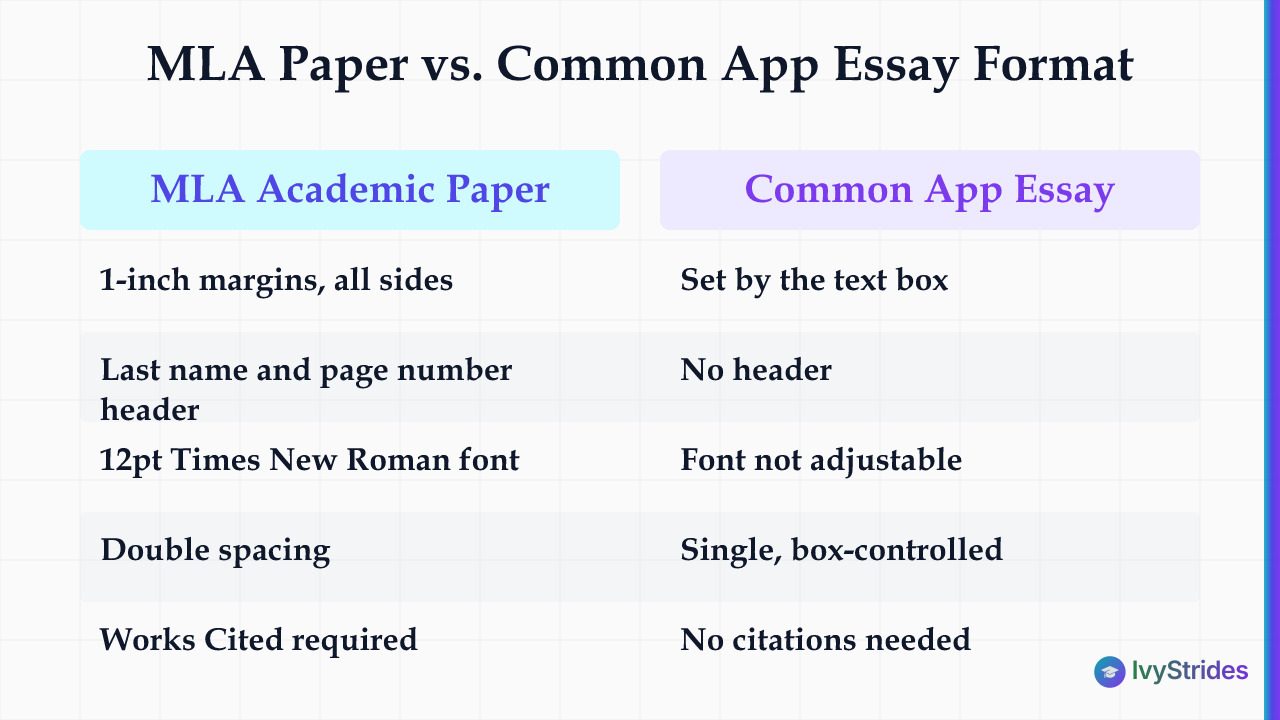
MLA format is a set of academic conventions for research papers that cite sources. It requires 1-inch margins, a running header with your last name and page number, 12-point Times New Roman, double spacing, and a Works Cited page, per the Purdue OWL MLA General Format guide. Those elements exist to organize citations. Your personal essay has none to organize.
Building on the block paragraph rule above, notice the mismatch: every defining MLA element is either stripped by the text box or irrelevant to a personal narrative. The Common App essay is a personal narrative, a first-person story about who you are. It is not a class paper, so it needs no header, no margins, and no Works Cited.
MLA or APA? Neither. Students often ask whether college essays should follow MLA or APA. APA is the citation style for social-science papers, and it belongs in a psychology lab report, not a college application. For the personal essay, no citation style applies at all.
What the admissions reader wants is a clear, specific voice inside 650 words. The 2026-27 Common App prompts are unchanged from last cycle, and the seventh prompt lets you write on any topic of your choice. Prompt selection is a content decision, separate from formatting.
| Element | MLA academic paper | Common App personal essay |
| Margins | 1-inch, all sides | Set by the text box |
| Header | Last name and page number | None |
| Font | 12pt Times New Roman | Not adjustable |
| Spacing | Double | Single, box-controlled |
| Citations | Works Cited required | None |
| Purpose | Cite research | Tell a personal story |
Once your formatting is clean, the next question is whether your essay's structure is doing its job, and the two frameworks for structuring a Common App essay work best inside the 650-word limit.
Common App Essay Formatting Checklist Before You Submit
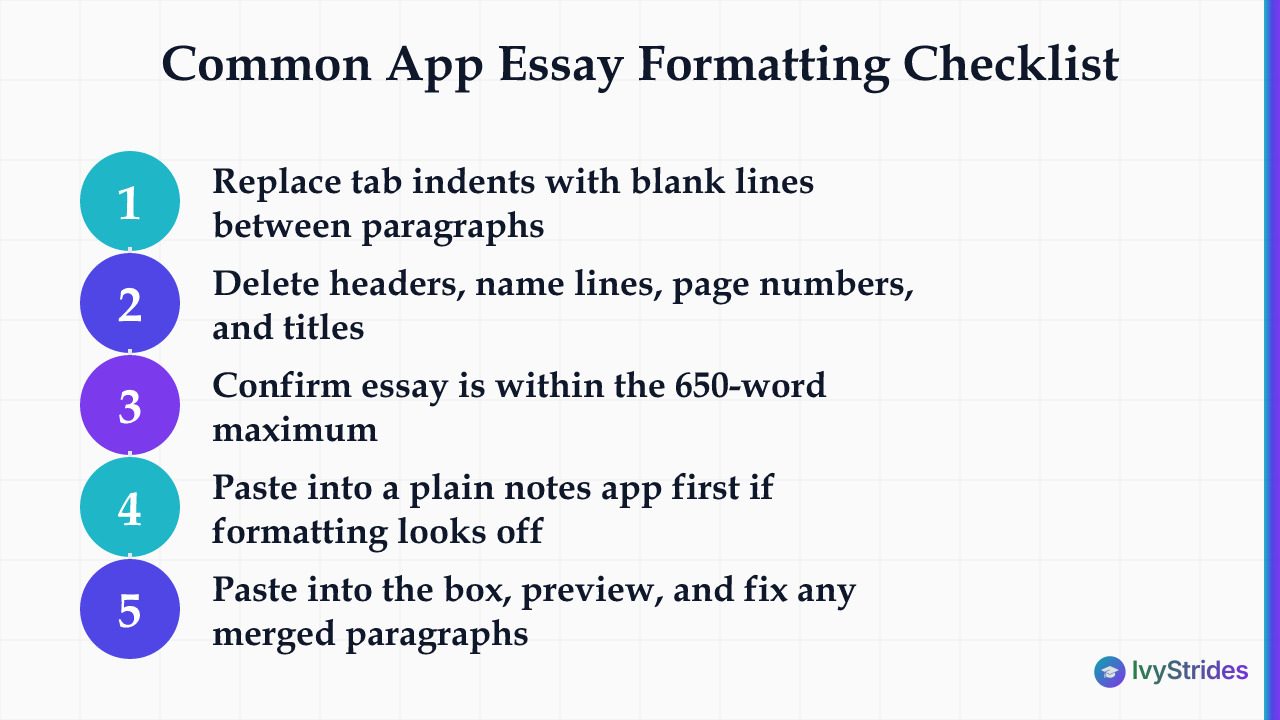
The Common App personal essay needs one final pass before you paste and submit, and it takes about five minutes. This checklist turns the formatting rules above into steps you can run in order, so nothing runs together or overflows the field.
A common failure we see is this: students draft in Word or Google Docs and paste without previewing, so every paragraph merges into a wall. The preview step below is what catches it.
-
Replace all tab indents with a blank line between paragraphs (block paragraph format).
-
Delete any running header, name line, page number, or title.
-
Confirm the essay sits within the 650-word maximum.
-
Use bold, italic, and underline sparingly, only where emphasis earns it.
-
Paste through a plain notes app first if formatting looks off, as Common App suggests.
-
Paste into the text box, then read the whole thing with the preview button.
-
Fix any merged paragraphs by inserting blank lines.
-
Submit, knowing you can still edit later.
Watch the other limits too. The Challenges and circumstances question has a 250-word maximum for first-year applicants, and it replaced the "Community disruption" question on August 1, 2025. That is a different field with its own ceiling, so don't confuse it with the personal essay.
Want a coach to review your draft for both voice and submission-ready formatting? IvyStrides' college essay coaching reviews both. College-specific prompts come next, and supplemental essays that worked show what those shorter answers look like.
Does Word Count Matter More Than Format for the Common App Essay?
Word count matters far more than format for the Common App essay, because format goes invisible once you follow the block paragraph rule while length is the one limit the platform enforces. The essay caps at 650 words. That number is a ceiling, not a target.
Common App sets no minimum length. IvyStrides' guidance: aim for roughly 550 to 650 words. An essay well under that range can read as thin, and one padded to hit exactly 650 usually shows the padding. The admissions reader values a specific, focused narrative over a filled quota.
Padding reads as padding. A reader moving through a stack of applications notices filler in a sentence. Cut the throat-clearing first, then see where you land.
| Word count range | What it signals to the reader | Recommendation |
| Under 400 | May read as underdeveloped | Add specificity, not filler |
| 400 to 500 | Workable if every line earns it | Tighten and expand the core moment |
| 500 to 550 | Solid, if focused | Fine to submit |
| 550 to 650 | The comfortable range | Aim here |
| Exactly 650 | Fine unless padded to reach it | Cut anything that only fills space |
The seven prompts are unchanged for 2026-27, so one clean draft can anchor several applications, and adapting one narrative across schools keeps it from reading generic. Each college sets its own timing, so line your essay plan up against every fall 2027 application deadline before you finalize anything.
FAQ: Common App Essay Formatting and Word Count
What format should the Common App essay be in?
Plain text with block paragraphs: a blank line between each paragraph, no tab indents. Common App supports bold, italic, and underline. Leave out MLA headers, a title, and any Works Cited. Keep the essay within the 650-word maximum.
Should I write my college application essay in MLA format?
No. MLA is built for academic research papers that cite sources. A college application essay is a personal narrative with no citations. The text box has no running headers or margins anyway, so applying MLA gives you nothing and risks a display error.
Do common app essays need to be indented?
No. Indents often don't survive a paste into the Common App box, so use a blank line between paragraphs instead, then check the result with the preview button.
Is it bad if my Common App essay is 550 words?
No. The 650-word limit is a maximum, not a goal. An essay of 550 to 650 words that is specific and well-structured reads better than a draft padded to reach 650. Admissions readers value clarity and focus over hitting the exact count.
Your Next Step on Common App Essay Formatting
Formatting the Common App essay is quick once you know the box strips academic conventions and keeps only block paragraphs and three inline styles. The harder work is making the writing itself worth a read.
- Swap every tab indent for a blank line between paragraphs.
- Delete any MLA header, title, or Works Cited.
- Confirm the essay sits within the 650-word maximum.
- Paste into the box, preview, and fix any merged paragraphs.
- Verify Common App formatting rules each August 1, when the new cycle opens.
Award-winning author (South Asian Book Award) and graduate of BITS Pilani and UCLA Luskin School of Public Affairs. Brings a published writer's eye to Common App essays and grammatical precision to SAT and ACT R&W instruction.