
Writing the MIT Supplemental Essays When There Is No Common App Essay
On this page
- How Many MIT Supplemental Essays Are There for 2026-27
- What MIT Is Actually Looking for Across All Eight Prompts
- How to Write Each MIT Essay Prompt Without Repeating Yourself
- What MIT's Short Responses Reveal That Essays Cannot
- FAQ: MIT Supplemental Essays and Prompts
- Does MIT require supplemental essays?
- What are the MIT essay prompts for the 2026-2027 application?
- How many MIT supplemental essays are there?
- How optional are the MIT optional essays really?
MIT requires four short-answer essays (about 100 to 200 words each) and four short responses (40 to 50 words each), submitted through MIT's own application portal, not the Common App. For 2026-27, the essays cover your field of study, doing something different than expected in your educational journey, your community impact, and a challenge you didn't expect.
Those prompts come from MIT's Essays, Activities and Academics page. The harder problem is distributing one coherent story across eight short pieces without repeating yourself, when there's no personal statement to carry the narrative.
How Many MIT Supplemental Essays Are There for 2026-27
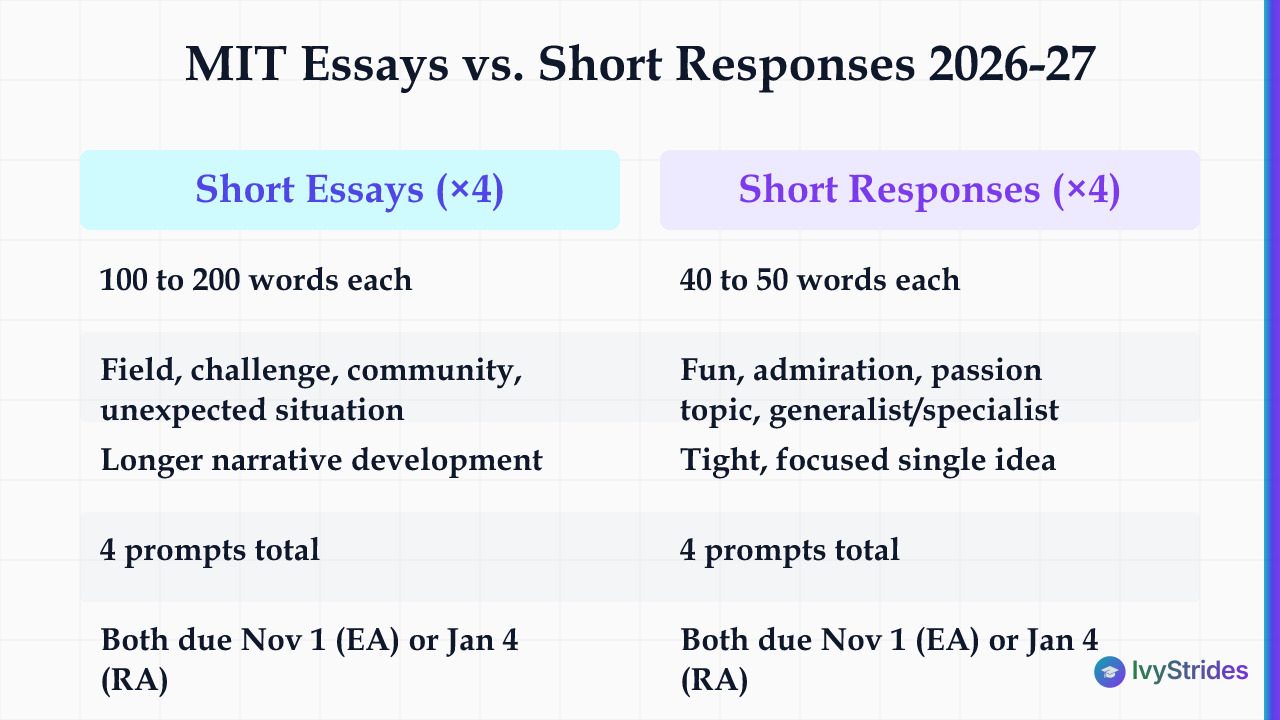
MIT requires eight pieces of writing: four short-answer essays and four short responses. You submit all of them through the MIT application portal, which is separate from the Common App. With no personal statement, these eight pieces carry your narrative.
MIT's essay section also ends with one open-ended additional-information box for anything else you think MIT ought to know.
One application per year. MIT lets you apply only once per entry year, in either Early Action or Regular Action. EA closes November 1 with decisions in mid-December; Regular Action closes January 4 with decisions in mid-March. EA is non-restrictive, so applying early here does not bar you from other schools.
| Piece | Prompt summary | Word limit | Deadline |
| Essay 1 | Field of study and the origin of interest | About 100 to 200 words | Nov 1 or Jan 4 |
| Essay 2 | Doing something different than expected | About 100 to 200 words | Nov 1 or Jan 4 |
| Essay 3 | Experiences shaping problems and community impact | About 100 to 200 words | Nov 1 or Jan 4 |
| Essay 4 | Managing an unexpected situation or challenge, and what you learned | About 100 to 200 words | Nov 1 or Jan 4 |
| Short response 1 | What you do just for fun | 40 to 50 words | Nov 1 or Jan 4 |
| Short response 2 | Someone you admire and why | 40 to 50 words | Nov 1 or Jan 4 |
| Short response 3 | A topic you could talk about for hours | 40 to 50 words | Nov 1 or Jan 4 |
| Short response 4 | Generalist or specialist, and why | 40 to 50 words | Nov 1 or Jan 4 |
One more constraint: MIT's activities form caps you at four activities, and you use MIT's form, not a resume. So any activity that defines you but doesn't make the top four can surface inside the essays instead. EA applicants need all eight pieces complete by November 1, so build them into the full 2026-27 college application timeline early.
What MIT Is Actually Looking for Across All Eight Prompts

Photo by Andy Barbour on Pexels
MIT says its essays are designed to help it get to know you, so the eight pieces should show character and fit, not STEM credentials. MIT's 2025-26 Common Data Set rates Character/personal qualities as Very Important in section C7. That same section rates alumni relation, state residency, religious affiliation, and level of applicant's interest as Not Considered. Demonstrated interest will not move your file. Your character will.
That ranking changes how you draft. Grades and scores matter for academic preparedness, but MIT states that the match between the applicant and the Institute drives selection, which is why every essay should connect to a specific aspect of MIT's culture rather than to STEM achievement in the abstract.
Impact can be small. MIT writes that "tutoring a single kid in math changes the world." You do not need a patent or a nonprofit. You need evidence of initiative, collaboration, and the willingness to act on a problem instead of only thinking about it.
| MIT value (source: mitadmissions.org) | Where it surfaces in the writing set |
| Match with the Institute matters most | Essay 1 and Essay 3 |
| Mission: science and technology to better the world | Essay 3 |
| Collaborative and cooperative spirit | Essay 3; generalist vs. specialist response |
| Initiative to pursue opportunities | Essay 2; short response on fun |
| Risk-taking and resilience | Essay 2 and Essay 4 |
| Hands-on creativity (Mind and Hand) | Essay 1; topic you'd discuss for hours |
MIT designs many problem sets for groups, so a student who always prefers working alone may not be happy there. That collaborative spirit should surface honestly, especially in Essay 3, where community impact is the point. The same principle that governs how supplemental essays work across a full application applies here: each answer adds a dimension the others do not already cover.
How to Write Each MIT Essay Prompt Without Repeating Yourself
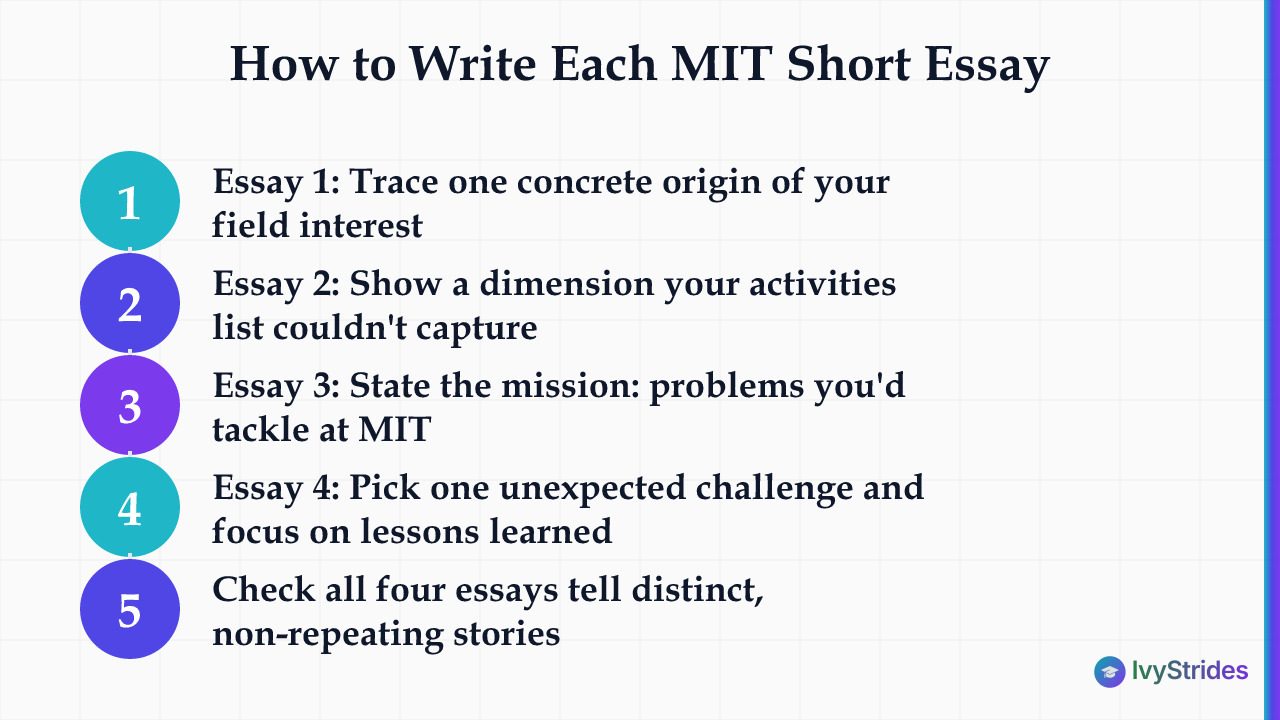
The four short-answer essays each have a distinct job, and the biggest risk is telling the same story twice. MIT's prompts for 2026-27 cover your field of study, a departure from the expected path, the problems you want to tackle, and a challenge you didn't expect. Treat each as a separate facet of one person.
Essay 1: field of study (about 100 to 200 words). You pick a field of study from a drop-down, then reflect on what led to the interest. The prompt asks which field appeals to you most right now, so it pushes you to name one concrete discipline.
So the answer has to trace a specific intellectual thread rather than list achievements. In this short space, you have room for one honest origin. Prompt 1 is MIT's version of the major question, and writing a strong "why this major" answer follows the same rule: name the moment the interest started.
Essay 2: something different (about 100 to 200 words). This asks about ways you did something different than expected in your educational journey. Use this prompt for a dimension the four-activity limit cut off, rather than repeating an achievement already in the activities list.
Essay 3: problems and impact (about 100 to 200 words). MIT asks how your personal and academic experiences shape the problems you'd tackle with an MIT education and the impact you aim to make on your community. This is the mission prompt. Tie it to MIT's stated aim of using science, technology and scholarship to make the world better, and keep the scale honest.
Essay 4: the unexpected (about 100 to 200 words). MIT asks how you managed a situation or challenge you didn't expect and what you learned from it. Pick one specific moment, keep the setup short, and spend most of the space on what you did and learned. It suits the risk-taking and resilience MIT values, but choose a different episode from Essay 2.
With eight pieces to draft, revision pressure runs high, and the real risk is editing out the specific details that make an answer distinctive. Learning how to keep your voice intact across multiple drafts protects those details.
Before you submit each short essay, check it against this list:
- Does this answer tell a story none of the other seven pieces tells?
- Does it name a concrete moment, person, or problem rather than a category?
- Is it inside the word limit without padding or truncation?
- Does it connect to one of MIT's stated values?
- Would it make sense to a reader who hasn't seen my activities list?
Plan the full set of MIT supplemental essays as one portrait, assigning each prompt a distinct quality so no two pieces repeat. If you want a second reader on that plan, IvyStrides counselors give structured help with all eight MIT essays, reviewing the set together rather than prompt by prompt.
What MIT's Short Responses Reveal That Essays Cannot
MIT's four short responses reveal a lot for their length, because 40 to 50 words punishes every hedge. The four responses ask what you do just for fun, someone you admire and why, a topic you could talk about for hours, and whether you are more of a generalist or a specialist. Don't treat them as filler after weeks on the longer essays.
At 40 to 50 words, there is no room to qualify. "I enjoy a lot of things, but if I had to pick one" eats a third of your budget and says nothing. Name the thing, and be specific enough that no other applicant could have written it.
| Prompt (40 to 50 words) | What your answer can show | Common mistake to avoid |
| What you do just for fun | Genuine curiosity, initiative | Picking something that sounds impressive |
| Someone you admire and why | Values and judgment | A famous figure with no personal link |
| A topic you'd discuss for hours | Intellectual energy | Repeating your intended major |
| Generalist or specialist, and why | Self-awareness, fit | Hedging instead of committing |
MIT says it values both generalists and specialists, so commit to the answer that is true for you. If a substantial engineering or crafting project of your own design doesn't fit the four-activity limit, the MIT Maker Portfolio and what it adds to your file is the right channel, not a short-response answer. Significant research, advanced performing arts and visual art have their own optional SlideRoom portfolios: the Research Supplement, Music and Theater Arts, and Visual Art and Architecture.
One more signal sits beside the writing. After you apply, MIT may offer an interview with an alumni Educational Counselor; if none can be arranged, it's waived with no adverse effect. The CDS rates the interview Important, and your essays and that interview should tell the same story. Remember too that admissions outcomes depend on the full application, not the essays alone.
Draft the four essays before the short responses, and confirm no two pieces tell the same story before the November 1 Early Action or January 4 Regular Action deadline.
FAQ: MIT Supplemental Essays and Prompts
Does MIT require supplemental essays?
Yes. MIT requires four short-answer essays (about 100 to 200 words each) and four short responses (40 to 50 words each), all submitted through MIT's own application portal. No Common App personal statement exists, because MIT does not use the Common App. Every applicant writes all eight pieces.
What are the MIT essay prompts for the 2026-2027 application?
For 2026-27, MIT's short-answer essays ask about your chosen field of study and what sparked it, ways you did something different than expected in your educational journey, how your experiences shape the problems you want to tackle and the community impact you aim to make, and how you managed a situation or challenge you didn't expect and what you learned. The four short responses ask about fun, someone you admire, a topic you could discuss for hours, and whether you're a generalist or specialist.
How many MIT supplemental essays are there?
Eight pieces in total: four short-answer essays at about 100 to 200 words each, and four short responses at 40 to 50 words each.
How optional are the MIT optional essays really?
The genuinely optional pieces are MIT's creative portfolios in SlideRoom (Research Supplement, Music and Theater Arts, Visual Art and Architecture, and Maker), not the eight writing prompts. All four short essays and all four short responses are required. MIT advises submitting a portfolio only if it features work that is both significant to you and relevant to your MIT application.

Hemant is a seasoned entrepreneur, investor, and growth strategist with deep ground in education and technology-driven learning. His core training is in Mathematics and Physics — he authored Physics for IB Diploma: Ultimate Revision Guide, recognized as a top student resource.