
Is UCLA Hard to Get Into? What Readers Weigh When Only 9.4% Get In
On this page
- Is UCLA Hard to Get Into? What the 9.4% Acceptance Rate Really Means
- What UCLA Actually Weighs: The Factors That Move Your Application
- How UCLA Reads Applications: What the 9.4% Rate Actually Reflects
- How to Strengthen a UCLA Application Before the November 30 Deadline
- FAQ: UCLA Admissions Difficulty and Requirements
- Is UCLA a public or private school?
- Can I get into UCLA with a 3.0 GPA?
- Is UCLA harder to get into than UC Berkeley?
- What extracurriculars does UCLA look for?
- Your Next Step on UCLA Admissions
Yes, UCLA is very hard to get into. For fall 2025, UCLA admitted 13,659 of 145,086 first-year applicants, an acceptance rate of about 9.4%. UCLA is test-free: SAT and ACT scores are not used in admission. Readers weigh academic rigor, GPA, and the application essay most heavily.
Those counts come from UCLA's Common Data Set, section C1/C2 (fall 2025). The number that trips families up is not the acceptance rate itself; it is that the most familiar lever, a strong SAT or ACT score, does nothing here. For the 2026-27 cycle (fall 2027 entry), UCLA reads your academic record and your essays, not your test scores.

Is UCLA Hard to Get Into? What the 9.4% Acceptance Rate Really Means
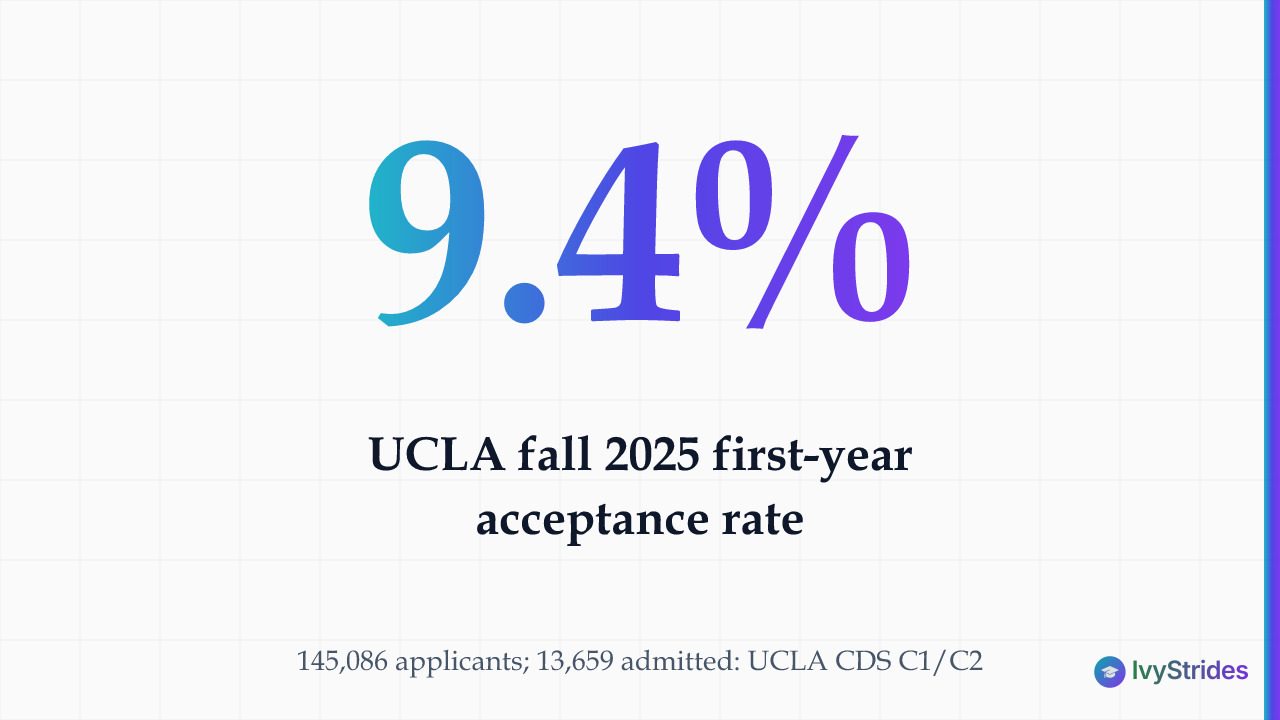
UCLA is one of the most selective public universities in the United States, and for fall 2025 its first-year acceptance rate was about 9.4%. UCLA is a public research university in the University of California system, and it describes itself as the most applied-to university in the country, counting first-year and transfer applications together.
The raw numbers. For fall 2025, UCLA received 145,086 first-year applications, admitted 13,659, and enrolled 6,553, per its Common Data Set C1/C2. That admit count divided by the applicant count produces the 9.4% figure cited throughout this article.
The acceptance rate alone understates the difficulty, because so many strong candidates apply. The waitlist tells the rest of the story: UCLA offered 20,563 waitlist spots, 13,612 applicants accepted a place, and only 1,514 were admitted from it. If you are deciding between UCLA and USC, the two schools use different review frameworks and different test policies; our USC vs. UCLA comparison breaks down where each school is more or less selective by profile.
No early round, one filing window. UCLA offers no early decision, no early action, and no deferred admission, per its CDS. Everyone files inside the same window, October 1 to November 30. Decisions arrive by March 31, and the reply deadline is May 1.
| Metric | Figure | Source |
| First-year applicants | 145,086 | UCLA CDS C1/C2, fall 2025 |
| Admitted | 13,659 | UCLA CDS C1/C2, fall 2025 |
| Acceptance rate | about 9.4% | IvyStrides, from CDS counts |
| Enrolled | 6,553 | UCLA CDS C1/C2, fall 2025 |
| Admitted from waitlist | 1,514 | UCLA CDS, fall 2025 |
| Early decision / early action | None | UCLA CDS, fall 2025 |
What UCLA Actually Weighs: The Factors That Move Your Application
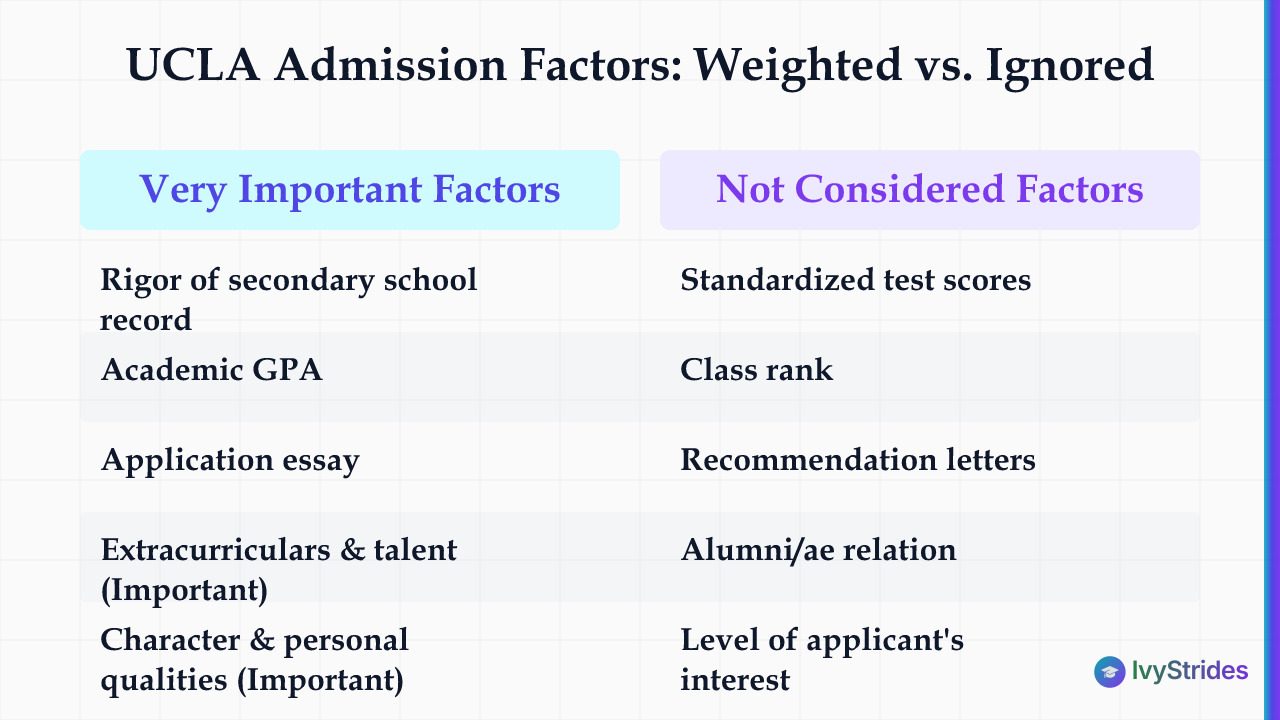
UCLA rates three factors Very Important in its admission review: rigor of secondary school record, academic GPA, and the application essay. That list comes straight from section C7 of its Common Data Set, and it tells you where to spend your effort.
What UCLA does not consider is just as instructive. Standardized test scores, class rank, recommendation letters, interviews, alumni/ae relation, religious affiliation, and level of applicant's interest are all rated Not Considered. UCLA is test-free, not test-optional, for the 2026-27 cycle. That distinction matters: test-optional schools still read a submitted score, while UCLA does not use SAT or ACT scores in admission or scholarship decisions at all. This status applies to fall 2027 entry; future cycles may differ, so confirm on UCLA's admission site before you assume it holds.
| Factor | UCLA Rating |
| Rigor of secondary school record | Very Important |
| Academic GPA | Very Important |
| Application essay | Very Important |
| Standardized test scores | Not Considered |
| Class rank | Not Considered |
| Recommendations | Not Considered |
| Interview | Not Considered |
| Alumni/ae relation | Not Considered |
| Religious affiliation | Not Considered |
| Level of applicant's interest | Not Considered |
UCLA also rates extracurricular activities, talent or ability, character and personal qualities, volunteer work, and work experience Important, and first-generation status, geographical residence, and state residency Considered.
Rigor means your hardest honest curriculum. UCLA states that competitive applicants earn high marks in the most rigorous curriculum open to them, carry a strong senior-year load, and do work beyond the A-G minimums.
Taking AP or IB courses where they are available is part of what UCLA means by that phrase, and strong AP scores can also support course placement once you enroll; how AP courses strengthen your academic record explains the admissions mechanism in detail. AP credit policies vary by college, so do not assume a particular score earns UCLA credit.
Personal qualities carry real weight. UCLA's review names leadership ability, character, motivation, tenacity, initiative, originality, creativity, intellectual independence, responsibility, insight, maturity, and demonstrated concern for others and the community. Readers also weigh context: hardships and how you responded to them, your linguistic background, and parental education and support at home.
Because UCLA rates the application essay Very Important and does not accept recommendation letters, your four Personal Insight Questions are where UCLA wants you to come through as an individual; see our guide to choosing and writing the UC PIQs for a question-by-question strategy.
How UCLA Reads Applications: What the 9.4% Rate Actually Reflects
UCLA reads every application twice, in its entirety, by professionally trained readers. That double-read process is stated on UCLA's application review process page, and it is why the 9.4% rate reflects slow, deliberate judgment rather than a score screen.
Because that review is holistic, UCLA says its criteria carry no pre-assigned weights. A reader weighs your whole file against a broad concept of merit, so no single factor, not GPA, not an essay, decides the outcome by itself. Stanford and UCLA both use holistic review with no single dominant factor, but Stanford requires the SAT or ACT while UCLA does not; the strategic differences are worth understanding if both are on your list, and how to get into Stanford covers them.
Major matters only at the specialty schools. In the College of Letters and Science, UCLA does not consider your intended major. Five schools do: the Henry Samueli School of Engineering and Applied Science, the School of Theater, Film and Television, the School of the Arts and Architecture, the Herb Alpert School of Music, and the Joe C. Wen School of Nursing. Four of the five also require a supplemental application, per the UCLA Counselor Admission FAQ (May 2026); the Samueli school is the one that does not.
Those supplements, which may include auditions, portfolios, or letters, fall due between December 4, 2026 (music) and January 20, 2027 (art and architectural studies), per UCLA's supplemental applications page.
Out of state and international. UCLA applies the same holistic review to every applicant, but UC says it prioritizes admission for California residents and sets a higher minimum GPA for nonresidents: 3.4 in A-G courses, against 3.0 in state. The emphasis stays the same: rigor, GPA, essays, personal qualities.
Here is what UCLA will and will not take from you:
| Item | Accepted? |
| Four Personal Insight Questions | Yes, required |
| SAT or ACT scores | Not used in admission |
| Letters of recommendation | No, unless a supplemental asks |
| Transcripts at application | No, unless a supplemental asks |
| Resume | No |
| Interview | Not offered |
| Specialty-school portfolio or audition | Yes, where required |
How to Strengthen a UCLA Application Before the November 30 Deadline
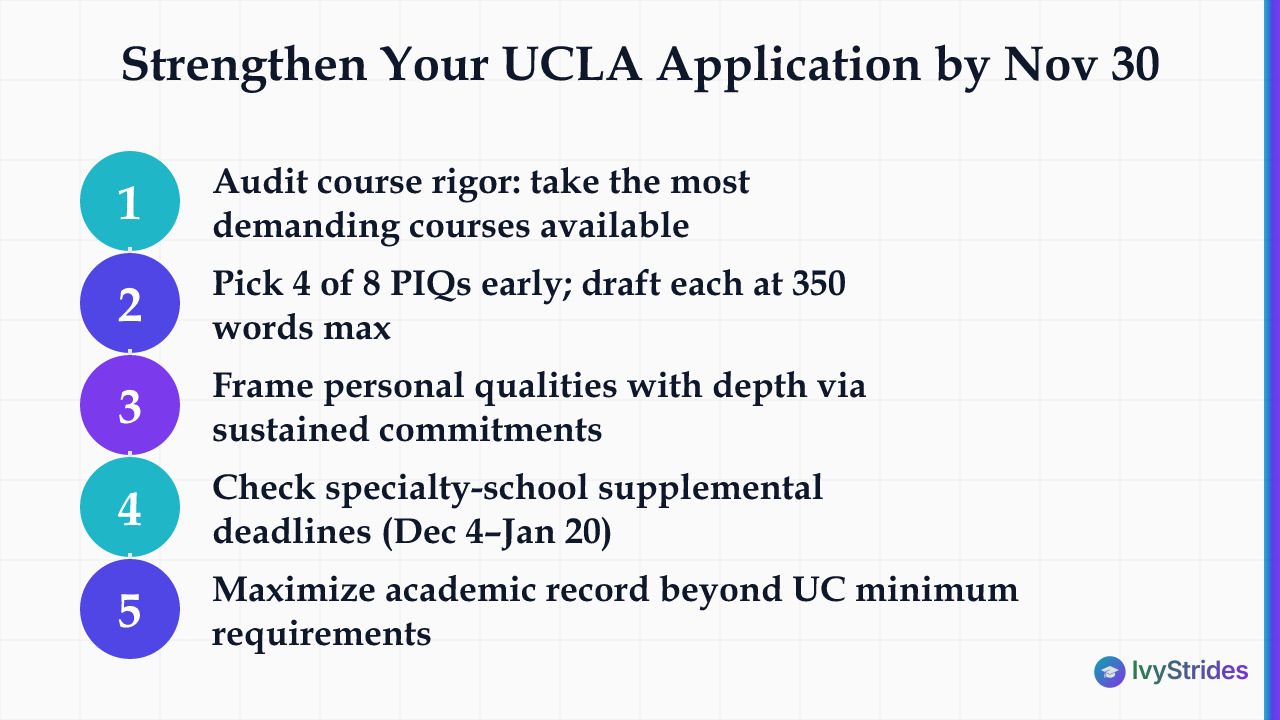
Strengthening a UCLA application means acting on the three Very Important factors before the November 30 filing deadline, because those are the levers you control. The filing window opens October 1, and submitting earlier or later inside it gives no advantage, per the UCLA Counselor FAQ. So the deadline is a planning tool, not a race.
Your four Personal Insight Questions are where the essay weight lands. You answer 4 of 8 questions, 350 words maximum each, and UCLA gives all questions equal consideration. Treat each PIQ as a standalone story rather than a resume entry. Mapping your course rigor, PIQ topics, and specialty-school supplemental requirements across a full college list is the kind of grade-by-grade planning our college admissions counseling program is built around.
-
Audit your course rigor. Confirm you are taking the most demanding courses your school offers, including AP or IB where available, and hold a strong senior-year load.
-
Pick your four PIQs early. Choose the four of eight that let you show different sides of yourself, then draft at 350 words each with college essay coaching if the voice is not landing.
-
Frame personal qualities with depth. Show tenacity, originality, and concern for community through one or two sustained commitments; what a spike in college admissions looks like explains how to build that depth.
-
Check specialty-school deadlines. Applicants to the Herb Alpert School of Music, the School of the Arts and Architecture, the Joe C. Wen School of Nursing, and the School of Theater, Film and Television should note their supplemental deadlines, which fall after the main November 30 UC deadline: December 4, 2026 through January 20, 2027, depending on the program.
-
Maximize the academic record. UCLA says admitted students usually have academic achievements far higher than the UC minimum requirements; what admitted students' GPAs look like gives the data.
One honest caveat: no single factor guarantees admission. UCLA's outcome depends on the full application read against a pool where most strong candidates are turned away.
FAQ: UCLA Admissions Difficulty and Requirements
Is UCLA a public or private school?
UCLA is a public research university, part of the University of California system. As a public institution it receives state funding, but its 9.4% acceptance rate for fall 2025 makes it as selective as many private universities. In-state California residents make up the majority of enrolled students.
Can I get into UCLA with a 3.0 GPA?
A 3.0 GPA sits below the profile of competitive UCLA applicants, who earn high marks in the most rigorous curriculum open to them. UC's minimum GPA in A-G courses is 3.0 for California residents and 3.4 for nonresidents, while first-year students who enrolled in fall 2025 averaged a 3.94 high school GPA, per UCLA's Common Data Set, and admitted students had an unweighted median of 4.00, per UCLA's first-year profile. Context still matters: readers weigh course rigor, grade trends, and your circumstances alongside the number.
Is UCLA harder to get into than UC Berkeley?
Both campuses are highly selective and both use holistic review. UCLA's fall 2025 acceptance rate was about 9.4%. Berkeley's admissions office says selectivity varies among its colleges, so certain programs are more competitive than its overall rate suggests. Confirm each campus's current figures on its own admissions site before you compare.
What extracurriculars does UCLA look for?
UCLA publishes no preferred extracurricular list. Its review looks for personal qualities, leadership, tenacity, originality, and demonstrated concern for community. The criteria also recognize exemplary, sustained achievement in any field, so commit deeply to one or two areas instead of building a long list of surface activities.
Your Next Step on UCLA Admissions
UCLA is hard to get into, and the data says so plainly: about 9.4% admitted for fall 2025, no test scores used, and a double-read review that weighs rigor, GPA, and essays above everything else. What you control is the transcript and the four Personal Insight Questions.
Before the November 30 deadline:
- Confirm your senior-year schedule is the most rigorous your school allows.
- Choose your four PIQs and start drafting at 350 words each.
- Check whether your target school is a specialty school with its own supplemental deadline.
- Build one or two commitments that show depth, not a long activity list.

Hemant is a seasoned entrepreneur, investor, and growth strategist with deep ground in education and technology-driven learning. His core training is in Mathematics and Physics — he authored Physics for IB Diploma: Ultimate Revision Guide, recognized as a top student resource.