
USC vs UCLA: Which Is Harder to Get Into, and How Each One Decides
On this page
- USC vs UCLA Acceptance Rates and Selectivity
- USC vs UCLA Test Policies: Test-Optional vs Test-Free
- What USC and UCLA Actually Look For in Applicants
- How USC and UCLA Applications Actually Differ
- FAQ: USC vs UCLA Admissions
- Is USC or UCLA better?
- Is UCLA more prestigious than USC?
- Is UCLA or USC harder to get into?
- Is USC ranked higher than UCLA?
- Your Next Step on USC vs UCLA
UCLA is slightly harder to get into by acceptance rate: about 9.4% for fall 2025 versus USC's 11.2%. USC and UCLA are the two flagship Los Angeles research universities applicants compare most, and they decide differently. IvyStrides calculated both rates from the applicant and admit counts in each school's Common Data Set. UCLA is test-free. USC is test-optional. Both use holistic review.
Those admit figures come from each school's official Common Data Set for the fall 2025 entering class, linked in the next section. The harder question is not which number is lower. It's which school's review framework fits what you can actually put on the page, because the two are not interchangeable targets.
USC vs UCLA Acceptance Rates and Selectivity
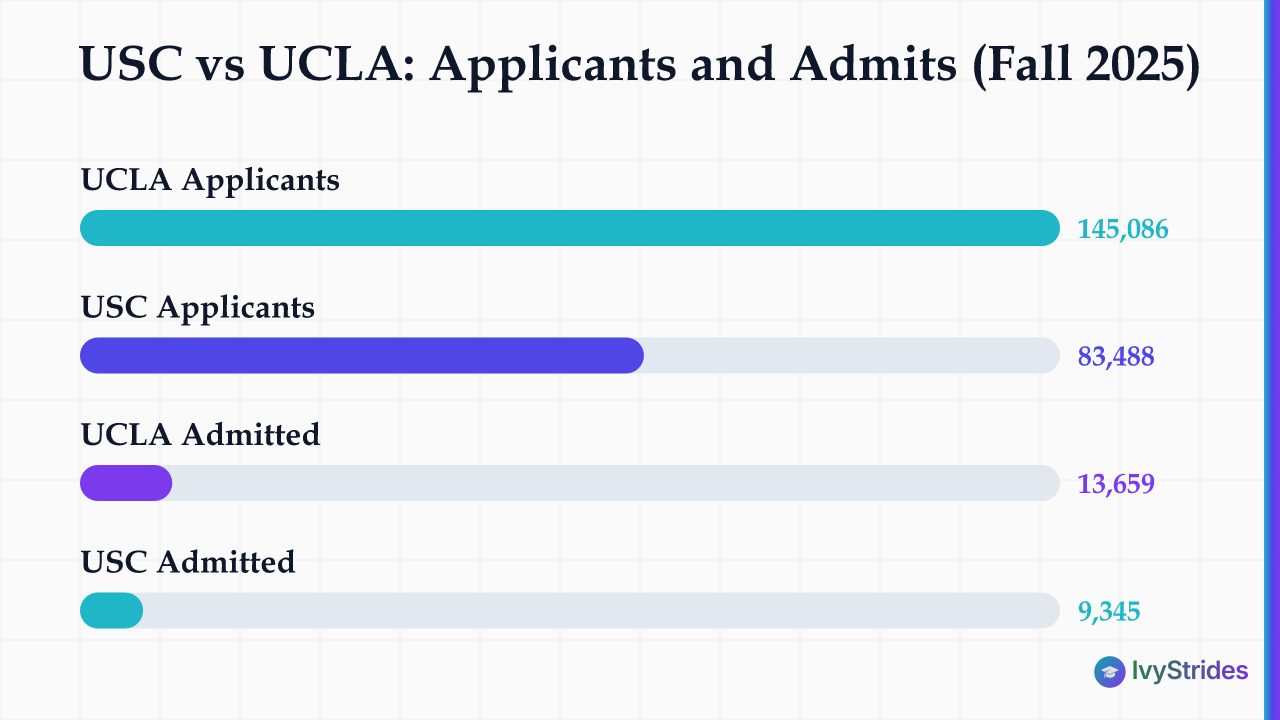
By acceptance rate, UCLA edges out USC as the harder admit. UCLA admitted about 9.4% of fall 2025 first-year applicants, drawing 145,086 applications and admitting 13,659. USC admitted about 11.2%, from 83,488 applications and 9,345 admits. Both figures come from each school's Common Data Set, section C1.
The gap in raw applications matters. UCLA fields nearly twice the applicant pool USC does, which pushes its acceptance rate lower. UCLA is a public university and USC is private, and that structural difference shapes who applies and how the pools compare.
Read the numbers as a floor, not a verdict. A 9.4% rate means UCLA turns down more than nine of every ten applicants; USC turns down close to nine. Both sit firmly in reach-for-everyone territory. Neither rate tells you your odds, because readers at both schools evaluate files individually.
| Metric | USC | UCLA |
| Applicants (fall 2025) | 83,488 | 145,086 |
| Admitted | 9,345 | 13,659 |
| Acceptance rate | about 11.2% (IvyStrides) | about 9.4% (IvyStrides) |
| Institution type | Private | Public |
| Waitlist admits | Not reported | 1,514 |
IvyStrides divides 9,345 by 83,488 for USC and 13,659 by 145,086 for UCLA, since each CDS publishes applicant and admit counts separately. UCLA's waitlist offered 20,563 spots for fall 2025, 13,612 students accepted a place, and UCLA admitted 1,514 from it. USC's CDS reports no waitlist policy. One caveat: these are fall 2025 figures, the most recent CDS available, so fall 2027 rates will differ.
USC vs UCLA Test Policies: Test-Optional vs Test-Free
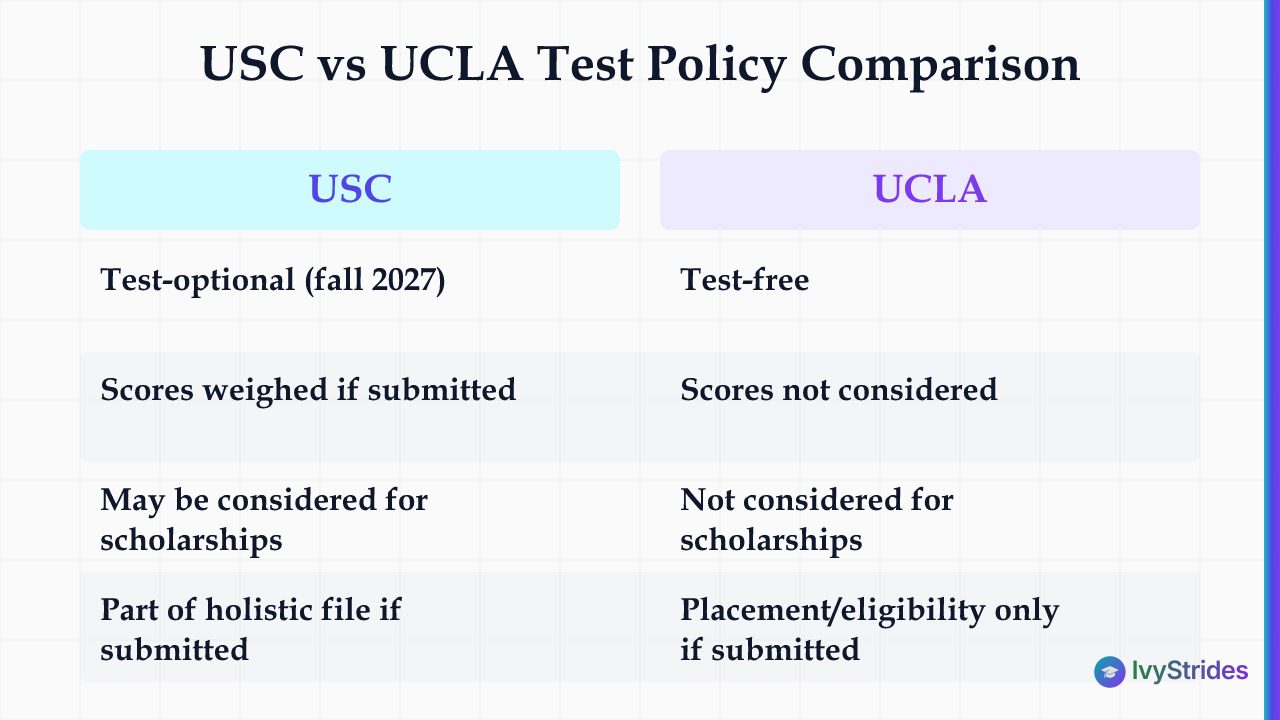
USC is test-optional for fall 2027; UCLA is test-free, and the difference is not cosmetic. USC admissions runs a test-optional policy for the 2026-27 cycle, so it does not penalize non-submitters and asks applicants whether they plan to submit. UCLA is test-free: it does not consider SAT or ACT scores for admission or scholarships at all.
That distinction, test-optional versus test-free, sits directly on top of the private-versus-public gap the acceptance rates revealed. Test-optional means a reader may weigh a score if you send it. Test-free means the reader never sees it as an admissions input. UCLA's CDS answers C8A as "No" for standardized test scores in admission decisions. You can still submit scores to UCLA, but the office uses them only for course placement or eligibility, never to decide the offer.
Score strategy is a USC question. USC is test-optional for fall 2027, so a strong SAT or ACT score can strengthen your file, while UCLA is test-free and will not consider scores at all. The decision of whether to prep and submit is entirely USC-specific.
| Policy dimension | USC | UCLA |
| Cycle policy (fall 2027) | Test-optional | Test-free |
| Scores in admission decision | Weighed if submitted | Not considered |
| Scores for scholarships | May be considered | Not considered |
| Purpose if submitted anyway | Part of holistic file | Placement/eligibility only |
What this means for your prep. In our coaching with students applying to both schools, we find the test-optional versus test-free distinction is the single most common source of confusion. Students preparing a strong SAT score for UCLA are surprised to learn it carries zero admissions weight there.
So the practical rule is simple. If you're deciding whether to prep and submit, that decision is a USC question, not a UCLA one. For the fuller framework on when a score helps a test-optional school, see what is test-optional and should you submit SAT scores. One caveat: test-optional policies vary by school and year, so verify each institution's current policy before you apply.
What USC and UCLA Actually Look For in Applicants
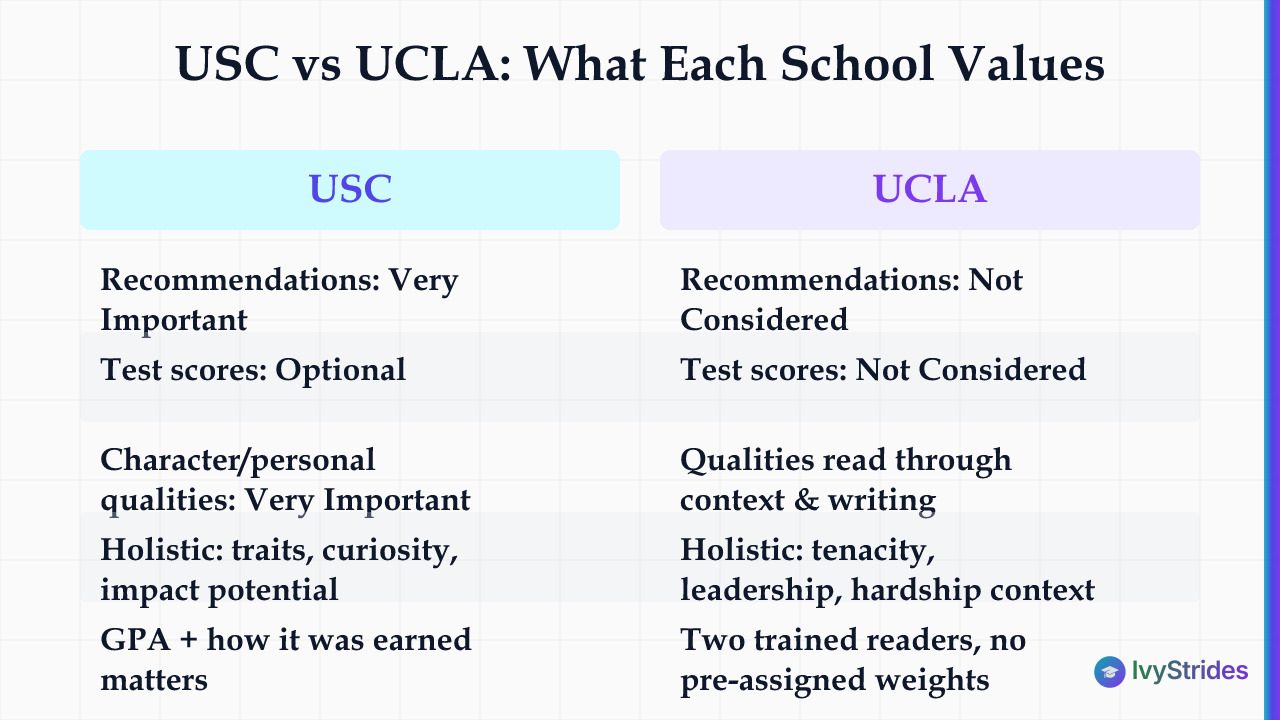
Both schools rate rigor of secondary school record, academic GPA, and the application essay as Very Important, but the lists diverge from there. USC also rates recommendations and character/personal qualities as Very Important. UCLA considers no recommendations at all and, of course, ignores test scores. Holistic review means neither school admits by formula.
The essay carries weight at both, which sits right against the test policies above: where UCLA closes the door on scores and letters, it leans harder on what you write. Because both USC and UCLA rate the application essay as Very Important, the quality of your personal statement and supplemental writing is one of the few factors you can still improve before you submit.
| Admissions factor | USC | UCLA |
| Rigor of school record | Very Important | Very Important |
| Academic GPA | Very Important | Very Important |
| Application essay | Very Important | Very Important |
| Recommendations | Very Important | Not Considered |
| Character/personal qualities | Very Important | (via qualities read) |
| Standardized test scores | Optional | Not Considered |
| Class rank | Not Considered | Not Considered |
| Level of applicant's interest | Not Considered | Not Considered |
USC reads for character and how a GPA was earned. USC describes its process as holistic review by people, not formulas, with readers weighing how a GPA was earned rather than the number alone. It names the traits it wants: a willingness to go beyond the requirements, curiosity about the world, and the potential to make an impact. USC expects at least three years of math including advanced algebra, and admitted students typically took the most rigorous schedule available.
UCLA reads twice, weights nothing in advance. UCLA says professionally trained readers read every application twice, in its entirety, using a broad concept of merit whose criteria carry no pre-assigned weights. It names qualities like leadership, tenacity, initiative, originality, intellectual independence, and concern for others. It also weighs context: hardships and how you responded, linguistic background, and support at home.
Students who treat USC's "willingness to go beyond requirements" framing as a cliche rather than a specific signal tend to write generic essays; the ones who address it concretely, with a named example, write stronger USC supplements. That's where expert essay support earns its place. Our college admissions essay coaching works the personal statement and the USC supplement against each school's actual criteria, which matters because USC explicitly asks for your own words, not AI-generated text.
How USC and UCLA Applications Actually Differ
USC uses the Common App plus a writing supplement; UCLA uses the UC application with four Personal Insight Questions. These are two different platforms with two different essay formats and two very different deadline structures, so the same student writes different applications for each. That's the practical translation of the criteria gap above: recommendations and character feed USC's file, while UCLA's file leans on the PIQs and context.
USC's application, briefly. USC pairs the Common App with a required short essay of about 250 words on how you'll pursue your academic interests and why at USC, plus a set of one-line Quick Takes. You pick a first-choice and second-choice major, and Viterbi Engineering considers the first-choice major only. USC requires one recommendation, from a counselor or teacher, with extra letters optional. No interviews, and USC does not consider demonstrated interest.
USC's new deadlines change the calendar. USC announced on Feb 9, 2026 that it opened binding Early Decision to fall 2027 applicants in nearly all undergraduate programs. USC excludes Dance, Music, and Dramatic Arts, which keep a Dec 1 Regular Decision deadline. For the trade-offs between the three plans, see early decision vs early action vs regular decision.
| Requirement | USC | UCLA |
| Platform | Common App + supplement | UC application |
| Main essays | ~250-word supplement + Quick Takes | 4 of 8 PIQs, 350 words each |
| Recommendations | 1 required | None accepted |
| Early plans | ED and EA, both Nov 1 | None |
| Regular deadline | Jan 10, 2027 | Nov 30 (filing opens Oct 1) |
| Decisions | ED mid-Dec; RD by Apr 1 | By March 31 |
| Interviews | None | None |
UCLA's application, briefly. UCLA uses the UC application with four of eight Personal Insight Questions, 350 words max each, filed between Oct 1 and Nov 30. Submitting earlier in that window gives no advantage. UCLA accepts no letters of recommendation except for supplemental applications to Herb Alpert Music, Arts and Architecture, Nursing, and Theater, Film and Television. UCLA runs no ED, no EA, and no deferred enrollment; decisions land by March 31 with a May 1 reply deadline.
If USC's new Early Decision deadline of November 1 is on your radar, you need to finalize your essay drafts, recommendation request, and score submission decision weeks earlier than a Regular Decision timeline. Managing two frameworks at once is where end-to-end college admissions counseling earns its keep.
FAQ: USC vs UCLA Admissions
Is USC or UCLA better?
Neither is objectively better; they serve different profiles. USC is private, rates recommendations and character as Very Important, and now offers binding Early Decision. UCLA is public, is test-free, does not consider recommendations, and has a lower acceptance rate. The better school is the one whose review criteria align with your strongest assets.
Is UCLA more prestigious than USC?
Both are highly regarded research universities, and prestige rankings vary by source and field. UCLA's lower acceptance rate, about 9.4% versus USC's 11.2% for fall 2025, reflects a larger applicant pool rather than a categorical prestige gap. For admissions purposes, the more useful question is which school's criteria fit your profile.
Is UCLA or USC harder to get into?
By acceptance rate, UCLA is marginally harder: about 9.4% versus USC's 11.2% for the fall 2025 entering class. UCLA also fields nearly twice as many applications. But the schools use different frameworks, so difficulty depends on your profile: UCLA considers neither test scores nor recommendations, while USC weighs both.
Is USC ranked higher than UCLA?
Rankings vary by source and methodology, and neither school consistently outranks the other across every list. For admissions planning, rankings matter less than fit: which school's stated Very Important factors match what you can put on the page. Both use holistic review, and neither admits by formula.
Your Next Step on USC vs UCLA
The comparison is not really about which number is lower. It's about which review framework rewards the file you can build. Once you know that, the work is concrete.
- Match your strongest assets to each school: strong recommendations and character signals favor USC; strong PIQs and context favor UCLA.
- Decide test submission for USC only, since UCLA is test-free.
- Draft the right essay format for each: a ~250-word USC supplement, four 350-word UCLA PIQs.
- Map USC's Nov 1 ED and EA deadlines against your finished-draft date before committing.
Verify each school's current policy on its official admissions page before you apply, since test and deadline rules shift by cycle.

Hemant is a seasoned entrepreneur, investor, and growth strategist with deep ground in education and technology-driven learning. His core training is in Mathematics and Physics — he authored Physics for IB Diploma: Ultimate Revision Guide, recognized as a top student resource.