
AMC 10 or AMC 12: How to Choose When Your Student Can Sit Either

On this page
- AMC 10 vs AMC 12: Eligibility, Format, and Syllabus Compared
- Which AMC 10 or AMC 12 Score Actually Qualifies for AIME
- How the AMC 10 vs AMC 12 Choice Affects Your College Application
- Which AMC Exam Should You Choose: A Score-Band Decision Framework
- FAQ: AMC 10 vs AMC 12 Scores and Eligibility
- Can I take both AMC 10 and AMC 12?
- Is AMC 10 A or B harder?
- Is 100 on AMC 10 good?
- What is a good score for AMC 10?
- Your Next Step on the AMC 10 vs AMC 12 Decision
Both the AMC 10 and AMC 12 are 25-question, 75-minute multiple-choice exams from the MAA with identical scoring. The AMC 10 is open to grade 10 or below; the AMC 12 adds trigonometry and logarithms. Students eligible for both can sit one A-window exam and one B-window exam.
Those eligibility rules, format details, and syllabus scope all come from the Mathematical Association of America (MAA), cited throughout below. The decision that actually matters is which exam gives your student the better combination of AIME qualification odds and admissions signal, and that turns on their current score band and grade.
AMC 10 vs AMC 12: Eligibility, Format, and Syllabus Compared
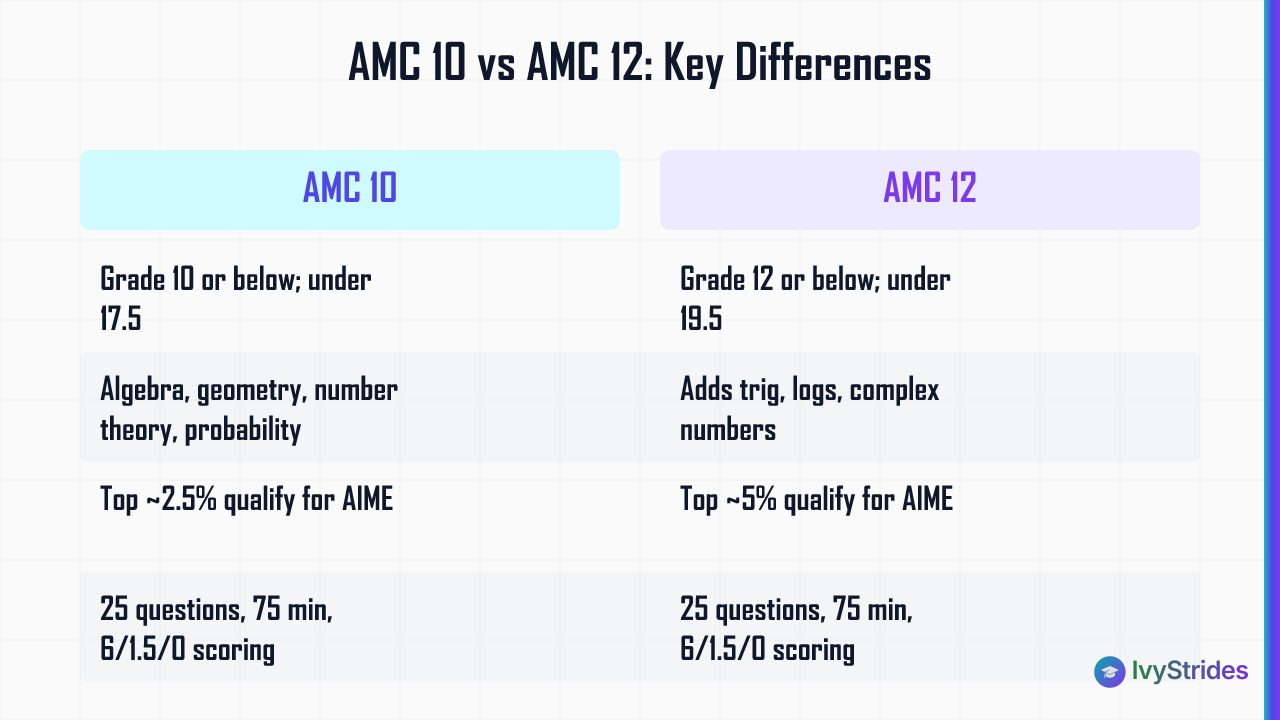
The AMC 10 and AMC 12 are the two entry-level exams in the American Mathematics Competitions, administered by the MAA each November. Eligibility is the first filter. The AMC 10 is open to students in grade 10 or below who are under 17.5 years old on the contest date, while the AMC 12 is open to students in grade 12 or below who are under 19.5 years old. A grade 11 or 12 student cannot sit the AMC 10 at all.
Same shell, both exams. Each runs 25 questions in 75 minutes, both are multiple-choice, and both use identical scoring: 6 points for a correct answer, 1.5 points for a blank, and 0 for a wrong answer. That blank-scoring rule matters more than most students expect, because guessing randomly on the last five questions usually costs you the 1.5-point credit for leaving them empty.
Where they diverge: the syllabus. The AMC 10 covers algebra, geometry, number theory, and probability up to a 10th-grade curriculum. The AMC 12 adds trigonometry, logarithms, complex numbers, and more advanced algebra on top of that scope, though it explicitly excludes calculus. On any A or B sitting, roughly 10 to 15 of the 25 questions overlap between the two exams, so a student strong on the shared core is already partway into AMC 12 territory.
| Feature | AMC 10 | AMC 12 |
| Grade eligibility | Grade 10 or below | Grade 12 or below |
| Age limit (contest date) | Under 17.5 | Under 19.5 |
| Questions | 25 | 25 |
| Time | 75 minutes | 75 minutes |
| Scoring | 6 / 1.5 / 0 | 6 / 1.5 / 0 |
| Added syllabus | None | Trig, logs, complex numbers |
| Sittings | A and B (November) | A and B (November) |
| AIME target | Top ~2.5% of takers | Top ~5% of takers |
Format, scoring, and eligibility per MAA; per-question pacing of about 180 seconds (75 minutes over 25 questions) is IvyStrides' arithmetic from the MAA figures.
The A and B sittings run on separate dates and carry the same difficulty level, so neither is officially harder. Students who competed in the AMC 8 in middle school are often ready for the AMC 10 by 9th or 10th grade; see our guide on what counts as a good AMC 8 score for the progression benchmarks.
Which AMC 10 or AMC 12 Score Actually Qualifies for AIME
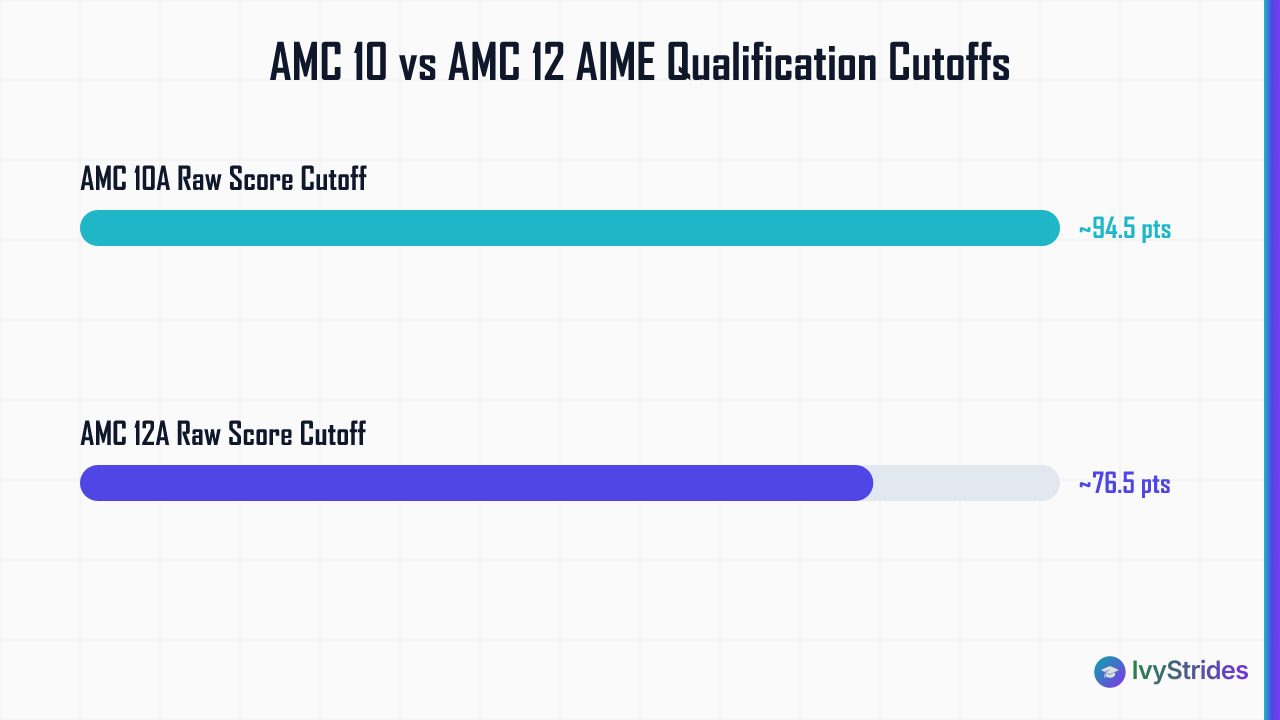
AIME qualification is the reason most students agonise over the AMC 10 vs AMC 12 choice, and the arithmetic is less intuitive than the syllabus split above suggests. The AMC 10 invites roughly the top 2.5% of its takers to the AIME; the AMC 12 invites roughly the top 5%. Because the AMC 10 excludes the hardest problem types, more students cluster in the middle range, which pushes its raw-score cutoff higher than the AMC 12's in the same year.
Look at the numbers side by side. In a typical recent year, the AMC 10A raw-score cutoff sat around 94.5 while the AMC 12A cutoff sat around 76.5. Same AIME, lower raw bar on the AMC 12, harder questions to clear it. That trade-off is the whole decision in one line.
| Exam | Approx. AIME Cutoff | % of Takers Who Qualify | Leads To |
| AMC 10A | ~94.5 | Top ~2.5% | AIME, then USAJMO |
| AMC 10B | varies by year | Top ~2.5% | AIME, then USAJMO |
| AMC 12A | ~76.5 | Top ~5% | AIME, then USAMO |
| AMC 12B | varies by year | Top ~5% | AIME, then USAMO |
Cutoffs are set separately after each contest and by A vs B version. Figures above are from a recent year and are illustrative only; verify current-year figures at maa.org.
The path past AIME splits by exam. A student who reaches the AIME through the AMC 10 competes for USAJMO qualification; one who reaches it through the AMC 12 competes for USAMO qualification. So the exam you pick does not just change your cutoff, it changes which olympiad you are eligible for next.
Here's the part most students miss. In our coaching, students who score below 60 on AMC 10 practice rarely reach the AMC 12 AIME cutoff without first closing foundational gaps in the shared algebra and geometry core. The lower AMC 12 raw bar does not make it an easier route if you have not yet studied trigonometry, logarithms, and complex numbers. Students working toward AIME qualification benefit from structured coaching on the problem types that appear only on the AMC 12, particularly logarithms and complex-number arguments.
That work is exactly what IvyStrides' math olympiad preparation program provides: per-subject specialist coaching on the AMC 12 topics that separate it from the AMC 10, rather than generalist review. For the fuller ladder beyond these two exams, see our overview of math competitions for high schoolers.
How the AMC 10 vs AMC 12 Choice Affects Your College Application
The AMC 12 reads as a stronger admissions signal than the AMC 10 for STEM-focused colleges, even before AIME enters the picture. Because the AMC 12 syllabus reaches precalculus-level topics, an admissions reader interprets an AMC 12 attempt as evidence a student has taken on harder mathematics voluntarily. In our coaching, that signal holds even when the score lands just short of the AIME cutoff.
A strong AMC 12 result, especially one that reaches AIME, functions as a quantifiable academic spike that admissions readers at selective colleges can compare across applicants. For the broader context of why one deep achievement outperforms a scattered list, see what is a spike in college admissions.
The A/B strategy lets you have both. The MAA prohibits sitting the AMC 10 and AMC 12 on the same day, but the A and B windows are separate dates. An eligible student can sit the AMC 10 in one window and the AMC 12 in the other, taking two attempts with two different exams in a single year. You report only your best result, and no application penalty attaches to a lower AMC 12 score you choose not to list.
-
Confirm you are eligible for both: grade 10 or below and under 17.5 on the contest date.
-
Register for the AMC 10 in the A window.
-
Register for the AMC 12 in the B window (or reverse the order).
-
Prepare the shared core first, then layer in the AMC 12-only topics.
-
Report only your strongest result on the application.
Once you earn an AMC 12 or AIME result, presenting it well matters as much as earning it. Our guide to how to write strong activities list descriptions covers how to phrase a competition result on the Common App.
Which AMC Exam Should You Choose: A Score-Band Decision Framework
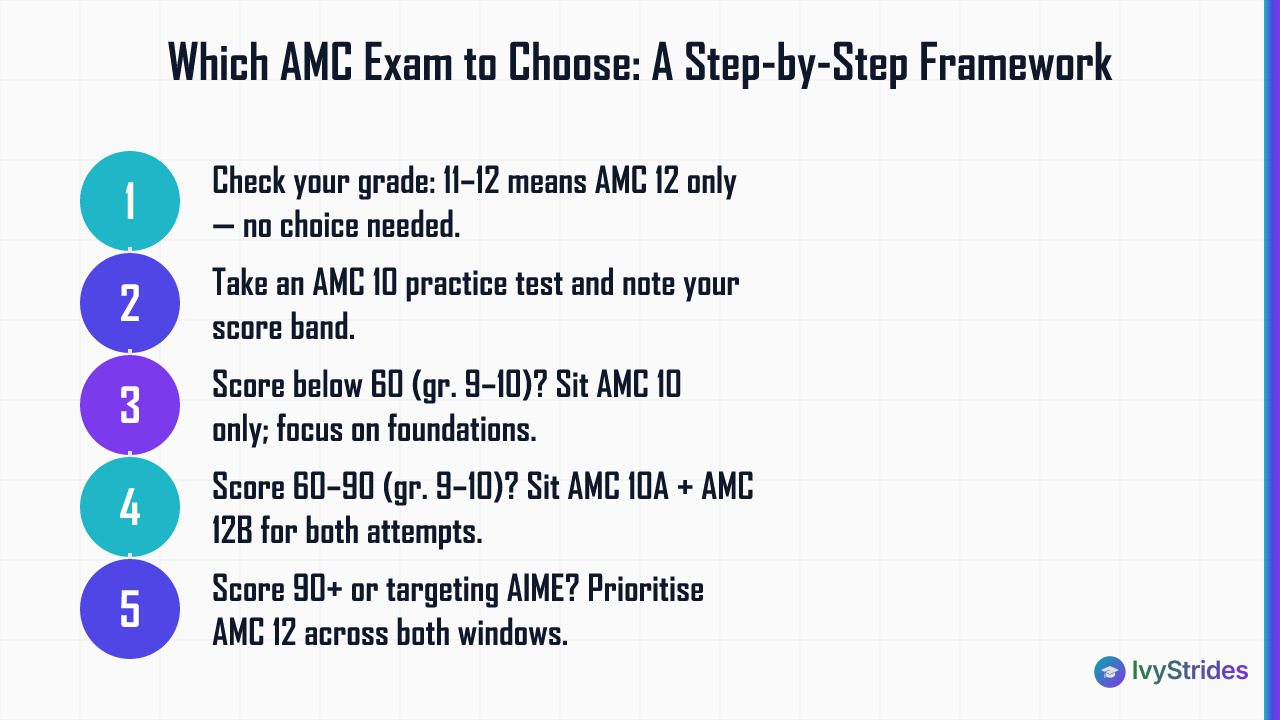
Your current AMC 10 practice score, paired with your grade, decides the exam. The framework below converts the comparison above into a concrete pick. Grade sets a hard constraint first: a student in grade 11 or 12 is ineligible for the AMC 10, so the AMC 12 is the standard exam for those grades, and that is not a disadvantage.
For everyone eligible for both, the score band drives the call. In our coaching, students in the 60-to-90 AMC 10 practice band benefit most from the A/B sitting strategy, because it gives them a realistic AMC 10 attempt and an ambitious AMC 12 attempt without wasting a sitting.
| Current AMC 10 Practice Score | Grade | Recommended Exam(s) | Preparation Focus |
| Below 60 | 9-10 | AMC 10 only | Foundational algebra, geometry |
| 60-90 | 9-10 | AMC 10A + AMC 12B | Shared core, then trig/logs |
| 90+ | 9-10 | Prioritise AMC 12 | Complex numbers, advanced algebra |
| Any | 11-12 | AMC 12 (only option) | Full AMC 12 syllabus |
| 90+, AIME goal | 9-12 | AMC 12, both windows | Speed on core, AMC 12 topics |
Score-band guidance reflects IvyStrides coaching observations across AMC 10/12 students; syllabus additions per MAA. AIME outcomes are never guaranteed and cutoffs change annually.
The preparation focus shifts by exam. An AMC 10-only student spends their time on the shared algebra, geometry, number theory, and probability core. A student aiming at the AMC 12 has to add trigonometry, logarithms, and complex numbers on top of that same core, which is real additional study, not a swap. Families building a longer-term profile around competition math can pair this with our college counseling for grades 9 and 10.
FAQ: AMC 10 vs AMC 12 Scores and Eligibility
Can I take both AMC 10 and AMC 12?
Yes, but not on the same day. The MAA prohibits sitting both exams on a single date. An eligible student can sit the AMC 10 in the A window and the AMC 12 in the B window, or reverse it, which gives two attempts with two different exams in the same year.
Is AMC 10 A or B harder?
Neither version is officially harder. The A and B sittings cover the same syllabus and use the same 6/1.5/0 scoring. Difficulty shifts slightly year to year with the specific problem set, and the MAA sets AIME cutoffs separately for each version after the contest.
Is 100 on AMC 10 good?
A score of 100 on the AMC 10 is a strong result, placing a student well above the median and often right around the AIME qualification cutoff, which in recent years has ranged from roughly 94 to 108 depending on the version. It signals readiness to attempt the AMC 12 through the A/B strategy.
What is a good score for AMC 10?
For most students, scoring above 60 is above average, and scoring above 90 puts a student in AIME-contention range. Recent AIME cutoffs have sat around 94 to 108 depending on the A or B version. In our coaching, students targeting AIME via the AMC 10 aim for consistent practice scores above 90 before the contest date.
Your Next Step on the AMC 10 vs AMC 12 Decision
The choice comes down to three inputs: your grade, your current practice score, and whether AIME qualification is a realistic near-term goal. Grade rules out the AMC 10 for 11th and 12th graders. Score band tells everyone else whether to sit the AMC 10, the AMC 12, or both across the A and B windows.
- Take a full-length AMC 10 practice test and record your raw score.
- Map that score to the band table above and note your grade constraint.
- If you land in the 60-to-90 band, plan the A/B sitting strategy.
- Study the shared core first, then add the AMC 12-only topics if you are targeting that exam.
- Verify current-year eligibility ages and AIME cutoffs at maa.org before you register.

Two decades teaching quantitative and verbal aptitude on standardized tests. Rare dual expertise across Math and Verbal — particularly effective for students with gaps on both sides. Senior AP Mentor for our Calculus and English tracks.