
How to Edit and Revise Your College Essay (Without Losing Your Voice)
On this page
- What Editing a College Essay Actually Means (And Why It Is Different From Other Writing)
- The Four-Pass Revision Framework: How to Edit a College Essay in the Right Order
- How to Check Your Essay's Structure Without Losing the Story
- The Voice Pass: How to Make Sure Your Essay Still Sounds Like You
- Can Someone Else Edit Your College Essay? What Is and Is Not Appropriate
- Line Editing and Cutting: How to Trim Your Essay to the Word Limit Without Losing Meaning
- A College Essay Editing Checklist: What to Verify Before You Submit
- Frequently Asked Questions About Editing a College Essay
- Can I change my college essay after I submit it?
- Can I use ChatGPT to edit my college essay?
- What are the 5 D's of college essays?
- What is the 10% rule, and does it apply to college essays?
- Who can ethically edit my college essay?
- How do I edit a college essay quickly if I'm running out of time?
- How much do people charge to edit college essays?
- How does this connect to my broader admissions plan?
To edit a college essay well, work in four passes in this order: structural (does it answer the prompt and tell a coherent story?), voice (does every sentence sound like you?), line-level (cut filler and tighten sentences), and proofreading (grammar, spelling, punctuation). Wait at least 24 hours after finishing a draft before starting Pass 1. Read the essay aloud during Pass 2. The Common App personal statement has a 650-word maximum, and most strong essays land between roughly 550 and 650 words.
The word limit and prompt list come from the Common App's official 2025-2026 announcement, which confirmed the seven personal statement prompts are unchanged from the prior cycle. The harder part, and what the rest of this article addresses, is what no word counter can help with: making the essay tighter without polishing your voice into someone else's.
What Editing a College Essay Actually Means (And Why It Is Different From Other Writing)
Editing isn't one activity. It's three, and treating them as one is why most drafts get worse before they get better.
Structural revision is about the shape of the essay: does each paragraph earn its place, does the story have a beginning, middle, and end, does it answer the prompt you chose? Line editing is sentence-level work: cutting filler, replacing passive constructions, tightening rhythm. Proofreading is the last mile: commas, homophones, verb tense, spelling.
Almost every student proofreads first. You catch a comma error in paragraph two, fix it, then realize forty minutes later that paragraph two shouldn't exist. All that comma work was wasted. Structural revision has to come first because it's the only pass that decides which sentences survive.
The stakes here also differ from a term paper. Your English teacher reads one essay from you. An admissions reader at a large university may read dozens of essays a day during peak season. Generic writing, no matter how clean the grammar, is invisible in that stack. Specificity and authentic voice are what make a reader remember the applicant.
One caveat before you start: at test-optional schools, the personal statement often carries additional weight in the admissions file, making a specific, authentically voiced essay even more important. Test-optional policies vary by school and year, so check each college's current policy on their admissions page or through FairTest.
If you're still in the drafting phase rather than the revision phase, our step-by-step guide on how to write a personal statement walks you through building a strong first draft before you begin editing.
The Four-Pass Revision Framework: How to Edit a College Essay in the Right Order
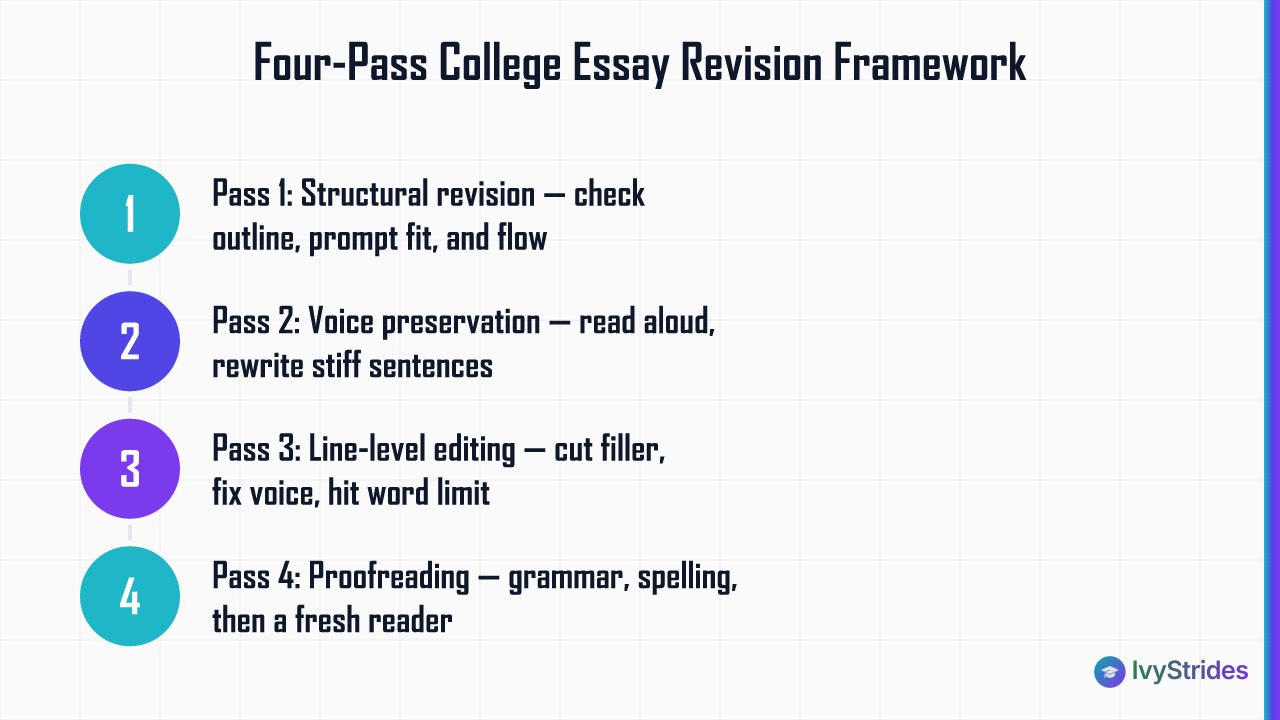
Here's the sequence. Each pass has a single job. Don't multitask.
Pass 1: Structural revision (24 to 48 hours after finishing your draft). Print the essay or view it in a new format. Read it once without editing. Then extract the first sentence of each paragraph, paste those sentences alone into a new document, and read them as a sequence. That's your skeletal outline. If those sentences don't tell a coherent mini-story on their own, the essay has a structural problem no line edit can fix. Ask: Does the essay answer the exact prompt I chose? Is there a clear before-state, a specific moment, and an after-state that shows growth or insight? Should any paragraph be cut, moved, or expanded?
Pass 2: Voice preservation. Read the entire essay aloud. Not in your head. Out loud. Every place you stumble, every sentence that sounds like a term paper or a college brochure, mark and rewrite in your natural speech. This is the pass where drafts most often get flattened, so it's the one to protect most carefully.
Pass 3: Line-level editing. Now you cut. Delete filler phrases, convert passive to active voice, remove redundant transitions. If you're over 650 words for the Common App personal statement, this is where you get under. If you're writing a supplemental essay with a 150 to 350 word limit, the pressure here is heavier, and every sentence needs to carry specific information about that school, program, or community.
Pass 4: Proofreading. Grammar, spelling, punctuation, homophones. Then, and only then, a fresh reader for a final clarity check.
The 650-word Common App limit is a hard cap. Essays over the limit cannot be submitted through the platform, per the Common App's official guidance. Aim to land between roughly 550 and 650. If you're at 700, you'll cut about 50 words in Pass 3, which is closer to 7% of the draft, not the classic 10% cutting rule. Apply the 10% rule at the paragraph level instead: no single paragraph should exceed roughly 10% of total essay length, so in a 650-word essay, cap paragraphs around 65 to 80 words.
If you want a coach to walk through these passes with you in real time, our one-on-one help for common app essay pairs you with an essay specialist who asks questions rather than rewriting your sentences.
How to Check Your Essay's Structure Without Losing the Story
Structural revision is diagnostic work. You're not writing new material yet. You're asking whether the material you already have does what it needs to do.
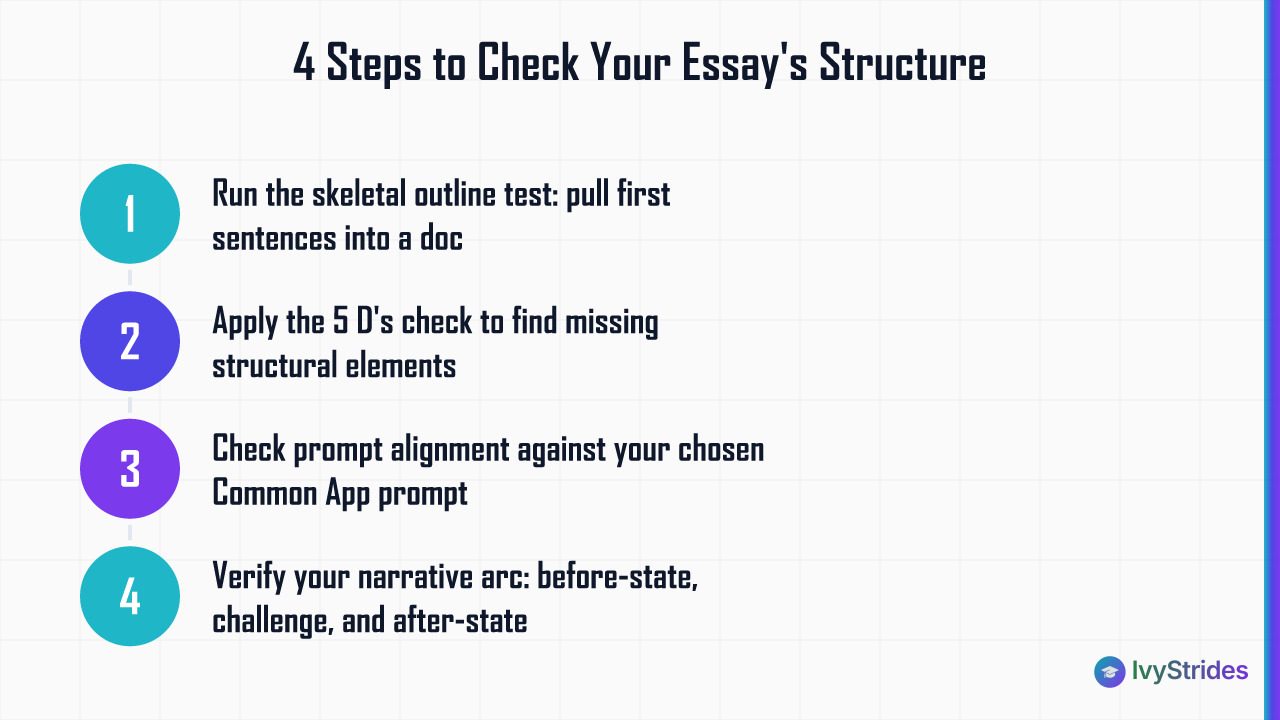
Start with the skeletal outline test from Pass 1. Pull the first sentence of every paragraph into a new document. Read them in order. In a well-structured essay, those sentences should read like a coherent summary of the narrative. If they read like a random collection of thoughts, your paragraphs aren't carrying their weight, and you'll need to rewrite topic sentences or restructure.
Next, run the 5 D's check. This is a framework we use in essay coaching to make sure a draft is doing the five things a strong college essay has to do:
-
Define your topic or central experience clearly. What is this essay actually about?
-
Describe a specific moment or scene, not a general pattern. A single Saturday afternoon beats "throughout high school."
-
Demonstrate growth or insight. What did you learn or how did you change?
-
Distinguish yourself with details only you could provide. Could another applicant have written this same paragraph?
-
Deliver a clear takeaway that connects the experience to who you are now.
If your draft is missing any of the five, that's your structural revision priority.
Then check prompt alignment. Re-read the exact Common App prompt you chose from the seven 2025-2026 prompts. Does every paragraph connect back to it, even indirectly? Essays that drift off-prompt are one of the most common revision issues.
Finally, check the narrative arc. Can you identify a before-state, a specific moment or challenge, and an after-state showing insight or growth? In our coaching with students, the single most common structural problem is an essay that describes an activity thoroughly but never reveals what the student actually learned or how they changed. The activity isn't the story. The change is the story.
For students who have a near-final draft and want a single round of expert feedback, our essay review service provides a detailed written critique you can act on immediately.
The Voice Pass: How to Make Sure Your Essay Still Sounds Like You

This is the pass students fear most. And with good reason. Voice is the hardest thing to preserve when multiple people are giving you feedback, and it's the easiest thing to destroy accidentally.
Two tools work better than anything else here.
Reading aloud. Not silently, not in your head. Out loud, at normal speaking speed. Every sentence that makes you stumble, sounds stiff, or reads like a term paper gets rewritten. If you would never say "throughout my formative years" in conversation, that phrase shouldn't be in your college essay. Reading aloud is the single most reliable voice-preservation test we've seen.
The thumb test. Cover your name on the essay. If a stranger read it, could they identify it as yours based only on the specific details and the way the sentences sound? Would any other applicant with a similar background have written the same paragraphs? If the answer is yes, your essay is generic, no matter how well-written it is on the sentence level.
Specificity is the strongest voice signal. "I love science" is generic. "I spent three Saturdays debugging a pH sensor for my school's water-quality project" is specific, voice-bearing, and something only you could have written. In our coaching with students, essays that have gone through five or more rounds of adult feedback often lose exactly these idiosyncratic details, which were what made the original draft interesting in the first place.
Admissions readers also notice when the vocabulary and sentence structure in an essay don't match the rest of the application. If your recommendation letters describe a sixteen-year-old and your essay reads like a 42-year-old with an MFA wrote it, that mismatch registers. Not always consciously. But it registers.
One more warning: if you find yourself on revision round seven, and each round is smoothing out more of what made the essay feel like you, stop. Over-editing is real. A slightly rougher, more specific essay in your voice will outperform a highly polished, generic one every time.
For students who want structured voice-preservation feedback, our common app essay tutor coaches are trained to ask questions rather than rewrite sentences, which is the entire point.
Can Someone Else Edit Your College Essay? What Is and Is Not Appropriate
Short answer: yes, you can have someone else help you edit, and it isn't unethical if the boundaries are clear. The essay must remain your own work, in your own voice, expressing your own ideas. Outside help is appropriate when it takes the form of questions and suggestions. It crosses the line when someone rewrites your sentences in their voice and you submit that language as yours.
Here's how to think about each type of outside editor.
Peers. Useful for the thumb test and the "does this sound like you?" question. Peers usually aren't strong on grammar or structural revision, but they're often the best voice-check readers you have.
Parents. Handle with care. In our coaching with students, parent edits are one of the most common sources of voice loss. Parents mean well, but they tend to make essays sound more formal, more grammatically conservative, and more adult. Reddit's college-admissions forums are full of students describing exactly this pattern. If a parent wants to help, ask them to mark places where they were confused or wanted more detail, not places where they'd phrase things differently.
School counselors. Often excellent for structural and prompt-alignment feedback. Time-constrained during application season, but a great first outside read if you can get it.
Professional essay coaches. Should ask questions and offer options, not rewrite for you. A good coach will say "What do you mean by this sentence?" or "What's the specific moment behind this general statement?" A coach who hands back a revised draft with their own sentences replacing yours isn't coaching, they're ghostwriting, and admissions offices have gotten better at detecting the difference.
AI tools like ChatGPT. Legitimate but limited use. AI can flag grammar errors, catch homophones, and identify awkward sentence structures. It can't evaluate whether an essay sounds authentically like you, and it can't judge admissions fit. The bigger risk: AI rewrites tend toward polished, generic prose that strips out the specific details that make an essay memorable. Admissions readers are increasingly familiar with AI writing patterns, and heavily AI-edited essays are easier to spot than students realize. Use AI as a grammar checker. Don't use it as a rewriter.
For structured feedback from a coach who works within these boundaries, our essay review service delivers a single detailed written critique. Students who want multiple rounds of coaching through the revision process can look at our one-on-one help for common app essay.
Line Editing and Cutting: How to Trim Your Essay to the Word Limit Without Losing Meaning
Line editing is where students often either save their essay or accidentally strip out what made it good. The rule: cut words, not ideas.
Start with the filler-phrase hit list. Search your document for each of these and delete or replace:
- "In conclusion,"
- "I have always believed"
- "Throughout my life"
- "This experience taught me that"
- "I am passionate about"
- "Ever since I was young"
- "It goes without saying"
- "Needless to say"
Every one of these phrases either states the obvious or wastes words on setup. Cut them and rewrite the sentence to start with the actual content.
Next, convert passive to active voice wherever possible. "The project was completed by our team" becomes "Our team completed the project." That's a two-word savings and a clarity gain in a single edit. Do this everywhere.
Search for the word "very" and delete every instance. Do the same with "really," "just," "actually," and "quite." These words almost never add meaning. "I was very excited" becomes "I was excited," or better, gets rewritten to show excitement through action or detail.
Cut redundant transitions. "As a result," "For example," and "In addition" are often unnecessary when the logical connection is already clear from the sentences themselves.
For the Common App personal statement, the 650-word ceiling is a hard limit. In our coaching with students, cutting a 700-word draft down to 650 almost always improves the essay, because the cutting pressure forces the student to identify which sentences are doing real work and which are just filling space.
For supplemental essays, the pressure is heavier. A 250-word "Why this school?" essay has no room for setup. Every sentence has to carry specific information about that school, that program, or that community. Named professors, named courses, named clubs, named traditions. Generic praise of a school's "welcoming community" or "strong academics" is dead weight at any word count.
If you're building a broader admissions plan alongside essay work, our sat study guide pdf covers how to sequence testing and essays without burning out.
A College Essay Editing Checklist: What to Verify Before You Submit
Run through this checklist in order. Structural items first, submission items last.
Structural check:
- The essay answers the specific Common App prompt I selected
- I can identify a before-state, a specific moment, and an after-state
- The 5 D's are all present (Define, Describe, Demonstrate, Distinguish, Deliver)
- No paragraph exceeds roughly 10% of total essay length
- The skeletal outline (first sentence of each paragraph) reads as a coherent sequence
Voice check:
- I read the essay aloud and didn't stumble on any sentence
- The thumb test passes: someone who knows me could identify this as mine
- The essay contains specific details only I could provide
- No sentence sounds like a 40-year-old wrote it
Line-edit check:
- Word count is at or under 650 for the Common App personal statement
- Supplemental essays are within each school's stated limit
- Filler phrases ("very," "really," "just," "in conclusion") have been searched and cut
- Passive voice converted to active where possible
Proofreading check:
- Homophones checked (their/there/they're, its/it's, your/you're)
- No comma splices or run-ons
- Verb tense is consistent within each section
- Spelling verified (don't rely only on autocorrect)
Submission check:
- Confirmed word count in Common App's actual submission preview, not just your word processor
- Formatting is plain text; the Common App does not preserve bold, italics, or special formatting
- One fresh reader has done a final clarity-only read
- The Additional Information section (300 words for 2025-2026, per Common App) is separate from the personal statement and should be used only if you have context that materially helps your application
Two important notes on submission mechanics. Once you submit to a specific college through Common App, that version of your essay is permanently locked for that college. You can't revise after submission for that school. If you haven't yet submitted to other schools on your list, though, you can still revise the essay and those schools will receive the updated version. That's why some students apply to a lower-priority school first as a live test of their essay before submitting to reach schools.
Our free downloads page has additional planning worksheets if you want a printable version of this checklist.
Frequently Asked Questions About Editing a College Essay
Can I change my college essay after I submit it?
Once you submit to a specific school through Common App, that version is permanently locked for that school. If you haven't yet submitted to other schools on your list, you can revise the essay and those schools will receive the updated version. Some students deliberately apply to a lower-stakes school first to see whether their essay reads well in the actual Common App submission format before sending to reach schools.
Can I use ChatGPT to edit my college essay?
AI tools can catch grammar errors, flag awkward sentence structures, and check for basic clarity issues. Where they fail: judging whether the essay sounds like you and evaluating admissions fit. AI rewrites tend toward polished, generic prose, which is the opposite of what admissions readers respond to. Use AI as a grammar checker. Don't use it as a rewriter. Admissions offices are increasingly familiar with AI writing patterns.
What are the 5 D's of college essays?
The 5 D's are a revision framework: Define your topic clearly, Describe a specific moment rather than a general pattern, Demonstrate growth or insight, Distinguish yourself with details only you could provide, and Deliver a clear takeaway that connects the experience to who you are now. During structural revision, check whether your essay hits all five. Missing any of them is your priority to fix.
What is the 10% rule, and does it apply to college essays?
The 10% rule suggests no single paragraph should exceed roughly 10% of total essay length. In a 650-word Common App essay, that caps individual paragraphs around 65 to 80 words. Use it as a diagnostic: if one paragraph is running 150 words while others are 80, that paragraph is probably doing too much work and should be split or trimmed.
Who can ethically edit my college essay?
Peers, parents, school counselors, and professional coaches can all give feedback, as long as the feedback comes as questions and suggestions rather than rewrites. Your voice, your ideas, and your story must remain entirely your own. The ethical line is crossed when an adult rewrites sentences in their own voice and you submit that language as yours. If someone else's phrasing shows up unchanged in your final draft, that's ghostwriting, not editing.
How do I edit a college essay quickly if I'm running out of time?
Prioritize Pass 1 (structural) and Pass 2 (voice) over line editing and proofreading. A clear, authentic essay with a few minor grammar errors outperforms a polished but generic one. Cut the most obvious filler phrases, confirm you're under the word limit, do one read-aloud pass, and submit. Perfectionism past a certain point produces diminishing returns.
How much do people charge to edit college essays?
Costs vary widely. Free options include school counselors and peers. Independent coaches often charge roughly $50 to $150 per session. Full-service packages from established programs can run $500 to several thousand dollars. IvyStrides offers a free strategy call as a starting point, so families can see the essay's specific issues before committing to a service. See our about page for how we structure essay coaching.
How does this connect to my broader admissions plan?
Your essay is one part of a connected admissions strategy. If you're also managing SAT, ACT, or AP prep alongside application season, our ap sat act testing plan shows how to sequence everything without burning out. And if you're still in the drafting phase, start with how to write a personal statement before returning here for revision.
One caveat that applies to all of the above: admissions outcomes depend on the full application, not the essay alone. A strong essay strengthens your file. It doesn't, on its own, determine an admission decision.
Editing well is a skill separate from writing well. The four-pass framework exists because the passes protect each other: structural work first so you don't polish sentences you're about to cut, voice work before line editing so you don't smooth over what makes the essay yours, proofreading last so it's the last thing a reader sees. Follow the order, guard your voice, and know when to stop.

Award-winning author (South Asian Book Award) and graduate of BITS Pilani and UCLA Luskin School of Public Affairs. Brings a published writer's eye to Common App essays and grammatical precision to SAT and ACT R&W instruction.