
When to Request PSAT Accommodations, and What Carries to the SAT
On this page
- PSAT Accommodations Deadline: The 7-Week Window You Cannot Miss
- What Documentation College Board Needs for PSAT Accommodations
- How Long the PSAT Takes With Extended Time Accommodations
- Which PSAT Accommodations Carry Over to the SAT
- FAQ: PSAT Accommodations Deadline and Process
- How long does it take for the College Board to approve accommodations?
- Does ADHD qualify for SAT accommodations?
- Do IEP students get extra time on SAT?
- Can you get accommodations for PSAT?
- Your Next Step on PSAT Accommodations
The PSAT accommodations deadline, the date by which College Board must receive the request and any required documentation, falls about 7 weeks before your school's testing week. A PSAT accommodation is an approved testing adjustment, like extended time, granted by College Board's Services for Students with Disabilities (SSD) office. Most requests go through your school's SSD coordinator, though a family can also apply directly. Once approved, accommodations almost never need a new request for the SAT.
Those timing and process rules come from the College Board accommodations portal. The rule to know first: a school IEP or 504 plan does not equal a College Board approval, so even a student with one must submit a request.
PSAT Accommodations Deadline: The 7-Week Window You Cannot Miss
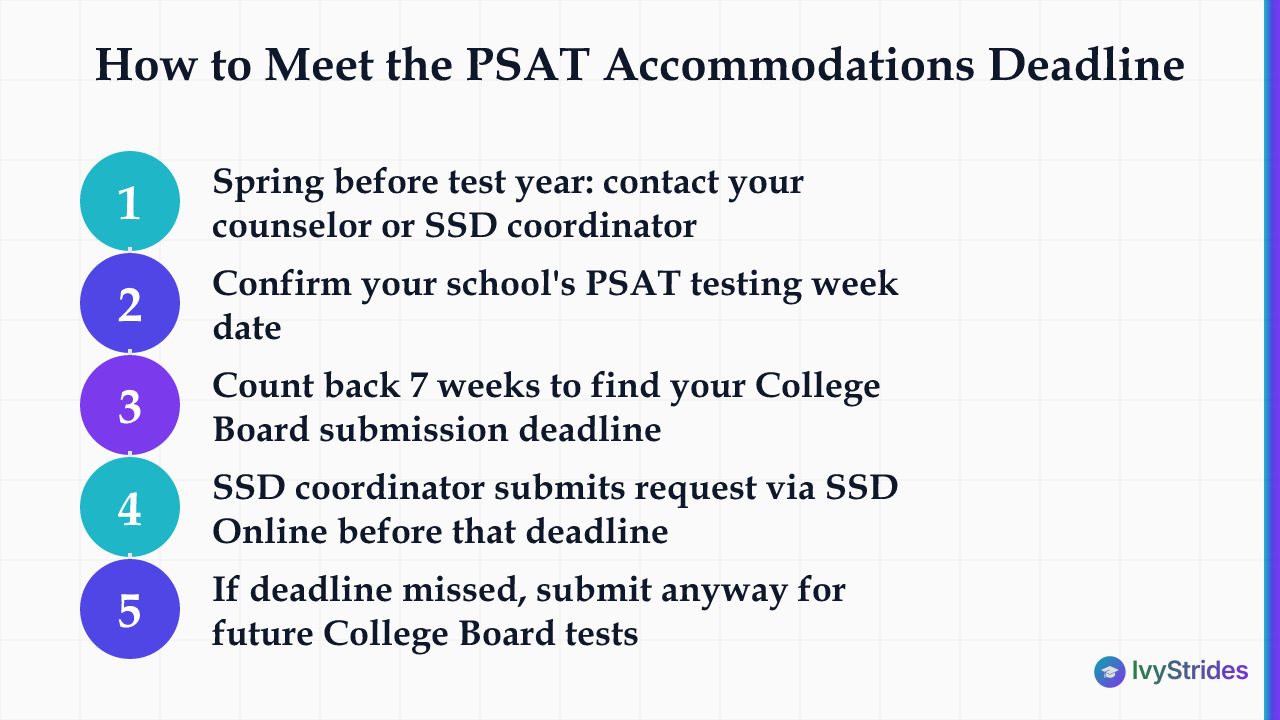
The PSAT accommodations deadline is about 7 weeks before your school's testing week, and by then the request must already be at College Board. College Board warns that the approval process can take up to seven weeks, plus another seven if more documentation is required, and that after a missed deadline, accommodations might not be approved or in place on test day. As of October 2026, every fall 2026 PSAT/NMSQT request deadline (August 10 to September 8) has passed, so the next requests to plan are for the spring 2027 PSAT 10 and PSAT 8/9, due between January 11 and March 8, 2027.
College Board recommends requesting through the school: your SSD coordinator, a counselor or other educator registered with College Board, submits the request through SSD Online, which families cannot use. A family can apply directly with the paper Student Eligibility Form, but must then always include documentation, and College Board calls the school route the fastest and most efficient.
Count back, then start earlier. Schools give the PSAT/NMSQT in a fall testing window, October 1 to 30 in 2026, so a school testing October 12 to 17 needed the request at College Board by August 24, 2026. For the PSAT/NMSQT, College Board advises starting with the counselor or SSD coordinator in the spring of the previous school year, well before summer recess.
| Your school's testing week | Request and required documentation due at College Board | Start the SSD process at school by |
| October 1 to 2, 2026 | August 10, 2026 | Spring of the prior school year |
| October 5 to 9, 2026 | August 17, 2026 | Spring of the prior school year |
| October 12 to 17, 2026, including the Saturday PSAT/NMSQT date | August 24, 2026 | Spring of the prior school year |
| October 19 to 23, 2026 | August 31, 2026 | Spring of the prior school year |
| October 26 to 30, 2026 | September 8, 2026 | Spring of the prior school year |
| Spring 2027 PSAT 10 or PSAT 8/9, March 1 to April 30, 2027 | January 11 to March 8, 2027, depending on the week | As early as possible |
If you have already missed a deadline, submit anyway. College Board's advice is to submit the request as soon as possible; an approval granted less than 14 days before test day may not be available for that test, but you may use it for future College Board tests, including the SAT. The March 6, 2027 SAT, for example, has a January 15, 2027 accommodations deadline.
Counting back works only once you have your school's date fixed, so start with the 2026 PSAT dates and school registration schedule to anchor that subtraction. Picturing what an extended-time grant actually adds is easier once you know how College Board structures and times the PSAT.
What Documentation College Board Needs for PSAT Accommodations

Photo by Centre for Ageing Better on Pexels
A school IEP or 504 plan is a starting point, not a College Board approval. College Board says students with an IEP or 504 plan must still request accommodations, though most students who receive accommodations at school and request them are approved. Section 504 and the ADA protect individuals with disabilities from discrimination, but for the PSAT/NMSQT and SAT, the operative gate is SSD approval.
In most cases, students requesting the same accommodations they use in school under a formal school-based plan are approved without further documentation, while families applying without the school must always submit it. Documentation must show that the student has a disability and needs the accommodations requested; College Board says a doctor's note is not sufficient. For PSAT accommodations planning, IvyStrides PSAT prep offers a free call that reviews your documentation against College Board's requirements, flags gaps, and maps the steps to your school's SSD submission deadline.
What College Board typically asks for varies by category. Psychiatric and anxiety documentation, for example, should be current because psychiatric disabilities can change over time, including an update from within the past year if the diagnosis is more than a year old. The table below is a general guide, not a promise of approval; requirements shift, so confirm the current rules at accommodations.collegeboard.org.
| Disability category | Typical documentation required | Key College Board note |
| ADHD | Current professional evaluation, diagnosis | IEP or 504 is not automatic approval |
| Anxiety / psychiatric | Initial evaluation, plus an update from the past year if the diagnosis is over a year old | Test anxiety alone usually does not qualify |
| Reading disability | Full evaluation report with standardized subtest scores | A reader or text-to-speech request needs a comprehensive reading assessment |
| Physical disability | Medical documentation of the condition | May need specifics on the barrier |
| Learning disability | Full evaluation with test scores, testing no more than five years old | Extended-time requests need timed and untimed or standard-time measures |
Every request begins with a signed Parent Consent Form, often the only form a family needs when the school submits, and SSD cannot review a request until all required documentation is received. Gather it first.
How Long the PSAT Takes With Extended Time Accommodations
The standard PSAT/NMSQT runs 2 hours and 14 minutes of testing across 98 questions, and extended time lengthens that testing time: approval in reading covers the whole test, while approval in math calculation alone covers only the Math section. The PSAT/NMSQT has 98 questions total: 54 in Reading and Writing over 64 minutes, and 44 in Math over 70 minutes.
Because that standard timing is fixed, you can picture exactly what an approval adds. College Board's extended-time FAQ lists testing times for two levels, up to time-and-a-half (+50%) and up to double time (+100%), each plus breaks.
Use College Board's published times, not multiplication. The FAQ gives 3 hours and 22 minutes with time-and-a-half, including 106 minutes for Math, not the 105 a 1.5 multiplier gives, and 4 hours and 28 minutes with double time. College Board's PSAT accommodations page gives 3 hours and 21 minutes for time-and-a-half, one minute less than the FAQ, so confirm the figure on College Board's accommodations site before you plan the day.
| Accommodation | Reading and Writing time | Math time | Total testing time |
| Standard | 64 min | 70 min | 2 hr 14 min |
| Time-and-a-half (+50%) | 96 min | 106 min | about 3 hr 22 min (3 hr 21 min on the PSAT accommodations page) |
| Double time (2x) | 128 min | 140 min | about 4 hr 28 min |
On SAT Suite tests, including the PSAT/NMSQT and the SAT, extended time also brings extra breaks; extended breaks and breaks as needed are separate accommodations, and break time does not count as testing time. College Board lists the same times for the SAT, so these figures hold when you weigh how the PSAT and SAT compare in format and difficulty.
Which PSAT Accommodations Carry Over to the SAT
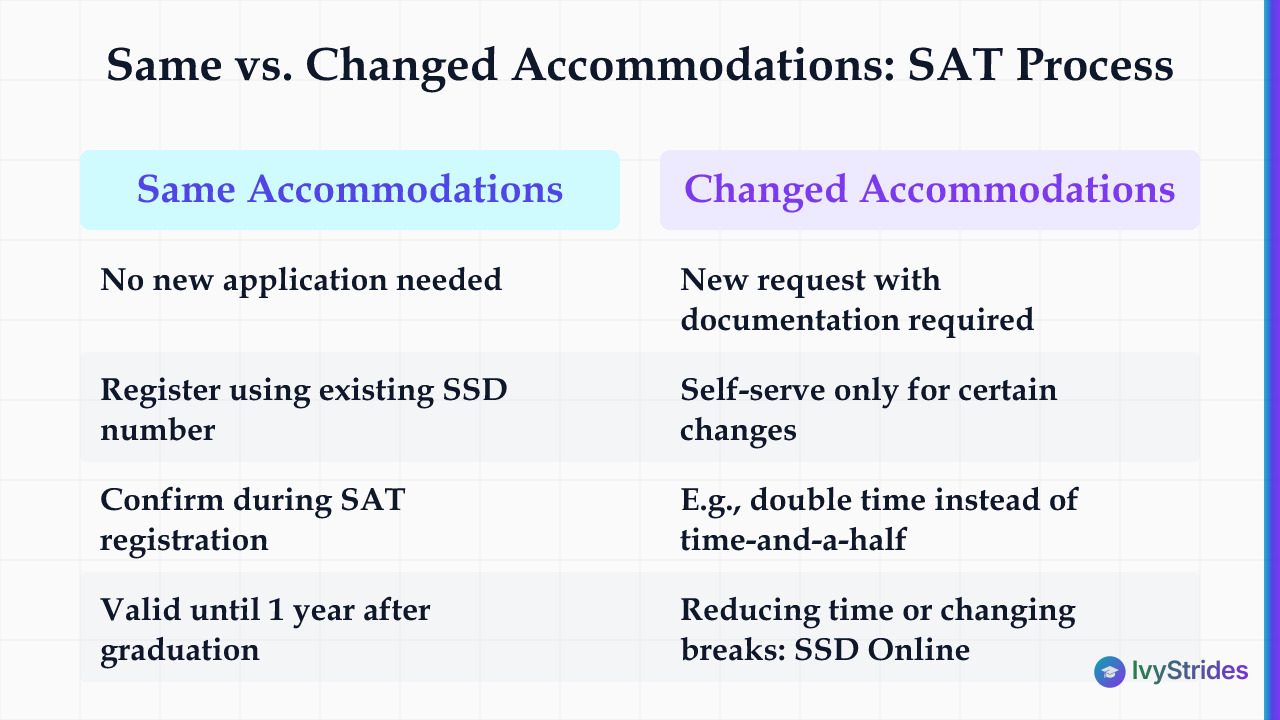
Because the PSAT and SAT share the same College Board approval system, a student whose PSAT accommodations are approved does not need to reapply for the SAT. College Board says a new SAT request is probably not needed if you ask for the same accommodations; you register with your SSD number and confirm them during registration. School-based accommodations, such as a screen reader or dictation, usually mean taking the SAT at your own school.
That carry-over is not permanent, though. Approved accommodations remain in effect until one year after high school graduation unless College Board is told the student no longer needs them. Asking for more, say double time instead of time-and-a-half, takes a new request with supporting documentation; only certain changes, such as reducing extended time or changing the type of breaks, are self-serve in SSD Online.
Colleges are not told. College Board says that when colleges receive SAT scores, they won't know if a student took the SAT with accommodations.
With the administrative side settled, the work shifts to preparation. Before your PSAT, run this quick carry-over check:
-
Confirm your approval letter from College Board's SSD office is in hand.
-
Note the accommodation type granted (extended time, breaks, technology).
-
Tell your SSD coordinator you plan to test with accommodations so the school can make arrangements.
-
Check that your approval has not hit the one-year post-graduation expiry.
-
Tell your SSD coordinator if your needs have changed since approval.
-
Plan your prep around your full, approved time allocation.
Once accommodations are confirmed for both tests, your PSAT score becomes a baseline for setting a realistic SAT target. From there, a junior's priority is a prep plan that uses the full time allocation effectively, and College Board advises taking a practice test with your approved accommodations.
FAQ: PSAT Accommodations Deadline and Process
How long does it take for the College Board to approve accommodations?
Once College Board receives all documentation, a new request may take up to seven weeks; College Board says timing depends on whether the school submits it and whether the student already has the same accommodation for school and state tests. Aim well before the published deadline, the date by which College Board must already have the request and documentation.
Does ADHD qualify for SAT accommodations?
Yes, ADHD can qualify for College Board accommodations, including extended time. A school IEP or 504 plan listing ADHD is a starting point, not an automatic approval. When College Board reviews documentation, it expects a diagnosis by a credentialed professional and educational testing generally no more than five years old.
Do IEP students get extra time on SAT?
An IEP does not transfer directly to a College Board approval, so the student must still request accommodations. College Board says most students who receive accommodations at school and request them are approved, in most cases without further documentation when the request matches a formal school plan, and approval must come before the test.
Can you get accommodations for PSAT?
Yes. The PSAT/NMSQT uses the same College Board SSD approval system as the SAT. Common accommodations include extended time, extra breaks, and assistive technology. Most requests go through your school's SSD coordinator, and College Board must receive the request and any required documentation about 7 weeks before the school's testing week.
Your Next Step on PSAT Accommodations
The accommodations process is administrative, but the clock is real, and a missed deadline can mean testing without approved accommodations on a score that feeds National Merit and SAT planning.
- Contact your school's SSD coordinator this week, before anything else.
- Ask how much lead time the school needs before College Board's published deadline.
- Gather your current professional documentation now, not after.
- Confirm your request and documentation reach College Board by the published deadline for your school's testing week.
- Once approved, build a prep plan that uses your full allotted time.

Rajesh is a technology leader, entrepreneur, and angel investor with 28+ years in Business & Technology Leadership and Product & Solution Engineering. He is passionate about education, mentoring, and driving digital transformation.