
Yale GPA Requirements: What the Transcript Shows That a GPA Can't
On this page
- Yale GPA Requirements: The Number Yale Does Not Publish
- What Yale's Eight Very Important Factors Say About GPA
- Can You Get Into Yale With a 3.5 or 3.8 GPA? What the Numbers Actually Mean
- How to Build a Yale-Competitive Transcript Before You Apply
- FAQ: Yale GPA Requirements
- Can you get into Yale with a 3.5 GPA?
- Can I get into Yale with a 3.8 GPA?
- Can you get into Yale with a 4.0 GPA?
- What is the lowest GPA you can get into Yale with?
Yale has no published minimum GPA. The high school transcript is the single most important document in the application, and Yale reads it for course rigor and consistent performance across subjects, not a raw number.
Yale's admissions officers say they "can't pinpoint a minimum GPA," because grades "can mean very different things in different contexts" (Inside the Yale Admissions Office). So Yale reads every transcript against the courses the student's own school offered (What Yale Looks For).

Yale GPA Requirements: The Number Yale Does Not Publish
Yale College publishes no minimum GPA and reports no GPA average for admitted or enrolled students. Yale states instead that the transcript is "the single most important document" and that it looks for students who "have consistently taken a broad range of challenging courses in high school and have done well" (What Yale Looks For). A GPA is one line on that document. The course list above it carries at least as much weight.
Why no cutoff exists. Yale judges each file in context, so no one is disadvantaged by what their school could not offer. A fixed GPA floor would contradict that: a 3.9 from a school with eight AP options reads differently from a 3.9 from a school with two. On Yale GPA requirements, IvyStrides' counselors review your course list and grade trend against Yale's Very Important factors and name which part of your academic file to address.
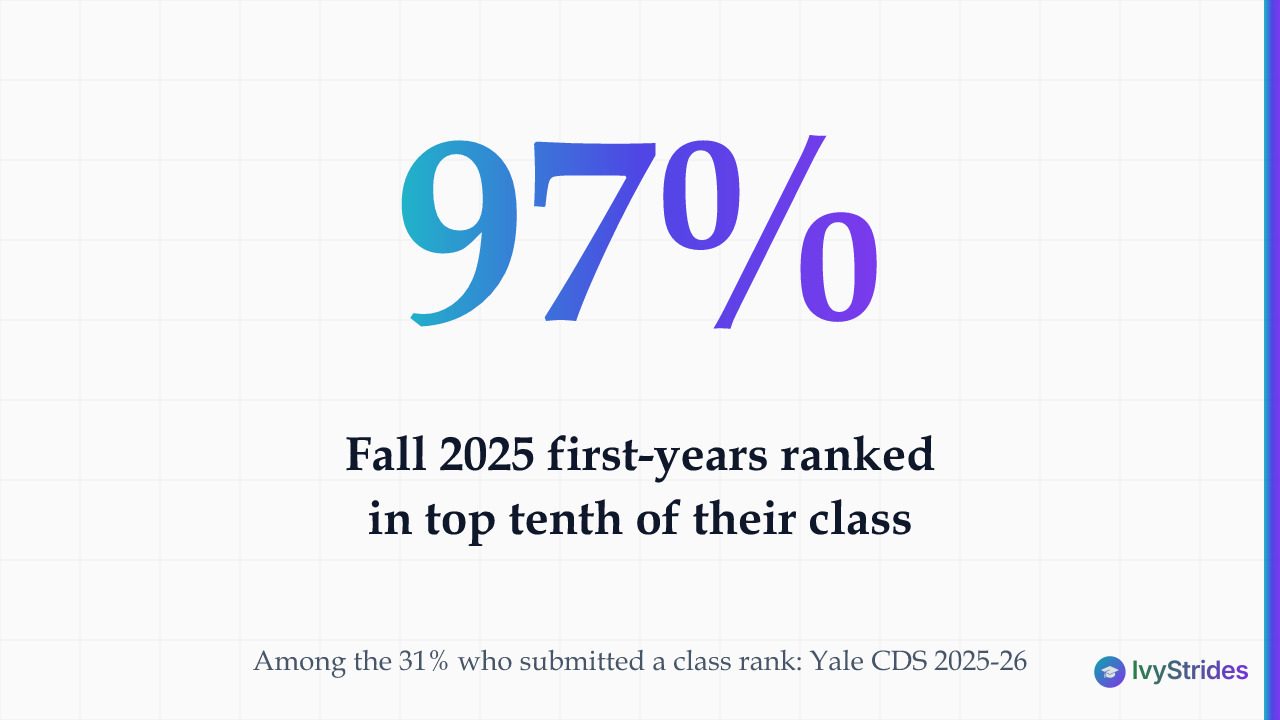
Yale's 2025-26 Common Data Set leaves its GPA items blank, and College Board's BigFuture profile shows 0% in every Yale GPA band (BigFuture). The CDS does report that 97% of fall 2025 first-years who submitted a class rank (31% did) were in the top tenth of their class, and that those who sent scores had a middle 50% of 1480 to 1560 on the SAT and 33 to 35 on the ACT (Yale CDS 2025-26). Treat those as enrolled-student data, not a target you must clear.
For the 2026-27 cycle (fall 2027 entry), Yale requires the SAT or ACT from first-year and transfer applicants, a change it announced on May 27, 2026 that ended its test-flexible policy (Yale testing policy; Yale News).
A strong score confirms the readiness your transcript already signals rather than compensating for a weaker one. If you're weighing whether a 1540 SAT score fits within Yale's competitive range, the answer depends on the rest of the file too.
| Factor | What Yale Publishes | Source |
| Minimum GPA | None published | Yale admissions |
| GPA average or distribution | Not reported (GPA items blank) | Yale CDS 2025-26 |
| SAT or ACT | Required, 2026-27 cycle (fall 2027 entry) | Yale testing policy |
| SAT middle 50% (enrolled fall 2025) | 1480 to 1560 | Yale CDS 2025-26 |
| ACT middle 50% (enrolled fall 2025) | 33 to 35 | Yale CDS 2025-26 |
What Yale's Eight Very Important Factors Say About GPA
Yale's Common Data Set rates eight factors "Very Important," and GPA is only one of them. The 2025-26 CDS lists these: rigor of secondary school record, class rank, academic GPA, application essay, recommendations, extracurricular activities, talent/ability, and character/personal qualities (Yale CDS 2025-26). Rigor of secondary school record and academic GPA both come straight off the transcript, so the transcript underpins two of the eight.
Yale's admissions officers "do not, for example, unweight or reweight grade point averages," and grades are "never fed into a formula or an algorithm" (What Yale Looks For). That sets Yale apart from the usual account of how selective colleges recalculate your GPA on their own scale: your weighted GPA is read against your school's own scale, beside the courses that produced it.
Rigor, in practice. "Rigor of secondary school record" means AP, IB, honors, and dual enrollment measured against what your school made available. In our college counseling, we see Yale read the counselor's school profile, so a student at a school with few AP offerings is not penalized for taking fewer.
Note on the test-score rating. Yale's 2025-26 CDS rated standardized test scores only "Considered," but Yale assigned that rating while the test-flexible policy was in effect. It may change in the next CDS now that the SAT or ACT is required for 2026-27 applicants, so read it as the 2025-26 rating only.
International applicants are read the same way: Yale seeks to understand "every applicant's transcript within its unique context," drawing on school reports and school profiles (Yale course selection), so a grade on a French 20-point scale is read on its own scale, not compared directly to a 4.0 US unweighted GPA. On how US colleges read non-US grading systems, the short version is that readers want the pattern, not a converted number.
| Admissions Factor | Yale's Rating (2025-26 CDS) |
| Rigor of secondary school record | Very Important |
| Class rank | Very Important |
| Academic GPA | Very Important |
| Application essay | Very Important |
| Recommendation(s) | Very Important |
| Extracurricular activities | Very Important |
| Talent/ability | Very Important |
| Character/personal qualities | Very Important |
Behind all eight sit Yale's two guiding questions: who is "likely to make the most of Yale's resources" and who "will contribute most significantly to the Yale community" (What Yale Looks For).
Can You Get Into Yale With a 3.5 or 3.8 GPA? What the Numbers Actually Mean

A lower unweighted GPA does not automatically disqualify an applicant, because Yale sets no cutoff, but it has to be explained. Yale's admissions officers want "consistently-strong grades" in the most rigorous coursework your school offers (Inside the Yale Admissions Office). A 3.5 would need exceptional course rigor, a compelling context, and standout strength across the other Very Important factors to stay in contention. A 3.8 leaves a smaller gap, and context does more of the work.
Context decides each case. A single lower grade matters less than the four-year pattern, so if you're worried about whether one B on an otherwise strong transcript changes how colleges read your GPA, Yale's officers answer directly: "one grade of B is not going to undo your application."
The perfect-GPA trap. A perfect GPA is not sufficient on its own. Yale's admissions officers say a straight-A student in the most rigorous curriculum is "still in the running with tens of thousands of others with similar academic profiles." A top GPA in an undemanding schedule is less competitive than a slightly lower one in the hardest curriculum a school offers, because Yale reads grades against the rigor behind them. In our work with applicants to selective colleges, the transcript review starts with the course list, not the GPA row.
Grade trends matter too. Yale looks for consistently strong grades, so a steady record of top grades reads well; where a record dips, a clear recovery in junior and senior years reads better than a continued slide. Test scores "play an important role in establishing your readiness," Yale says, but scores "on their own, do not represent the full measure" of an applicant's academic potential (What Yale Looks For).
| Unweighted GPA Band | Typical Context | What Yale's Review Weighs Most |
| Near-perfect | Grades alone do not set you apart | Rigor, essays, character |
| Near-perfect with one B | Not decisive on its own | Course rigor and grade trend |
| Several B grades | Needs a clear reason in context | Rigor, upward trend, school context |
| Uneven or lower grades | Hard to explain without strong context | Exceptional context required |
Yale publishes no GPA averages, so these bands describe how a context-based review reads a transcript, not a Yale cutoff.
How to Build a Yale-Competitive Transcript Before You Apply
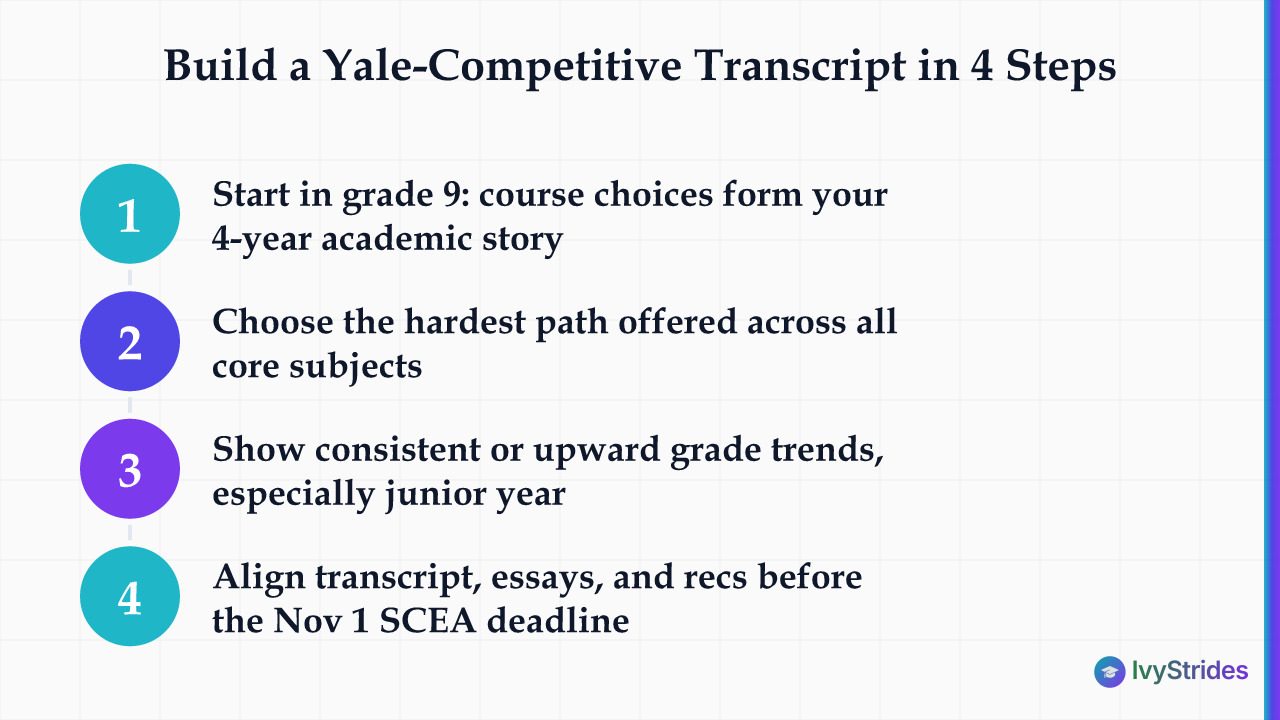
Building a Yale-competitive transcript means stacking course rigor, consistency, and intellectual depth across four years, not chasing a GPA number in senior year.
In our college admissions counseling, we begin the transcript review in grade 9, because a freshman's course choices surface four years later as the foundation of the academic story Yale reads. Building the transcript Yale wants is a four-year project, and a grade-by-grade college counseling plan from grade 9 through 12 maps each year's courses to the profile Yale reads.
Choose the hardest path your school offers. Yale looks for "the motivation to stretch one's capacities," which it says includes open-mindedness, curiosity, creativity, and an enterprising mindset (What Yale Looks For). On a transcript, that shows up as AP, IB, honors, or dual enrollment across subjects, not stacked in one strength.
The academic-interest essay Yale requires for 2026-27 is where the intellectual curiosity your transcript signals gets a voice, so the two documents should reinforce each other. Applicants choose up to three academic areas and write 200 words or fewer about a topic or idea that excites them (Yale essay topics). Yale's 2026-27 supplemental essays and where academic fit now lives deserve the same planning as your course list.
Your planning horizon is Yale's Single-Choice Early Action deadline of November 1, with decisions in mid-December; Regular Decision closes January 2, with decisions in late March (Yale timelines). SCEA is non-binding but restrictive: you may not also apply Early Action or Early Decision elsewhere, with a few exceptions such as non-binding programs at public universities (Yale SCEA).
Yale Transcript Checklist: What to Have in Place Before You Apply
- Take the most demanding courses your school offers, across all core subjects
- Keep performance consistent, not peaked in one area
- Show an upward or sustained grade trend, especially junior year
- Pursue depth in the two or three fields your essay will name
- Line up two core-subject teacher recommendations early
- Have SAT or ACT scores ready for the 2026-27 cycle (fall 2027 entry)
- Pull your transcript and read the course list before the GPA
- Map course choices to the November 1 SCEA deadline
Admissions outcomes depend on the full application, not GPA or test scores alone, and testing policies change by school and year, so confirm Yale's requirement for your cycle on its admissions site before you apply.
FAQ: Yale GPA Requirements
Can you get into Yale with a 3.5 GPA?
Yale publishes no GPA cutoff, so a 3.5 does not rule you out, but it is a hard case to make. Yale reports no GPA data, and 97% of its fall 2025 first-years who submitted a class rank (31% did) were in the top tenth of their class. A 3.5 would need to pair with exceptional course rigor, a compelling personal context, and outstanding strength across every other Very Important factor.
Can I get into Yale with a 3.8 GPA?
A 3.8 unweighted GPA is not an automatic disqualifier, because Yale sets no GPA cutoff. Yale's context-based review weighs course rigor, grade trends, and the full transcript. A 3.8 earned in the most demanding courses a rigorous school offers reads very differently from a 3.8 in a lighter schedule.
Can you get into Yale with a 4.0 GPA?
A 4.0 unweighted GPA helps, but it does not guarantee admission. Yale also weighs course rigor, the SAT or ACT (required for the 2026-27 cycle), essays, recommendations, and character. A 4.0 in easy courses is less competitive than a near-perfect record in the hardest curriculum available.
What is the lowest GPA you can get into Yale with?
Yale publishes no minimum GPA and reports no GPA averages for admitted or enrolled students; its admissions officers say they "can't pinpoint a minimum GPA." Yale's own guidance holds that it judges every applicant in context, so no single number is a floor or a ceiling.

Hemant is a seasoned entrepreneur, investor, and growth strategist with deep ground in education and technology-driven learning. His core training is in Mathematics and Physics — he authored Physics for IB Diploma: Ultimate Revision Guide, recognized as a top student resource.