
Rice University Admission Requirements: What Your Chosen Major Adds
On this page
- How Rice's Committee-Based Review Weighs All Nine Factors
- What Your Chosen School of Study Adds to the Rice Review
- The Rice Writing Supplement: What Each Essay Actually Tests
- Rice University Application Deadlines, Fees, and Score Submission
- FAQ: Rice University Admission Requirements
- What GPA is needed to get into Rice?
- How difficult is it to get into Rice University?
- What does Rice require from first-year applicants?
- Is Rice as good as an Ivy League school?
- Your Next Step Toward a Stronger Rice Application
Rice University requires the Common App, the Rice Writing Supplement, a $75 fee, one counselor evaluation, and two teacher recommendations. For the 2026-27 cycle, test scores are optional but recommended, and Rice superscores both the SAT and ACT.
Those terms come from Rice's first-year domestic applicants page, confirmed for entry in fall 2027. The harder part is how your chosen school of study adds a second layer of review.
How Rice's Committee-Based Review Weighs All Nine Factors
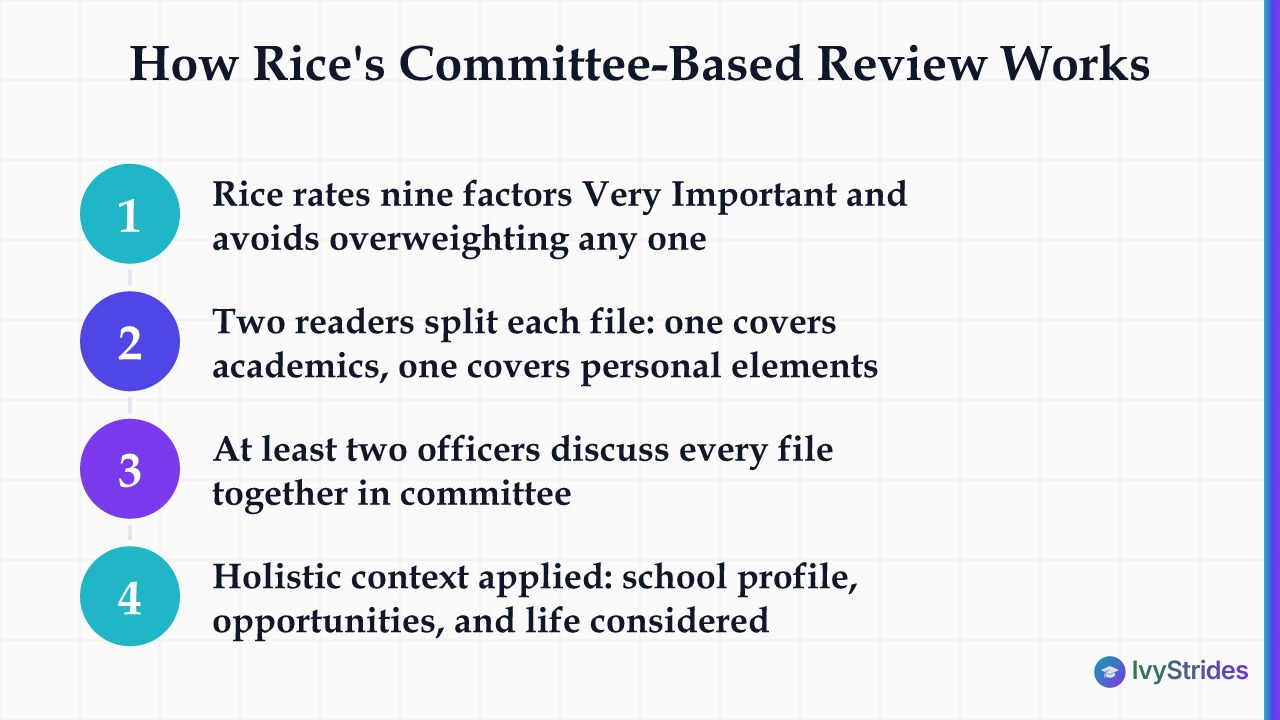
Rice University rates nine factors "Very Important" in its 2025-26 Common Data Set, section C7, and reads every file through holistic review rather than scoring any single number. Holistic review means Rice weighs your record in the context of your school, your opportunities, and your life, not against a fixed cutoff.
The nine, verbatim. Rigor of secondary school record, class rank, academic GPA, standardized test scores, application essay, recommendation(s), extracurricular activities, talent/ability, and character/personal qualities.
| Factor | Rice Rating |
| Rigor of secondary school record | Very Important |
| Class rank | Very Important |
| Academic GPA | Very Important |
| Standardized test scores | Very Important |
| Application essay | Very Important |
| Recommendation(s) | Very Important |
| Extracurricular activities | Very Important |
| Talent/ability | Very Important |
| Character/personal qualities | Very Important |
| Level of applicant's interest | Considered |
| Religious affiliation/commitment | Not Considered |
Test scores sit alongside eight other Very Important factors, not above them. Rice's application philosophy page states that it is careful not to overweight any single metric such as class rank, GPA, or test scores. A strong number won't carry a thin file, and one soft number won't sink a deep one.
Two readers, one file. Rice runs Committee-Based Evaluation, in use since 2017. Pairs of admission officers read each file: one focused on academics (transcript, school profile, recommendations), one on personal elements (activities, honors, essays). At least two officers discuss every file. For a deeper look at how the two-reader committee divides academic and personal review, we break down each reader's checklist.
Rice describes its ideal students as voracious lovers of life with unquenchable curiosity about the world, diverse thinkers who bring different experiences to campus. That language tells you what the character and personal-qualities factor is screening for. A counselor who audits your record against each stated criterion can map all nine factors against your file with you.
What Your Chosen School of Study Adds to the Rice Review
Beyond those nine shared factors, Rice applicants pick one of seven schools of study plus up to three majors or areas of interest, and the academic reader assesses your preparedness and alignment to those selections. Your school-of-study choice tells the committee which academic strengths to look for in your transcript and your 150-word academic essay.
The seven schools are Architecture, Business, Engineering and Computing, Humanities and Arts, Music, Natural Sciences, and Social Sciences. Rice's FAQ states students are assessed on their preparedness and alignment to the majors they selected, and the philosophy page adds that the academic schools look for different strengths and qualities. A computer science applicant inside Engineering and Computing, for instance, should show math depth and a reason those courses point at Rice specifically.
| School of Study | Standard Requirements | Additional Requirement | Extra Deadline |
| Architecture | Common App + Supplement | Portfolio + 2 essays | With application |
| Business | Common App + Supplement | None | None |
| Engineering and Computing | Common App + Supplement | None | None |
| Humanities and Arts | Common App + Supplement | None | None |
| Music | Common App + Supplement | Preliminary Submission + audition | Dec 1 |
| Natural Sciences | Common App + Supplement | None | None |
| Social Sciences | Common App + Supplement | None | None |
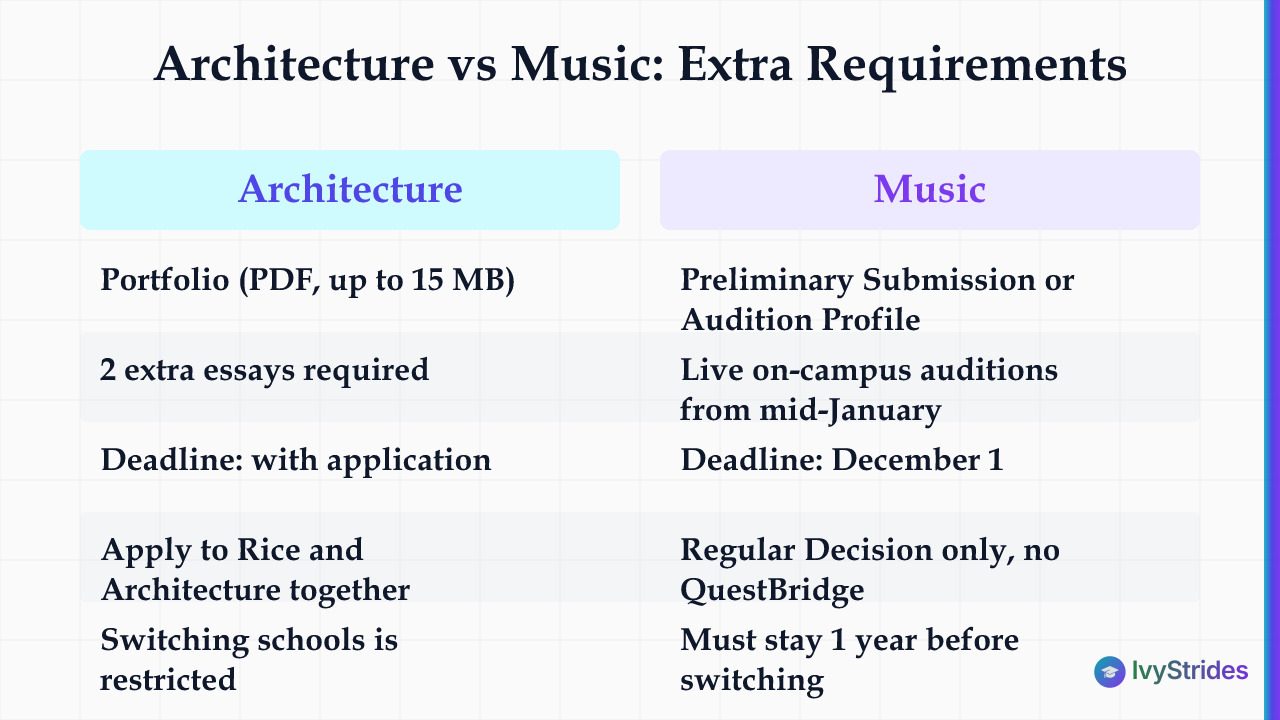
Architecture asks for more. You apply to Rice and the Rice School of Architecture at the same time. The portfolio is a PDF up to 15 MB, horizontal A4 or Letter, 150-300 dpi, a cover page plus up to 10 pages, uploaded to the Rice portal. It should show creative aptitude and spatial comprehension, need not be architectural, and freehand work is welcome. Two extra essays come with it.
Music runs on its own calendar. Fall 2027 music applicants file the Common App and Rice Supplement, choosing Music, plus a Preliminary Submission or Audition Profile Form by December 1. Music applicants cannot apply Early Decision; the Shepherd School admits by Regular Decision only. Live auditions run on campus from mid-January. Admitted music students must stay in the music program at least one year before changing schools.
In our coaching, students who choose Architecture or Music late often underestimate the portfolio or the December 1 music deadline. You can generally switch schools of study after enrolling, but Music and Architecture are the exceptions. The 150-word academic essay follows the same logic as the Why This Major supplement at other schools.
The Rice Writing Supplement: What Each Essay Actually Tests
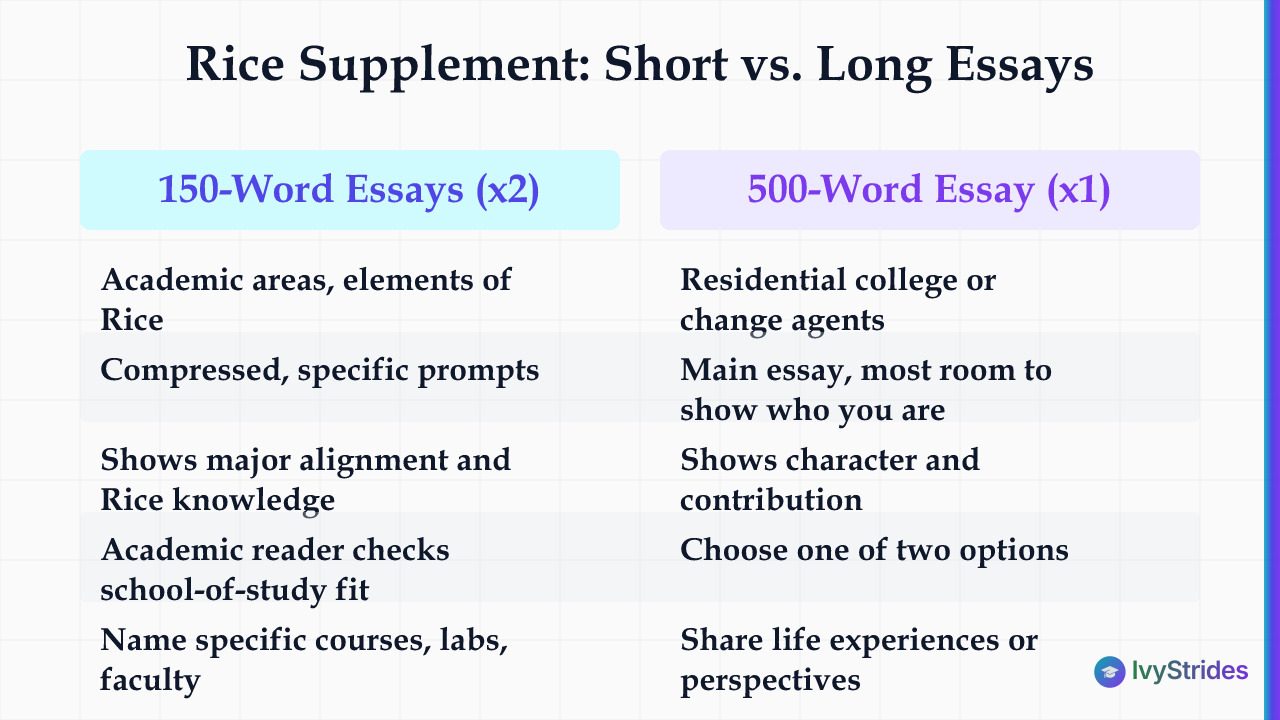
The Rice Writing Supplement is three essays for 2026-27: two at 150 words and one at 500 words, plus a non-evaluative image upload called The Box. In our reading, each essay maps to a Very Important factor, so a vague answer costs you in more than one place.
The 150-word "elements of Rice" essay is a compressed version of the Why This College prompt, and the same specificity principles apply. The CDS rates level of applicant's interest as Considered, and the essays are where you show you understand the Rice undergraduate experience rather than admiring it from a ranking list.
| Essay | Word Limit | What It Tests | Relevant Factors |
| Academic areas and exploration at Rice | 150 | Major alignment | Rigor, talent/ability |
| Elements of the Rice experience | 150 | Knowledge of Rice | Level of interest |
| Choose one: community or perspective | 500 | Character, contribution | Character/personal qualities |
| The Box (image) | n/a | Non-evaluative | None |
The "Relevant Factors" column is IvyStrides' reading of each prompt, not Rice's.
The 500-word prompt. You choose one of two options. One asks what life experiences or perspectives you would share with fellow Owls in the residential college system. The other asks which perspectives shaped by your background, upbringing, or cultural identity draw you to Rice's community of change agents. This is the file's main essay, and it carries the most room to show who you are.
The Box stays required. All applicants upload a two-dimensional image of something that appeals to them, through the Common App or the Rice portal. Rice says the image is not used for evaluative purposes and exists to show who you are beyond your achievements. Required, not scored. Upload it anyway.
In our essay coaching, the 150-word academic essay is the most commonly underdeveloped piece in a Rice supplement: students describe interests in general terms rather than naming specific Rice courses, labs, or faculty tied to their selected school of study. That specificity is exactly what the academic reader checks. Name the course. Name the lab. Our essay coaching that drafts and revises each piece for school-of-study alignment targets that gap.
Rice University Application Deadlines, Fees, and Score Submission
Rice University's first-year deadlines for the 2026-27 cycle are November 1 for ED I and January 4 for both ED II and Regular Decision, with a $75 nonrefundable application fee. Both Early Decision rounds are binding, and Rice offers no non-binding Early Action.
QuestBridge applicants apply through that path. Music applicants are not eligible for QuestBridge or either Early Decision round.
Rice is test-optional for 2026-27. The first-year page recommends that applicants submit SAT or ACT scores if available, and applicants who cannot or prefer not to submit still receive full consideration. Rice superscores both the SAT and the ACT, using the highest score from each section across all your test dates. If you have tested more than once, submitting lets your strongest sections show.
- ED I application: November 1 (binding)
- ED I interview request: November 3
- Music Preliminary Submission: December 1
- RD priority interview request: December 16
- ED II / RD interview request: January 6
- ED II (binding) and Regular Decision: January 4
- Application fee: $75 nonrefundable (or fee waiver)
- Recommendations: one counselor, two core-subject teachers
- The Box image: required, non-evaluative
Interviews are recommended but optional and not guaranteed. A Rice Alumni Volunteers for Admission member or a current student conducts every 2026-27 interview virtually, and Rice weighs both equally. Not being matched with an interviewer won't affect your decision. Choose a binding ED round only if Rice is your clear first choice.
Still deciding whether Rice belongs on your list? Weigh whether your profile fits Rice before committing to a binding round. If you're unsure about submitting a score, read how much a submitted SAT actually helps at test-optional schools. Test-optional status is specific to this cycle; verify it for future years at admission.rice.edu, since policies shift annually.
FAQ: Rice University Admission Requirements
What GPA is needed to get into Rice?
Rice does not publish a minimum GPA cutoff. Its 2025-26 Common Data Set rates academic GPA as Very Important, and Rice states that it does not overweight any single metric. Rice reads GPA in the context of course rigor and your school profile, not as a threshold.
How difficult is it to get into Rice University?
Very. Rice admitted 2,948 of 36,791 first-year applicants for fall 2025, an overall admit rate of about 8.0% by IvyStrides' calculation from its Common Data Set. Nine factors are rated Very Important, and the school-of-study alignment review adds a second layer of scrutiny, so a well-matched, specific application matters more than raw numbers alone.
What does Rice require from first-year applicants?
Rice requires the Common App, the Rice Writing Supplement, a $75 nonrefundable fee or a fee waiver, one counselor evaluation, and two teacher recommendations. Test scores are optional for 2026-27 but recommended if available. Music and Architecture applicants add their own portfolio or audition materials.
Is Rice as good as an Ivy League school?
Rice is not an Ivy League member; the Ivy League is an athletic conference of eight universities. Rice is a private research university in Houston with a residential college system, and its selectivity is in the same range as many Ivy League schools.
Your Next Step Toward a Stronger Rice Application
Rice reads your file in context, across nine Very Important factors, with your chosen school of study shaping what the academic reader expects. Treat the supplement and the major choice as one connected decision.
Before November 1, work through this short list:
- Audit your transcript, activities, and recommendations against all nine Very Important factors.
- Decide your school of study and up to three majors, then check whether your record supports that alignment.
- Decide whether to submit an SAT or ACT score, given Rice superscores both.
- Draft the three supplement essays, starting with the 150-word academic piece.
- If you are applying to Architecture or Music, lock their earlier portfolio and audition deadlines first.

Rajesh is a technology leader, entrepreneur, and angel investor with 28+ years in Business & Technology Leadership and Product & Solution Engineering. He is passionate about education, mentoring, and driving digital transformation.