
Columbia Admission Requirements: How to Show Fit Without a Visit

On this page
- What the Columbia Application Actually Requires in 2026-27
- Does Columbia Require the SAT or ACT for Fall 2027
- What Columbia's Holistic Review Actually Weighs
- How Columbia's Writing Supplement Shows Fit Without a Visit
- FAQ: Columbia Admission Requirements
- What GPA do you need to have to get into Columbia?
- Can someone with an 80 GPA get into Columbia?
- Can you get into Columbia with a 1400 SAT?
- Which is harder to get into, Columbia or Harvard?
- Your Next Step on Columbia's Requirements
Columbia College and Columbia Engineering are test-optional for fall 2027 entry. Required pieces are a transcript, two teacher recommendations, a counselor report, the Common App personal essay, and the Columbia supplement: one 100-word intellectual list plus five 150-word short answers. There is no GPA floor, and interviews are not part of the process.
Columbia admission requirements are the materials and criteria Columbia College and Columbia Engineering use to review first-year applicants, and this guide cites each one to Columbia's admissions pages or its Common Data Set. The harder question is how you show fit when you cannot visit New York City or sit for an interview.
What the Columbia Application Actually Requires in 2026-27
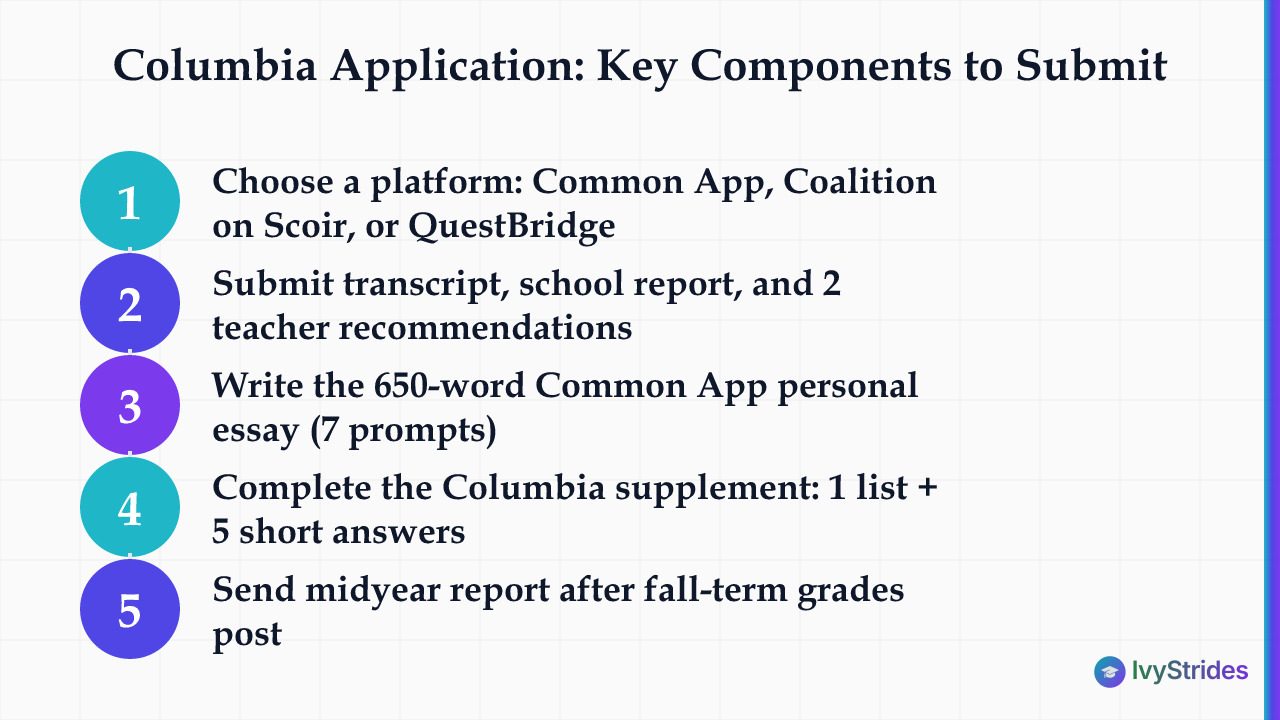
Columbia's first-year application runs through the Common App, the Coalition Application on Scoir, or QuestBridge (Columbia Undergraduate Admissions). The required set is short and specific. You submit a transcript and school report, two teacher recommendations from academic subjects, a counselor recommendation, and a midyear report once your fall-term grades post.
Recommendations differ by school. Columbia Engineering applicants need one of the two teacher recommendations to come from a math or science teacher. If you're weighing how many letters most selective colleges expect, the count here starts with these two plus the counselor.
The writing has two parts. The Common App personal essay caps at 650 words and draws from seven prompts, unchanged for the 2026-27 cycle. Then the Columbia supplement adds one intellectual list and five short answers, covered in detail below.
| Component | Requirement | Notes |
| Application platform | Common App, Coalition on Scoir, or QuestBridge | Pick one |
| Transcript | High school transcript and school report | Midyear report follows |
| Teacher recommendations | Two, from academic subjects | Engineering: one from math or science |
| Counselor recommendation | Required | Plus school report |
| Personal essay | 650-word maximum, seven prompts | Common App 2026-27 |
| Columbia supplement | 1 list (100 words) + 5 short answers (150 words each) | See supplement section |
| Test scores | Optional for fall 2027 | Yes/no in the supplement |
| Authenticity | Accuracy and Authenticity statement | Generative AI Policy applies |
| Optional | Research abstract, creative portfolio (SlideRoom) | Not required |
Columbia College strongly recommends four years of English and math, three to four years of history, lab science, and a world language (Columbia Undergraduate Admissions). Columbia expects Engineering applicants to have physics and calculus.
Which of the seven Common App prompts fits your story shapes the personal essay you draft.
Does Columbia Require the SAT or ACT for Fall 2027
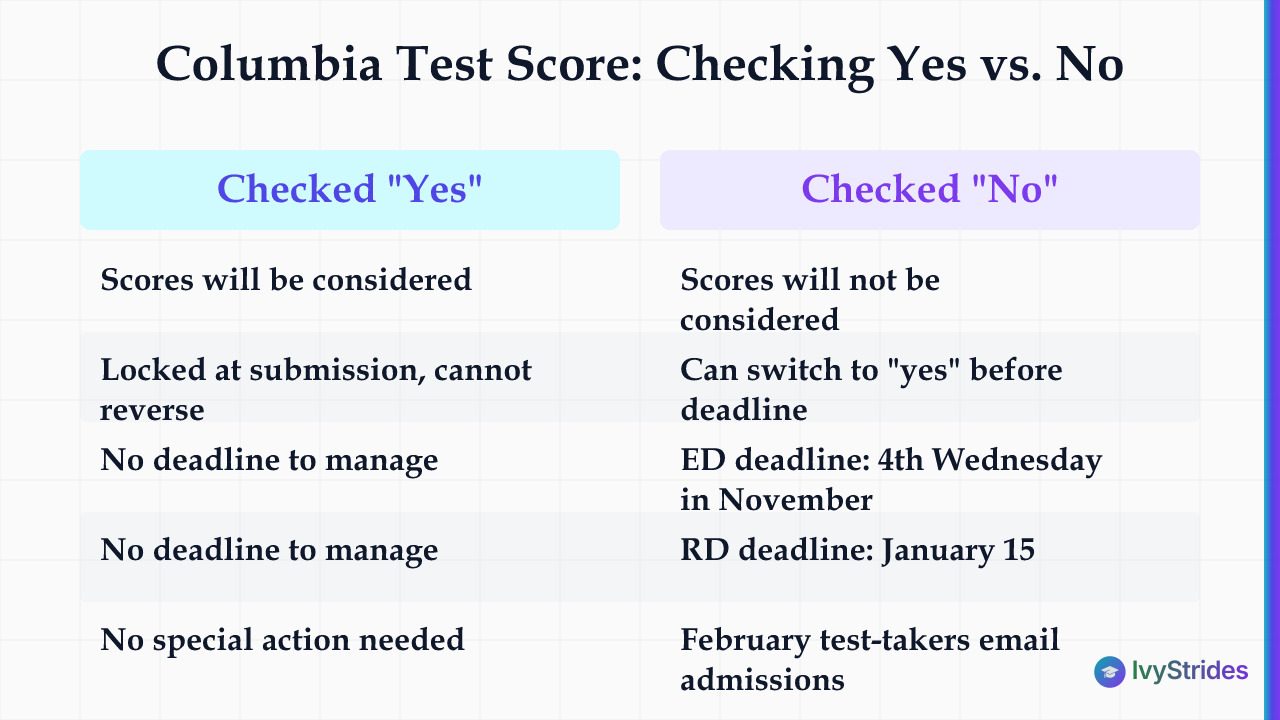
Columbia is test-optional for the 2026-27 cycle, so no, Columbia does not require the SAT or ACT for fall 2027 entry (Columbia Undergraduate Admissions). You choose. Inside the Columbia supplement you answer a yes-or-no question on whether the committee should consider your scores.
A "yes" cannot be changed or withdrawn after you submit. A "no" can be switched to "yes" up to a deadline: the fourth Wednesday in November for Early Decision, or January 15 for Regular Decision. February test-takers email the admissions office directly.
| Scenario | Deadline to switch decision | Can you reverse? |
| You checked "yes" | None | No, locked at submission |
| You checked "no" (ED) | Fourth Wednesday in November | Yes, switch to "yes" |
| You checked "no" (RD) | January 15 | Yes, switch to "yes" |
| February test-taker | Email admissions office | Handled by email |
So how do you decide? Columbia's 2025-26 Common Data Set rates test scores as Considered, not Very Important, which tells you a score sits below course rigor and essays in the file. Weigh your score against the rest of your application rather than against a cutoff, because Columbia publishes none.
What test-optional really means and when submitting a score actually helps lays out the full framework for that call. If you decide to submit and want the logistics, how to send SAT scores to Columbia picks up where this leaves off.
Columbia requires scores from fall 2028 entry onward. That is a future change, so for fall 2027 the optional status holds.
What Columbia's Holistic Review Actually Weighs
Columbia states no minimum GPA, no cut-off, and no formula. Its review is holistic, contextual, and committee-based, and Columbia admits no candidate without discussion by multiple officers (Columbia Undergraduate Admissions). So the honest answer to "what GPA do I need" is: the strongest record your school makes possible, read against what your school offered.
Building on that no-formula standard, Columbia names five criteria it evaluates: academic preparation, curiosity, engagement with others, individual voice, and knowledge of Columbia. Academic preparation means strong performance across subjects, effective writing, and the most rigorous course load your school allows. You demonstrate the other four through your essays, recommendations, and activities, not through a number.
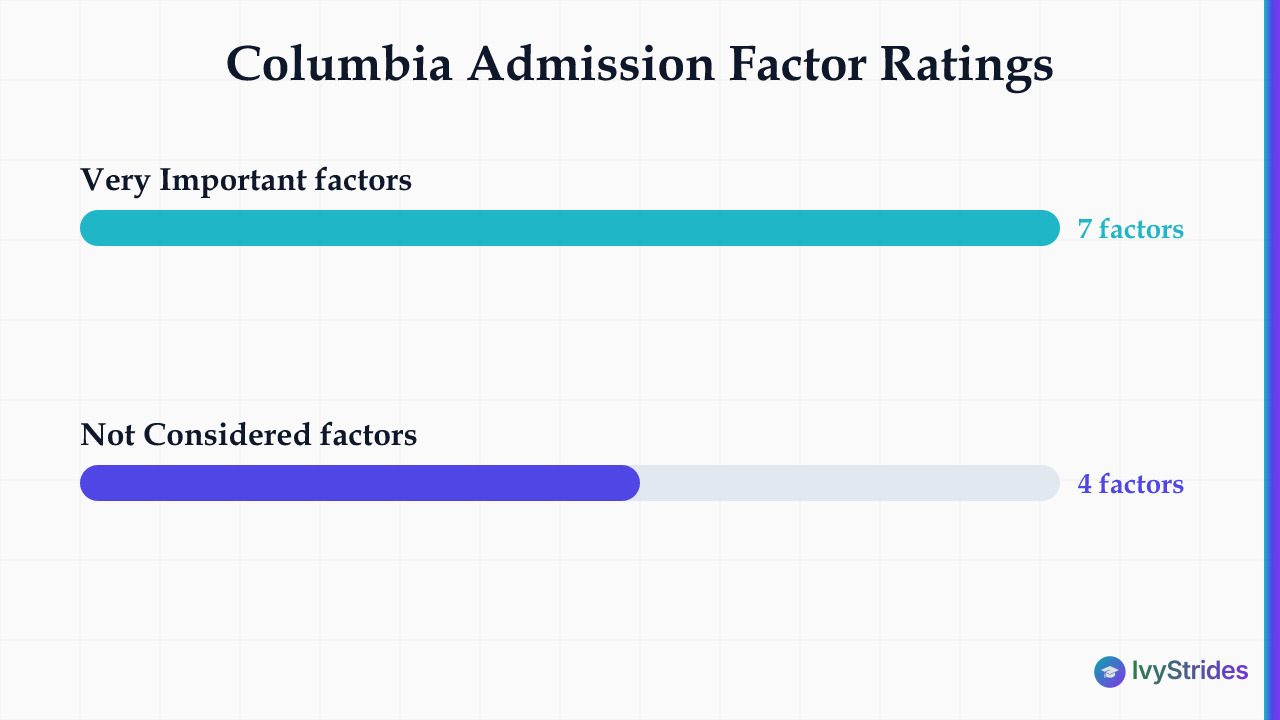
The Common Data Set turns that into factor ratings: seven Very Important and four Not Considered.
| Factor | Columbia rating | Where it shows |
| Rigor of secondary school record | Very Important | Transcript |
| Class rank | Very Important | School report |
| Academic GPA | Very Important | Transcript |
| Application essay | Very Important | Common App + supplement |
| Recommendation | Very Important | Teacher/counselor letters |
| Extracurricular activities | Very Important | Activities list |
| Character/personal qualities | Very Important | Essays, letters |
| Interview | Not Considered | None offered |
| Level of applicant's interest | Not Considered | Demonstrated interest |
| State residency | Not Considered | Application data |
| Religious affiliation/commitment | Not Considered | Application data |
That table settles two common worries. Because Columbia rates extracurricular activities and character/personal qualities as Very Important, your activities list carries real weight; what each Ivy actually rewards in extracurriculars shows how that weighting plays out. And because Columbia rates demonstrated interest as Not Considered, you gain nothing from tracked visits or info sessions; what colleges actually record about campus visits explains why that frees you to skip the visit and focus on the file.
Context is the piece students underestimate. Columbia weighs family circumstances, work, commute, home responsibilities, and school resources, then asks what you did with the opportunities available to you.
Early Decision is not a shortcut. For Early Decision applicants, the fall 2025 entering class drew 5,868 ED applications and admitted 819, an ED admit rate of roughly 14%. Columbia's CDS publishes both counts but not the rate; IvyStrides divides 819 by 5,868 to get that figure. ED is a fit-and-certainty decision, reviewed against the same holistic bar.
How Columbia's Writing Supplement Shows Fit Without a Visit
The Columbia supplement is where you prove fit when you cannot visit campus, and it has two parts: one intellectual list of up to 100 words and five short answers of up to 150 words each (Columbia Undergraduate Admissions). Since demonstrated interest is Not Considered, this writing is where the committee learns whether Columbia genuinely suits you.
The intellectual list names texts, resources, and outlets that shaped you outside class: books, journals, podcasts, plays, museums, videos. Titles only, no authors, no commentary. In our essay coaching, this list is where students most often underestimate the specificity required: broad genres read as surface-level, while named titles read as real engagement. The five short answers open with an aspect of your lived experience; read all five on Columbia's questions page before you plan.
IvyStrides' planning map below ties each of Columbia's five published criteria to where the supplement can show it and one drafting principle.
| Columbia criterion | Where the supplement can show it | One drafting principle |
| Academic preparation | A short answer about a class or problem you pursued | Show the question you chase |
| Curiosity | The 100-word intellectual list | Name titles, not genres |
| Engagement with others | A short answer about a role you hold | Concrete role, not a label |
| Individual voice | The lived-experience short answer | One specific moment, not a resume |
| Knowledge of Columbia | Any answer about why Columbia | Name the Core Curriculum |
The Core Curriculum is the anchor. A strong "Why Columbia" answer names specifics a visitor would notice, and why-this-college essays that worked show how to reach that specificity without a campus visit. In our admissions counseling, students who connect a short answer to the Core Curriculum tend to write more specific 'Why Columbia' responses than those who describe New York City alone. Name both, but let the Core do the heavy lifting.
Remember the Accuracy and Authenticity statement: every word must be your original work under Columbia's Generative AI Policy. The optional one-page research abstract, uploaded in the Columbia questions with your mentor's contact details, helps only if the work is real. Mapping five holistic criteria across a transcript, supplement, and recommendations is exactly the planning a counselor who reviews your file against Columbia's stated criteria is built for.
FAQ: Columbia Admission Requirements
What GPA do you need to have to get into Columbia?
Columbia states no minimum GPA and no formula. Its Common Data Set rates academic GPA as Very Important, and the committee reads it in context: what your school offered and how much rigor you chose. A 3.9 with five AP options reads differently from a 3.9 with thirty.
Can someone with an 80 GPA get into Columbia?
Columbia sets no minimum and no cut-off, and its contextual review asks what opportunities were available and what you did with them. An 80 average would need strong course rigor, an upward grade trend, and a compelling supplement to compete. Columbia does not publish the GPA profile of admitted students, so treat any single number as one part of a full file.
Can you get into Columbia with a 1400 SAT?
Columbia is test-optional for fall 2027 and names no cut-off score, so a 1400 is a submit-or-withhold decision, not a pass-fail line. The 2025-26 Common Data Set rates test scores Considered, not Very Important. Weigh the score against your course rigor, essays, and recommendations before you check yes or no.
Which is harder to get into, Columbia or Harvard?
Both are among the most selective universities in the country, and both use holistic review with no formula. Comparing acceptance rates gives only a rough signal. The more useful question is which school fits a specific student's profile and interests, since fit is what the committee actually reads.
Your Next Step on Columbia's Requirements
Work through Columbia's requirements in this order:
- Confirm your platform (Common App, Coalition on Scoir, or QuestBridge) and line up two teacher letters, plus a math or science teacher if you're applying to Engineering.
- Decide yes or no on scores, and note your switch deadline: fourth Wednesday in November for ED, January 15 for RD.
- Map your five short answers to the five criteria, and draft the Core Curriculum answer first.
- Read your transcript the way Columbia does: rigor against what your school offered, not a raw number.

Hemant is a seasoned entrepreneur, investor, and growth strategist with deep ground in education and technology-driven learning. His core training is in Mathematics and Physics — he authored Physics for IB Diploma: Ultimate Revision Guide, recognized as a top student resource.