
Is Cornell Test Optional? Not Anymore, and Essays Still Outrank Scores
On this page
- Cornell Is Test-Required for Fall 2027: What the Policy Actually Says
- Cornell SAT and ACT Score Ranges: What the Numbers Actually Mean
- What Cornell Actually Weighs: Six Very Important Factors Beyond Your Score
- Cornell Early Decision vs Regular Decision: Deadlines, Rates, and Score Timing
- Which Ivy League Schools Are Still Test Optional for Fall 2027
- FAQ: Cornell's Testing Policy and Scores
- Is 1450 a good SAT score for Cornell?
- Can I get into Cornell with a 1400 SAT?
- Which Ivy League schools are test optional for fall 2027?
- Is Cornell test optional for international students?
Cornell is not test-optional. Since fall 2026 entry, every Cornell undergraduate college and school has required the SAT or ACT. For the 2026-27 cycle, meaning entry in fall 2027, scores are mandatory for every first-year applicant.
Those rules come from Cornell's standardized testing policy page, and Cornell announced the reinstatement in April 2024. You may self-report on the application; enrolling students send official scores. The harder question is how much your score weighs once it arrives, because Cornell rates six other factors more highly than test scores.

Cornell Is Test-Required for Fall 2027: What the Policy Actually Says
Cornell University's testing policy requires the SAT or ACT from every first-year applicant, effective for students applying to enroll in fall 2026 or later. You self-report scores on the Common App, and Cornell asks for official scores only if you enroll or are a recruited athlete, per Cornell's testing policy.
How Cornell reads multiple sittings matters as much as the requirement itself. Cornell uses your highest section scores across SAT test dates and takes part in College Board Score Choice, so you decide which dates to send. That is a superscore. For the ACT, Cornell uses the ACT-provided superscore and does not require science. On the enhanced ACT, the composite averages English, math, and reading, with science reported separately.
Why a second sitting helps. If your Reading and Writing peaked on one date and Math on another, Cornell combines the highs. That shift is the whole case for whether Early Decision is workable when your score is still climbing.
| Item | Cornell's Rule |
| Policy status | Test-required, all eight colleges |
| Effective | Fall 2026 entry onward |
| Tests accepted | SAT or ACT |
| Self-reporting | Allowed on application |
| Official scores | Required at enrollment; recruited athletes send them with the application |
| SAT scoring | Highest section scores across dates (superscore) |
| ACT scoring | ACT-provided superscore; science section not required |
Source: Cornell University Standardized Testing Policy; ACT, Inc.
Cornell SAT and ACT Score Ranges: What the Numbers Actually Mean
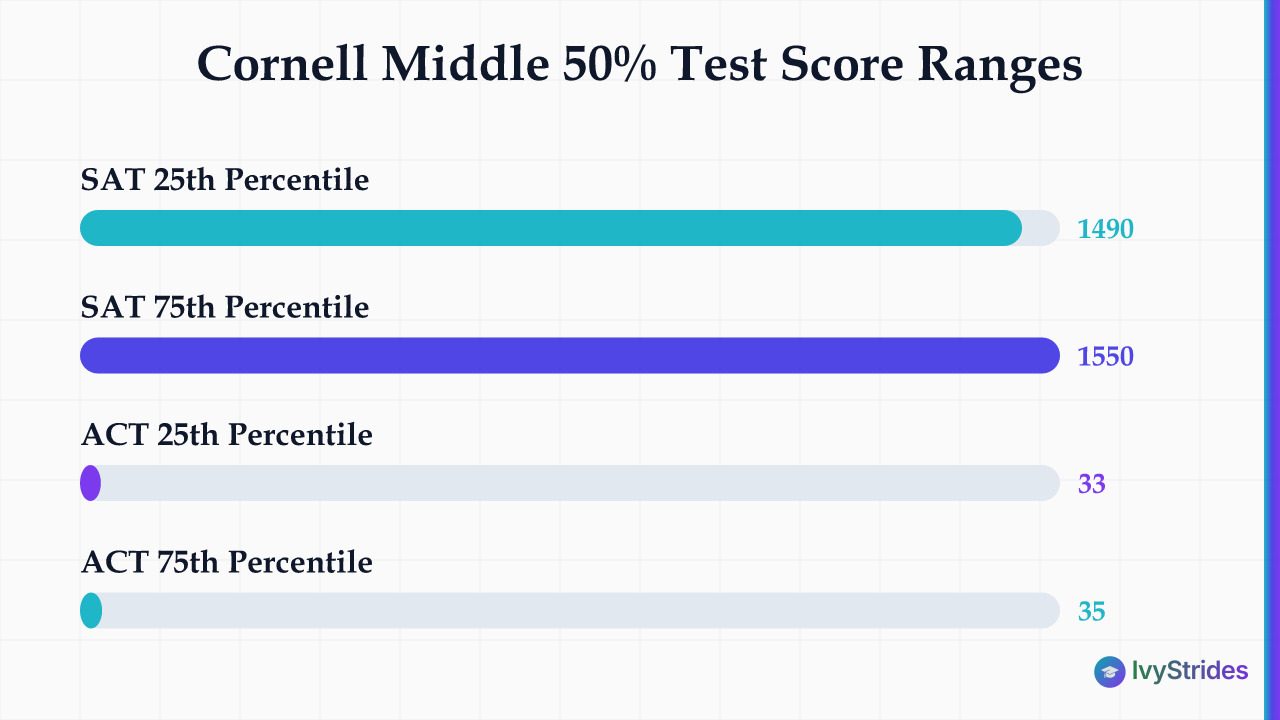
Cornell's middle 50% SAT range for enrolled students who sent a score is 1490 to 1550, per the school's Common Data Set for the fall 2025 entering class. That range describes students who enrolled and submitted an SAT, not every admitted applicant, and not a cutoff. Cornell's own testing policy says scores, read in context with GPA, rigor, activities, essays, and recommendations, help create a more complete picture of each applicant.
Because Cornell superscores both tests, students with uneven section scores should check which test superscores better for your score pattern before choosing which one to sit again.
What "middle 50%" means. About a quarter of enrolled students who sent an SAT scored below 1490, and about a quarter scored above 1550. So a score under the 25th percentile does not end your file, and one above the 75th does not carry it on its own.
| Test | 25th Percentile | 75th Percentile | SAT-Taker Percentile at 25th | SAT-Taker Percentile at 75th |
| SAT total | 1490 | 1550 | 97th | 99th |
| ACT composite | 33 | 35 | - | - |
SAT and ACT ranges: Cornell Common Data Set 2025-2026, fall 2025 entering class. SAT-taker percentiles: College Board user-group tables.
Is 1450 enough? A 1450 sits at the 95th percentile of recent SAT takers and falls below 1490, the 25th percentile of Cornell's range. It is a strong score that keeps you in contention, especially paired with a demanding transcript. A 1400, at the 93rd percentile, sits further below the 25th and asks more of the rest of your file. Students curious how a higher number reads across the Ivies can see how a 1500 SAT score positions you across Ivy League admissions.
A score near Cornell's 25th percentile paired with a strong course load keeps a file in contention. The essay and recommendations are where the file earns or loses ground.
What Cornell Actually Weighs: Six Very Important Factors Beyond Your Score

Photo by https://kaboompics.com/ on Pexels
Cornell rates six factors "Very Important" in section C7 of its Common Data Set, and your test score is not one of them. Those six are rigor of secondary school record, the application essay, recommendations, extracurricular activities, talent or ability, and character or personal qualities. Standardized test scores are rated only Considered, below class rank and GPA (Important); religious affiliation and level of applicant's interest are Not Considered.
Because Cornell rates the application essay as Very Important, the college-specific prompts carry as much weight as your score, and each of the eight colleges asks something different. CALS asks why your major (350 words) and why CALS (350 words); Arts and Sciences asks one essay on an intellectual passion and the liberal-arts curriculum (650 words); Brooks asks one policy-interest essay (650 words), plus an optional 350-word essay for its DC Start program. You can see Cornell's college-specific essay prompts and how to approach each one before you draft.
What Cornell says it looks for. Duffield Engineering, for example, names intellectual potential, character traits such as integrity, open-mindedness, initiative, empathy, and curiosity, and engagement beyond the classroom in its published applicant criteria. One college sets its own rule on interest: the ILR School says it does not consider demonstrated interest and instead wants academic success, exposure to ILR topics, and an essay showing strong interest.
| Factor | Where It Shows Up in Your Application |
| Rigor of record | Transcript, course selection |
| Application essay | College-specific Cornell prompts |
| Recommendations | Counselor, two teacher letters |
| Extracurriculars | Activities list, jobs, volunteering |
| Talent or ability | Portfolio, activities, essays |
| Character | Essays and recommendations |
Source: Cornell Common Data Set 2025-2026, C7.
For students building Cornell applications, the college-specific essay is often the factor that most separates competitive files, because it is the one place where a student can directly address the intellectual potential and character criteria Cornell names as central. That is where IvyStrides' essay coaches spend the most time.
Cornell Early Decision vs Regular Decision: Deadlines, Rates, and Score Timing
Cornell offers binding Early Decision with a November 1 deadline and no early action. Regular Decision closes January 2, and ED decisions arrive mid-December. Because the application essay sits among Cornell's Very Important factors, the round you pick does not change what the file must carry; it changes your timeline for getting the score and essay ready.
If your score is at or above Cornell's middle 50% range, applying Early Decision by November 1 is worth considering: ED produced about 31% of all offers in the fall 2025 cycle. IvyStrides' analysis of Cornell's published Common Data Set counts, 1,889 admitted from 10,057 Early Decision applicants, puts the binding ED acceptance rate at about 18.8% for the fall 2025 entering class. The overall rate was lower: 6,077 of 72,523 applicants, which works out to about 8.4%.
Score timing against the deadline. For ED, you need a usable score before November 1, so check SAT test dates and registration deadlines for the 2026-27 cycle and count backward from score release. If Cornell defers you to Regular Decision review, you face the question of what to do if Cornell defers your early application and whether a new score helps.
| Round | Deadline | Acceptance Rate (Fall 2025) | Score Submission Rule |
| Early Decision | November 1 | ~18.8% | Self-report; official at enrollment |
| Regular Decision | January 2 | ~6.7% outside ED | Self-report; official at enrollment |
| Waitlist (not ranked) | N/A | 254 admitted of 6,598 who accepted a place | Self-report; official at enrollment |
Source: Cornell Common Data Set 2025-2026, C2 and C21.
For fall 2025, Cornell offered 9,720 applicants a waitlist place, 6,598 accepted it, and 254 were admitted. The waitlist is not ranked. If your score sits below the range and you have a test date before November 1, 1-on-1 SAT prep built around your target test date starts from a diagnostic that flags the specific modules holding the score down.
Which Ivy League Schools Are Still Test Optional for Fall 2027
Only Princeton and Columbia remain test-optional among the Ivies for fall 2027 applicants. The other six, including Cornell, require standardized test scores for that cycle. Both Princeton and Columbia will require scores beginning with fall 2028 entry, so this is a one-cycle window, not a standing policy.
That split means students applying to both Cornell and Princeton for fall 2027 entry decide whether to send scores to Princeton separately from meeting Cornell's requirement. NYU, a common alternative on Ivy-adjacent lists, is test-optional for fall 2027.
| School | 2026-27 Cycle (Fall 2027 Entry) | 2027-28 Cycle (Fall 2028 Entry) |
| Cornell | Test-required | No change announced |
| Harvard | Test-required | No change announced |
| Yale | Test-required (SAT or ACT) | No change announced |
| Dartmouth | Test-required | No change announced |
| Brown | Test-required | No change announced |
| Penn | Test-required | No change announced |
| Princeton | Test-optional | Test-required from fall 2028 entry |
| Columbia | Test-optional | Test-required from fall 2028 entry |
Source: each school's admissions testing page, checked October 2026.
Test-optional policies vary by school and year, so confirm each school's current page before you apply. Yale's 27 May 2026 announcement made the SAT or ACT the only way to meet its requirement for fall 2027 entry onward, ending a test-flexible policy that also accepted AP or IB scores.
For Cornell itself, the plan is short: check your score against the fall 2025 middle 50% (1490 to 1550 SAT, 33 to 35 ACT), find your college's essay prompts, and choose ED or RD by when a usable score will be ready.
FAQ: Cornell's Testing Policy and Scores
Is 1450 a good SAT score for Cornell?
A 1450 sits at the 95th percentile of recent SAT takers and falls below Cornell's middle 50% SAT range for the fall 2025 entering class. But Cornell rates six factors as Very Important, and test scores are not among them, so the application essay, recommendations, and course rigor carry significant weight in the review.
Can I get into Cornell with a 1400 SAT?
A 1400 is at the 93rd percentile of recent SAT takers and falls below 1490, the 25th percentile of Cornell's SAT range. Cornell reads scores in context, as one part of a holistic review. A 1400 paired with a demanding course load, strong essays, and compelling recommendations can still produce a competitive file, though a higher score strengthens the application.
Which Ivy League schools are test optional for fall 2027?
Princeton and Columbia are test-optional for fall 2027 applicants. All other Ivies, including Cornell, Harvard, Yale, Dartmouth, Brown, and Penn, require standardized test scores for fall 2027 entry. Princeton and Columbia will require scores from fall 2028 entry. Policies vary by school and year, so check each school's current admissions page.
Is Cornell test optional for international students?
No. Cornell's test-required policy applies to all first-year applicants, including international students. Unless you are a U.S. citizen or permanent resident, a native English speaker, or taught primarily in English for the past four years, you must also submit an English proficiency exam score, separate from the SAT or ACT.

Hemant is a seasoned entrepreneur, investor, and growth strategist with deep ground in education and technology-driven learning. His core training is in Mathematics and Physics — he authored Physics for IB Diploma: Ultimate Revision Guide, recognized as a top student resource.