
How to Prepare for a College Interview in 2026: A Step-by-Step Walkthrough
On this page
- How to Research a College Before Your Interview
- What Questions Will Be Asked in a College Interview
- How to Practice College Interview Answers Without Sounding Scripted
- College Interview Practice Checklist
- Interview Coming Up. Not Sure Your Stories Are Ready?
- What to Do After a College Interview to Leave a Strong Impression
- After the Interview: Three Steps in 24 Hours
- Prep Plan Clear. Application Still Has Open Questions?
- FAQ: College Interview Preparation
- What questions will be asked in a college interview?
- How do I introduce myself for a college interview?
- What are good questions to ask at a college interview?
- How long does it take to prepare for a college interview?
- Your Next Step Before the Interview
A college interview is a two-way conversation between you and an admissions officer or alumnus, not an interrogation. To prepare, do three things: research the school specifically, practice common questions out loud using bullet points instead of scripts, and prepare three to five questions to ask.
Those three steps map to the rest of this walkthrough, backed by admissions-office guidance from Harvard College and the University of Rochester. Re-read your application essays the night before so your stories are fresh. One caveat before you start: interview weight varies by school, and most treat it as one factor among many, not the deciding one.
How to Research a College Before Your Interview

Photo by RDNE Stock project on Pexels
School research for a college interview means knowing the programs, faculty, and traditions specifically enough to explain why this school, not just any school. Start with the academic catalog and the department pages for your intended major, then read the student newspaper and recent campus news. Skip the rankings. Rankings tell an interviewer nothing about you.
Find two or three specifics that genuinely interest you. A professor whose research overlaps your intended field, a first-year seminar you'd want to take, a campus tradition tied to how students actually live there. When the interviewer asks "Why this college," you answer with those specifics instead of a line anyone could say about any school.
A well-researched interview is one of the clearest signals of genuine interest a student can send, and some schools track it as a formal factor in the admissions decision. That signal is called demonstrated interest, and a specific, engaged interview answer carries more weight than a campus visit you never mention again.
| Research Area | Where to Find It | How to Use It in the Interview |
| Academic programs and faculty | Department pages, course catalog | Name one course or professor you'd want |
| Campus traditions | Student newspaper, admissions blog | Show you know how students live there |
| Student organizations | Club directory, activities pages | Connect one club to what you already do |
| Recent news or initiatives | School news page, press releases | Reference a new center or program launch |
| Why-this-school fit | All of the above, plus your own goals | Bridge a specific to your intended major |
You're building the same school-specific argument here that a written supplemental essay makes. If you want to see how that argument reads on paper, our Why This College essay examples break down three that worked and why they landed.
What Questions Will Be Asked in a College Interview
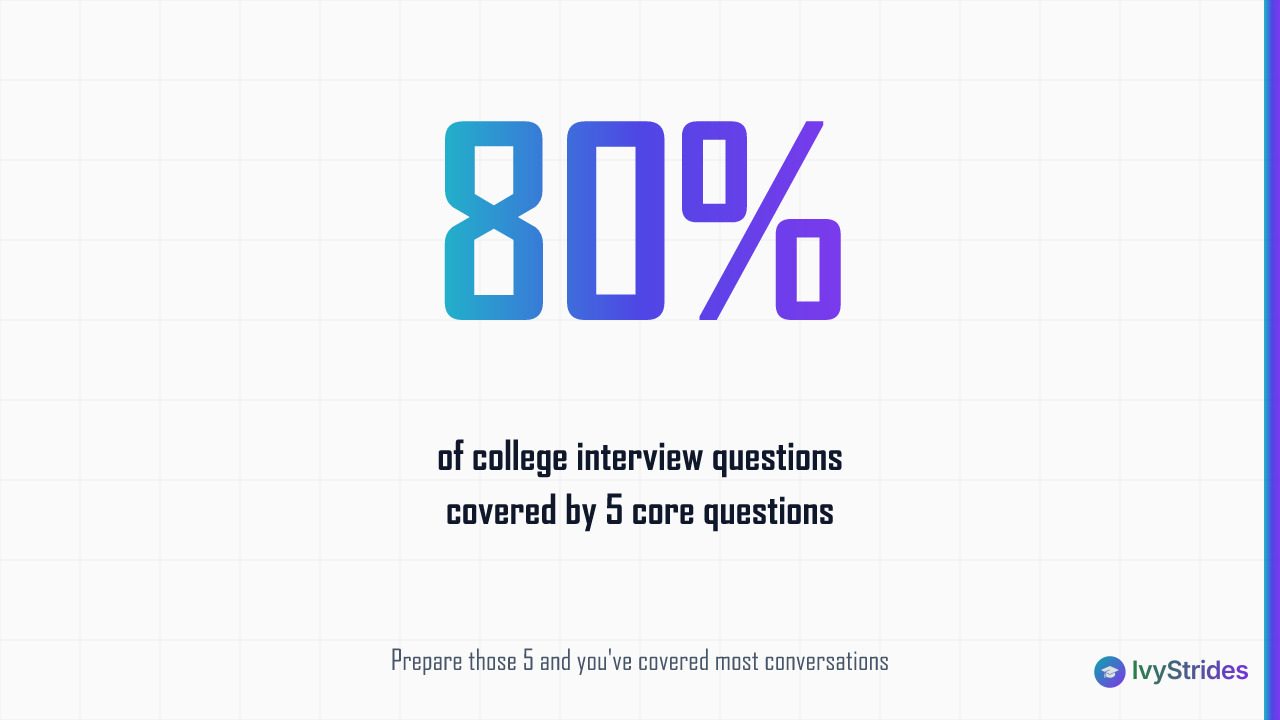
Most college interviews open with "Tell me about yourself," then move through "Why this college," "What do you want to study," "Describe a challenge you overcame," and "What will you contribute to campus." Five core questions account for the majority of most conversations. Prepare those and you've covered roughly 80 percent of what actually gets asked.
The opener does the most work. "Tell me about yourself" wants a 60-to-90-second answer covering who you are, what you care about most, and why you're excited about this school. It is not a recital of your resume. The interviewer already has your application; they want to hear how you think.
According to the Harvard College student interview tips, interviewers are looking for intellectual curiosity, self-awareness, and fit, not a flawless performance. The University of Rochester admissions blog frames the same thing as a conversation rather than a test. That's the lens to answer through: be specific, be honest, and end each answer with a natural bridge back to the school.
| Question | What the Interviewer Is Evaluating | One-Line Answer Framework |
| Tell me about yourself | Self-awareness, communication | Who you are, one thing you care about, why here |
| Why this college | Fit, demonstrated interest | Two specifics plus your goal |
| What do you want to study | Intellectual curiosity | The question that pulls you, not the job |
| Describe a challenge | Resilience, reflection | What happened, what you learned |
| What will you contribute | Fit, community awareness | One thing you'd bring, tied to a real activity |
Keep answers between 60 and 120 seconds. The stories you tell here should already be sharp from your application; if they're not, our guide to college essay feedback shows how to tighten them before anyone asks you to say them out loud.
How to Practice College Interview Answers Without Sounding Scripted
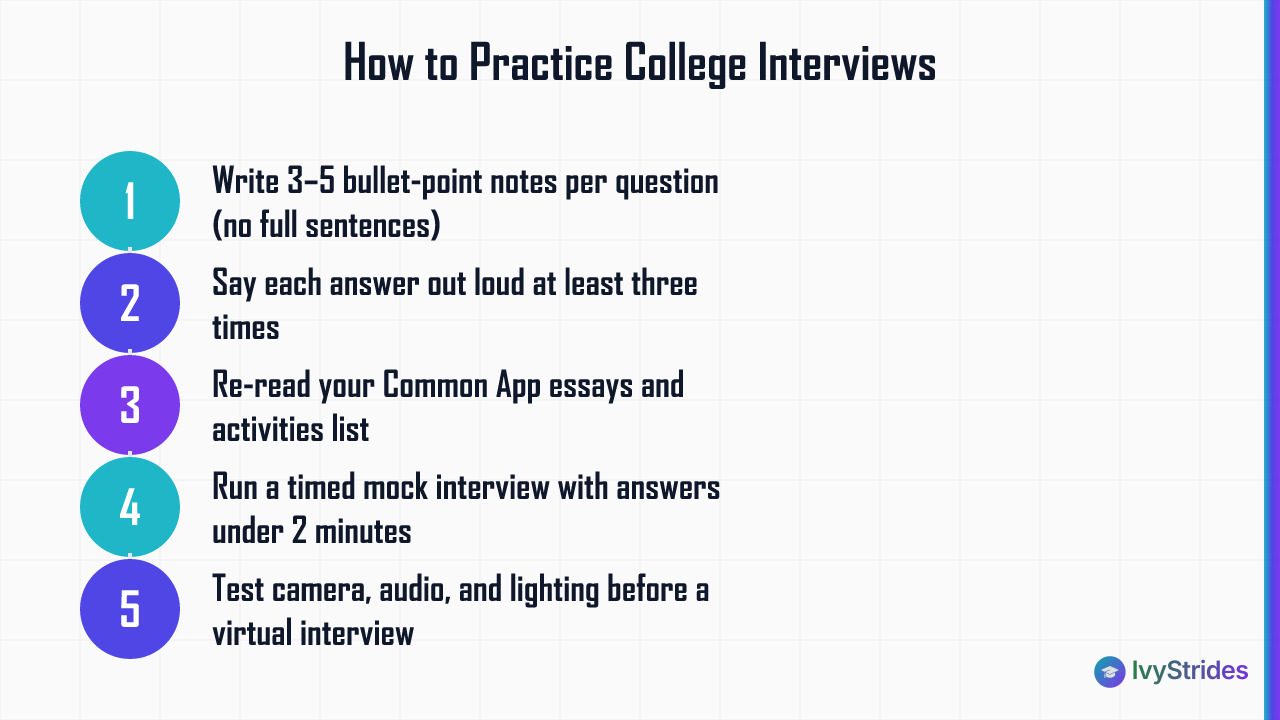
The fix for robotic answers is bullet-point notes, not scripts. Write three to five key points per question, not full sentences. When you practice from bullets, your brain reassembles the answer fresh each time, so it sounds like you talking rather than you reciting. Word-for-word memorization is what makes students freeze when the interviewer phrases a question slightly differently.
Practice out loud, not in your head. Silent review feels productive and does almost nothing for filler words. Saying an answer aloud to a parent, a friend, or a mirror is what trims the "um, like, you know" that creeps in under pressure. In our coaching, students who practice out loud at least three times before the interview report noticeably less anxiety and fewer filler words on the day.
The stories and themes you developed in your Common App personal statement are the same raw material your interviewer will ask you to expand on, so re-reading your essays the night before is one of the highest-use prep steps you can take. Per the Common App, your activities list and personal statement stay attached to your application, and the interviewer may reference either. Keep them fresh.
Run a timed mock interview. Have your practice partner ask the five core questions in a random order and time each answer. If one runs past two minutes, cut it. If one dies at fifteen seconds, add a specific.
If your interview is virtual, the logistics matter as much as the answers:
-
Set your camera at eye level, not looking up your nose.
-
Choose a neutral, uncluttered background.
-
Light your face from the front, never with a window behind you.
-
Test your audio and video 15 minutes before the call.
-
Close every other tab so nothing pings mid-answer.
College Interview Practice Checklist
- Write bullet-point notes for the five core questions
- Say each answer out loud at least three times
- Run one timed mock interview with a partner
- Re-read your Common App personal statement and activities list
- Draft three to five questions to ask the interviewer
- Confirm the time, format, and location
- For virtual: test camera, audio, and lighting
- Pick a business-casual outfit the night before
One pattern from our essay coaching: students who've already worked through their personal statement arrive with clearer, more specific stories. If re-reading yours turns up gaps, catching them now beats hearing them in an interview. Start with our list of common college essay mistakes to avoid. If the essay itself needs real work, our college essay coaching rebuilds the story before it costs you.
Interview Coming Up. Not Sure Your Stories Are Ready?
You have a date, a school, and a blank practice document. A free 15-minute call reviews the stories you're planning to tell, identifies where they're too vague to land, and gives you a concrete revision path before the interview.
What to Do After a College Interview to Leave a Strong Impression
The single most important post-interview step is a thank-you note sent within 24 hours. Email is standard, and it should be short: thank the interviewer, reference one specific thing you discussed, and reaffirm your interest. That one specific detail is what separates a genuine note from a template and proves you were actually present in the conversation.
Because that specific detail carries the note, jot down one thing you talked about the moment the interview ends, while it's fresh. The University of Rochester admissions blog recommends arriving 10 to 15 minutes early for in-person interviews and dressing business-casual; for a virtual interview, log in about five minutes before the scheduled time.
If the interview felt rough, don't spiral. Most schools describe interviews as informational or as one factor among many, and a single awkward interview rarely makes or breaks an application. Interviews typically happen in the fall and early winter of senior year, which means they overlap with essay deadlines and score submission windows, so your energy is better spent on the parts of the application still in your control.
After the Interview: Three Steps in 24 Hours
| Step | What to Do | Why It Matters |
| Note the detail | Write one thing you discussed | Fuels a specific thank-you |
| Send the note | Email within 24 hours | Shows genuine engagement |
| Refocus | Return to open deadlines | Interview is one signal, not all |
The interview sits inside a larger calendar. To see exactly where it lands against your remaining deadlines, check our map of college application deadlines for fall 2026. If you're weighing which demonstrated-interest signals are worth your time, our take on whether do campus visits help admission puts the interview in context.
Prep Plan Clear. Application Still Has Open Questions?
You have the interview steps, the question list, and the follow-up checklist. A free 15-minute call looks at your full application picture, checks where your essays and scores stand against your target schools, and tells you where to focus the time you have left.
FAQ: College Interview Preparation
What questions will be asked in a college interview?
Most college interviews open with "Tell me about yourself," then move to "Why this college," "What do you want to study," and "Describe a challenge you overcame." Preparing specific, story-based answers to these five questions covers the majority of most conversations. The interviewer may also ask what you do outside school or what you're currently reading.
How do I introduce myself for a college interview?
A strong self-introduction runs 60 to 90 seconds and covers three things: who you are and what you care about most, one or two specific activities that show it, and why you're excited about this particular school. Avoid reciting your resume; the interviewer has your application. Aim for a natural, conversational tone rather than a memorized speech.
What are good questions to ask at a college interview?
Ask about something specific you can't find on the school's website: a professor's research, how students in your intended major typically spend their first year, or what the interviewer found most surprising about the school. Avoid questions about acceptance rates, financial aid amounts, or anything answered on the homepage. Two to three well-researched questions are enough.
How long does it take to prepare for a college interview?
Based on the component tasks, IvyStrides estimates three to five focused hours over two to three days is enough for most students: about one hour on school research, one to two hours drafting bullet-point notes, and one hour of out-loud practice with a partner. Students who've already written strong essays need less time, because their core stories are already developed.
Your Next Step Before the Interview
You now have the full arc: research the school, prepare for the five core questions, practice out loud from bullets, and follow up within 24 hours. The interview rewards a specific, honest version of you, not a rehearsed one.
Here's where to start in the next three days:
- Block one hour to research two or three specifics about the school.
- Write bullet-point notes for the five core questions and say each aloud three times.
- Draft three questions to ask, and re-read your Common App essays the night before.

Award-winning author (South Asian Book Award) and graduate of BITS Pilani and UCLA Luskin School of Public Affairs. Brings a published writer's eye to Common App essays and grammatical precision to SAT and ACT R&W instruction.