
Is 9th Grade Too Early to Plan for College? Where the Record Starts
On this page
- Do Colleges Actually Care About 9th Grade Grades?
- What 9th Grade College Prep Actually Looks Like, Step by Step
- When Should a 9th Grader Start Thinking About SAT, ACT, or PSAT?
- How to Build a 9th Grade College Prep Plan That Holds Through Senior Year
- FAQ: 9th Grade College Planning
- Is 9th grade too early to think about college?
- Do colleges really care about freshman grades?
- What age should you start planning for college?
- What should I do as a freshman to prepare for college?
- Your Next Step in 9th Grade
No, 9th grade is not too early to start college planning. 9th-grade college preparation is the first year of the college-admissible record: freshman grades land on every transcript colleges read, and the courses you pick now decide which AP and honors classes open later.
The real question is not whether to plan but what to focus on at this stage. This article separates the moves that build the record, strong grades, a four-year academic plan, a few committed activities, from the high-pressure steps that genuinely belong in 10th and 11th grade.

Do Colleges Actually Care About 9th Grade Grades?
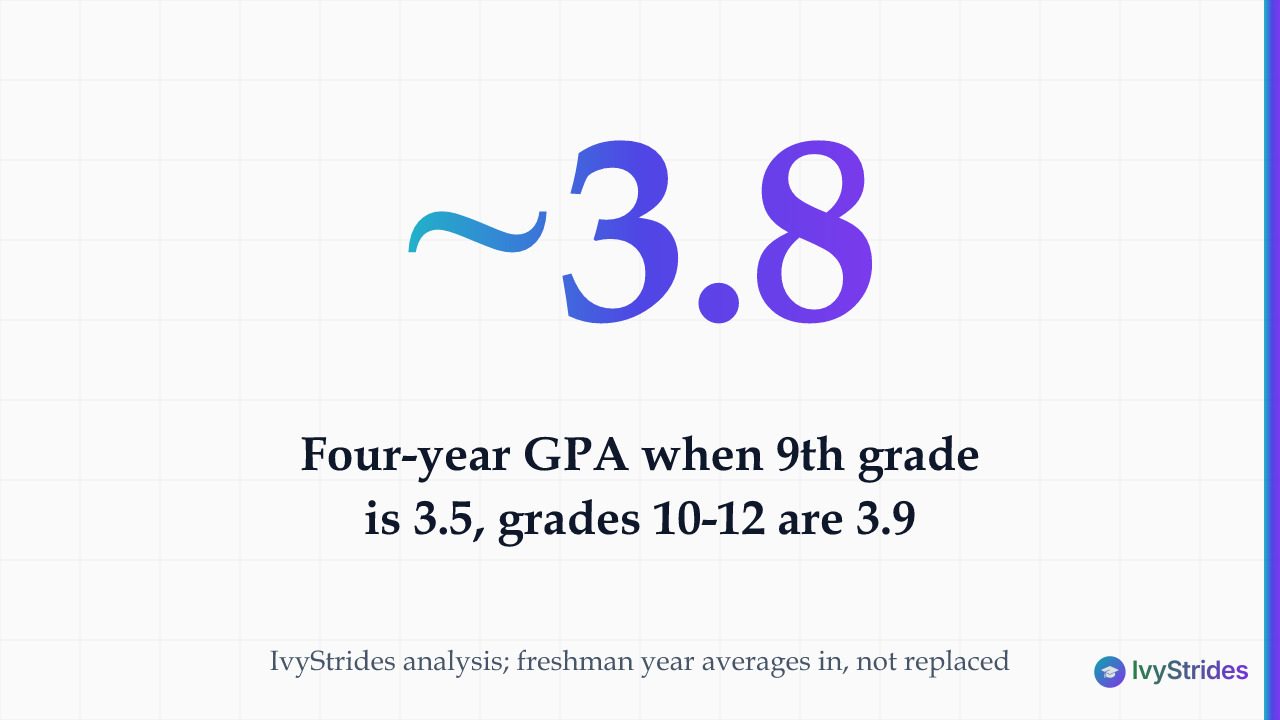
Yes. 9th-grade grades appear on the transcript colleges evaluate, and many colleges count them in the GPA they recalculate; the University of California is one exception, using only courses from the summer after 9th grade through the summer after 11th grade (UC Admissions). Freshman year is not a practice round that gets erased. Where it counts, a weak start averages in; it does not get replaced by later strong grades.
Because many colleges recalculate GPA on their own scale and include every year from 9th grade forward, a strong freshman year is not a head start; it is the floor the rest of the record is built on. Many strip out non-academic courses and reweight honors or pre-AP classes, so how colleges recalculate your GPA across all four years can shift a number up or down from your school report.
The arithmetic is unforgiving. IvyStrides' analysis of a student who earns a 3.5 in 9th grade and a 3.9 across 10th through 12th puts the cumulative four-year GPA at about 3.8, not 3.9, which works out that way because freshman year counts as one of the four years averaged in. A single soft year pulls the whole average, and it cannot be retroactively removed.
Course rigor matters as much as the number. Colleges read what you took, not just how you scored. Enrolling in honors or pre-AP coursework in 9th grade signals readiness for harder classes later, and the federal 9th-grade college prep checklist tells freshmen to take challenging classes in core academic subjects.
A caveat on testing: test-optional policies vary by school and year and do not eliminate the value of a strong GPA and course record (FairTest). Whatever a college's score policy, it still reads the transcript.
| Record Element | Visible to Colleges? | Why It Matters |
| 9th-grade semester grades | Yes | Counted in GPA at many colleges |
| Course rigor (honors, pre-AP) | Yes | Signals readiness for AP later |
| Weighted vs. unweighted GPA | Both, often recalculated | Colleges apply their own scale |
| Grade trend across years | Yes | Upward trend reads favorably |
| Freshman activities | Via Common App later | Builds extracurricular depth |
What 9th Grade College Prep Actually Looks Like, Step by Step

Photo by RDNE Stock project on Pexels
9th-grade college prep is four concrete tasks: earn strong grades in challenging courses, build a four-year academic plan with your school counselor, explore two or three activities you might commit to, and lock in study habits. Everything else can wait.
That short list overlaps with the federal checklist, which tells freshmen to get involved in school- or community-based activities, volunteering included, and tells parents to keep an eye on study habits and grades. Engaging a college counselor in 9th or 10th grade means spending that time building the record rather than reacting to it, a different kind of work than counseling that starts in 11th grade.
A counselor earns their place in freshman year by naming which courses keep options open, which is what families weigh when deciding when to hire a college counselor and what each grade buys.
Explore first, then commit. Selective colleges reward depth in one or two areas over a long list of brief memberships, which is why 9th grade is the right time to explore broadly before committing to the two or three activities a student will pursue seriously through senior year.
Exploring broadly in 9th grade and committing to two or three activities by 10th helps a student arrive at the Common App Activities section with a coherent narrative, while joining many clubs briefly leaves a list that is hard to frame. This is what a spike in college admissions looks like and how to build one, and it reads to an admissions officer as commitment rather than clutter.
The Common App personal essay runs up to 650 words, its seven essay prompts are unchanged for 2026-27 (Common App), and the Activities section reflects involvement across all four years. Neither is a 9th-grade task. But the experiences they draw on start accumulating now.
The plan prevents the scramble. A student who arrives in 11th grade without a four-year academic plan often discovers they are missing a prerequisite for the AP course they wanted, which forces a schedule change rather than a strategic choice. Mapping those prerequisites early is the work of grade-by-grade college counseling starting in 9th and 10th grade.
| Do in 9th Grade | Wait Until 10th-11th Grade |
| Earn strong grades in rigorous courses | Intensive SAT or ACT prep |
| Build a four-year academic plan | Finalize a college list |
| Explore 2-3 activities | Draft the personal statement |
| Build consistent study habits | Campus visits for demonstrated interest |
| Take PSAT 8/9 as optional baseline | Sit the PSAT/NMSQT (11th grade counts for National Merit) |
| Meet your school counselor | Request recommendation letters |
When Should a 9th Grader Start Thinking About SAT, ACT, or PSAT?
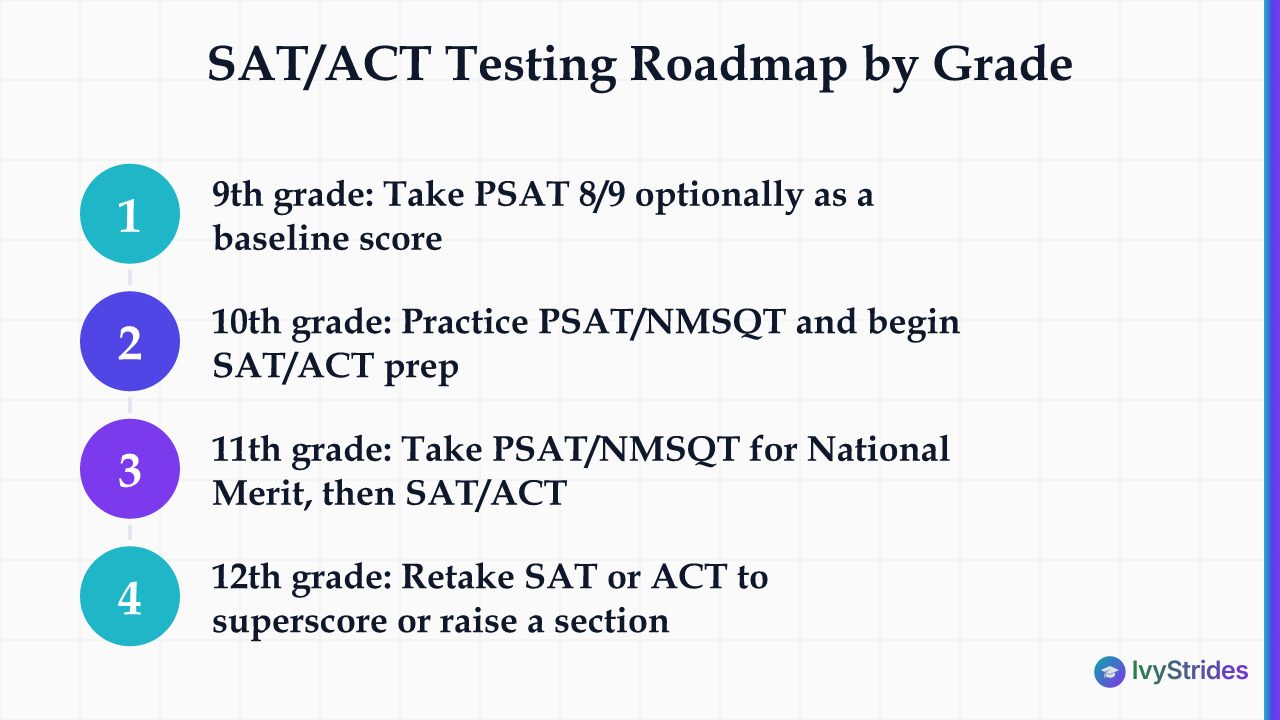
9th grade is for building the skills the tests measure, not for intensive test prep. A freshman can sit the PSAT 8/9 as an optional baseline, but focused SAT or ACT prep belongs in 10th and 11th grade, and the PSAT/NMSQT, designed for 10th and 11th graders, is the National Merit qualifying test in 11th grade.
That 11th-grade score is the initial National Merit screen, yet the reading, writing, and math skills the test measures are built from 9th grade on. The PSAT 8/9 scores on a 240-1440 range and shares a common scale with the broader SAT Suite, so an early score is a genuine progress marker (College Board). The right starting point differs by grade, which is the whole question behind how early to start PSAT prep by grade.
Skills now, prep later. The digital SAT scores 400 to 1600 (College Board), and focused prep fits best in 10th or 11th grade, once the foundational math and reading are in place. A parent deciding the exact term will find a grade-by-grade framework in when your child should start SAT prep, by grade.
One 9th-grade move that pays off at test time: some AP classes have recommended courses to take first, and high schools may set their own requirements (College Board AP Program), so the courses chosen now shape which AP classes are open later. AP enrollment is also one component of the course-rigor signal colleges weigh.
| Grade | Recommended Testing Action | Purpose |
| 9th | PSAT 8/9 (optional) | Baseline on common scale |
| 10th | PSAT/NMSQT practice, early SAT/ACT prep | Build skills, pick a test |
| 11th | PSAT/NMSQT (fall), SAT or ACT | National Merit, first real scores |
| 12th | Retake SAT or ACT if needed | Superscore or raise a section |
How to Build a 9th Grade College Prep Plan That Holds Through Senior Year
A 9th-grade plan that holds is one conversation and one document: a four-year academic plan, mapped with your school counselor, that sequences prerequisites, names two or three activities worth deepening, and sets a realistic testing timeline. Build it in freshman year and junior year becomes a sprint, not a scramble.
The federal checklist backs that plan: it lists the core courses most colleges require, suggests rounding out the course load with electives, and tells freshmen to ask a counselor or teachers which AP courses are available and how to enroll. Colleges evaluate the number and difficulty of courses taken, not GPA alone, which is why prerequisite sequencing in 9th grade matters so much. Families often underestimate how much a counselor does at each stage, from mapping prerequisites now to what a college counselor does, grade by grade through senior year.
Set a GPA target, not a college list. In 9th grade the useful goal is a strong cumulative GPA and an upward trend, not a dream school. Picking colleges, touring campuses, and drafting essays are 10th-to-11th-grade work. Whether a freshman-year visit even registers is answered in whether campus visits in 9th or 10th grade affect admission chances.
At IvyStrides, the Grades 9-10 college counseling program starts with exactly this conversation: mapping a four-year academic plan that sequences prerequisites, identifies two or three extracurricular commitments worth deepening, and sets a realistic testing timeline. No single element decides admission; the full application does, and policies on testing and AP credit vary by college and year.
| Grade | Academic Focus | Extracurricular Focus | Testing Focus |
| 9th | Strong GPA, honors courses | Explore broadly | PSAT 8/9 (optional) |
| 10th | AP prerequisites in place | Narrow to 2-3 | Begin test prep |
| 11th | Peak rigor | Leadership roles | PSAT/NMSQT, SAT/ACT |
| 12th | Maintain, finish strong | Deepen and lead | Final retakes |
FAQ: 9th Grade College Planning
Is 9th grade too early to think about college?
No. Freshman grades sit on every transcript colleges read, and the courses you choose now decide which AP and honors classes are open in 11th and 12th. Thinking about college in 9th grade means building the record, not stressing over applications that are years away.
Do colleges really care about freshman grades?
Yes. Many colleges count freshman grades in the GPA they calculate, and the transcript shows course rigor from 9th grade forward. A weak freshman year stays visible, and where it counts toward GPA, later strong grades average in rather than replace it.
What age should you start planning for college?
Most students benefit from starting in 9th grade, around age 14 or 15, because that is when the college-admissible transcript begins. Earlier planning in middle school can focus on study habits and exploring interests, but the formal record colleges evaluate starts in high school.
What should I do as a freshman to prepare for college?
Four things: earn strong grades in challenging courses, build a four-year academic plan with your school counselor, explore two or three activities to find what you'll commit to, and build consistent study habits. Intensive test prep and college-list building can wait until 10th or 11th grade.
Your Next Step in 9th Grade
Freshman year is the floor of the college record, not a dress rehearsal. The work now is quiet and specific: protect the GPA, pick rigor you can handle, and set up the four-year plan before course selection closes.
- Book a planning conversation with your school counselor this term.
- Choose honors or pre-AP courses that keep AP options open later.
- Commit to two or three activities to explore, not ten.
- Treat the PSAT 8/9 as an optional baseline, and leave intensive SAT or ACT prep for 10th and 11th grade.

Rajesh is a technology leader, entrepreneur, and angel investor with 28+ years in Business & Technology Leadership and Product & Solution Engineering. He is passionate about education, mentoring, and driving digital transformation.