
College Interview Questions to Expect, and How to Answer Them Well
On this page
- What Questions to Expect in a College Interview, by Category
- How to Answer the Most Common College Interview Questions
- What College Interview Questions Are Actually Hardest to Answer Well
- Not Sure Your Answers Are Specific Enough to Hold Up Under Follow-Up Questions?
- Good Questions to Ask Your College Interviewer
- Answer Bank Built. Now Find Out Which Answers Need Sharper Detail.
- FAQ: College Interview Questions and Answers
- What are good college interview questions?
- What are the 5 hardest interview questions for college applicants?
- What are some good questions to ask in a college interview?
- What is the biggest red flag to hear when being interviewed?
- Your Next Step on College Interview Prep
College interview questions are the spoken version of your application. Most interviews cover four categories: getting-to-know-you openers, academic and school-fit questions, personal growth prompts, and a chance for you to ask questions. The two interviewers weight most are "Why this college" and "Tell me about yourself."
Those categories hold across most selective schools, according to question lists published by Indeed. The harder truth is that interviewers are not grading your polish. They are listening for whether your answers could belong to any applicant or only to you. Strong answers are specific and story-based, not resume recitations.
What Questions to Expect in a College Interview, by Category
Typical college interview questions fall into four categories: getting-to-know-you, academic and school-fit, personal growth and challenge, and questions you ask the interviewer. Each category surfaces a different signal, and knowing that signal is what lets you prepare a genuine answer instead of a generic one.
Who's across the table changes the tone. Most college interviews are conducted by alumni volunteers, not admissions officers, per the question guide published by Indeed. An alumni interviewer wants to feel your enthusiasm and report back that you'd fit, which shifts things toward conversation rather than interrogation.
| Category | Example Questions | What the Interviewer Is Listening For |
| Getting-to-know-you | Tell me about yourself; What do you do outside school; How friends describe you | A real person with genuine interests |
| Academic and school-fit | Why this college; What do you want to study and why | Specific research and honest fit |
| Personal growth | Greatest strength and weakness; A challenge you overcame | Self-awareness and reflection |
| Questions you ask | Your prepared questions at the end | Research depth and real curiosity |
Timing matters here. Interview invitations typically arrive in October through January, which overlaps with supplemental essay deadlines, so building your answer bank early keeps both tracks on schedule. Knowing which questions to expect is the first step; the full preparation walkthrough, including mock-interview logistics and timing, is covered in our step-by-step guide on how to prepare for a college interview.
In our coaching with students preparing for college interviews, the most common gap is not knowing the answer. It's giving one too vague to hold up under a follow-up question.
How to Answer the Most Common College Interview Questions
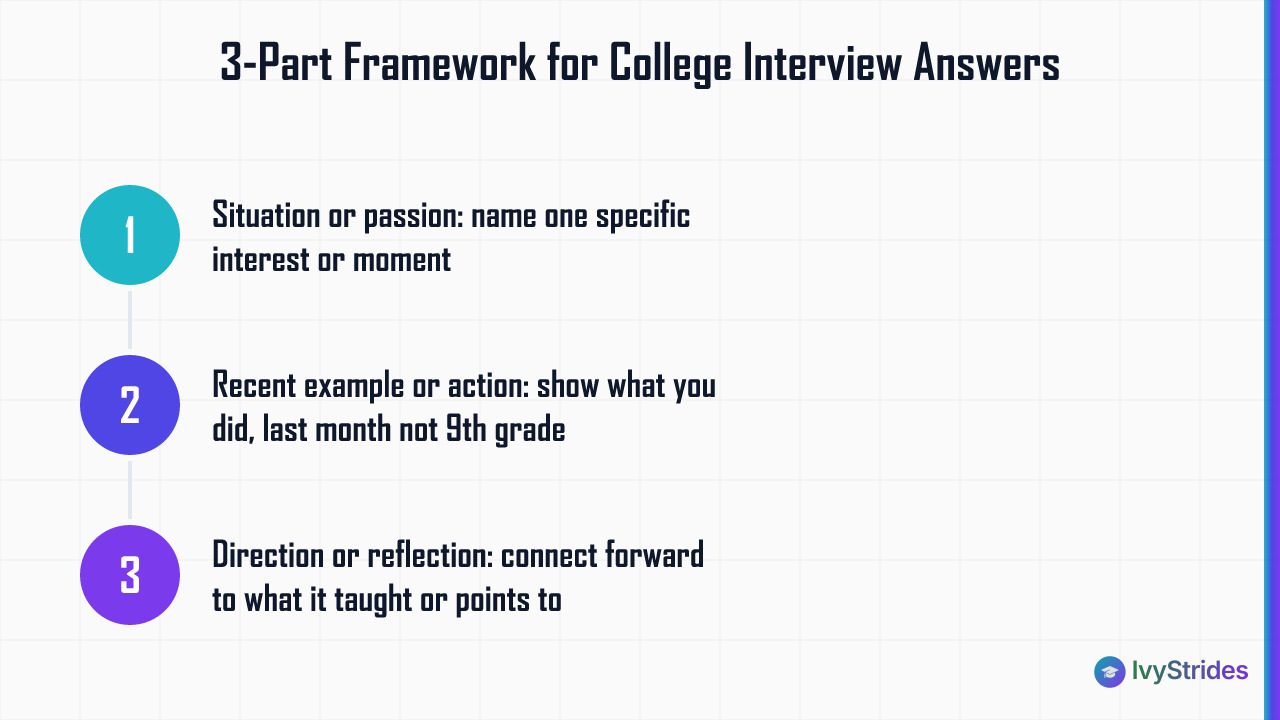
The five most common college interview questions each have an answer framework: "Tell me about yourself," "Why this college," "What do you want to study and why," "What is your greatest weakness," and "Tell me about a challenge you overcame." The same three-part structure works for almost all of them.
-
Situation or passion: name the concrete starting point, one specific interest or moment.
-
Recent example or action: show what you actually did about it, last month, not in ninth grade.
-
Direction or reflection: connect it forward to what it taught you or where it points.
Tell me about yourself. Don't list your resume. Open with a core passion, give one recent example that proves it, then point at where it's headed. "I got into urban planning after mapping bus routes for a class project, and this summer I built a walkability survey for our downtown" beats "I'm hardworking and I love learning."
Why this college. This is the question interviewers weight most heavily, because a generic answer is obvious in seconds. Name a specific program, a professor whose work you've read, or a campus tradition. "Your reputation for strong academics" applies to 200 schools. "Professor Lin's lab on coastal resilience" applies to one.
What do you want to study and why. Connect a high school experience to the major. The link is the answer. An AP Biology dissection that made you want to study neuroscience is specific; "I've always loved science" is not.
Greatest weakness. This one wants active self-awareness, not a disguised strength. "I work too hard" signals no self-awareness at all. "I rush the first draft and have to force myself to revise, so now I build in a cooling-off day" shows you noticed a real pattern and did something about it.
A challenge you overcame. Use situation, action, reflection. The reflection matters more than the crisis, per answer frameworks from Indeed. Interviewers aren't scoring how big your obstacle was. They're listening for what you understood afterward.
The themes you develop in your Common App personal statement are the same ones an interviewer will probe in person, so strong essay work and strong interview prep reinforce each other. Working through those narratives with college essay coaching gives you the raw material both draw from. The same story-based specificity that makes an essay land is the show, don't tell in college essays skill applied out loud.
What College Interview Questions Are Actually Hardest to Answer Well
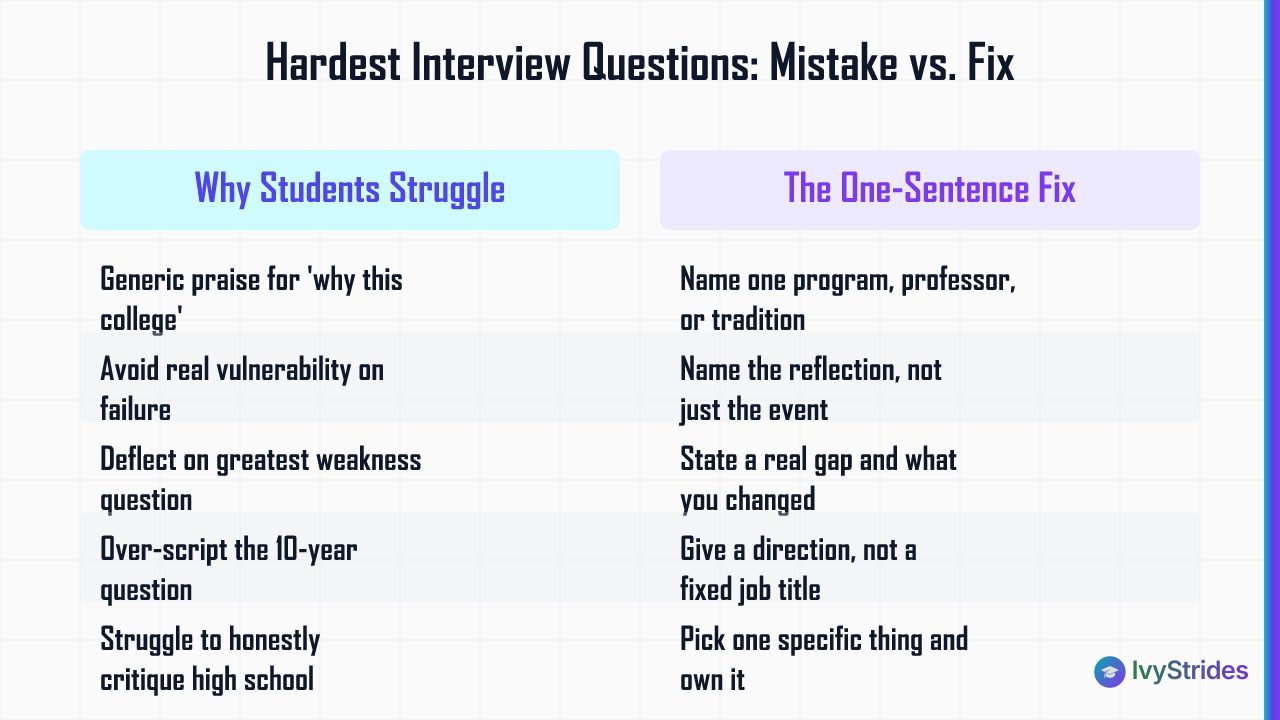
The hardest college interview questions are hard not because the topics are difficult, but because the strong answer demands genuine self-reflection or school-specific research you can't fake in the moment. Five questions trip up students most consistently, and each has a one-sentence fix.
| Question | Why Students Struggle | The Fix |
| Why this college | Generic praise is instantly obvious | One named program, professor, or tradition per answer |
| Tell me about a time you failed | Students avoid real vulnerability | Name the reflection, not just the event |
| What is your greatest weakness | Deflection is the default | State a real gap and what you changed |
| Where do you see yourself in 10 years | Over-scripting or under-thinking | Give a direction, not a fixed job title |
| What would you change about high school | Requires honest self-reflection | Pick one specific thing and own it |
The biggest red flag interviewers report is an answer that could apply to any school. Praising "great academics" or "beautiful campus" with no specific detail tells the interviewer you didn't research and aren't genuinely interested. One concrete, school-specific detail per answer closes that gap.
The failure question is a good example. Students describe a setback and stop there, hoping the crisis alone counts. It doesn't. The answer rewards honesty about what you understood afterward, so the reflection carries the weight, not the drama.
Across hundreds of essay and interview coaching sessions, the weakness question is the one students most often want to skip in practice, which is exactly why it needs the most rehearsal. If you're still weighing how much time to invest, our data-backed breakdown of do college interviews matter gives you the honest answer. The same vagueness that weakens an answer weakens an essay, which is why the common college essay mistakes to avoid are worth reading alongside this.
One caveat before you over-invest: interview weight varies by school. Some colleges treat the interview as evaluative, others as informational only, and admissions outcomes depend on the full application, not the interview alone.
Not Sure Your Answers Are Specific Enough to Hold Up Under Follow-Up Questions?
You have the question list and the frameworks. The gap most students cannot close alone is knowing whether their answers are genuinely specific or just polished-sounding. A free 15-minute call reviews the answers you are planning to give, identifies where they are too vague to land, and gives you a focused revision path before your interview date. Students and parents are both welcome.
Good Questions to Ask Your College Interviewer
The best questions to ask a college interviewer are ones only that person can answer from personal experience, per CollegeEssayGuy. Asking strong questions signals research depth and genuine interest; asking none, or asking what the website already answers, signals the opposite. Prepare 3 to 5 questions so you're never caught empty.
- Strong: What did you find most challenging academically, and how did you handle it?
- Strong: Looking back, what would you do differently as a student here?
- Strong: How did a specific program or professor shape your path after graduation?
- Strong: What surprised you most about the community your first year?
- Weak: What's your acceptance rate? (The website answers this.)
- Weak: When is the application deadline? (Signals no research.)
- Weak: Is this a good school? (Signals no genuine interest.)
Adapt to who's across from you. An alumni interviewer can speak to lived experience and what stayed with them; an admissions officer can speak more to the program itself. Point your questions where that person's real knowledge lives.
Students who prepare school-specific details for these questions consistently report feeling more confident than those who rely on general praise. For a broader look at interview formats, what to wear, and what to bring, see our complete college interviews guide. If your questions touch a school's academic rigor, referencing your own coursework helps, and does AP help with college admission gives the context for that conversation.
Building the full answer bank takes roughly 3 to 5 focused hours: about 6 to 8 story-based answers at 20 to 30 minutes each, plus school research for your questions. That's the real stake. Walk in with vague answers and a follow-up question exposes them fast.
Answer Bank Built. Now Find Out Which Answers Need Sharper Detail.
You have the four question categories, the answer frameworks, and your prepared questions. Knowing whether your specific answers are ready for a real interviewer, one who will ask follow-up questions, takes a focused conversation. A free 15-minute call reviews your preparation, flags the two or three answers worth tightening most, and gives you a concrete revision before you walk in. Students and parents are welcome to join.
FAQ: College Interview Questions and Answers
What are good college interview questions?
Good college interview questions fall into four categories: getting-to-know-you openers, academic and school-fit questions, personal growth prompts, and questions you ask the interviewer. The most important to prepare are "Tell me about yourself," "Why this college," and "What is your greatest weakness," because those are where generic answers are most obvious to an interviewer.
What are the 5 hardest interview questions for college applicants?
The five hardest are "Why this college" (requires specific research), "Tell me about a time you failed" (requires real vulnerability), "What is your greatest weakness" (deflection is the default), "Where do you see yourself in 10 years" (easy to over-script), and "What would you change about your high school experience" (requires honest self-reflection). Each is hard because the strong answer demands specificity, not polish.
What are some good questions to ask in a college interview?
Ask questions only the interviewer can answer from personal experience: what they found most challenging academically, what they'd do differently, or how a specific program shaped their career. Avoid anything the school website already answers, like acceptance rates or deadlines. Prepare 3 to 5 questions, because asking none signals low interest.
What is the biggest red flag to hear when being interviewed?
The biggest red flag interviewers report is an answer that could apply to any school: praising a college's "great reputation" or "strong academics" without naming a specific program, professor, or tradition. It signals the student hasn't researched the school. The fix is one concrete, school-specific detail per answer.
Your Next Step on College Interview Prep
You now have the four question categories, an answer framework for each, the questions that trip students up most, and a list of strong questions to ask. Preparation is a skill, and the students who sound genuine are the ones who did the specific work, not the ones who memorized more.
Before your interview date:
- Draft 6 to 8 story-based answers mapped to the four categories.
- Add one school-specific detail to your "Why this college" answer.
- Practice the weakness and failure questions out loud, since those need the most rehearsal.
- Prepare 3 to 5 questions only the interviewer could answer.

Award-winning author (South Asian Book Award) and graduate of BITS Pilani and UCLA Luskin School of Public Affairs. Brings a published writer's eye to Common App essays and grammatical precision to SAT and ACT R&W instruction.