
How to Make an Ordinary Topic Compelling in Your College Essay
On this page
- What Makes a College Essay Topic Compelling vs. Cliche
- How to Elaborate on Any Topic: The 'So What?' Test for College Essays
- What Are the Key Elements That Make a College Essay Story Compelling
- How to Write a Compelling College Essay Story When Your Topic Feels Too Ordinary
- FAQ: Making an Ordinary College Essay Topic Compelling
- How to elaborate any topic?
- What are the key elements that make stories compelling?
- What is a good way to elaborate in an essay?
- What would be a great topic?
Any topic becomes compelling when you shift focus from what happened to why it mattered. Find the hidden stakes by asking "So what?" five levels deep until a specific human truth surfaces. Then replace summary with scene: one precise moment, one internal shift, one honest insight.
The topic rarely decides whether the essay works. A college admissions essay is the personal statement or supplemental piece a college reads to hear your voice, and the Common App's essay instructions cap the personal statement at 650 words, calling that number "your limit, not your goal." The harder question is not which topic to pick but how to reframe the one you have so an admissions reader feels it, not just follows it.

What Makes a College Essay Topic Compelling vs. Cliche
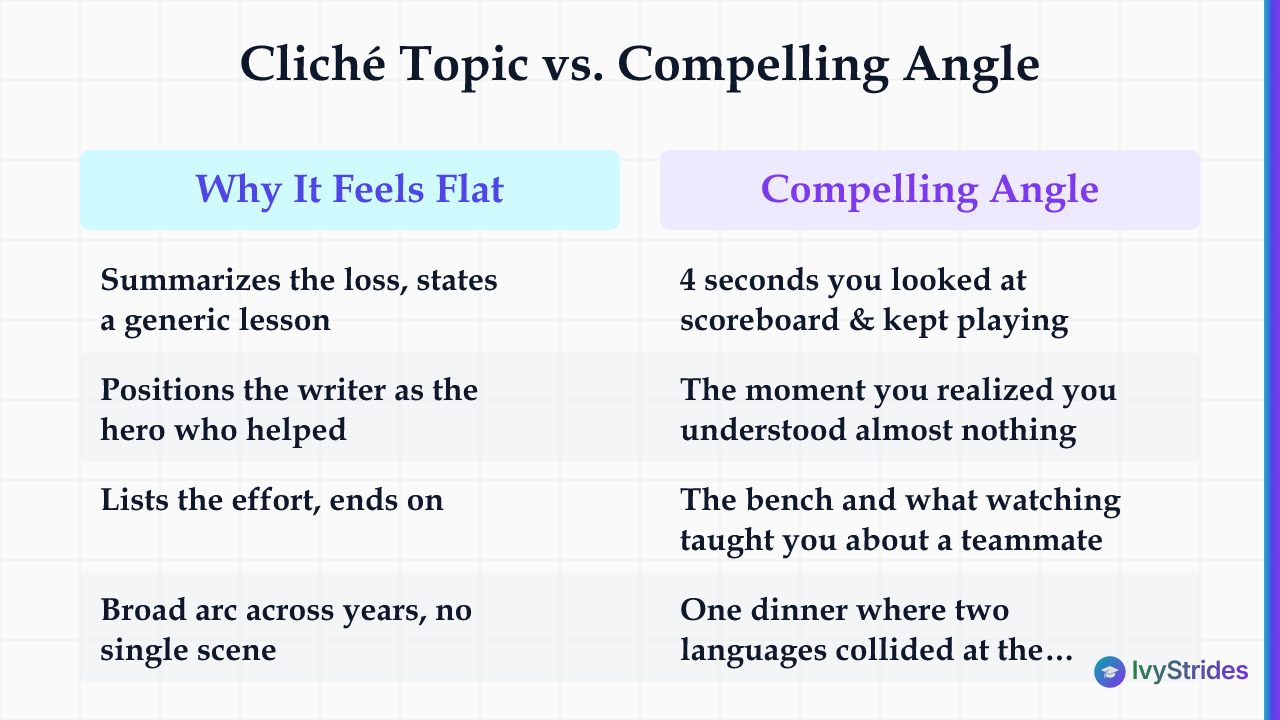
A compelling college essay topic is one told through a specific angle, not a rare event. Johns Hopkins' admissions office says of its essays that worked that in each one, students shared "stories from their everyday lives" to reveal something about their character and values. The angle, meaning the particular slice of the experience you inhabit, does most of the work. A common reason an essay feels flat is summary without stakes, not a weak topic.
Here's the part most students miss. A cliche is not a banned subject. A cliche is a subject rendered the way every other applicant renders it, which is why your opening lines carry so much weight: they show the reader early that this version comes from a new angle.
Topic versus angle. The sports injury, the mission trip, the grandparent's illness read as cliche only when the writer summarizes the lesson instead of showing the specific moment it landed. The same subjects work when the angle is precise and the stakes are honest.
| Ordinary Topic | Why It Feels Flat | Compelling Angle |
| Losing a big game | Summarizes the loss, states a generic lesson | The 4 seconds you looked at the scoreboard and kept playing |
| A mission trip | Positions the writer as the hero who helped | The moment you realized you understood almost nothing |
| Making the varsity team | Lists the effort, ends on "hard work pays off" | The bench, and what watching taught you about a teammate |
| Immigrating as a child | Broad arc across years, no single scene | One dinner where two languages collided at the table |
If you are tempted to scrap your draft, weigh it against the kinds of subjects that tend to work in a college essay first; an ordinary topic that holds up there needs a sharper angle, not a replacement. The prompts leave room for it, too: the Common App kept its seven personal essay prompts unchanged for 2026-27, and the seventh invites an essay on any topic of your choice.
How to Elaborate on Any Topic: The 'So What?' Test for College Essays
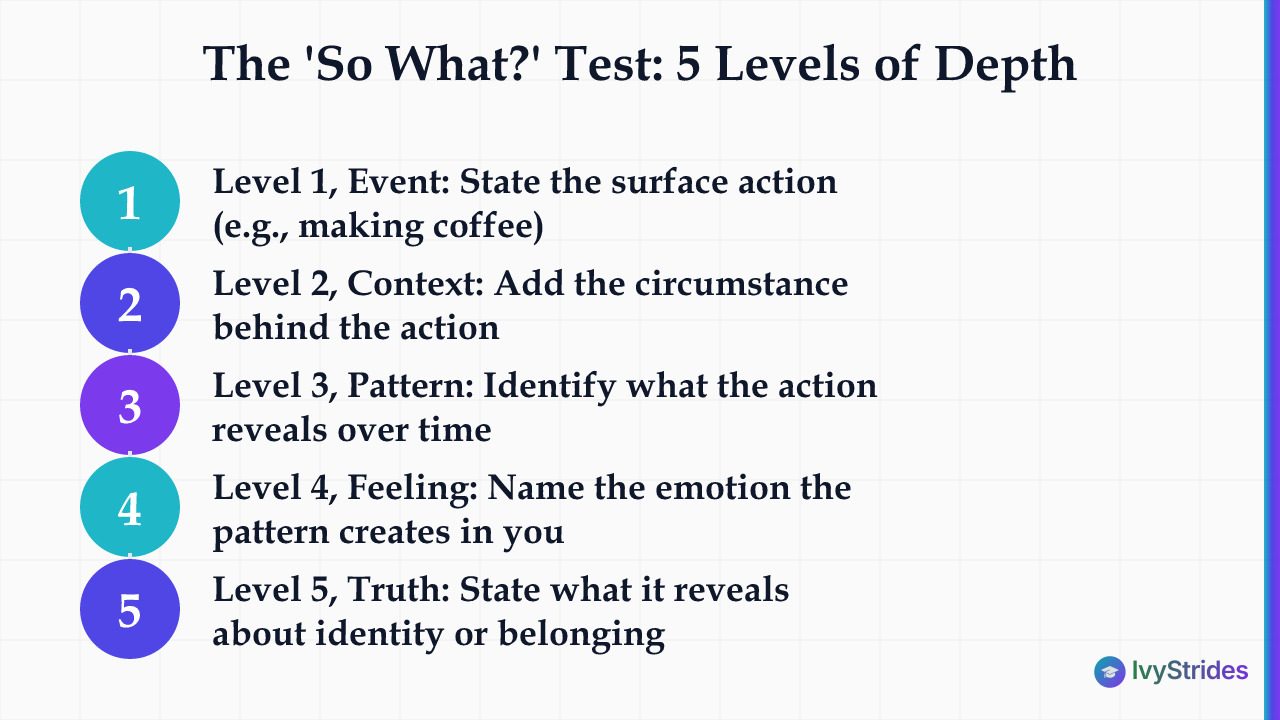
The "So What?" test is a five-level drill that moves an ordinary topic from surface event to a specific human truth. You ask "So what?" of your own sentence, answer honestly, and keep asking of each new answer until the fifth level names a truth about you. Elaboration here means depth, not word count.
That five-level depth is exactly what separates a compelling angle from a flat one. Take a genuinely mundane topic: you make coffee for your dad every morning before school.
-
Event: I make my dad coffee every morning. So what?
-
Context: He works a night shift and gets home as I leave. So what?
-
Pattern: The coffee is the only overlap in our two schedules. So what?
-
Feeling: I started dreading the mornings I overslept and missed it. So what?
-
Truth: That two-minute handoff is how we tell each other we are still a family, even when the calendar says otherwise.
Level five is the essay. The first four are throat-clearing you cut. If your fifth answer does not yet name something about identity, belonging, or responsibility that the first draft never said out loud, keep asking.
The internal shift. Notice the drill ends on what changed inside you, not on the coffee. An external event with no internal shift reads as a diary entry. Once you have found your stakes, lock in the one theme that holds the whole essay together, so every scene you keep serves that idea and the rest can go.
Once an ordinary topic has been through the drill, an IvyStrides essay coach can read the draft to judge whether the stakes land or read as forced, then map one revision direction before your deadline. If you want that outside read on a first draft, you can meet the tutors, among them a coach whose specialties include Common App and supplemental essays.
What Are the Key Elements That Make a College Essay Story Compelling
Four elements consistently separate a compelling college essay from a flat one: specificity, narrative proximity, emotion, and a visible internal shift. Those same four are why the "So What?" test works; the test finds the shift, and these elements dramatize it.
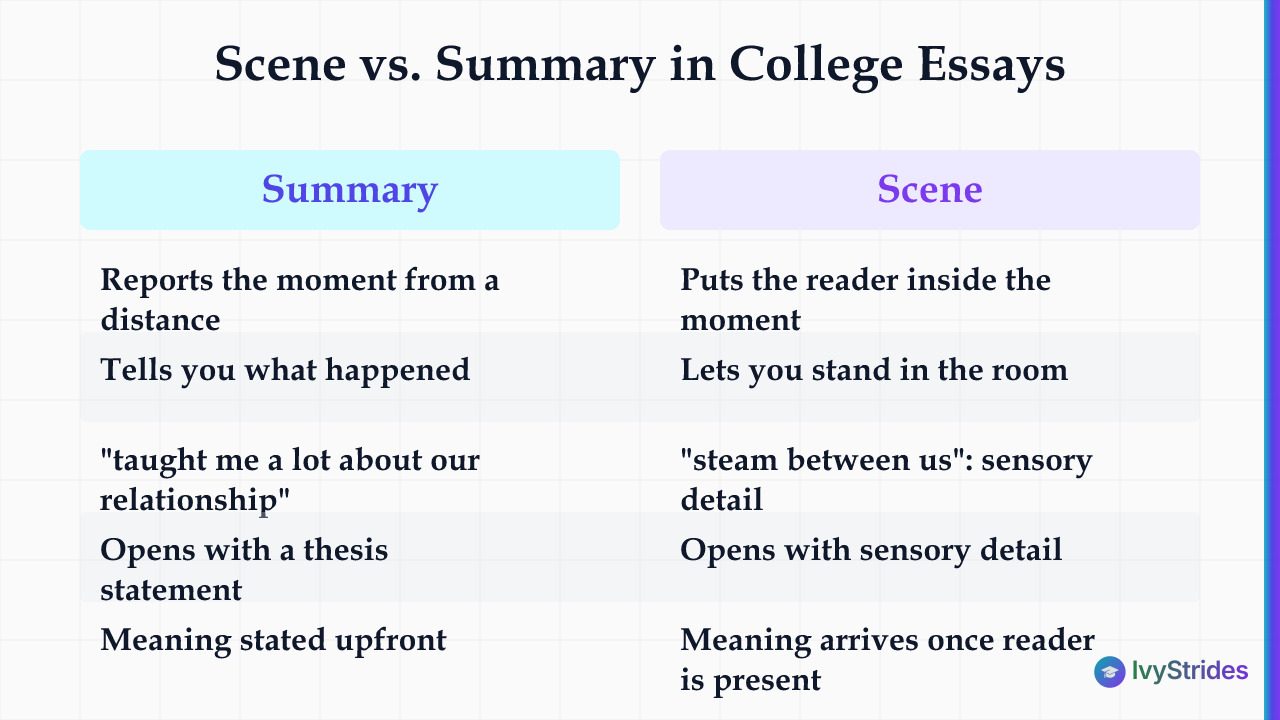
Scene versus summary is the one that changes the most drafts. Summary reports the moment from a distance. Scene puts the reader inside it.
Summary: "Making coffee for my dad every morning taught me a lot about our relationship."
Daily SAT and ACT prep on YouTube: short strategy videos from IvyStrides. Subscribe to IvyStrides on YouTube.
Scene: "The kettle clicked at 6:14. He came through the door as I went out, and we traded the mug in the doorway without a word, steam between us."
Same topic. One tells you; one lets you stand in the kitchen. Open on the sensory detail rather than a thesis statement, and let the meaning arrive once the reader is already in the room.
| Element | What It Means in Practice | Quick Test to Apply to Your Draft |
| Specificity | One named detail, not a vague description | Can you point to a noun a reader could photograph? |
| Narrative proximity | Scene over summary; inside the moment | Are we in the room, or hearing about it later? |
| Emotion | An honest internal reaction | Do you name what you felt, not what you should have felt? |
| Internal shift | The writer understands something new | Is the you at the end different from the you at the start? |
With the four elements in place, structure your 650 words so the opening scene and the closing insight answer each other; a vivid first paragraph still needs an ending that names what changed. Practice the scene move one sentence at a time, turning each told line into a shown one, which is the core of showing rather than telling in a college essay.
How to Write a Compelling College Essay Story When Your Topic Feels Too Ordinary
An ordinary topic becomes a compelling story when you cut the summary opening and start inside the scene where the real stakes live. That single move applies everything above: specificity, narrative proximity, and the internal shift the "So What?" test surfaced. A common revision is replacing the first paragraph, which summarizes the topic, with the third paragraph, which is usually where the real story starts.
Watch it happen on the coffee essay.
Before: "Every morning I make coffee for my dad. He works nights, so it is one of the few things we do together. Over time I realized how much these small routines mean to a family."
After: "6:14. The kettle clicked, and headlights swung into the driveway as I zipped my backpack. He smelled like the warehouse. I handed him the mug, he handed me the car keys, and neither of us said the thing we both meant."
The after version names a time, a smell, an object, and an unspoken feeling. It trusts the reader to feel the stakes instead of being told them. That trust is what voice sounds like: honest self-disclosure, not performance.
One caveat before you revise. No essay technique guarantees admission. The essay is one component of a holistic application that weighs grades, rigor, and the rest, so a strong essay complements your record; it does not overwrite it.
-
Does the first paragraph open in a scene, not a summary?
-
Is there one named sensory detail in the first 100 words?
-
Have you asked "So what?" until a truth about you surfaced?
-
Does the essay show an internal shift, not just an event?
-
Is every emotion honest rather than the one you think readers want?
-
Does the closing sentence carry the insight, not restate the plot?
College admissions insights on LinkedIn: follow IvyStrides for application guidance and counseling updates.
- Are you inside the Common App 650-word limit?
Once the scene and stakes are in, edit the draft without sanding off the voice you just surfaced: cut filler and fix errors, but keep the sentences that sound like you. Treat the checklist as a last pass against the mistakes that flatten an otherwise strong college essay; a summary opening and an ending that only restates the plot are two it catches directly.
FAQ: Making an Ordinary College Essay Topic Compelling
How to elaborate any topic?
Ask "So what?" five levels deep, moving from the surface event to the human truth underneath it. Then replace one summary sentence with a specific scene: name the place, the physical detail, the internal reaction. Elaboration is depth, not length, so this often shortens the essay rather than padding it.
What are the key elements that make stories compelling?
Four elements do most of the work in a compelling college essay: specificity, a named detail rather than a vague one; narrative proximity, scene over summary; emotion, an honest internal reaction; and a visible shift, where the writer understands something new by the end.
What is a good way to elaborate in an essay?
Follow every external event with an internal reaction: what did you think, feel, or decide in that moment? Then add one concrete sensory detail. Those two moves turn a flat statement into a paragraph that feels lived-in rather than reported, and they cost you almost no words.
What would be a great topic?
A great college essay topic is not rare or dramatic; it is specific and honest. Making a parent's coffee, fixing a bicycle, or teaching a sibling to read can each carry a strong essay, as long as you find the real stakes in the moment and render it in precise detail.

Hemant is a seasoned entrepreneur, investor, and growth strategist with deep ground in education and technology-driven learning. His core training is in Mathematics and Physics — he authored Physics for IB Diploma: Ultimate Revision Guide, recognized as a top student resource.