
How to Answer the Vanderbilt Supplemental Essay on 'Dare to Grow'
On this page
- What the Vanderbilt Supplemental Essay Prompt Is Actually Asking
- Why the Vanderbilt Supplemental Essay Carries Real Weight in the Review
- How to Structure Your Vanderbilt 'Dare to Grow' Response in 250 Words
- Common Mistakes in Vanderbilt Supplemental Essay Drafts and How to Fix Them
- FAQ: Vanderbilt Supplemental Essay Questions
- Does Vanderbilt have any supplemental essays?
- How long is the Vanderbilt supplemental essay?
- Can you provide some examples of supplemental essays for Vanderbilt University?
- Should I submit a 1490 to Vanderbilt?
- Your Next Step on the Vanderbilt Short Answer
Vanderbilt requires one supplemental short answer of about 250 words for all first-year applicants. The prompt, built on the motto Crescere aude ("dare to grow"), asks how one or more aspects of your identity, culture, or background has played a role in your personal growth, and how it will contribute to Vanderbilt's campus community.
That wording and word count come from Vanderbilt's official prompts page. One caveat worth flagging: the page names no application year, so treat it as current for the 2026-27 cycle but confirm it against the live Common App before you submit.
What the Vanderbilt Supplemental Essay Prompt Is Actually Asking
The Vanderbilt Crescere aude short answer is the one supplemental essay every first-year applicant must write, and it does two jobs at once. The prompt asks you to reflect on how one or more aspects of your identity, culture, or background has played a role in your personal growth, and how it will contribute to the campus community as you dare to grow at Vanderbilt (Vanderbilt Admissions). No separate "Why Vanderbilt" essay sits behind it.
One essay, two clauses. Read the prompt as a hinge. The first half looks backward at growth that already happened; the second half looks forward at what you will add to Vanderbilt. A strong draft answers both.
You submit the short answer through one of three platforms: the Common App, Coalition on Scoir, or QuestBridge. Vanderbilt states no preference.
A note for a few applicants. If you apply to Peabody College and choose an Elementary, Secondary, or Special Education major, you answer one extra question about the field of education. Blair School of Music applicants complete a separate application and an audition that includes a pre-screening video.
| Element | Detail |
| Number of supplemental essays | One required short answer |
| Prompt theme | Crescere aude, "dare to grow" |
| Word count | About 250 words |
| Two-part ask | Personal growth, then campus contribution |
| Platforms | Common App, Coalition on Scoir, QuestBridge |
| Peabody education majors | One additional question on education |
| Blair School of Music | Separate application plus audition |
Students applying to several selective universities write many short answers, and how a single focused prompt compares to the rest of your supplemental load is worth mapping early.
Vanderbilt now has five undergraduate schools: Arts and Science, Engineering, Peabody, Blair, and the new College of Connected Computing, which admits its first undergraduate class in fall 2027 with programs in Computer Science, Data Science, and AI Design and Practice (Vanderbilt). That fifth school gives you a fresh, specific place to point your campus contribution.
Why the Vanderbilt Supplemental Essay Carries Real Weight in the Review
Photo by Trần Phan Phạm Lê on Pexels
Vanderbilt rates the Application Essay as "Very Important" in its Common Data Set, the top tier of its holistic review (Vanderbilt CDS 2025-2026). The same tier that holds your GPA and course rigor holds this 250-word answer.
Because the essay sits that high, Vanderbilt reads it against a file it evaluates holistically, with no cutoffs for test scores or GPA (Vanderbilt first-year process). The review mainly weighs academic achievement, community engagement and leadership, the personal essay, the short answer, and recommendations.
| Factor | Weight (CDS 2025-2026, C7) |
| Rigor of secondary school record | Very Important |
| Class rank | Very Important (few enrolled students submitted one; see below) |
| Academic GPA | Very Important |
| Application Essay | Very Important |
| Extracurricular activities | Very Important |
| Character/personal qualities | Very Important |
| Religious affiliation | Not Considered |
| Level of applicant's interest | Not Considered |
One caveat on class rank. Vanderbilt rates it Very Important, but only 19.8% of first-years who enrolled in fall 2025 submitted a class rank (CDS C10), so it applies mainly to students whose schools rank. Demonstrated interest, by contrast, is Not Considered for ED I, ED II, and RD applicants, so skip any instinct to prove how much you love Vanderbilt.
Testing adds a second reason the essay matters. Vanderbilt is test-optional for fall 2027 and fall 2028 entry, and will require the SAT or ACT from the class entering fall 2029 (Vanderbilt testing policies). For students applying test-optional for fall 2027, the short answer and personal essay together carry even more of the differentiation work. Whether a score strengthens your specific file is a separate decision, and how test submission fits the full Vanderbilt picture is worth weighing against your GPA and rigor.
IvyStrides' analysis of Vanderbilt's published 2025-2026 CDS, 874 admitted from 6,202 Early Decision applications (the CDS does not split ED I from ED II), puts the Early Decision admission rate, not the overall rate, at roughly 14.1%. In a pool that tight, a vague short answer is a missed chance to look like more than a strong transcript. If you want a second read against the prompt's two halves, an essay coach who checks both clauses can catch what a self-review misses.
How to Structure Your Vanderbilt 'Dare to Grow' Response in 250 Words
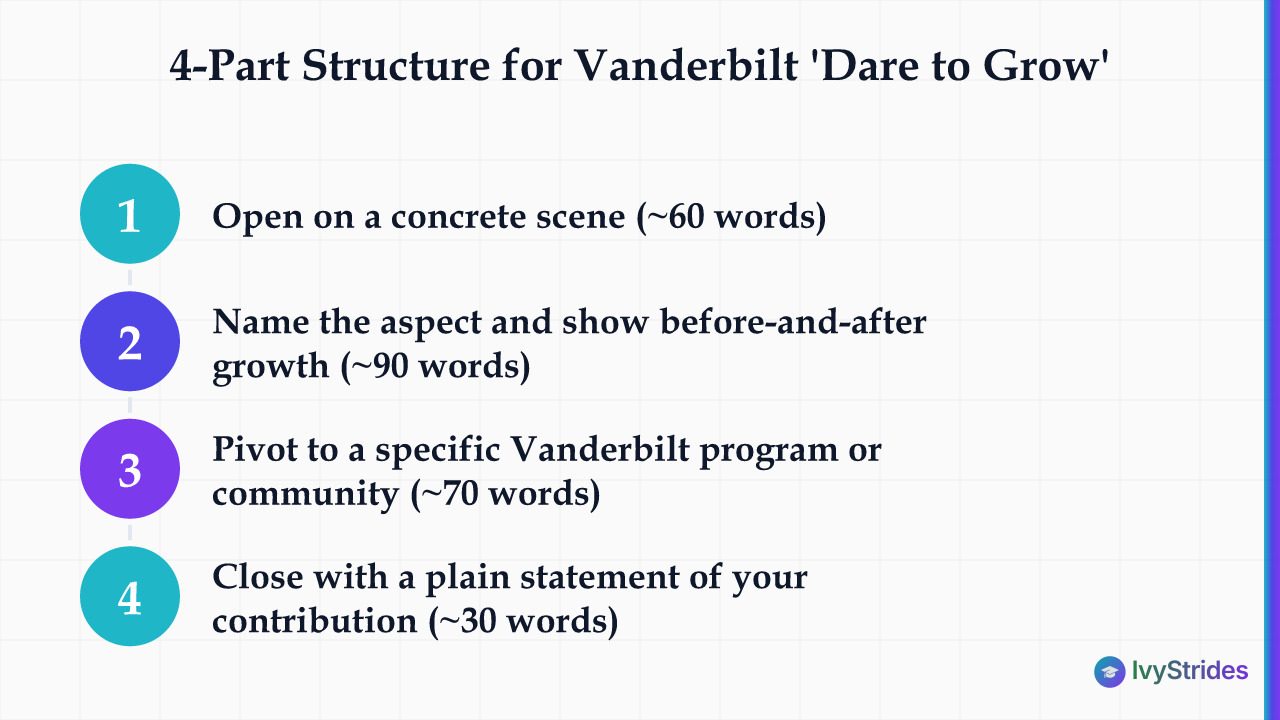
A strong Crescere aude short answer opens with a concrete scene, names one aspect of identity or background, shows the growth that followed, and closes on a specific campus contribution.
The 250-word target is a structural constraint, not a minimum to pad or a ceiling to fight. At that length you have room for one story and one contribution, not two of each.
Here is a four-part structure that fits the word count.
-
Open on a scene (about 60 words). Drop the reader into a specific moment tied to one aspect of your identity, culture, or background. Not "my heritage shaped me," but the actual kitchen, rehearsal, or conversation where it did.
-
Name the aspect and the growth (about 90 words). Identify the one thread you are tracing, then show what changed in how you think or act. Growth means a before and an after, not a trait you have always had.
-
Pivot to Vanderbilt (about 70 words). Connect that growth to a specific community, program, or school: a research lab, Peabody's education focus, the College of Connected Computing, an organization you would join.
-
Close on contribution (about 30 words). State plainly what you will add, grounded in the growth you just described.
The short answer is not a second personal statement; it is a focused, 250-word complement that adds a dimension the longer essay does not cover. Your Common App personal essay is the longer piece and can carry a sweeping narrative. If your personal statement already covers a theme, pick a different one here.
Specificity is the whole game. Vanderbilt looks for students who have "demonstrated strong academic skills and intellectual curiosity" (Vanderbilt Admissions). A closing that names an actual lab or course signals curiosity; a closing that says "I will bring diversity" signals nothing. Delete any sentence that could appear in an essay for a different university.
Common Mistakes in Vanderbilt Supplemental Essay Drafts and How to Fix Them
Check first whether your Vanderbilt short-answer draft answers the growth half of the prompt and stops there, leaving the campus contribution clause unaddressed. To fix that, close on one specific program, community, or school at Vanderbilt instead of a generic final sentence.
Here are four mistakes to check for, with the fix for each.
| Mistake | Fix |
| Ignoring the campus contribution clause | Add a close that names one Vanderbilt community |
| Listing several identities instead of one | Cut to the single thread with clearest growth |
| A growth story that fits any college | Delete every sentence that could run elsewhere |
| Running well past 250 words | Trim to one story and one contribution |
Depth over breadth is the diagnostic. Vanderbilt tells applicants not to join every club just to fill a resume (Vanderbilt expert advice), and the same instinct should govern the essay. One aspect of your identity, explored with real specificity, beats three named in passing.
Fixing these mistakes usually means cutting sentences, and the risk is the essay starts to sound like a committee wrote it. Protect the voice in the parts that are unmistakably yours: the scene, the small detail, the honest line about what changed. The campus contribution clause works the way the school-fit component does elsewhere, so how a "why this campus" dimension stays specific rather than flattering is a useful model for your closing.
Timing matters. The ED I deadline is November 1, 2026, with decisions mid-December; ED II and RD both close January 1, 2027 (Vanderbilt Admissions). Build in at least one full revision pass before whichever date applies to you.
| Check | What to Verify |
| Both clauses answered | Growth AND campus contribution both appear |
| One thread only | A single aspect of identity, not a list |
| Opens on a scene | First line drops into a specific moment |
| Vanderbilt-specific close | Names a real program, school, or community |
| Word count | Lands at 240 to 260 words |
| Vanderbilt-only | No sentence could run for another school |
Admission to Vanderbilt depends on the full application, never the essay alone, so treat this short answer as one lever among several. A second read catches the clause you cannot see because you wrote it.
FAQ: Vanderbilt Supplemental Essay Questions
Does Vanderbilt have any supplemental essays?
Yes. Every first-year applicant writes one short answer of approximately 250 words on the motto Crescere aude, covering personal growth and campus contribution. There is no separate "Why Vanderbilt" essay. Peabody applicants choosing Elementary, Secondary, or Special Education answer one additional question about the field.
How long is the Vanderbilt supplemental essay?
Vanderbilt asks for about 250 words. Its prompts page lists no separate minimum or maximum, but the Common App will flag an answer that falls outside any word limit set for the question. Treat 240 to 260 words as your practical target.
Can you provide some examples of supplemental essays for Vanderbilt University?
Strong Vanderbilt short answers share a structure: they open on one concrete scene tied to a specific aspect of identity or background, name the growth that followed, and close by connecting that growth to a specific Vanderbilt community, program, or school. The weakest versions list traits without showing change, or answer only the growth half.
Should I submit a 1490 to Vanderbilt?
Vanderbilt is test-optional for fall 2027 and fall 2028 entry, and the admissions office states that choosing not to submit will not advantage or disadvantage the review. Whether a 1490 strengthens your specific file depends on your GPA, course rigor, and the rest of your application. Make the decision in the context of your full profile, not the score alone.
Your Next Step on the Vanderbilt Short Answer
You know the prompt, the word count, and the two clauses it asks you to answer. The work now is turning one honest story into 250 specific words that no other applicant could have written.
- Pick one aspect of your identity, culture, or background with a clear before and after.
- Draft an opening scene rather than a definition.
- Trace the growth, then pivot to one specific Vanderbilt program or community.
- Cut every sentence that could belong to another college.
- Check your draft lands at 240 to 260 words and answers both clauses before your ED I, ED II, or RD deadline.

Hemant is a seasoned entrepreneur, investor, and growth strategist with deep ground in education and technology-driven learning. His core training is in Mathematics and Physics — he authored Physics for IB Diploma: Ultimate Revision Guide, recognized as a top student resource.