
How Can Parents Help with the College Essay: The Complete 2026 Playbook for a Top Score
On this page
- The Short Answer: What Parents Should and Should Not Do
- Why the College Essay Matters More Than Ever in 2026
- Stage 1: How Parents Can Help with Brainstorming Without Steering the Topic
- Stage 2: Building and Holding the Essay Timeline
- The Line Between Helpful and Harmful: What Parents Should Never Do
- Stage 3: How to Give Feedback That Helps Without Taking Over
- When to Bring In a Professional College Essay Mentor or Coach
- Do Parents Typically Read Their Child's College Essay Before Submission?
- A Note on AI Tools: What Students and Parents Should Know for 2026
- FAQ
- Should I say "mom" or "mother" in a college essay?
- Can admissions officers tell if a parent wrote or heavily edited a college essay?
- Is it okay for parents to help edit their child's college essay?
- What are the 2026-2027 Common App essay prompts?
- How much does a college essay consultant typically charge?
- My student has writer's block and won't start the essay. What can I do?
Parents help most with the college essay by playing three roles and only three: brainstorming partner before any writing starts, timeline manager across the summer and fall, and light proofreader on the final draft. Every writing decision, topic choice, sentence, and word belongs to the student. The Common App personal statement has a 650-word limit and requires the student to certify the work is their own, and admissions officers read for authentic student voice, so an essay that sounds like an adult wrote it creates a real problem in the review.
The source for the word limit and the student-certification rule is the Common App itself, linked above. The harder question, where the line falls between "helpful" and "ghostwriting" at each stage, is what the rest of this article maps out.
The Short Answer: What Parents Should and Should Not Do
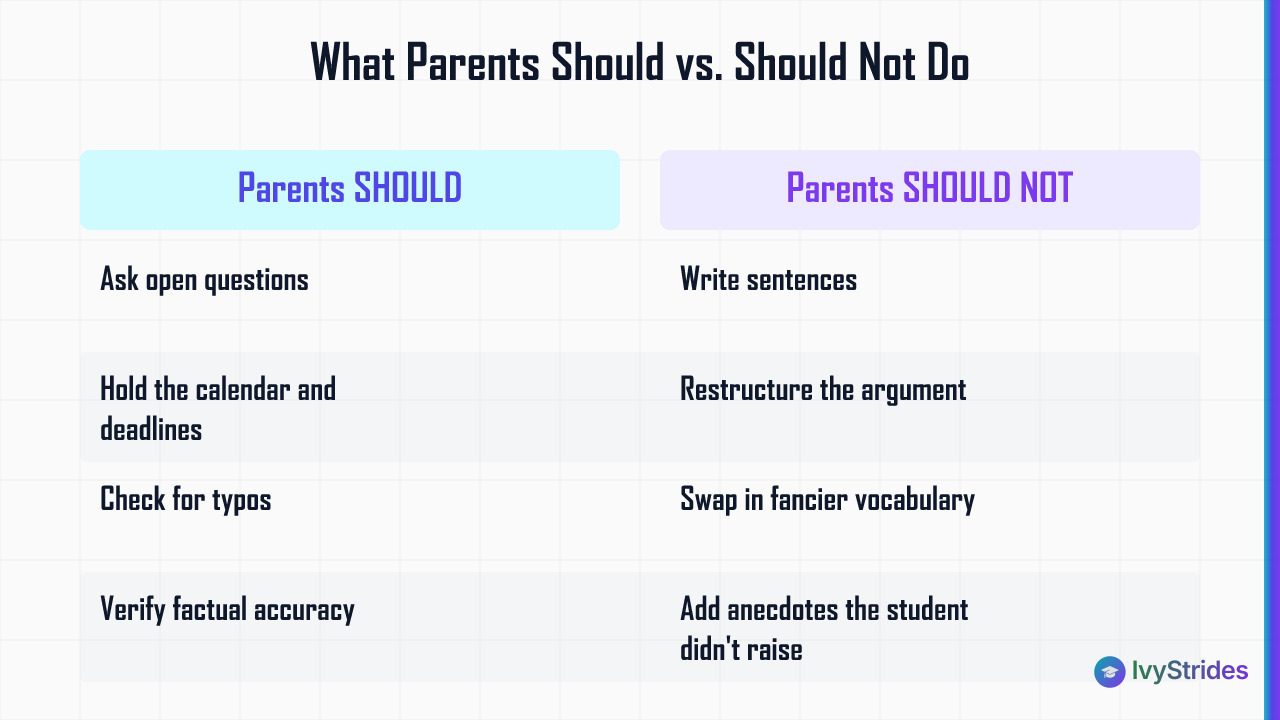
Here's the framework in one paragraph. Parents should ask questions, hold the calendar, and check for typos. Parents should not write sentences, swap in fancier vocabulary, restructure the argument, or add anecdotes the student did not raise. The Common App personal statement is capped at 650 words and is submitted to every Common App school the student applies to, so it carries real weight. The 2026-2027 prompts, announced by Common App, again cover themes of identity, challenge, belief or idea, problem solved, personal growth, gratitude, and a topic of the student's choice.
Why the boundary matters: admissions officers read thousands of essays per cycle, and they're trained to spot voice inconsistencies between the personal statement, the short-answer responses, and the activity descriptions. A student who writes "hella" in their activities list and then opens their essay with "In the crucible of adolescence, I came to apprehend..." raises a flag. That's the mechanism.
Three roles, three windows:
- Brainstorming partner, before the first draft, using open questions.
- Timeline manager, from June through the November deadline, holding dates without touching sentences.
- Proofreader, on the final draft, checking word count, typos, and factual accuracy.
Everything else in this article expands those three roles and marks the lines you don't cross. For a companion piece on the errors these boundaries prevent, see common college essay mistakes to avoid.
Why the College Essay Matters More Than Ever in 2026
The essay's relative weight has climbed for two reasons. First, holistic review means admissions committees read the essay in the context of the full application, and when other components look similar across a competitive applicant pool (comparable GPAs, comparable course rigor, comparable activities), the essay is where a student becomes a specific person on the page. Second, test-optional and test-flexible policies vary by school and by year, and at schools where a student isn't submitting a score, the essay picks up the slack in the narrative.
At schools that have reinstated score requirements, a strong SAT or ACT score can complement a compelling essay. At test-optional schools, the essay often carries even more weight in the review. AP scores, SAT results, and the admissions essay are reviewed together, so a parent who helps their student build a coherent academic narrative across all three is providing the most strategic support.
Now the volume problem. A student applying to 10 to 12 schools will typically write the 650-word personal statement plus roughly 2 to 5 supplemental essays per school. That's realistically around 20 to 40 individual pieces of writing between July and January. Supplemental prompts range from about 50 words (short-answer style) to 650 words (near-full essays), and "Why This School" and "Why This Major" essays make up most of that workload. If your student is still stuck on what to write about, the brainstorming frameworks in our guide on college essay ideas that work can give both of you a structured starting point.
One caveat worth stating plainly: admissions outcomes depend on the full application, not the essay alone. A brilliant personal statement doesn't compensate for a transcript that misses a school's academic profile, and a rough essay won't sink a candidate whose file is otherwise strong. What the essay does, when it works, is make a borderline file readable as a person the committee wants to admit. For structured feedback on a draft in progress, our essay review service is one option.
Stage 1: How Parents Can Help with Brainstorming Without Steering the Topic

Photo by Julia M Cameron on Pexels
This is where parents add the most value. It's also where most parents accidentally steer.
The rule: ask, don't propose. If you say, "You should write about your grandmother," you've chosen the topic. If you ask, "Who is someone in our family you think about when you're making a hard decision, and why?", you've opened a door. The student walks through it or doesn't.
Here are seven questions that surface real material in our coaching with students, without prescribing a topic:
-
What is something you changed your mind about in the last two years, and what changed it?
-
What would your closest friend say is your most unusual quality?
-
What do you do when no one is watching?
-
When was the last time you were surprised by yourself?
-
What is a small object in your room that you would never throw away, and why?
-
Which class or project made you lose track of time, and what were you actually doing?
-
What is something you believe that most of your friends do not?
Sit with your student, ask two or three of these in one conversation, and take notes or record it (with their permission). In our coaching with students, the most compelling essay topics tend to surface in the first 20 minutes or so of a structured conversation, not from a student staring at a blank page.
Then map what came up against the 2026-2027 Common App prompt categories: identity, challenge, belief or idea, problem solved, personal growth, gratitude, or open topic. You'll usually see one or two prompts that fit naturally. Don't force the fit. The open-topic option exists for a reason.
What you should not do at this stage: hand your student a topic. Reject a topic they raised. Compare their idea to "what worked for so-and-so's kid." Insist the topic sound impressive. The most memorable essays are almost never about the impressive-sounding thing.
Stage 2: Building and Holding the Essay Timeline
The logistics-manager role is where you can be organized without touching the writing. Honestly, it's also the role most parents are best at.
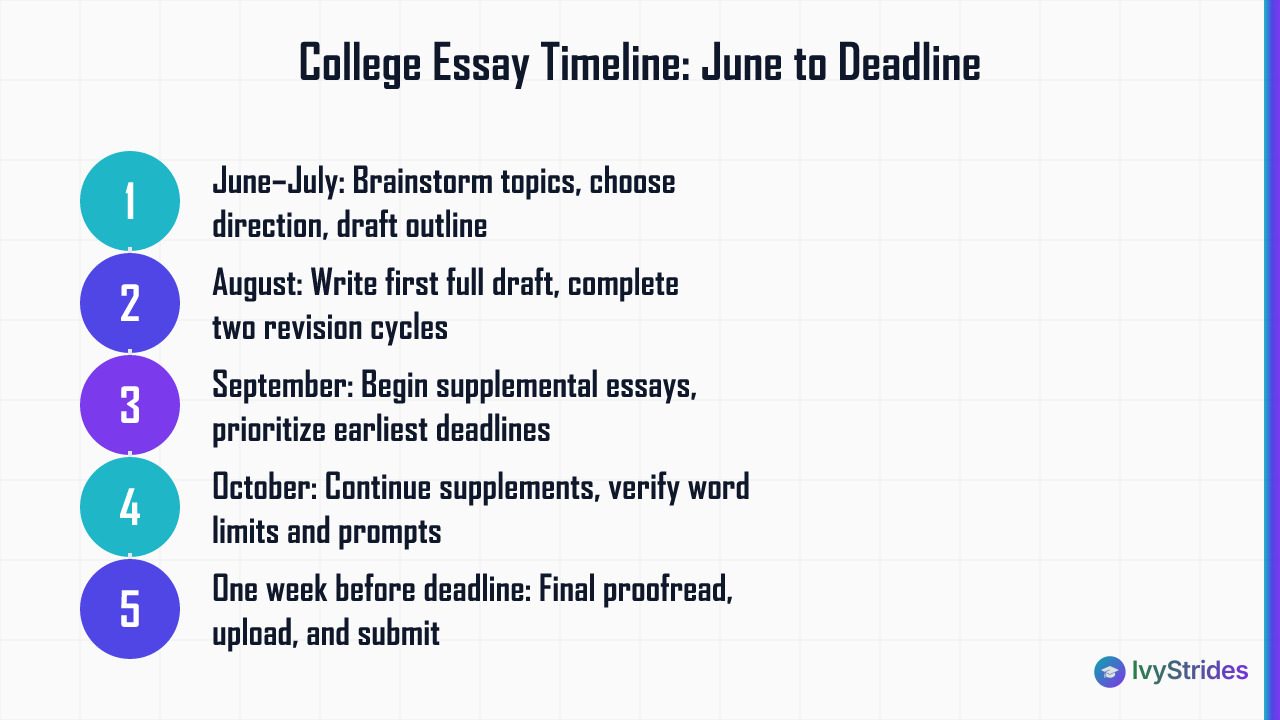
Here's a realistic timeline for a student targeting November 1 Early Decision or Early Action deadlines:
- Mid-June to early July: brainstorming conversations. Two or three sessions, notes captured.
- Mid-July: student chooses a personal statement direction and drafts an outline.
- August 1: Common App opens. First full draft of the personal statement complete.
- Early to mid-August: revision cycle one. Student rereads, revises, gets one round of outside feedback (parent, teacher, or coach).
- Late August: revision cycle two. Focus on opening line, ending, and specificity of detail.
- September: supplemental essays begin, school by school. Start with the two or three schools whose deadlines are earliest.
- October: supplemental essays continue. Cross-check word limits and prompt-specific requirements.
- One week before earliest deadline: final proofread, word-count check, submission-portal upload.
Students applying to 10 or more schools with supplements need to treat essay writing as a part-time job from July through October, averaging roughly 3 to 5 hours per week. That estimate assumes the student isn't starting from scratch on each supplement; strong "Why This Major" material often adapts across schools with careful rewriting.
What you can own as the parent: the master deadline spreadsheet, the submission-portal login list, the reminder cadence, the printouts of prompts and word limits, the meals during writing sessions, the removed-phone rule during focused blocks. Everything on that list is a college essay checklist item that has nothing to do with sentences.
Parents already managing test prep timelines for the ACT or SAT will recognize the same principle: starting earlier gives the student more revision cycles and less deadline pressure. Our guide on when should my child start ACT prep walks through the parallel planning question.
The Line Between Helpful and Harmful: What Parents Should Never Do
This is the section most parents came here for. So let's be direct.
The Common App requires the student to certify that all writing submitted is their own work. Submitting an essay written or heavily rewritten by a parent violates that certification. That's the black-and-white rule. Then there's the practical rule: even setting aside the certification, admissions officers can detect adult writing patterns, and detection creates skepticism about the whole file.
In our coaching with students, the essays that get flagged internally as parent-written tend to share three patterns. Passive constructions the student would never use in speech ("It was in that moment that I came to understand..."). Abstract philosophical openings that don't ground in a specific scene ("Life is a journey of self-discovery..."). Conclusions that summarize the essay rather than let the moment resonate ("And that is why this experience shaped who I am today").
Specific things parents must not do:
- Rewrite a sentence, even a bad one. Ask a question about it instead.
- Substitute a "better" word. If the student would say "weird," don't change it to "unconventional."
- Add an anecdote the student did not raise. Your memory of the event isn't their story.
- Restructure the argument. If the essay's shape is wrong, ask the student what they're trying to say and let them rebuild it.
- Submit the application on the student's behalf. The submission itself is part of student ownership.
Many of the most common college essay mistakes, including generic openings, adult-sounding vocabulary, and over-explained conclusions, get introduced when parents edit too heavily rather than ask questions. Our full breakdown of common college essay mistakes to avoid covers each pattern in detail.
If you find yourself typing into your student's document instead of talking, close the document. If you're rephrasing sentences aloud and expecting the student to write them down, that's ghostwriting with extra steps. The test: after your feedback, does the essay sound more like your student or less? If less, you crossed the line.
For families who want structured support that keeps the student's voice intact, we offer one-on-one help for common app essay writing.
Stage 3: How to Give Feedback That Helps Without Taking Over
Reader-response feedback is the protocol. Here's how it works.
Read the essay once, silently, in full. Don't stop to correct. When you're done, tell your student three things: what you understood the essay to be about, what specific moment or detail stuck with you, and what felt unclear or slowed you down. Don't suggest wording. Don't say "I would say it this way." Your job is to describe your reading experience, not prescribe the writing.
Structural questions you can ask out loud:
- Does the opening make me want to keep reading, or does it feel like a warm-up?
- Is there a moment in this essay where I can picture you specifically, not any student?
- Does the ending feel like a conclusion or a discovery?
- If I had to describe you to a stranger based only on this essay, what would I say?
Then have the student read the essay aloud to you. In our coaching with students, the most productive feedback sessions happen when the parent reads the essay once silently, then asks the student to read it aloud. The student almost always self-identifies the weak sections. The mouth stumbles where the writing stumbles. Trust it.
Supplemental essays need a different frame. For each supplement, check three things without editing: Did the student actually answer the prompt as asked? Are they within the word limit? Have they recycled personal-statement material without adapting it to this specific school? Recycling isn't the crime; recycling without adaptation is.
Once the student has a solid second draft, the revision process becomes more technical, and our guide on how to edit and revise your college essay walks through that stage in detail.
When to Bring In a Professional College Essay Mentor or Coach
Not every student needs a college essay consultant. Some do. Here's how to think about it honestly.
A professional coach adds three things a parent usually can't. First, admissions-context knowledge: what specific schools are looking for, how supplements have shifted year over year, which prompts reward risk versus safety. Second, structural feedback without emotional investment in the outcome; a coach doesn't have a stake in whether the essay is about the family trip to Italy. Third, pattern recognition from hundreds of drafts, which lets a coach spot problems (buried lede, wrong point-of-view, mismatched tone) in the first read.
Typical market rates: hourly college essay consulting runs roughly $150 to $350 per session, and full-package services covering the personal statement plus multiple supplements typically range from around $2,000 to $10,000 or more depending on the provider's scope, reputation, and hours included. Prices vary widely, and a higher price doesn't automatically mean better voice preservation. Ask any coach how they preserve student voice, how many drafts they work through, and whether they show you anonymized before-and-after samples.
IvyStrides essay coaches have worked through hundreds of supplemental essay drafts and approach each essay with prompt-specific analysis and voice-preserving feedback. Learn more about our essay coaching classes if you want the structured version. For families who want a single round of expert eyes on a draft rather than full coaching, the essay review service is the lighter option.
One important framing: parents and coaches aren't mutually exclusive. In our coaching with students, the most effective setups involve a parent handling logistics and emotional support while a coach handles structural and strategic feedback. The student still owns the writing. That's the whole point.
Caveat: no essay coach or consultant can guarantee admission. Admissions outcomes depend on the full application, and the essay is one component of many. If a provider promises admission to a specific school in exchange for a fee, walk away.
Do Parents Typically Read Their Child's College Essay Before Submission?
Yes, most parents do read the final essay, and that's fine. The question isn't whether to read it. It's what to do after you read it.
By senior fall, the transcript is set, the test scores are what they are, and the extracurriculars are documented. The essay is one of the few components entirely within the student's control at the moment of submission. That makes it emotionally loaded for everyone in the house.
Your final read should focus on four things: factual accuracy (did they get a date, name, or family detail right?), word-count compliance (are they at or under the limit?), typos and formatting, and one gut-level check, does this essay sound like the student you know? If the answer to the last one is no, that's a conversation, not an edit. Ask what happened between the last draft and this one.
If a student doesn't want a parent to read the essay, that preference is worth respecting. Some students write about identity, family conflict, or personal struggles they're not ready to share at home, and that's legitimate. In those cases, a trusted teacher, school counselor, or professional coach can serve the proofreading role. Parents who want to stay involved in the broader academic picture can shift focus to areas the student welcomes support on; our guide on how to support your AP student covers one of them.
A Note on AI Tools: What Students and Parents Should Know for 2026
The question isn't going away, so let's answer it plainly.
AI tools like ChatGPT can play a legitimate role in the early stages of essay work. Brainstorming a list of possible topics from a set of experiences the student describes, outlining a structure, or flagging sentences the student wrote that feel unclear, these are all defensible uses. What isn't defensible is submitting AI-generated prose as the student's own writing.
Many selective colleges have updated their academic integrity policies to address AI-generated content in admissions materials, and those policies are evolving each cycle. Students should check the current policy at each target school. The Common App's certification of authorship applies here too: the essay must be the student's own work.
The practical problem, separate from policy, is voice. In our coaching with students, AI-drafted essays share a recognizable pattern: smooth but generic prose, abstract framing, competent transitions, and a conspicuous absence of the specific sensory detail that makes a personal statement memorable. Admissions readers see a lot of essays. Generic competence is the opposite of what stands out.
The line to draw with your student:
- Appropriate: "Give me 10 possible essay directions based on this list of experiences I'll paste in." Then the student picks one and writes it in their own words.
- Appropriate: "Here's my draft. Which paragraphs feel unclear?" Then the student rewrites, in their own words.
- Not appropriate: "Write me a 650-word essay about learning resilience from playing violin."
- Not appropriate: pasting a draft in and asking the AI to "improve the writing." That's outsourcing voice.
FAQ
Should I say "mom" or "mother" in a college essay?
Either is acceptable. The choice should match how your student actually speaks and the tone of the essay itself. Warmer, more conversational essays usually use "mom" and "dad"; more formal or literary pieces may use "mother" and "father." The rule is consistency with the student's natural voice, which is what admissions officers listen for across the whole application.
Can admissions officers tell if a parent wrote or heavily edited a college essay?
Experienced admissions officers read thousands of essays per cycle and are trained to notice voice inconsistencies. The tells include vocabulary that doesn't appear elsewhere in the application, sentence structures more typical of adult professional writing, and a rhetorical sophistication that contrasts with the student's short-answer responses. The Common App also requires students to certify the work is their own, so heavy editing raises both a detection issue and an integrity issue.
Is it okay for parents to help edit their child's college essay?
Yes, within clear limits. Parents can read for clarity, flag confusing passages, check word count, and catch typos. What they shouldn't do is rewrite sentences, substitute vocabulary, or restructure arguments without the student's direction. Here's the test: if a sentence in the final essay sounds like the parent rather than the student, it needs to be revised back to the student's voice.
What are the 2026-2027 Common App essay prompts?
The Common App released its 2026-2027 prompts in mid-2025, covering identity, challenge, belief or idea, problem solved, personal growth, gratitude, and an open topic. The 650-word limit stays in place. Check commonapp.org for the exact wording before your student starts drafting, since Common App updates prompt language periodically.
How much does a college essay consultant typically charge?
Hourly rates for targeted college essay consulting typically run around $150 to $350 per session. Full-package services covering the personal statement plus multiple supplements range roughly from $2,000 to $10,000 or more depending on scope. Evaluate consultants on admissions-context experience, their approach to preserving student voice, and whether they offer a clear methodology rather than line-by-line rewriting.
My student has writer's block and won't start the essay. What can I do?
Start with a conversation, not a blank document. Ask your student to describe a moment in the last two years when they felt most like themselves, or a time they changed their mind about something they were sure of. Record it or take notes. The story that emerges in a low-pressure conversation is almost always more compelling than anything a student produces staring at a prompt. If the block persists past two or three sessions, a professional coach can provide the structured brainstorming framework that breaks the pattern.
Your student has one shot at this application cycle. The essay is where the file becomes a person. Your job, played right, is to make that possible without becoming the person on the page.

Award-winning author (South Asian Book Award) and graduate of BITS Pilani and UCLA Luskin School of Public Affairs. Brings a published writer's eye to Common App essays and grammatical precision to SAT and ACT R&W instruction.