
How Many Times Can You Take the ACT? No Limit, Seven Dates in 2026-27
On this page
- How Many Times Can You Take the ACT? The Official Retake Rules
- How Many Times a Year Can You Take the ACT?
- Can You Take the ACT Twice in One Month?
- How Many Times Should You Take the ACT? When a Retake Is Worth It
- Can You Take the ACT Too Many Times?
- Can Colleges See How Many Times You Take the ACT?
- Can You Retake the ACT One Section at a Time?
- How Many Times Can You Take the ACT in High School? Spacing 2026-27 Dates
- FAQ: ACT Retakes, Scores and Fee Waivers
- Should I retake the ACT if I got a 16?
- Is 27 a bad ACT score?
- How many times can you take the ACT for free?
- Do they make you retake the ACT if you get a 36?
- Your Next Step on How Many ACT Sittings to Book
ACT sets no limit on how many times you can take the ACT. The ACT is a college admissions test of English, math and reading, with a Composite score on a 1 to 36 scale. ACT offers seven national test dates in 2026-27 for the US, US territories and Puerto Rico, and reports one set of scores per national date.
That rule comes from ACT's retest guidance page, which also gives the average: students take the test "2-3 times to achieve their testing goals." The real limits are cost and timing.

How Many Times Can You Take the ACT? The Official Retake Rules
Is there a limit to how many times you can take the ACT? ACT's retest page settles it: "There is no limit to how many times students can take the ACT test." ACT's 2026-2027 Examinee Terms and Conditions set no cap either, so an attempt limit repeated online isn't part of ACT's current rules.
Retakes use normal registration. "Students wishing to retake the ACT can sign up for any National ACT test," ACT says, with no separate retest registration. Register each retake in MyACT, where every sitting's scores build your superscore.
| Question | ACT's answer | Where ACT says it |
| Can I retake one section? | No; the superscore is the alternative | Retest page |
| Two tests in one national administration? | ACT reports only the first test | Registration page |
| School-day State and District testing? | One test date per state administration | Registration page |
| Do fee waivers cover retakes? | Yes, up to two ACT tests in all | Fee waiver page |
Every sitting is the full test. The enhanced ACT core of English, math and reading runs 131 questions in 125 minutes. Each retake costs the full fee on ACT's fees page: $70 for the core, $5 more for Science, $25 more for Writing, or $100 for everything.
A fee waiver changes how many sittings a family pays for, not how many ACT allows, and ACT fee waiver eligibility depends on grade, testing location and economic need.
How Many Times a Year Can You Take the ACT?
How many times can you take the ACT per year? Up to seven times on national dates, with one scored sitting per national administration.
Can You Take the ACT Twice in One Month?
Not in the same calendar month on national dates. The closest 2026-27 national dates sit four weeks apart: September 19 to October 17, 2026 (both past), and June 12 to July 10, 2027, are 28 days each. Within one national administration, ACT's registration page warns: "The second or third set of scores will be cancelled without refund." The calendar, not a cap, sets the ceiling on sittings in a school year.
How Many Times Should You Take the ACT? When a Retake Is Worth It
How many times you should take the ACT depends on what each retake must change, and ACT's own average is two to three sittings. The real question is which sitting earns its fee.
For retesters whose first Composite falls between 13 and 29, ACT's research shows an average gain of one point, so the case for another sitting rests on what changes in your preparation between dates. That point lands on the Composite score, which ACT's Understanding Your Scores page defines as the rounded average of English, math and reading; Science isn't part of it.
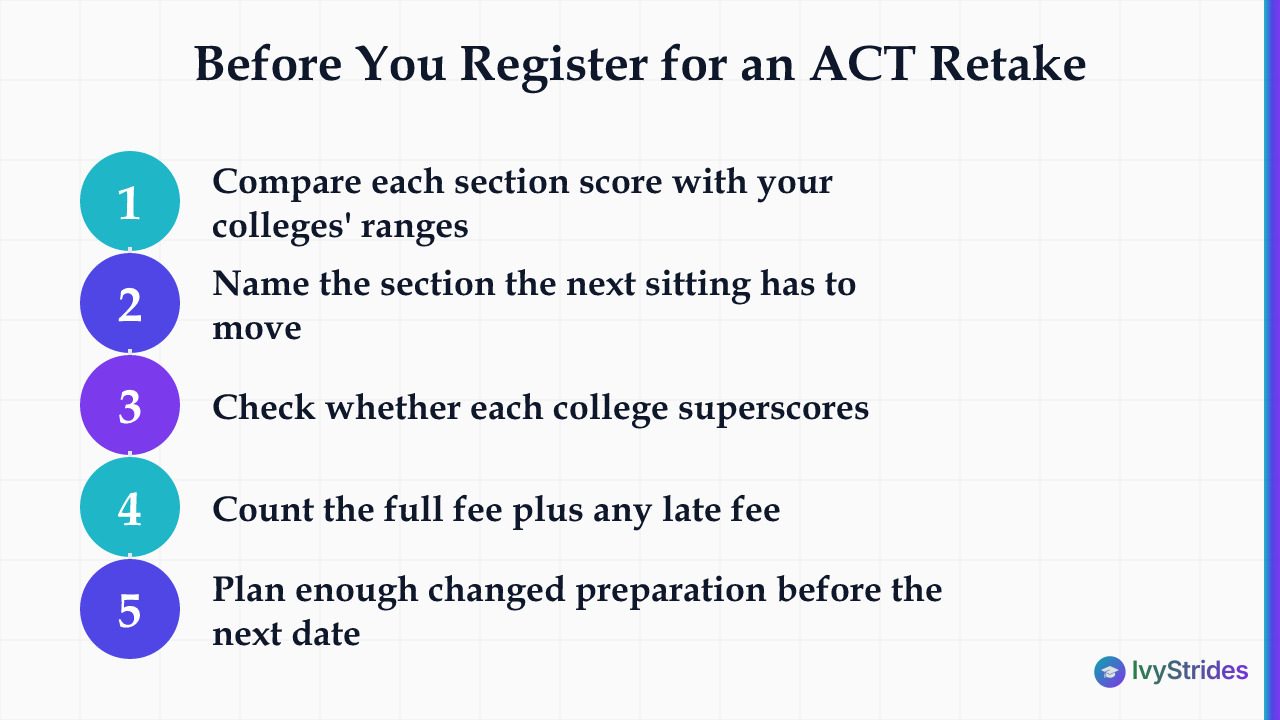
Whether one score deserves another sitting is its own ACT retake decision, judged against your colleges' ranges and your national rank, the percentage of test takers who earned your score or lower. Check these before you register:
- Section gap: each section score against your colleges' ranges
- Superscore policy: whether each college superscores
- Cost: the full fee plus any late fee
- Prep weeks: enough changed preparation before the next date
Name the section first. Put your last official section scores beside one timed practice test and name the section the next sitting has to move. IvyStrides' one-on-one ACT coaching starts from that kind of baseline: a diagnostic and a custom ACT roadmap set the focus areas, and the plan tunes each section's emphasis weekly.
Can You Take the ACT Too Many Times?
No ACT rule makes any count too high. "Too many" is a budget question: each sitting adds a full fee, a Saturday and weeks of preparation.
A flat Composite after two sittings is an ACT score plateau to fix before a third registration, because a third sitting tests the same skills. Book one without naming its target section, and you're paying again for the same test.
Can Colleges See How Many Times You Take the ACT?
Colleges see the ACT scores you choose to send: "You determine which set of scores is sent to colleges or scholarship programs," says ACT's Test Scores page. Each extra test you pay for adds a set of scores you control, though ACT automatically sends scores to colleges you named at registration, up to four in the fee.
What ACT's pages don't say. ACT's score pages don't describe colleges receiving a count of your attempts, but a college's own policy can ask for more, policies vary by college and year, and admission rests on the full application.
Get your Daily IV Dose on Instagram: quick study tips and test-day advice for high school students. Follow @ivy.strides.
How the superscore works now. ACT "automatically calculates a Superscore for students who have tested more than once since September 2016," per its Sending Your Scores page. The Superscore FAQs add that since 2025 the Superscore Composite uses only English, math and reading, while Science pairs with math for the STEM score.
The superscore is how a second full sitting can still lift a single weak section score into your best Composite. For example, English 24, math 26 and reading 25 average to 25, and a second test of English 27, math 24 and reading 24 also averages 25. The ACT superscore calculation takes 27, 26 and 25, for a 26.
| What you send or request | What the college or program gets | ACT source |
| Superscore | Composite from your best English, math and reading, plus each supporting test event's full report | Superscore FAQs |
| Individual test event | Scores from that one test date | Sending Your Scores |
| Additional score report | One test date per report, $20 each | Sending Your Scores |
| Cancellation request (not State or District testing) | Notice that the record is permanently cancelled | Test Scores page |
Some applications accept self-reported ACT scores first, so what a college reads early can differ from your official report. At a test-optional college, sending any ACT score stays your choice, a separate decision from how many times you sat the test. And because ACT names scholarship programs as recipients you choose, a retake aimed at ACT merit scholarship thresholds follows the same sending rules.
Can You Retake the ACT One Section at a Time?
No. How many times can you retake the ACT by section? Not once under ACT's current rules: "Currently, students cannot retake specific sections of the ACT, but they can earn a superscore." So plan each retake as a full sitting.
How Many Times Can You Take the ACT in High School? Spacing 2026-27 Dates
A high school student can take the ACT on each national test date, and five 2026-27 dates remain, from December 12, 2026, to July 10, 2027. Each full sitting needs its own registration, so how many times you can realistically take the ACT this year comes down to deadlines that may fall before your last scores are out.
December 12 is past its regular registration deadline, but late registration stays open until 11:59 pm Central Time on November 29, per ACT's test dates page. Registering in that window adds the $42.00 late fee.
| Test date | Online scores released | Next national date | Next regular deadline | Next late deadline |
| December 12, 2026 | December 17 | February 27 | January 22 | February 9 |
| February 27, 2027 | March 16 | April 10 | March 5 | March 23 |
| April 10, 2027 | April 15 | June 12 | May 7 | May 25 |
| June 12, 2027 | June 17 | July 10 | June 4 | June 22 |
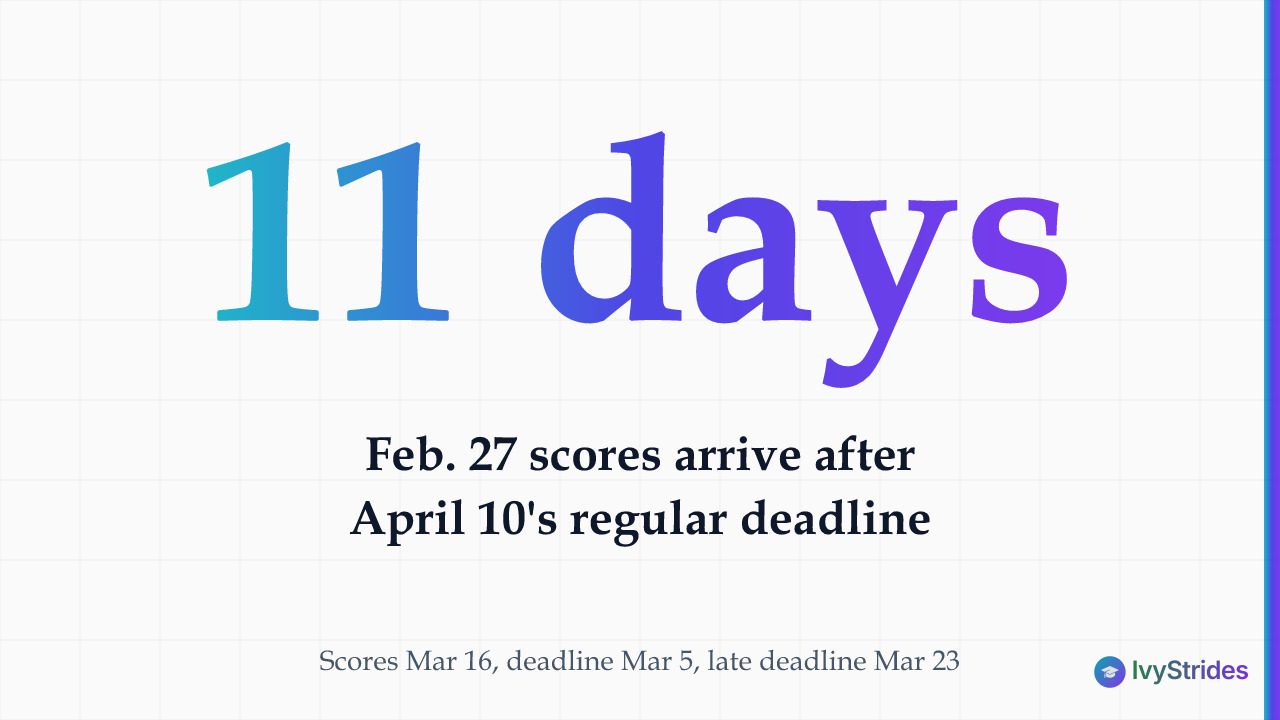
The two tight pairs. IvyStrides' analysis of ACT's 2026-27 test dates and score release calendar shows that February 27 scores arrive on March 16, 11 days after the March 5 regular deadline for April 10. A back-to-back retake that waits for scores needs April's late registration, open until March 23. June 12 online scores post June 17, after the June 4 regular deadline for July 10 and 5 days before its June 22 late deadline. December 12 online scores, by contrast, post December 17, 36 days before the January 22 deadline.
"Over 97% of ACT scores are available online within 1-4 weeks after your test date," says ACT's Test Scores page, and writing scores and paper results can take longer.
Plan around ACT registration and late deadlines, because after the February 27 and June 12 tests, the next date's late deadline is the first one that falls after your online scores post.
Before you register, a timed practice test shows whether your section scores have moved since your last sitting. IvyStrides' full-length ACT practice tests follow the enhanced ACT format, score the Composite on the 1 to 36 scale the moment you submit, and break results down by section.
Juniors and seniors plan differently. A junior has spring, summer and the next testing year to space sittings; a senior needs each college's deadline before choosing February 27 or later. Miss a late deadline, and only standby testing remains, adding $75.00 to the test fee.
FAQ: ACT Retakes, Scores and Fee Waivers
Should I retake the ACT if I got a 16?
Usually yes, if your colleges' ranges sit above 16 and your preparation changes. A 16 Composite has a national rank of 41 on ACT's 2026-27 national ranks, so most test takers scored higher.
Is 27 a bad ACT score?
No. A 27 Composite has a 2026-27 national rank of 89, meaning 89 percent of test takers earned a 27 or lower. Whether it calls for a retake depends on your colleges' ranges.
How many times can you take the ACT for free?
Up to two national sittings, if you qualify for an ACT fee waiver. It covers the registration fee, plus any Science or Writing add-on, but not a test date change fee.
Do they make you retake the ACT if you get a 36?
No. Retesting is your choice. ACT's Terms offer a free, private retest as one of three options in an Individual Score Review, which concerns whether scores are valid, not how high they are.
Your Next Step on How Many ACT Sittings to Book
Can you take the ACT more than once? Yes, as often as your calendar and budget allow, so choose the next date with care.
- Pick the next national date whose deadline you can still meet.
- Add or drop Science and Writing by that date's late deadline.
- Keep every sitting in one MyACT account.
Daily SAT and ACT prep on YouTube: short strategy videos from IvyStrides. Subscribe to IvyStrides on YouTube.

Hemant is a seasoned entrepreneur, investor, and growth strategist with deep ground in education and technology-driven learning. His core training is in Mathematics and Physics — he authored Physics for IB Diploma: Ultimate Revision Guide, recognized as a top student resource.