
Should You Take the Optional ACT Science Section? How to Decide

On this page
- What the ACT Science Section Actually Tests
- What the ACT Science Section Costs in Time and Money
- Who Should Take the ACT Science Section and Who Should Skip It
- How to Use a Practice Science Score to Make the Call
- FAQ: The Optional ACT Science Section
- Does the science section affect your ACT score?
- What happens if you don't take the science section of the ACT?
- Can you get a 36 on the ACT without science?
- Is there actually any point in taking ACT Science anymore?
- Your Next Step on the ACT Science Decision
Take the optional ACT Science section if you plan to major in a STEM field, have an undecided college list, or score well on practice Science tests. ACT Science is a separately scored, optional block on the Enhanced ACT that does not touch your composite. Skip it if you are humanities-focused and no target school reviews it.
That composite exclusion comes straight from ACT, Inc.'s official section structure. The harder question is not whether Science counts toward your composite. It doesn't. The real question is whether a separate Science score, and the STEM score it feeds, does any work for your specific college list before your registration deadline.
What the ACT Science Section Actually Tests
The ACT Science section is a 40-question, 40-minute optional block that tests data interpretation and scientific reasoning, not memorized biology or chemistry facts. Under the Enhanced ACT, ACT, Inc. confirms Science asks you to read graphs, tables, and experimental setups and draw conclusions. You won't need to recall the periodic table.
Science splits into three passage types. Data Representation gives you charts and asks you to read values and trends. Research Summaries describe experiments and ask what the design shows. Conflicting Viewpoints presents two or more scientists disagreeing and asks you to compare their reasoning. The skill sits closer to reading comprehension with numbers than to a science class.
Scored on its own scale. Science reports a 1 to 36 score, separate from your composite. It also combines with your ACT Math score to produce a STEM score, reported on its own line. Neither figure raises or lowers the composite.
Can you get a 36 without Science? Yes. A 36 composite requires a perfect average of English, Math, and Reading only, so skipping Science has no effect on that ceiling. The section turned optional under the Enhanced ACT, and a South Dakota Board of Regents knowledge base article confirms students can now register for the ACT National test with or without it.
| Feature | Detail |
| Status | Optional under the Enhanced ACT |
| Length | 40 questions in 40 minutes |
| Score scale | 1 to 36, reported separately |
| Composite impact | None (composite uses English, Math, Reading) |
| STEM score | Combines ACT Math and ACT Science |
| Passage types | Data Representation, Research Summaries, Conflicting Viewpoints |
| Tests | Data interpretation and scientific reasoning |
For the full picture of where Science sits, see our breakdown of the Enhanced ACT format, sections, and timing.
What the ACT Science Section Costs in Time and Money
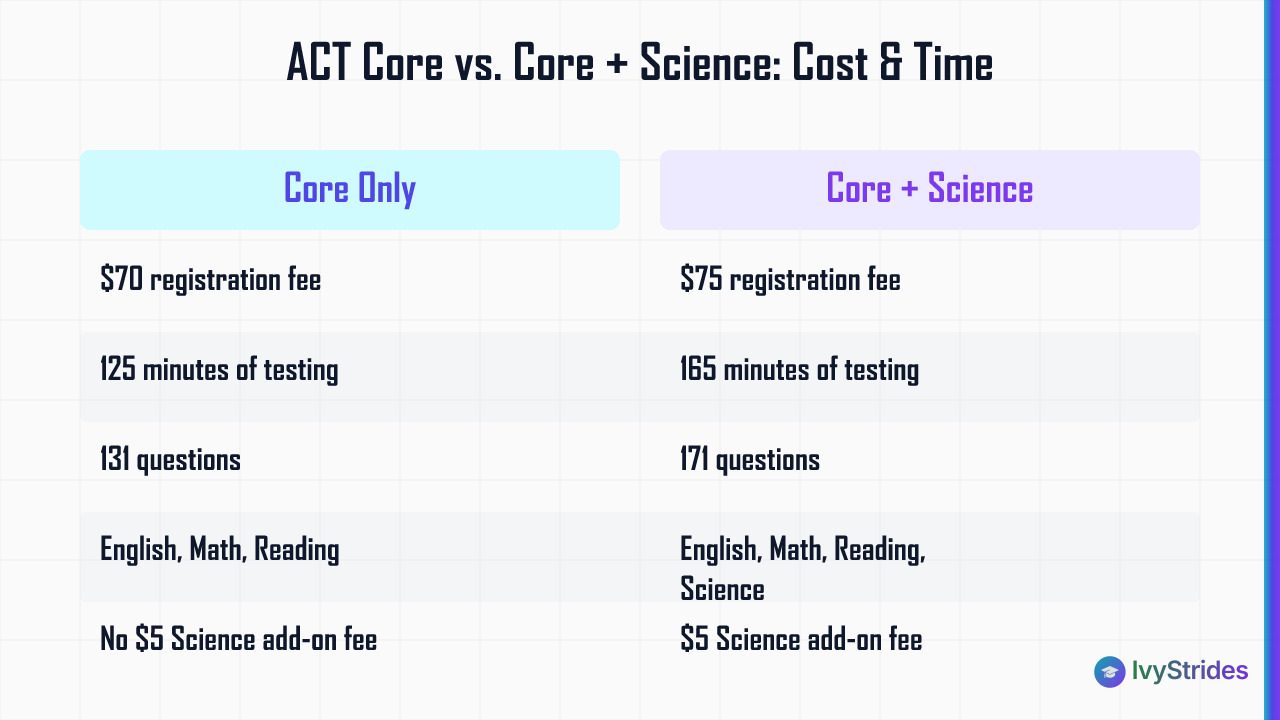
Adding ACT Science costs $5 at registration and 40 minutes on test day. Those two figures, the fee and the added time, are the whole cost of the decision, per ACT, Inc.'s official fee schedule. Skip Science and you leave the testing center earlier.
The added time builds on those core sections. The Enhanced ACT core runs 131 questions across English, Math, and Reading in 125 minutes; Science adds 40 more questions and 40 more minutes as a separate, optional block. Add Science and your total testing time reaches roughly 165 minutes, about 2 hours 45 minutes. ACT, Inc. publishes the core (125 minutes) and Science (40 minutes) lengths separately; IvyStrides sums them to 165 minutes when Science is included.
The Writing add-on is a different decision. ACT Writing is also optional, also excluded from the composite, and costs $25 to add. It's a separate essay and a separate article. Don't confuse the two checkboxes at registration.
| Registration Option | Sections Included | Total Fee |
| Core only | English, Math, Reading | $70 |
| Core plus Science | English, Math, Reading, Science | $75 |
| Core plus Writing | English, Math, Reading, Writing | $95 |
| All sections plus Writing | Core, Science, Writing | $100 |
The base registration is $70 and the Science add-on is $5; IvyStrides sums them to $75 for the Science-included, Writing-excluded option. For the complete breakdown including late fees and waivers, see how much the ACT costs in 2026.
Who Should Take the ACT Science Section and Who Should Skip It
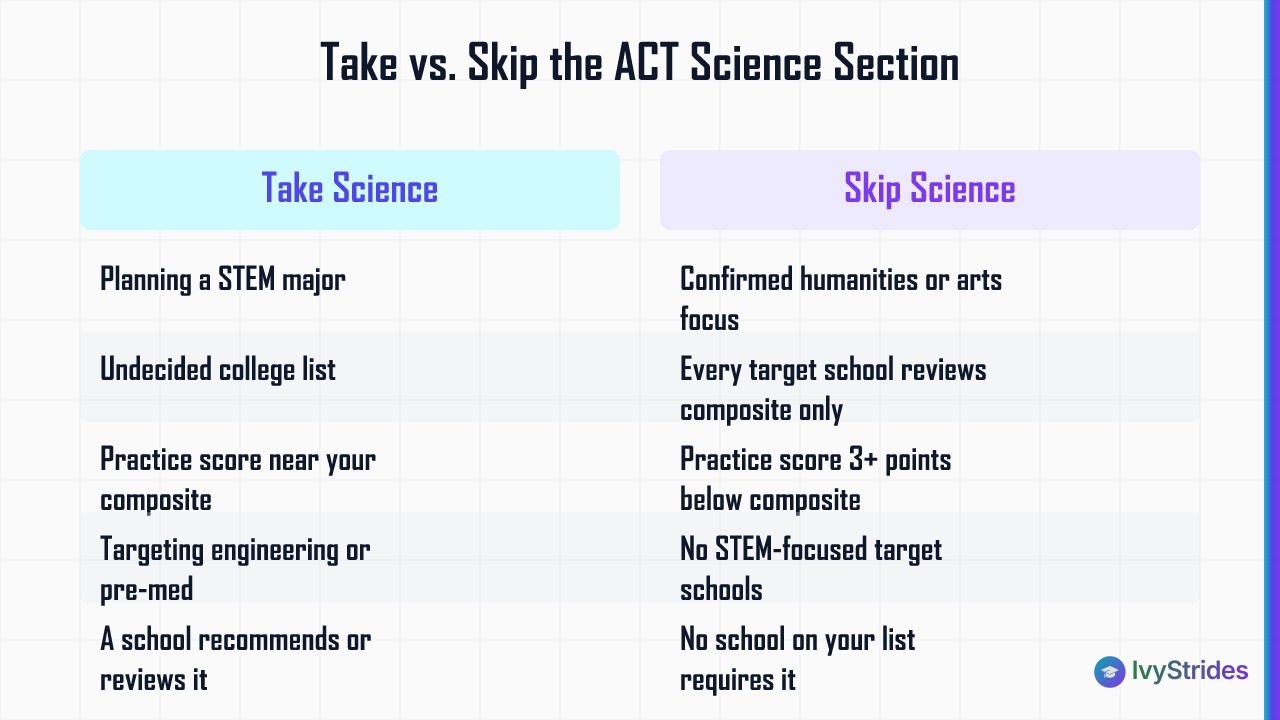
Take Science if you are targeting a STEM major, have an undecided college list, or score well on practice. Skip it if you are humanities-focused, have confirmed none of your target schools review Science, or your practice score sits low with no school requiring it. Those criteria, not habit, should drive the checkbox.
Building on the cost math above, here's the plain trade. Science carries no composite risk. A weak score never drags your 1 to 36 composite down. A strong Science score builds a competitive STEM score, and ACT, Inc. recommends the section for students interested in STEM fields. That STEM score matters most for engineering, computer science, and pre-med applicants at selective programs.
| Take Science | Skip Science |
| Planning a STEM major | Confirmed humanities or arts focus |
| Undecided college list | Every target school reviews composite only |
| Practice score near your composite | Practice score 3+ points below composite |
| Targeting engineering or pre-med | No STEM-focused target schools |
| A school recommends or reviews it | No school on your list requires it |
Verify each school directly. College Science score policies vary by institution and by year. Test-optional status does not automatically extend to Science, and FairTest notes test-optional policies shift year to year. Check each target school's admissions page or its Common Data Set before you register, and never assume a policy carries over. Don't treat a strong Science score as a guarantee of admission to any STEM program; it's one data point in a full application.
If you decide to take Science, targeted prep on the three passage types is where most gains come from, and our ACT section-by-section prep for English, Math, Reading, and Science covers each one. Students still choosing between tests should resolve that first, since the Science question only applies to ACT registrants; our guide on ACT vs SAT: which test is right for you walks through that decision.
How to Use a Practice Science Score to Make the Call
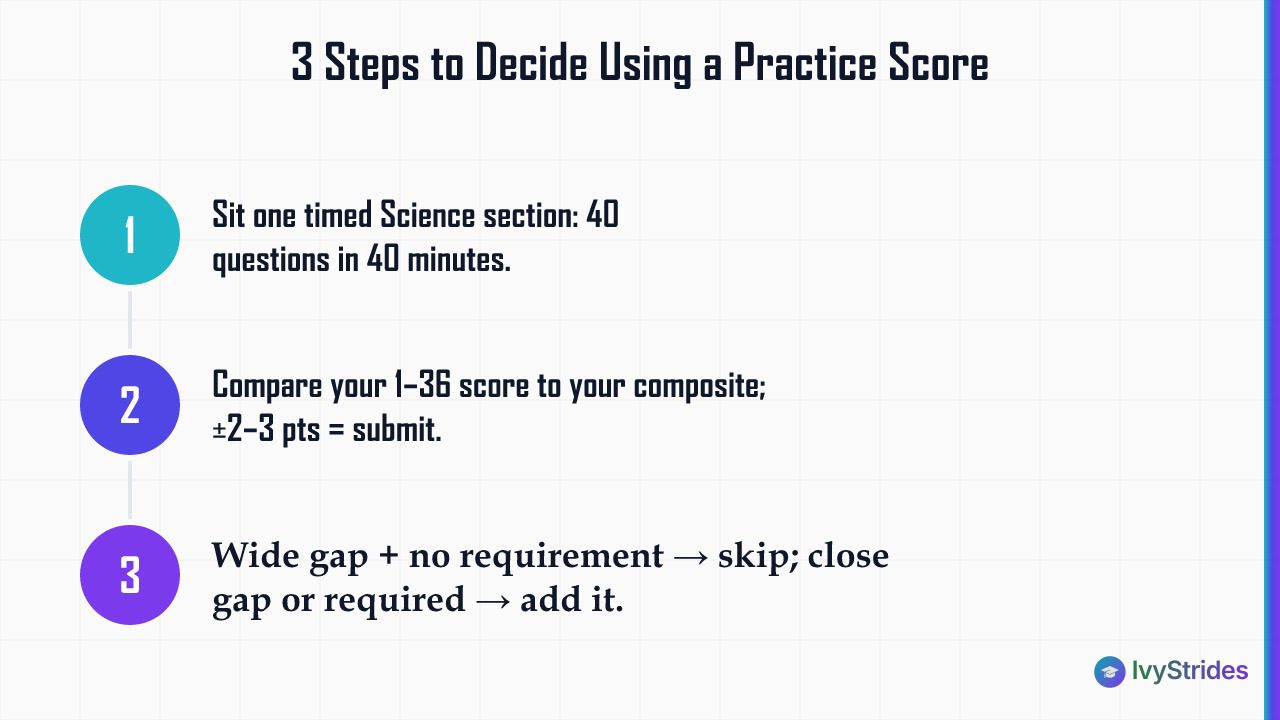
Take one timed ACT Science section, 40 questions in 40 minutes, and compare the result to your composite. A practice score turns the checklist above into a personal yes or no. ACT, Inc. offers official practice material at act.org, and one honest timed run tells you more than any general rule.
That same 1 to 36 scale gives you a clean benchmark here. If your Science score lands within 2 to 3 points of your composite, submitting it adds a positive signal at no composite risk. If it sits 3 or more points below your composite and no target school requires it, skip it.
In our coaching, students targeting engineering or pre-med programs at selective schools who score within 2 points of their composite typically benefit from submitting Science. Students whose Science score sits 3 or more points below composite, with no STEM-focused target schools, consistently see no admissions benefit from submitting it.
Where the gap is closeable. If your practice score is a few points short of your composite and you are aiming for STEM programs, targeted work usually moves it. A Science-specialist coach in our 1-on-1 ACT prep can review your practice section, pinpoint which of the three passage types is costing points, and build a plan before your deadline. To find quality timed material first, see the best ACT practice tests in 2026.
Three steps to decide using a practice score:
-
Sit one full timed Science section, 40 questions in 40 minutes, under real conditions.
-
Compare that 1 to 36 score to your current composite; within 2 to 3 points is worth submitting to STEM programs.
-
If the gap is wide and no school requires Science, register core-only; if it's close or a school reviews it, add the $5 section.
FAQ: The Optional ACT Science Section
Does the science section affect your ACT score?
No. Under the Enhanced ACT, the composite is the average of English, Math, and Reading only. Science reports on a separate 1 to 36 scale alongside a STEM score, but it never raises or lowers your composite, no matter how you perform on it.
What happens if you don't take the science section of the ACT?
Your composite stays unaffected, and you leave the testing center earlier. You won't receive a Science score or a STEM score on your report. The only real risk is a target college that recommends or reviews Science for STEM applicants, so verify each school's policy before you register.
Can you get a 36 on the ACT without science?
Yes. A 36 composite requires a perfect average across English, Math, and Reading only. Science falls outside that calculation, so skipping it has zero effect on your ceiling. Students aiming for a 36 should put every prep hour into the three core sections.
Is there actually any point in taking ACT Science anymore?
Yes, in specific cases. A strong Science score builds a competitive STEM score that strengthens a STEM application, and some selective programs still review it. If your practice score lands within 2 to 3 points of your composite and you are targeting STEM programs, submitting it adds a positive data point at no composite risk.
Your Next Step on the ACT Science Decision
The decision comes down to three checks you can finish this week. Match your major intent and college list against the criteria above, then let one timed practice section confirm the call before your registration window closes.
- Confirm your intended major direction: STEM, undecided, or humanities.
- Check each target school's Science and test-optional policy on its own admissions page or Common Data Set, and re-check annually.
- Sit one timed ACT Science section and compare it to your composite.
- Register with Science if the score is close or a school reviews it; register core-only if the gap is wide and no school requires it.

Award-winning author (South Asian Book Award) and graduate of BITS Pilani and UCLA Luskin School of Public Affairs. Brings a published writer's eye to Common App essays and grammatical precision to SAT and ACT R&W instruction.