
Should You Self-report or Send Official ACT Scores? The Straight Answer for 2026 (and What to Do Next)

On this page
- The Short Answer: Self-Report First, Send Official Scores Later
- What Self-Reporting Actually Means (and What It Does Not)
- Which Colleges Require Official ACT Scores Before Enrollment
- How to Self-Report ACT Scores on Common App: Step by Step
- When Should You Actually Send Official ACT Scores
- Should You Submit ACT Scores at a Test-Optional School, and Does Reporting Still Apply
- The Score-Reporting Decision in Context: What It Actually Affects
- FAQ
- Can you self-report ACT scores to Harvard?
- Does sending official ACT scores instead of self-reporting help your application?
- What happens if you self-report the wrong ACT score?
- Do you need to send ACT scores to every school you apply to?
- Is self-reporting AP scores the same as self-reporting ACT scores?
- Does UIUC accept self-reported SAT and ACT scores?
For nearly every college on your list, self-report your ACT scores on the application and hold off on sending official reports from ACT, Inc. until you're admitted and ready to enroll. Self-reporting is free. Official score sends cost $16 per recipient through the MyACT portal, and most schools only use them to verify what you self-reported.
The $16 figure comes from ACT, Inc.'s official test-taker documentation, cited in each section below. The harder question isn't whether to self-report; it's which schools on your list fall into the exception category, and how to enter your scores on the Common App without triggering a discrepancy at enrollment. That's where costly mistakes happen.
The Short Answer: Self-Report First, Send Official Scores Later
Here's the standard rule that governs the majority of four-year colleges in the United States: during the application phase, you enter your ACT composite and section scores yourself in the Common App testing section (or in the school's own portal). The admissions office reads those self-reported scores at face value. If you're admitted and choose to enroll, that's when the school asks you to send an official score report from ACT, Inc. to verify what you entered.
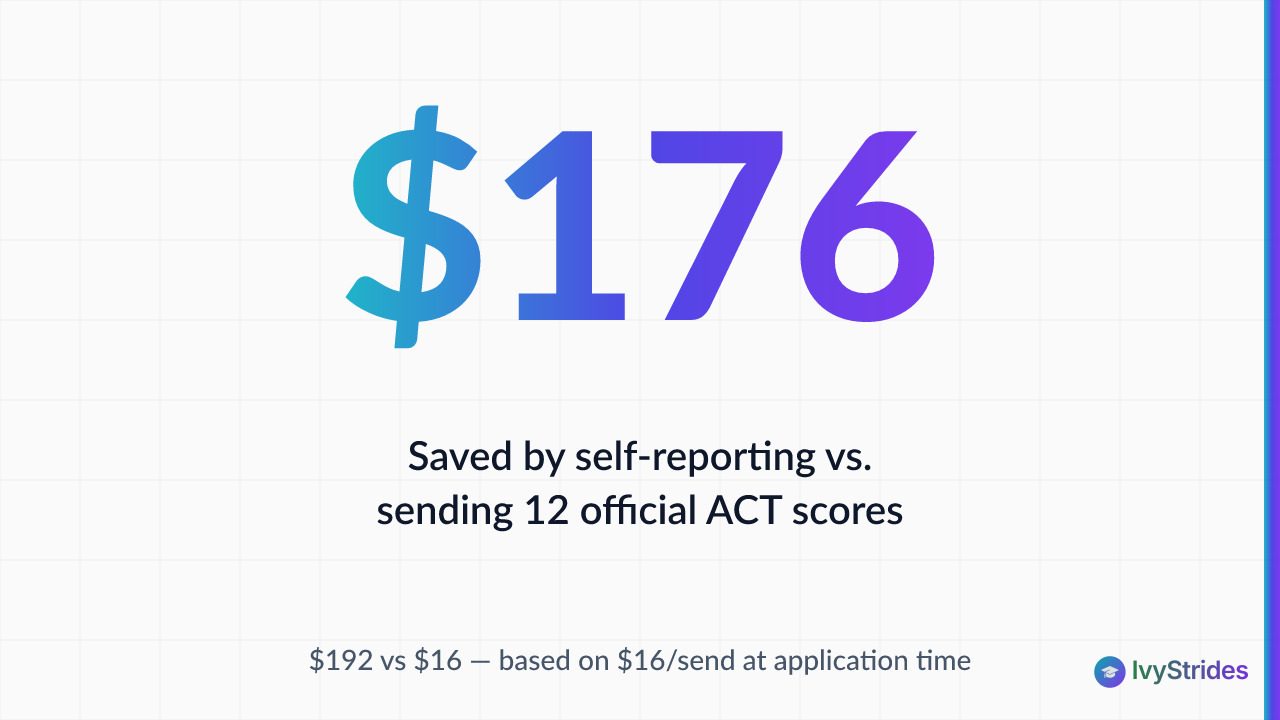
The financial logic is straightforward. Apply to 12 schools and pay $16 per official score send at application time, and that's $192. Wait to send an official score only to the one school you enroll at, and that's $16. The difference funds a decent chunk of an application-fee-waiver budget or an ACT retake registration.
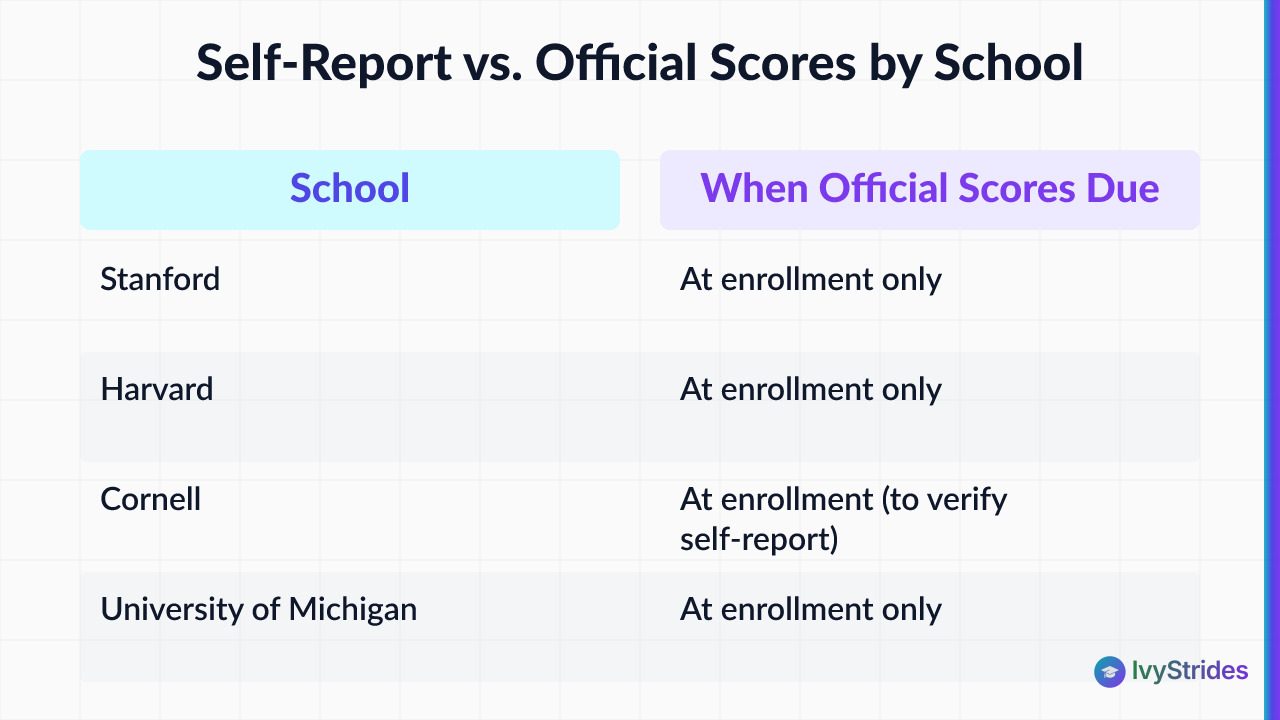
Stanford, Harvard, and Cornell all follow this pattern. Stanford's testing page tells applicants to self-report their highest scores and requires official reports only for enrolling students. Harvard's self-reporting FAQ says the same. Cornell's standardized testing policy states that enrolling students must submit official scores to verify their self-reported figures.
Still deciding whether the ACT is even the right test to submit? Our comparison of ACT vs SAT difficulty and format covers that upstream decision before you get to reporting logistics.
What Self-Reporting Actually Means (and What It Does Not)
Self-reporting is you, in the testing section of the Common App or the school's portal, typing in your ACT composite and each section score, per test date. No PDF upload. No screenshot. No submission from ACT, Inc.
The Common App has a strict rule here: each test date is entered as a separate row, with all four (or five) section scores from that sitting. You do not average, blend, or superscore inside a single entry. Take the ACT three times, and you enter three rows. The admissions office does the superscore math on their end if their policy allows it.
The trust piece matters. Colleges accept your self-reported numbers as if they were official and build your file, your reader ratings, and your admissions decision on them. Then, at enrollment, they check. If the official report from ACT, Inc. doesn't match what you entered, the school can rescind the admission offer. This isn't hypothetical. Every admissions cycle produces cases, usually accidental (a 32 Reading entered as a 33, wrong test date attached to the wrong section scores) rather than deliberate. The outcome is the same.
In our coaching, we've seen students accidentally build a "superscore" inside a single Common App row, mixing the best section from one sitting with the best section from another. When a coach catches it during application review, it's a five-minute fix. When it goes through unnoticed, the official report at enrollment shows two different sittings and flags the discrepancy.
Double-check every score against the MyACT portal before you hit submit. Families who plan their ACT prep timeline early have more test dates to choose from and more flexibility in deciding which scores to self-report, which is one reason we talk with families about when should my child start ACT prep well before junior year.
Which Colleges Require Official ACT Scores Before Enrollment
This is the section that keeps students up at night. Let's name specifics.
Schools following the standard rule (self-report on application, official at enrollment):
- Stanford: self-report highest section scores on the application; enrolling students submit official reports. See Stanford's testing page.
- Harvard: self-report accepted at application; official scores required from enrolling students only. See Harvard's self-reporting FAQ.
- Cornell: enrolling students must submit official ACT scores to verify self-reported values. See Cornell's testing policy.
- University of Michigan: admitted students who self-reported must send official scores at enrollment that corroborate the highest self-reported figures. Verify at Michigan's admissions requirements page.
- Emory: self-reporting is encouraged; official scores are not required at application time. See Emory's testing policy page.
Schools with policies that deserve extra attention:
- UNC Chapel Hill: only self-reported scores are considered during review, and there's a specific self-reporting deadline that may fall on a different date from the application deadline. See UNC's admissions FAQ.
- Georgia Tech: publishes its own score-reporting requirements, which have shifted between cycles. Verify current cycle policy at Georgia Tech's testing page.
Two structural warnings before you build your list.
First, some schools have a score-report deadline that doesn't match the application deadline. If a scholarship agency at a state school requires official scores by December 1 for early consideration, that window is tighter than the application window. Read each school's policy page. Do not assume the application deadline is the score-reporting deadline.
Second, test-optional does not mean self-report-optional. Decide to submit scores at a test-optional school, and that school's reporting policy still applies to you.
Policies shift year over year. The Ivy League has made multiple changes since 2020. Verify each school on your list against its official admissions page before you finalize your Common App submission. Building a Cornell application in particular? We walk through the current cycle in Apply to Cornell University in 2026: What You Must Know. For Northwestern, see Should You Apply to Northwestern University in 2026?.
How to Self-Report ACT Scores on Common App: Step by Step
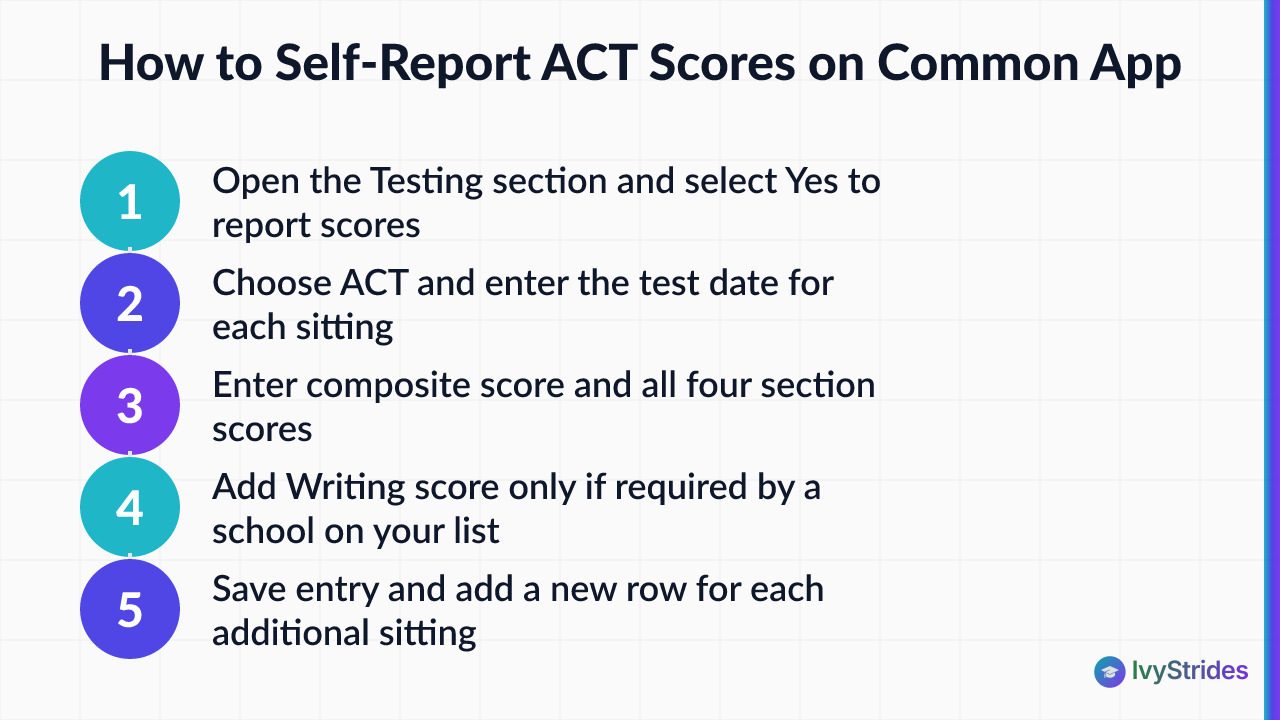
Log into the Common App. Open the "Testing" section under the main application tab. Select "Yes" when asked if you'd like to report test scores. Choose "ACT" from the list of tests.
Then, for each ACT sitting:
-
Enter the test date exactly as it appears in your MyACT portal (month and year).
-
Enter the composite score for that sitting.
-
Enter each section score: English, Math, Reading, Science. All four are required per test date.
-
Enter the Writing score only if you took the optional Writing section AND a school on your list requires or considers it. Most don't.
-
Save the entry and add a new row for your next test date if applicable.
The mistake we see most often: students trying to build a superscore inside a single row by mixing the best section from March with the best section from June. Don't do this. Enter every sitting separately with that sitting's actual scores. If a school superscores the ACT, their admissions team calculates the superscore from the multiple rows you entered. Your job is to give them the raw data, cleanly.
Deciding which sittings to enter? Some schools want all scores; others allow score choice. When in doubt, self-report every ACT sitting where the composite is within striking distance of your highest. Colleges that superscore use the data. Colleges that don't focus on your best composite.
The same self-report-first logic applies to AP scores. Most colleges ask you to self-report AP results on the application and send official AP score reports from the College Board AP Program only after enrollment. Highly selective schools typically recommend self-reporting only 4s and 5s. That's a coaching call, not a rule.
For families in active ACT prep, our ACT prep overview explains how we structure section-specialist coaching. Students who want a diagnostic before committing to a plan usually start with our ACT practice test online to see the current score band.
When Should You Actually Send Official ACT Scores
The trigger is enrollment, not admission. Here's the sequence:
-
You submit the application with self-reported scores.
-
Admissions decisions release.
-
You choose the school you'll enroll at (Regular Decision reply date is May 1 for most schools).
-
You log into MyACT and send one official score report to that school, timed to arrive before their enrollment deadline.
One recipient. Sixteen dollars.
A few situations shift the timing.
Early Decision or Early Action applicants: self-report by the application deadline (typically November 1 or 15). If admitted in December, send official scores before the enrollment deadline the school states, usually in January or February.
Scholarship agencies: some external scholarships require official ACT scores earlier than your enrollment deadline. Read each scholarship's requirements. This is a common gotcha.
Schools with explicit application-stage requirements: rare, but real. UNC's self-reporting deadline is a good example of a stated cutoff that isn't the same as the application deadline. Note each school's score-reporting deadline separately when you build your list.
Processing time matters. ACT, Inc. notes that official score reports can take several weeks to arrive at their destination during peak seasons. In our coaching with students preparing for selective schools, we recommend confirming each school's official-score deadline at least four weeks before it falls, then initiating the send from MyACT with that buffer.
The reporting decision only matters if you have a score worth reporting. If your current composite is below the 25th percentile for your target schools, the more urgent question is how to raise it before your application deadline. If you're comparing test dates against your prep timeline, how to change or cancel an ACT registration covers the mechanics for shifting to a later sitting.
Should You Submit ACT Scores at a Test-Optional School, and Does Reporting Still Apply
Test-optional means the school will read your application without a test score if you choose not to submit one. It does not mean the school ignores scores that are submitted. And it doesn't mean self-reporting rules relax.
Two questions you need to answer, in order.
First: should you submit at all? The 25th to 75th percentile range published in each school's Common Data Set (search "Common Data Set [University Name]") is your benchmark. In our coaching with students at the 28 to 32 ACT composite band targeting selective test-optional schools, we generally recommend submitting if the composite lands at or above the school's 25th percentile of enrolled students. Below that, submitting typically doesn't strengthen the application. The exact call depends on the rest of the file (GPA, rigor, essays, context).
Second: if you submit, how do you report? Exactly the same way you would at a test-required school. Self-report on the Common App during the application phase. Send official scores from ACT, Inc. after admission and enrollment confirmation, unless that specific school requires official reports earlier.
Test-optional status is a moving target. Stanford, MIT, Yale, Dartmouth, Georgetown, and others have shifted policies multiple times since 2020. FairTest maintains a tracker, but verify the current cycle directly on each school's admissions page before you finalize your Common App submission. And remember: admissions outcomes depend on the full application, not test scores alone.
Building a list around this decision? Our writeup on Should You Apply to Brown University? Deadlines and Odds 2026 walks through score-submission strategy at Brown. For Dartmouth, see Should You Apply to Dartmouth College? SAT Scores and Trends.
The Score-Reporting Decision in Context: What It Actually Affects
Zoom out. The choice between self-reporting and sending official scores is a logistics question. It saves you money and keeps your application clean. It does not change how strong your candidacy is.
Colleges evaluate the score itself, not the delivery method. Sending official scores at application time does not signal seriousness or increase your admissions odds. There is no version of a Stanford or Cornell admissions read where the reader thinks, "This applicant sent official scores at application time; that's impressive." That's not a lever.
The levers are the score, the essays, the rigor, and the fit. Your ACT score is one input in the admissions file; your essays are another, and both need to be strong for selective schools. If your essays are still in early draft stage, our Common App essay coaching walks through brainstorming, drafting, and revising with a coach who's read hundreds of supplemental essays.
Comparing a strong SAT score against a weaker ACT score and wondering which to submit? The official SAT to ACT score concordance tables are the right starting point. Colleges do not prefer ACT over SAT or vice versa; every college that accepts standardized tests accepts both.
The upstream question is whether the score is worth reporting at all. In our coaching with students at the 28 to 32 ACT composite range targeting Ivy-plus schools, the more impactful lever is typically a targeted retake with section-specialist coaching, not the reporting logistics. A 30 composite becoming a 33 changes the application. Choosing between self-reporting and official-reporting a 30 does not. Our 1-on-1 ACT prep is built around this kind of section-by-section score-band work.
Parents often ask what their role looks like once test prep is underway. How can parents support ACT prep covers it directly.
FAQ
Can you self-report ACT scores to Harvard?
Yes. Harvard allows applicants to self-report ACT and SAT scores on the application. Admitted students who choose to enroll must submit official scores from ACT, Inc. to verify what was self-reported. See Harvard College's self-reporting FAQ for the current policy.
Does sending official ACT scores instead of self-reporting help your application?
No. Admissions offices evaluate the score itself, not the delivery method. Sending official scores early does not signal stronger candidacy or seriousness. Save the $16-per-school fee until after admission and enrollment confirmation, unless a specific school on your list requires official scores earlier.
What happens if you self-report the wrong ACT score?
If the official score you submit at enrollment does not match what you self-reported, the college can rescind your admission or flag the discrepancy for review. Always verify your scores in the MyACT portal before entering them on any application. If you realize you entered the wrong score after submission, contact the admissions office immediately and correct it in writing.
Do you need to send ACT scores to every school you apply to?
No. You only need to send official ACT scores to the school where you enroll, unless a specific school requires official scores at the application stage. During the application phase, self-reporting on Common App or the school's own portal is sufficient for the vast majority of colleges.
Is self-reporting AP scores the same as self-reporting ACT scores?
The mechanics are the same. Self-report AP scores on the application, and send official reports from College Board only after enrollment. Most colleges follow this pattern. Highly selective schools typically recommend self-reporting only AP scores of 4 or 5, though this is guidance, not a hard rule.
Does UIUC accept self-reported SAT and ACT scores?
The University of Illinois Urbana-Champaign has followed the standard policy of accepting self-reported scores during application review, with official scores required at enrollment. Verify the current cycle policy directly on the UIUC admissions website before submitting, as policies can shift between application cycles.
Self-report cleanly. Verify each school's policy on its official admissions page. Pay for one official send after you enroll. The exceptions to that pattern are named above; the rest of your list follows the standard rule.

Award-winning author (South Asian Book Award) and graduate of BITS Pilani and UCLA Luskin School of Public Affairs. Brings a published writer's eye to Common App essays and grammatical precision to SAT and ACT R&W instruction.