
What Grade Should You Take the ACT? A Grade-by-Grade Guide for Students and Parents
On this page
- What Grade Should You Take the ACT: The Grade-by-Grade Decision Table
- Should a 10th Grader Take the ACT? What an Early Attempt Actually Gives You
- ACT Registration Deadlines by Grade: Which 2026-27 Dates Are Still Open?
- How to Build Your ACT Testing Plan Across High School
- FAQ: ACT Timing by Grade
- Should my 10th grader take the ACT?
- In which grade did you take your first ACT?
- Is a 27 on the ACT okay?
- Is a 25 a bad ACT score?
- Your Next Step on ACT Timing
For most students, the right grade for a first ACT is 11th. Most students take the ACT during junior year, and ACT calls junior year often ideal for a first official score (ACT, Inc.). The ACT is a national college-entrance exam scored 1 to 36 on a Composite, and a junior-year first sitting leaves later junior dates and the fall of senior year for retakes before Early Action and Early Decision deadlines. A 10th-grade attempt adds a diagnostic baseline.
Waiting until 12th grade works, but it leaves little room for a second attempt before early deadlines. The harder question is which of the remaining 2026-27 dates fits your grade, and that is what the rest of this guide settles.

What Grade Should You Take the ACT: The Grade-by-Grade Decision Table
Eleventh grade is the standard first-attempt grade for the ACT, but each grade level carries a different role. The ACT Composite is the average of English, Math, and Reading only, rounded to the nearest whole number; the optional Science section is scored separately and does not count toward the Composite (ACT, Inc.). That matters for planning, because a student can build Composite readiness before Science is a concern.
Why 11th grade wins. By junior year, ACT notes, most of the core coursework the test assesses has been completed, and a junior's scores can be used for college planning and early applications. The test is offered seven times a year (ACT, Inc.), which leaves room to sit, see a real score, and retake.
| Grade | Recommended Role | Retake Window Before EA/ED | Key Consideration |
| 9th | Rarely worthwhile | Ample, but years out | Much of the ACT's coursework still ahead |
| 10th | Diagnostic baseline | Three or more junior dates | Needs Algebra II in progress |
| 11th | Standard first attempt | Later junior dates plus fall of senior year | Most common year to take the ACT |
| 12th | Retake window | One date, if any | Deadlines limit which dates count |
Test-optional policies vary by school and year, so check each college's admissions page before deciding how many sittings to plan. College Board currently lists 21 private and 42 public colleges that require or will soon require SAT or ACT scores, and warns the list changes frequently (College Board). Students aiming at National Merit should also note that the junior-year PSAT/NMSQT runs on its own separate timeline and needs its own prep window.
Should a 10th Grader Take the ACT? What an Early Attempt Actually Gives You

Photo by cottonbro studio on Pexels
A 10th grader should take the ACT when they have completed or are mid-way through Algebra II, because an early attempt gives a diagnostic baseline and leaves three or more junior-year dates for a retake. The score itself does not need to be strong; it shows which core section needs the most work before junior year.
What the enhanced ACT asks of a sophomore. The enhanced ACT core of English, Math, and Reading runs 131 questions in 125 minutes. Here is how each section breaks down (ACT, Inc.):
| Section | Questions | Minutes | Scored Questions |
| English | 50 | 35 | 40 |
| Math | 45 | 50 | 41 |
| Reading | 36 | 40 | 27 |
| Science (optional) | 40 | 40 | 34 |
At that length, the core allows less than a minute per question. A sophomore who has not practiced at that pace under timed conditions can lose points to the clock as well as to content.
Math is the first readiness checkpoint. The ACT Math section measures skills typically learned through the beginning of grade 12 (ACT, Inc.), and ACT notes that some math, science, or advanced reading content may still be unfamiliar to a sophomore. If much of that material is still ahead in class, waiting a term or two gives the baseline more meaning.
Before committing, a student should know the score range at their target colleges so the diagnostic result has a reference point. ACT's 2026-27 national ranks put the mean Composite at 19.1 (ACT, Inc.), but a national mean tells a sophomore little on its own.
Superscoring changes the math. The ACT superscore averages a student's best English, Math, and Reading scores, no matter which test date each came from (ACT, Inc.), though superscoring policies vary by college. A strong section from a 10th-grade sitting can carry forward, so an early attempt is rarely wasted even if the overall score is modest. A 10th grader who decides to sit needs a two-month prep plan built around the enhanced format rather than a generic schedule.
Here is a quick readiness check before you register:
For parents: IvyStrides shares admissions timelines and counseling guidance on LinkedIn. Follow along for the questions families ask most.
- Algebra II is complete or in progress
- The student can sustain focus for roughly two hours
- A target score range from real colleges is already on paper
- There is time for a timed full-length practice test first
- The family treats a modest first score as data, not a verdict
In a 10th-grade attempt, section readiness, pace, and the choice of date all interact, and guessing wrong costs a sitting.
ACT Registration Deadlines by Grade: Which 2026-27 Dates Are Still Open?
The ACT offers seven national test dates in the 2026-27 testing year, and the table below lists the five from December on, each with a regular registration deadline about five weeks before test day (ACT, Inc.). Picking the right grade is only half the decision; the other half is registering before the regular deadline, because registering in the late period adds a $42 fee (ACT, Inc.).
| Test Date | Regular Registration Deadline | Best Fit Grade | Notes |
| December 12, 2026 | November 9, 2026 (passed; late registration until November 29, 2026) | 12th (retake) / 11th | Scores arrive after November EA/ED deadlines |
| February 27, 2027 | January 22, 2027 | 11th | Mid-junior-year sitting |
| April 10, 2027 | March 5, 2027 | 11th (first attempt) | Spring of junior year |
| June 12, 2027 | May 7, 2027 | 11th (first attempt) | Pairs with a fall retake |
| July 10, 2027 | June 4, 2027 | 10th / 11th | Summer prep window |
Read the table against your deadlines. A junior who sits by April or June still has the fall of senior year for a retake: ACT's projected 2027-28 dates include September 11 and October 16, 2027, both before most Early Action and Early Decision deadlines (ACT, Inc.). A senior who first tests in the fall has one realistic retake at most before those deadlines, and a December score arrives after them. That is the specific risk of a 12th-grade-only plan.
Students who register early and then need to shift should understand how to change or cancel an ACT registration before the deadline and what each change costs, so a schedule conflict does not turn into a forfeited fee.
How to Build Your ACT Testing Plan Across High School
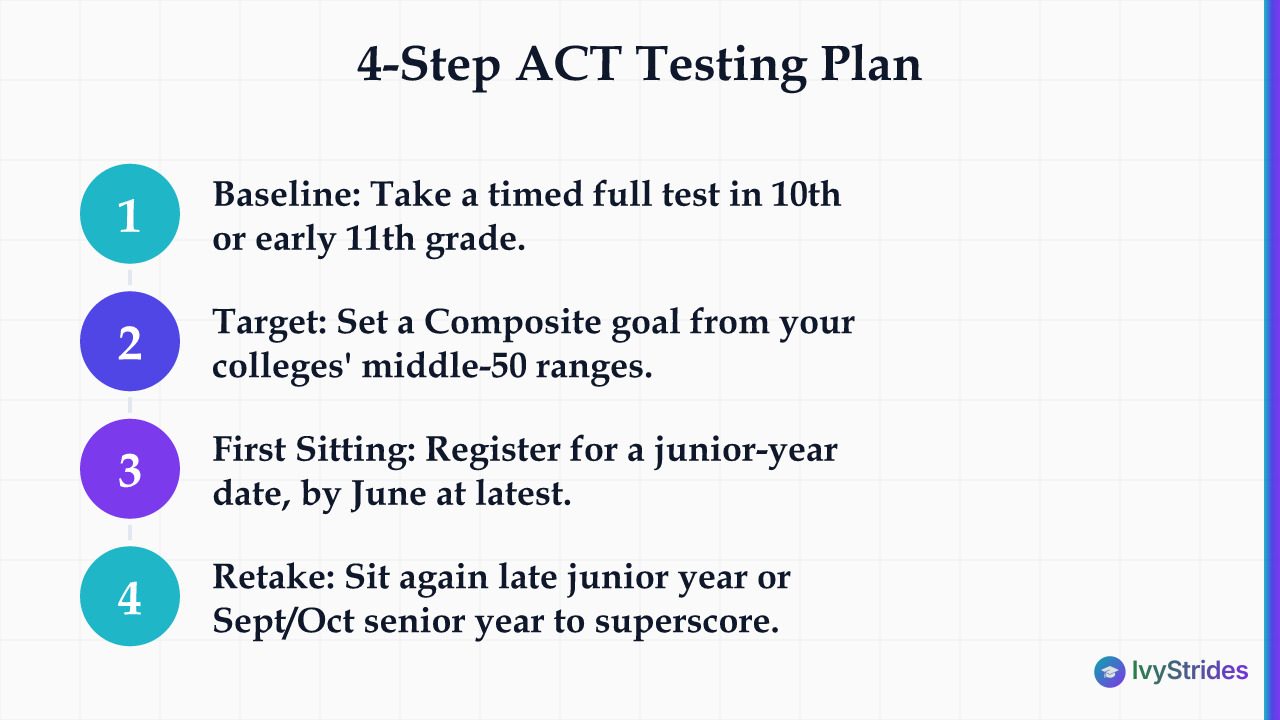
A sound ACT testing plan sequences a first sitting and one or two retakes so superscoring can work in the student's favor and the final score lands before application deadlines. ACT's own typical path is a first test in the fall of junior year, a retake in the spring, and a final attempt in the fall of senior year, especially for students applying early (ACT, Inc.). Leave enough time between sittings to work on the weakest section rather than retesting the same skills.
Here is a four-step sequence:
-
Baseline. Sit a timed full-length test, in 10th or early 11th grade, to find the weakest core section.
-
Target. Set a Composite goal from the actual middle-50 ranges at the student's colleges, not a round number.
-
First official sitting. Register for a junior-year date, by June at the latest, leaving the fall of senior year open.
-
Retake. Sit again later in junior year or in September or October of senior year, letting the superscore combine the best sections.
Full-length timed practice between official sittings shows which section still needs work, and a study plan that starts from a diagnostic and works section by section keeps those weeks focused. For students chasing automatic merit aid, build the plan around how ACT scores affect merit scholarship thresholds, not admissions ranges alone.
For a student working to a tight retake window, IvyStrides' one-on-one ACT tutoring starts with a diagnostic test that sets the baseline and focus areas, then follows a custom ACT roadmap with an expert instructor, paced to the student's target test date. Students who want to size the work honestly before committing can weigh what actually makes the ACT hard against their current section scores.
Test-optional policies still vary by school and year, and admissions outcomes depend on the full application, not test scores alone. A testing plan buys you options; it does not buy an outcome.
FAQ: ACT Timing by Grade
Should my 10th grader take the ACT?
Yes, if they have completed Algebra II or are mid-course. A 10th-grade attempt produces a diagnostic baseline and leaves three or more junior-year dates for a retake. The score does not need to be strong; the data it produces is what matters. Because the ACT superscore draws on a student's best section scores from any test date, a strong section from a sophomore sitting can carry forward at colleges that superscore.
In which grade did you take your first ACT?
Most students take the ACT during junior year, and ACT describes the fall of junior year as a common first test (ACT, Inc.). Some students sit in 10th grade for early experience and a baseline. A first attempt in 12th grade is workable but leaves limited room for a retake before Early Action and Early Decision deadlines close.
Is a 27 on the ACT okay?
A Composite of 27 places a student at the 89th national rank on ACT's 2026-27 tables (ACT, Inc.). It is competitive at many universities, though the most selective schools report higher middle-50 ranges. Whether 27 is enough depends on the colleges on your list.
Is a 25 a bad ACT score?
A 25 sits at the 83rd national rank on ACT's 2026-27 tables (ACT, Inc.). It is not a bad score in absolute terms, but it may fall below the middle-50 range at selective universities. The right benchmark is that range at your specific target schools.
Your Next Step on ACT Timing
Pick your first-attempt grade, then make it concrete. The grade sets the role; the date and deadline make it real.
- Choose your target grade: 11th for a standard first attempt, 10th if Algebra II is underway and you want a baseline.
- Match it to a 2026-27 date from the table and note the regular registration deadline.
- Sit a timed full-length practice test first so your real attempt is not your first.
- Leave at least one fall-senior date open for a retake before your EA/ED deadlines.
Watch the method, then try it: IvyStrides explains SAT and ACT question types on YouTube.

Hemant is a seasoned entrepreneur, investor, and growth strategist with deep ground in education and technology-driven learning. His core training is in Mathematics and Physics — he authored Physics for IB Diploma: Ultimate Revision Guide, recognized as a top student resource.