
What GPA Do You Need for Texas A&M? Course Rigor Counts Just as Much
On this page
- What GPA Range Is Competitive at Texas A&M for Fall 2027
- What Texas A&M Holistic Review Actually Weighs Beyond GPA
- Does Texas A&M Use Weighted or Unweighted GPA in Its Review
- Texas A&M Application Timeline and Deadlines for Fall 2027
- FAQ: Texas A&M GPA and Admission Requirements
- What is the lowest GPA Texas A&M will accept?
- Can I get into A&M with a 3.5 GPA?
- Is a 3.7 GPA good for Texas A&M?
- Is Texas A&M hard to get into?
- Your Next Step on the Texas A&M GPA Question
Texas A&M University College Station publishes no minimum GPA for fall 2027 freshman admission. In its Common Data Set, the university rates rigor of secondary school record, class rank, academic GPA, extracurricular activities, and talent or ability all as Very Important. Texas residents in the top 10% of their class qualify for automatic admission.
The ratings are from section C7 of Texas A&M's 2025-26 admissions data, and the rest of this guide uses the university's own pages, checked for the 2026-27 cycle. Outside the automatic-admission path, no published GPA figure guarantees or blocks an offer. On the question of what GPA you need for Texas A&M, a free call with IvyStrides reviews your GPA, course schedule, and activity list against TAMU's five Very Important factors and names the one component to strengthen before the application closes.

What GPA Range Is Competitive at Texas A&M for Fall 2027
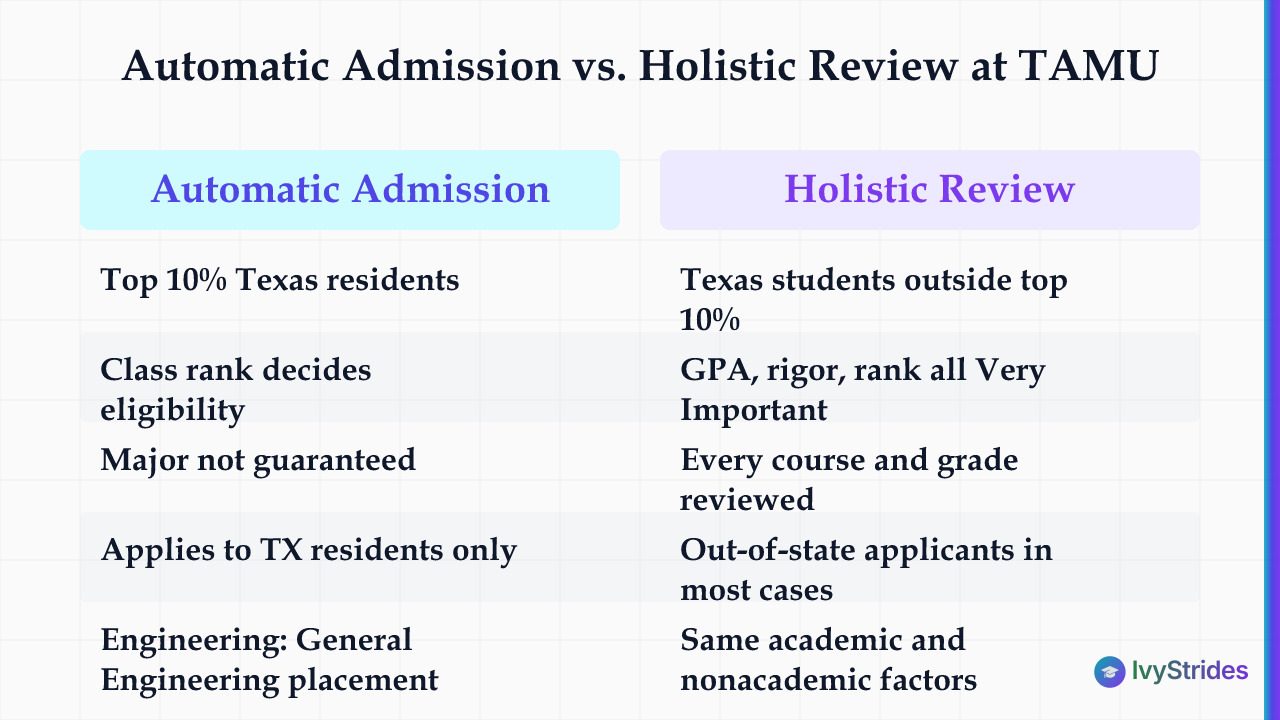
Texas A&M College Station admits freshmen through automatic admission or holistic review. Texas residents who rank in the top 10% of their high school class by the application deadline, and meet the other conditions Texas A&M lists, qualify for automatic admission under state law, so class rank, not a GPA figure, decides that path. Everyone else goes through holistic review.
No published admitted GPA. Texas A&M's Common Data Set reports no GPA data: its C11 GPA ranges and C12 average GPA read N/A. What the CDS does confirm: academic GPA, class rank, and rigor of secondary school record are all rated Very Important in first-year admission decisions. Treat any aggregator number as an estimate rather than a target.
Because Texas A&M rates course rigor in the same Very Important tier as GPA, reviewers weigh the courses behind your GPA, not just the number.
| Your Situation | Admission Path | What to Know |
| Texas resident, top 10% rank | Automatic admission, with conditions | Rank on an official transcript; major not guaranteed |
| Texas student outside the top 10% | Holistic review, if Uniform Admission Policy met | Every course and grade, rigor, GPA, class rank |
| Out-of-state applicant | Holistic review in most cases | Same academic and nonacademic factors |
| Engineering applicant | Reviewed for General Engineering placement | Includes top-10% automatic admits |
Texas A&M does not stop at your GPA: its self-reported transcript asks for every course and grade. If you want the mechanics, here is how colleges recalculate your GPA before reading it.
Texas A&M is test-optional for fall 2027, and its CDS rates test scores Considered, below the Very Important rating given to GPA and rigor. Texas A&M's test-optional FAQ says scores will only be used to benefit you and low scores will not make you less competitive. If you are weighing whether a submitted score strengthens a borderline file, compare your score with 1160 to 1390, the middle 50% SAT range of fall 2025 enrolled freshmen who sent SAT scores (CDS C9).
What Texas A&M Holistic Review Actually Weighs Beyond GPA

Photo by https://kaboompics.com/ on Pexels
Texas A&M holistic review treats GPA as one input among five Very Important factors, not the deciding one. The CDS 2025-26 C7 rates rigor of secondary school record, class rank, academic GPA, extracurricular activities, and talent/ability all as Very Important in first-year admission decisions. It rates interview, alumni/ae relation, and religious affiliation Not Considered.
Beyond grades, the Texas A&M catalog names what reviewers pull from your application: time commitment and duration for activities, leadership or exceptional talent, awards, jobs and internships with their dates and weekly hours, and family educational background, household income, and household size. The nonacademic factors on the freshman admissions page include extracurricular involvement, community service, leadership, employment, and summer activities.
Depth beats breadth. Texas A&M's own accomplishment tips favor major impact in a few organizations over light involvement in many. Sustained responsibility in one club fits that tip better than a long list of light memberships.
| Factor | What TAMU Looks For |
| Course rigor | Course level, such as AP, honors, IB or dual enrollment |
| Class rank | Position relative to your graduating class |
| Academic GPA | Grades across every course attempted |
| Extracurriculars | Depth and duration, with weekly hours |
| Essay (750 words) | One specific instance, in your own voice |
| Recommendations | Optional; only the first two count |
Once you know where your GPA stands, the next lever is the writing: one 750-word essay, one 250-word answer and four 100-word answers, all required, plus an optional 250-word answer. Texas A&M's essay advice is specific: build the response around one instance, explain how it changed you, and do not repeat what appears elsewhere in the application. Recommendation letters are optional, and only the first two received count.
Texas A&M's CDS rates course rigor and extracurricular activities Very Important and the application essay Important. A free call with IvyStrides' college counselors checks a Texas A&M applicant's GPA, course schedule, activity list and essay draft against those admission factors before Dec 1.
Does Texas A&M Use Weighted or Unweighted GPA in Its Review
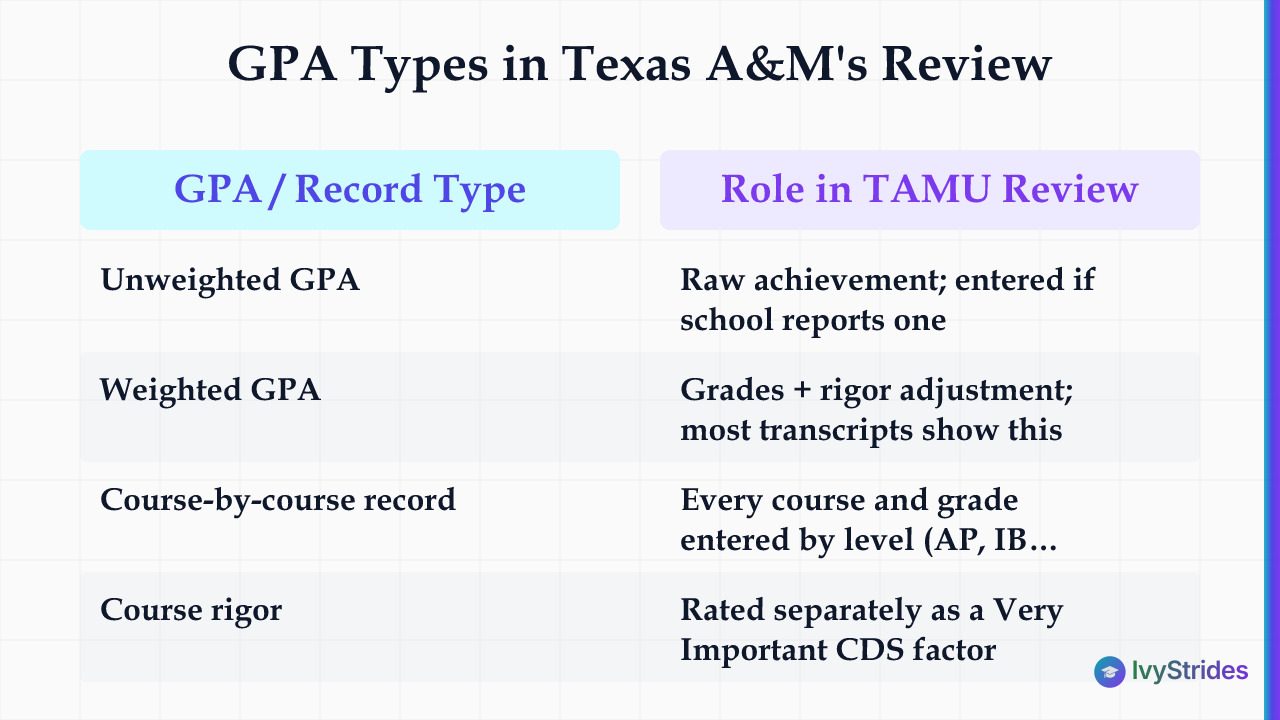
Texas A&M's self-reported transcript asks for both a weighted and an unweighted GPA, as your school reports them. The freshman admissions page states the academic factors in holistic review are every high school course attempted and the grade earned, course rigor, GPA, and class rank. Because the university also sees each course and grade, the weighted or unweighted label is only part of what it reads.
Rigor is rated separately. Course rigor is its own Very Important factor in the CDS, and the self-reported transcript has you tag each course with a level, such as AP, honors, IB or dual enrollment, which Texas A&M says defines the rigor of the course.
You enter your final grade in every course from grades 9 through 11, so reviewers see a single lower grade among all your others, along with any change from one year to the next. If one grade is weighing on you, here is whether one B can meaningfully change how a college reads your GPA.
| GPA Type | What It Shows | On the Self-reported Transcript |
| Unweighted | Raw achievement across all courses | Entered if your school reports one |
| Weighted | Grades plus a rigor adjustment | Entered; TAMU says most transcripts show this one |
| Course record | Every course and grade, by level | Entered course by course |
You report the whole record yourself through STARS, the Self-reported Transcript and Academic Record System, which every freshman applicant except GED graduates must complete.
Texas A&M Application Timeline and Deadlines for Fall 2027
Texas A&M College Station accepts fall 2027 freshman applications from Aug 1 to Dec 1, 2026, with supporting documents due Dec 15, 2026. That document deadline is the hard one for STARS: the self-reported transcript takes 2 to 6 hours and must be submitted and linked to your application by Dec 15.
You apply through either Common App or ApplyTexas, one application per student, and the platform does not affect the decision. ApplyTexas applicants also complete a separate Extracurricular Activities Form. Decisions go out on a rolling basis starting in late September. Top-10% applicants usually hear within about three weeks of a complete file; most holistic review applicants hear between Jan 1 and late March.
| Milestone | Date | Notes |
| Application opens | Aug 1, 2026 | Common App or ApplyTexas |
| Application deadline | Dec 1, 2026 | College Station fall term |
| Documents and STARS due | Dec 15, 2026 | STARS takes 2 to 6 hours |
| Rolling decisions begin | Late Sept 2026 | Top-10% within ~3 weeks of complete file |
| Holistic decisions | Jan 1 to late March | Most applicants hear in this window |
One more deadline note. Texas A&M reports no Early Decision (CDS C21), and its fall timeline lists waitlist offers in February.
On scores, Texas A&M's College Readiness FAQ says December test scores must be received by Dec 15 (checked 15 Oct 2026), so request your score send when you test.
If Texas A&M is on your list alongside UT Austin, the two Texas flagship admissions processes differ on test requirements, auto-admit thresholds, and essay volume.
FAQ: Texas A&M GPA and Admission Requirements
What is the lowest GPA Texas A&M will accept?
Texas A&M does not publish a minimum GPA for freshman admission. In holistic review, the university reads every course and grade alongside class rank and course rigor. Outside the top-10% automatic-admission path, no single number rules you in or out.
Can I get into A&M with a 3.5 GPA?
Texas A&M does not publish an admitted GPA range or a GPA cutoff, so your GPA is read alongside the rest of your file. Texas A&M weighs course rigor, class rank, extracurricular depth, and the required essays alongside GPA. If you have SAT or ACT scores, Texas A&M says they will only be used to benefit you.
Is a 3.7 GPA good for Texas A&M?
Texas A&M publishes no GPA benchmark to measure your GPA against; its Common Data Set reports no GPA data, so treat any figure you see elsewhere as an estimate. Reviewers read your GPA alongside course rigor and class rank, which get the same Very Important rating.
Is Texas A&M hard to get into?
IvyStrides' analysis of Texas A&M's published counts puts the fall 2025 first-year acceptance rate at 51.7%, from 32,531 admits among 62,967 applicants (CDS C1), automatic admits included. Among enrolled fall 2025 first-years who reported a class rank, 71.56% were in the top tenth of their class (CDS C10). For holistic review applicants, rigor of secondary school record, class rank, GPA, extracurricular depth, and the required essays all factor into the decision.
Your Next Step on the Texas A&M GPA Question
Your GPA is one input, rated Very Important alongside course rigor, class rank, extracurricular activities and talent/ability. What you can still shape before Dec 1 is how clearly your activity list and essays present you. Admission depends on the full application, not GPA alone, and test-optional status is confirmed for fall 2027 but may change for future cycles, so confirm on the admissions site if you are applying later.
- Find your class rank and check whether the top-10% automatic-admission path applies to you.
- Audit your course load for rigor, not just your GPA number.
- Decide whether a submitted SAT or ACT score strengthens a borderline file.
- Start STARS early; it takes 2 to 6 hours and is due Dec 15, 2026.
- Draft the 750-word essay around one specific instance in your own voice.

Hemant is a seasoned entrepreneur, investor, and growth strategist with deep ground in education and technology-driven learning. His core training is in Mathematics and Physics — he authored Physics for IB Diploma: Ultimate Revision Guide, recognized as a top student resource.