
Easiest AP Classes Are Not Always the Right First AP for Grade 10
On this page
- AP Classes Ranked by Difficulty: Where the Easiest Ones Actually Sit
- What the AP Score Scale Actually Means for a 10th Grader
- How to Pick the Right First AP for Grade 10, Not Just the Easiest One
- Which AP History Course Is Easiest, and What About AP Science and AP Math?
- FAQ: Choosing Your First AP Class
- What AP class has the lowest passing rate?
- Which AP history is easiest?
- What are the easiest AP exams to self study?
- Your Next Step on AP Course Selection
AP Psychology, AP Human Geography, AP Environmental Science, and AP Computer Science Principles are often called the easiest AP classes for their lighter content load, but their pass rates tell a different story. AP course selection is the decision a 10th grader makes about which exam-credit course to register for, and pass rate is only one factor in it.
In College Board's 2026 AP score distributions, those four ranged from 63% to 74% of test-takers scoring 3 or higher, while results across all exams ran from 59% in AP Music Theory to 90% in AP Research. The harder question, the one this article answers, is which of those courses is right for you as a first AP, given your subject strengths and your four-year plan.

AP Classes Ranked by Difficulty: Where the Easiest Ones Actually Sit
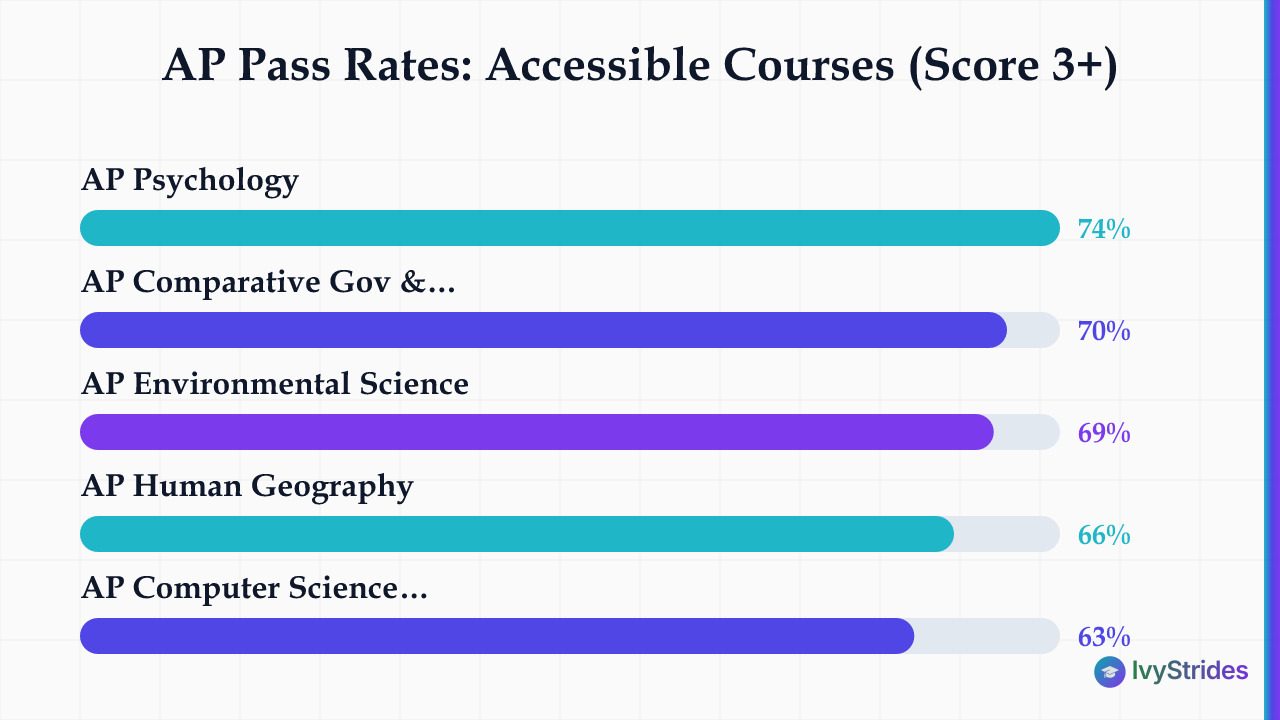
AP course difficulty is usually ranked by pass rate, the share of test-takers scoring 3 or higher on the 1-to-5 scale. By that metric, the courses in the table below are not the easiest; students find them accessible for their content load, not for their scores. Every AP exam is scored on a scale of 1 to 5, and College Board treats 3 as the lowest qualifying score.
One caveat before the table. A pass rate reflects all test-takers, including students with a full year of classroom instruction behind them. A self-studying 10th grader starts from a different baseline, so a high pass rate is not a promise that any individual student will clear a 3.
| AP Course | 2026 Pass Rate (score 3+) | Why Students Find It Accessible | Self-Study Viable? |
| AP Psychology | 74% | Vocabulary and theory, minimal math | Yes, strong candidate |
| AP Human Geography | 66% | Concepts and map recognition | Yes |
| AP Environmental Science | 69% | Interdisciplinary, basic math only | Yes, with lab awareness |
| AP Computer Science Principles | 63% | Project-based; algebra is the only recommended prerequisite | Yes |
| AP Comparative Government and Politics | 70% | Case-study structure, light reading | Yes |
Each of these rewards concept recognition over heavy computation or long-form essay writing, which is what makes them common entry points. Students who want the full difficulty spectrum should also know which AP courses post the lowest pass rates before finalizing a course list, because a course's easy reputation and its pass rate do not always match.
What the AP Score Scale Actually Means for a 10th Grader
The AP score scale runs 1 to 5, and for a 10th grader the gap between a 3 and a 5 matters more than clearing the pass-rate threshold. College Board describes a 3 as "qualified," a 4 as "very well qualified," and a 5 as "extremely well qualified." A 2 is "possibly qualified," with no college grade equivalent at all.
That scale, the same one behind the pass rates above, is what colleges see when you send or report your AP scores. Here is what each score means in College Board's own words.
| Score | College Board Descriptor | College Grade Equivalent | Credit Outlook (each college sets its own policy) |
| 5 | Extremely well qualified | A+ or A | Most likely to earn credit |
| 4 | Very well qualified | A-, B+, or B | Often earns credit |
| 3 | Qualified | B-, C+, or C | Minimum qualifying score |
| 2 | Possibly qualified | None | Rarely earns credit |
| 1 | No recommendation | None | No credit |
Qualifying is not the same as earning credit. College Board recommends credit at a 3, but it does not grant it. Whether a 3 earns credit at your target college depends entirely on that school's own AP credit policy, which varies widely even among selective universities.
So aim higher than the threshold. A 10th grader who scrapes a 3 on a subject they do not enjoy has spent a year earning a score College Board equates to a B-, C+, or C in college. A 4 or 5 on a subject that fits reads very differently. Score release timing and your subject's score distribution shape how you read your AP scores once they post, so plan to check your report against that distribution.
College Board delivers AP exams as fully digital or hybrid digital exams through Bluebook, its testing app, so your first AP experience includes learning that platform too.
How to Pick the Right First AP for Grade 10, Not Just the Easiest One
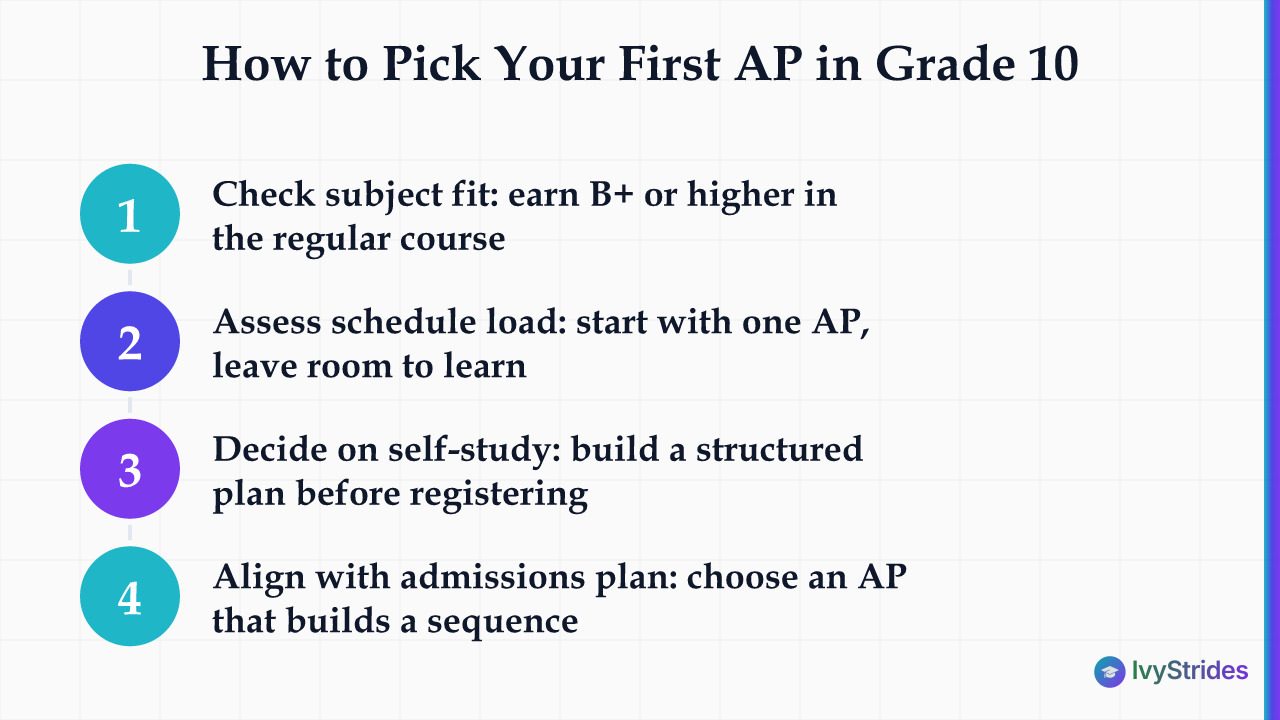
The right first AP for a 10th grader is the one that clears three tests: subject fit, schedule load, and admissions plan. That three-factor filter, applied to the accessible courses above, matters more than any ranked list because it accounts for the one variable a pass rate ignores, which is you.
| Factor | Question to Ask | Green Light Signal |
| Subject fit | Do I already earn a B+ or higher here? | Strength in the regular-level course |
| Schedule load | Can I carry this on top of my current classes? | One AP, room in the week |
| Admissions plan | Does this set up a subject I'll pursue? | Builds toward a junior-year sequence |
Subject fit first. Start your first-AP choice from the subjects you already handle well in regular coursework, not from a ranked pass-rate list.
Schedule load, honestly. One AP in grade 10 is a sensible starting point. It leaves room to learn how AP pacing and the free-response format work before you stack more on in junior year. Once your first AP is chosen, the next planning question is how many AP courses to add each year from 10th through 12th grade without compressing your scores.
Self-study is a habit question, not a subject question. AP Psychology is a strong self-study candidate because it leans on vocabulary and theory rather than lab work or teacher-led problem sets. But viability depends on whether you can hold a structured weekly schedule, not on the subject's pass rate. If you plan to self-study AP Psychology toward a 4 or 5, build the plan before registration, not after.
Students whose school does not offer a subject can still take it with live, per-subject AP instruction online. IvyStrides' AP Classes Online teach each subject as its own live course in a small cohort with a tutor, which matters most for the free-response sections where self-study tends to fall short.
One last caution. An "easy" AP does not lift admissions chances on its own. Admissions readers weigh course rigor against what your school offered and the score quality, so a thin transcript padded with the lowest-effort options is not a strategy.
Which AP History Course Is Easiest, and What About AP Science and AP Math?
The most accessible AP within each subject category is rarely the one students assume. By reading load, AP Comparative Government and Politics is the lightest first AP in the history and social studies family, though not the one with the highest 2026 pass rate, and lighter than AP US History or AP World History, both of which demand extensive document analysis and long-essay writing that a first-time AP student usually underestimates.
That subject-by-subject view matters once you know your preferred category. Here is the most manageable option in each, with the trade-off to watch.
| Subject Category | Most Accessible AP | Why It Is More Manageable | Watch Out For |
| History / Social Studies | AP Comparative Government and Politics | Case studies, lighter reading | Still needs source analysis |
| Science | AP Environmental Science | Interdisciplinary, basic math | A real lab component |
| Math / CS | AP Computer Science Principles | Project-based; algebra is the only recommended prerequisite | The performance task deadline |
| English | AP English Language and Composition | Argument over literary analysis | Timed essay pacing |
AP Computer Science Principles pairs an end-of-course exam with the Create performance task, which you complete over the course of the year, so it rewards steady work. AP Environmental Science adds a lab component that pure self-study can miss. And remember the earlier caveat: these pass rates include students with strong in-class preparation, so a self-studying sophomore faces a different climb.
Choosing the right subject category in grade 10 is one piece of a plan that coordinates AP, SAT, and ACT timing across all four years. If you land on the science category, AP Environmental Science rewards steady weekly review, the approach behind a week-by-week self-study schedule for AP Statistics, Human Geography, and Environmental Science.
Registration windows close well before the 2027 AP Exam administration, which runs May 3 to 7 and May 10 to 14 with late testing May 17 to 21. Pick the wrong course now and you carry it, and its score, for the two years colleges read.
FAQ: Choosing Your First AP Class
What AP class has the lowest passing rate?
In 2026, AP Music Theory had the lowest pass rate, with 59% of test-takers scoring 3 or higher, followed by AP Statistics at 62% and AP Computer Science Principles at 63%. AP Physics 1 posted 68% and AP Physics C: Electricity and Magnetism 75%. Neither is a light first AP, though: AP Physics C: E&M is calculus-based and AP Physics 1 is algebra-based, so a 10th grader without strong math preparation should treat them as junior or senior year courses, not a first AP.
Which AP history is easiest?
AP Comparative Government and Politics is the most accessible starting point, because its case-study structure and manageable reading load make it lighter than AP US History or AP World History, both of which require extensive document analysis and long-essay writing. Its pass rate is not the highest, though: in 2026, 70% of test-takers scored 3 or higher, compared with 74% in AP US History, 66% in AP World History: Modern, and 77% in AP African American Studies, the top figure among College Board's history and social science exams.
What are the easiest AP exams to self study?
AP Psychology and AP Human Geography are the strongest self-study candidates, because both rely more on concept recognition and vocabulary than on lab work or teacher-led problem sets. AP Environmental Science can work too, but its hands-on lab and field investigations are harder to replicate alone. Self-study is viable only if you commit to a structured weekly schedule and complete at least two full-length practice exams before test day.
Your Next Step on AP Course Selection
The AP with the easiest reputation is not automatically the right first AP for you. Run the accessible courses through the three-factor filter and pick the one that fits.
- Confirm you earn a B+ or higher in the subject's regular-level course.
- Check that your schedule has room for one AP alongside your current load.
- Decide whether self-study or a teacher-led course fits your study habits.
- Verify the subject sets up a sequence you want to continue in junior year.

Hemant is a seasoned entrepreneur, investor, and growth strategist with deep ground in education and technology-driven learning. His core training is in Mathematics and Physics — he authored Physics for IB Diploma: Ultimate Revision Guide, recognized as a top student resource.