
How to Self-Study AP Statistics, Human Geography, or Environmental Science for a 5
On this page
- What Score Do You Actually Need: The 5 Threshold for Each Exam
- AP Environmental Science Units, Exam Format, and Where Most Students Lose Points
- AP Human Geography: Seven Units, Dense Vocabulary, and the Concepts That Appear Most on the Exam
- AP Statistics Self-Study Plan: Formulas, Inference, and FRQ Communication
- Why Most Self-Studiers Plateau at a 3 (and What to Do Instead)
- Building Your Week-by-Week Self-Study Schedule for Each Subject
- Where to Find AP Environmental Science Practice MCQ and FRQ Resources
- When Self-Study Is Not Enough: Signs You Need Structured AP Support
- FAQ
- What percentage of students score a 5 on AP Human Geography?
- Is AP Environmental Science hard to score a 5 on?
- What is the Rule of 70 in AP Human Geography?
- Which is harder, AP Biology or AP Environmental Science?
- What is covered in AP Environmental Science Unit 1?
- How many multiple-choice questions are on the AP Environmental Science exam?
- Can I realistically self-study AP Human Geography as a freshman?
To self-study AP Statistics, AP Human Geography, or AP Environmental Science for a 5, take a full-length diagnostic first, then build a unit-weighted schedule that front-loads the heaviest units. A 5 on each exam typically requires roughly 70% of the composite score. AP Statistics is 40 MCQ + 6 FRQ split 50/50, with inference (Units 6-9) carrying the most weight. AP Human Geography is 60 MCQ + 3 FRQ, also 50/50, hinging on vocabulary breadth. AP Environmental Science is 80 MCQ + 3 FRQ weighted 60/40, with a mandatory calculation FRQ that decides most 4-versus-5 outcomes.
These format details come from the current College Board AP Program Course and Exam Descriptions, which we cite throughout. The harder question, which units get 60% of your hours and which FRQ skill separates a 4 from a 5 in your chosen subject, is where the next sections start.
What Score Do You Actually Need: The 5 Threshold for Each Exam
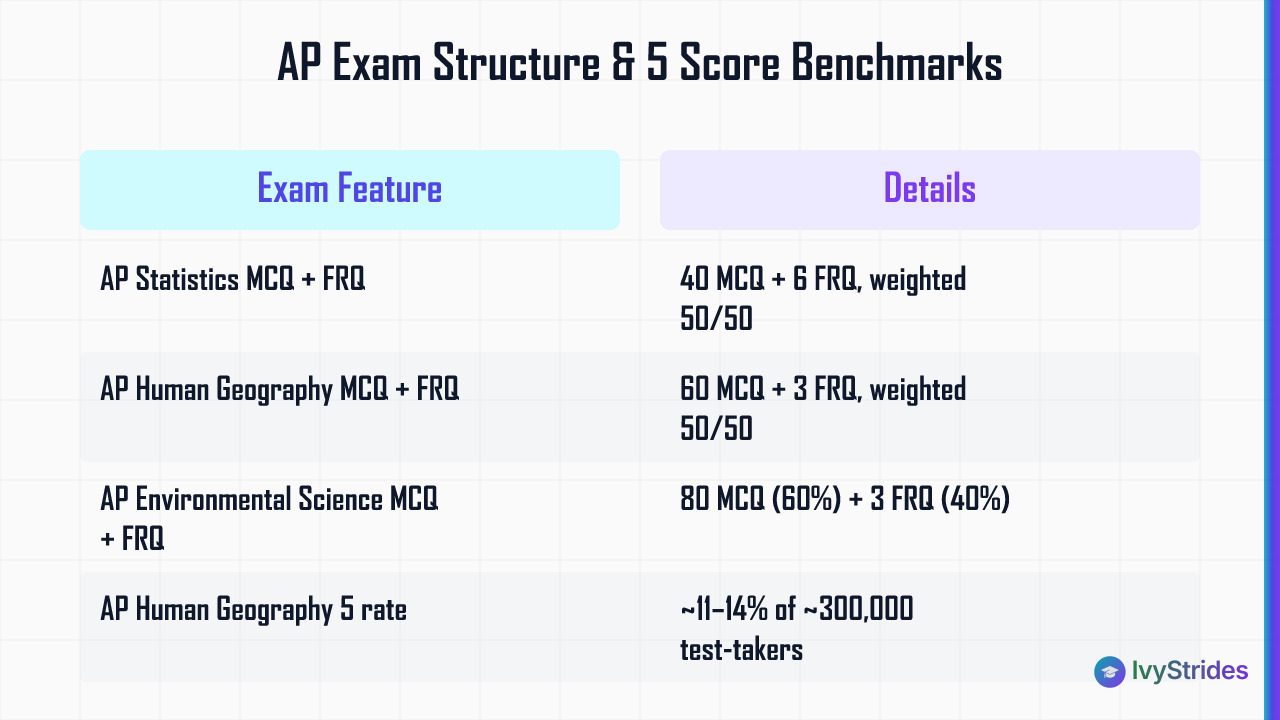
Start with the target so you know when to stop studying. Per the College Board AP Program, each exam's composite is calculated by weighting MCQ and FRQ sections and mapping the total to a 1-5 scale. Cut scores shift annually. Here's the working benchmark for each subject.
AP Statistics. 40 MCQ + 6 FRQ, each section worth 50% of the composite. A 5 typically requires around 70% of the composite score, though the College Board sets official cut scores each year based on psychometric equating.
AP Human Geography. 60 MCQ + 3 FRQ, weighted 50/50. In a typical year, roughly 11-14% of test-takers score a 5. It's one of the most-taken APs, with around 300,000 students annually, so the 5 threshold is competitive but reachable with disciplined vocabulary work.
AP Environmental Science. 80 MCQ (60%) + 3 FRQ (40%). Roughly 9-13% of test-takers score a 5 in a typical year. The exam's breadth, nine units spanning ecosystems through global change, is what usually catches self-studiers off guard.
Here's the caveat that matters more than any of these percentages. A 5 doesn't automatically convert to college credit. AP credit policies vary by institution and year: some selective universities award credit only for a 5, some only in specific subjects, some not at all. Before you invest 60 to 80 hours chasing a 5, confirm whether your target colleges award credit for AP scores in these subjects. Read our breakdown on do online AP courses count for college credit for the framework we use with families.
For current official score distributions and cut score data, go directly to the College Board AP Program rather than third-party summaries.
AP Environmental Science Units, Exam Format, and Where Most Students Lose Points
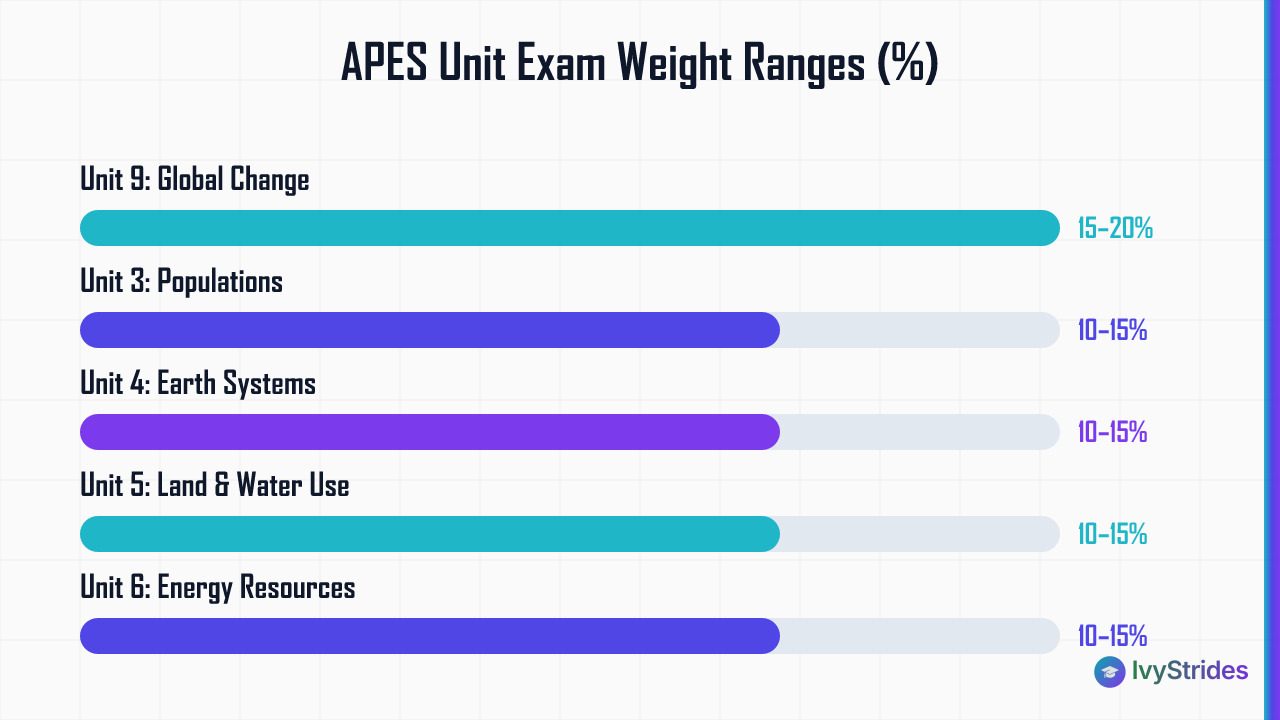
APES is nine units, 80 MCQ, and 3 FRQ. The 2026 exam is scheduled for Tuesday, May 12, 2026, verify against the College Board AP Program calendar before you register. The nine units, with approximate exam-weight ranges from the current CED:
-
The Living World: Ecosystems (roughly 6-8%)
-
The Living World: Biodiversity (roughly 6-8%)
-
Populations (roughly 10-15%)
-
Earth Systems and Resources (roughly 10-15%)
-
Land and Water Use (roughly 10-15%)
-
Energy Resources and Consumption (roughly 10-15%)
-
Atmospheric Pollution (roughly 7-10%)
-
Aquatic and Terrestrial Pollution (roughly 7-10%)
-
Global Change (roughly 15-20%)
AP Environmental Science Unit 1 is the conceptual foundation for the rest of the course. It covers terrestrial and aquatic biomes, primary productivity, the four biogeochemical cycles (carbon, nitrogen, phosphorus, water), trophic levels, and the 10% energy rule, the principle that only about 10% of the energy at one trophic level transfers to the next. Skip Unit 1 and you'll be lost by Units 5 through 9, because pollution and global change questions constantly reference biogeochemical cycles and energy transfer.
The hardest units for most students are Unit 6 (Energy) and Unit 9 (Global Change), both because of calculation density. The APES FRQ section includes a mandatory calculation question requiring unit analysis, formula setup, and a final answer with correct units. In our coaching with APES students in the 3-to-4 score band, students who practice concepts but never write out a full calculation FRQ under timed conditions consistently lose roughly 8 to 12 points on exam day.
Quick comparison for students choosing between APES and AP Bio: APES covers more topics at less depth, while AP Bio demands deeper cellular and molecular knowledge. APES is more accessible as a self-study subject, but "accessible" isn't "easy". The breadth is the trap.
Pacing on the MCQ section: 80 questions in roughly 90 minutes gives you about 1 minute 8 seconds per question. Speed matters.
For students preparing internationally, factor in our note on AP exam fees for international students before locking your registration. If self-study stalls on the calculation FRQ, our ap courses online put you with an APES specialist who has coached students through this exact gap.
AP Human Geography: Seven Units, Dense Vocabulary, and the Concepts That Appear Most on the Exam
APHUG runs 60 MCQ + 3 FRQ in roughly 2 hours 15 minutes, delivered digitally through the Bluebook app for the 2026 exam. The seven units, with approximate CED weight ranges:
-
Thinking Geographically (roughly 8-10%)
-
Population and Migration (roughly 12-17%)
-
Cultural Patterns and Processes (roughly 12-17%)
-
Political Organization of Space (roughly 12-17%)
-
Agriculture and Rural Land Use (roughly 12-17%)
-
Cities and Urban Land Use (roughly 12-17%)
-
Industrial and Economic Development (roughly 12-17%)
Unit 2 (Population and Migration) and Unit 7 (Industrial Development) are consistently the heaviest-tested. Units 4 (Political Organization) and 6 (Cities) are the vocabulary graveyards: dozens of terms like "gerrymandering", "enclave", "primate city", "gentrification", "Burgess concentric zone model", each with a precise definition the MCQ writers exploit. In our coaching with APHUG students, vocabulary gaps in Units 4 and 6 account for the majority of MCQ errors in the 3-to-4 score band.
One quantitative concept reliably appears: the Rule of 70, part of the population unit in the College Board's AP Human Geography course framework. Doubling time equals 70 divided by the natural increase rate (NIR). Suppose a country has an NIR of 3.5%: the doubling time works out to 70 / 3.5 = 20 years. At an NIR of 1.4%, it's 50 years. You'll see this in MCQ items and occasionally as an FRQ component, so build it into muscle memory.
The APHUG FRQ section asks three questions requiring geographic reasoning, evidence, and application, not just definitions. Students who memorize vocabulary but never write full FRQ responses under timed conditions land in the 3 range even with strong MCQ performance. The AP Human Geography CED on AP Central is the authoritative source for the current unit structure and FRQ rubrics.
Our SAT Data Analysis Strategies for Charts, Graphs, and Stats guide is useful here too, because APHUG stimuli lean heavily on population pyramids, migration flow maps, and demographic tables.
AP Statistics Self-Study Plan: Formulas, Inference, and FRQ Communication
AP Statistics is where self-studiers most often plateau, not because the math is hard, but because the FRQ section rewards written communication, not just correct numbers. The exam is 40 MCQ + 6 FRQ, each section worth 50%.
The nine units, roughly ordered by exam weight:
- Units 1-2: Exploring One-Variable and Two-Variable Data (roughly 20-30%)
- Unit 3: Sampling and Experimentation (roughly 12-15%)
- Units 4-5: Probability, Random Variables, Sampling Distributions (roughly 20-30%)
- Units 6-9: Inference procedures, confidence intervals and significance tests for means, proportions, chi-square, slope (roughly 35-45%)
Inference is where the exam is won or lost. Units 6-9 account for most of the FRQ section. The College Board provides a formula sheet on the exam, so you don't need to memorize every formula, but you do need to know when to apply which inference procedure, how to check conditions, and how to write a conclusion in the context of the problem.
Here's the part most self-studiers miss. Every FRQ response involving inference requires four elements to earn full credit: context, conditions, calculations, and conclusion. State the parameter and hypotheses in context. Verify the conditions (random sampling, normality, independence, 10% condition, large counts, whatever applies). Show the calculation with the correct test statistic. Write the conclusion in a full sentence tied back to the original context. In our coaching with AP Statistics students, FRQ written statistical justification, stating conditions and writing conclusions in context, is the skill that most reliably separates 4s from 5s.
The sixth FRQ, the investigative task, is longer, multi-part, and worth more points than FRQs 1 through 5 individually. Budget 25 to 30 minutes for it.
The data interpretation skills you build for AP Statistics, reading scatterplots, interpreting confidence intervals, and evaluating study design, directly reinforce the data analysis questions on the Digital SAT. See our SAT Data Analysis Strategies for Charts, Graphs, and Stats breakdown for the overlap. Students who handle AP Statistics inference units comfortably often find the transition to ap calculus ab more manageable because both courses reward precise written reasoning over rote computation.
Why Most Self-Studiers Plateau at a 3 (and What to Do Instead)
Here's the pattern we see repeatedly. A motivated student picks up a prep book in February, reads Unit 1, reads Unit 2, reads Unit 3, feels productive, and walks into the May exam having never taken a full-length timed practice test. They score a 3. Sometimes a 2.
The five mistakes that cause the plateau:
Mistake 1: Equal time across all units. Studying all nine APES units or all seven APHUG units with equal time ignores that some units carry two to three times the exam weight of others. You're donating your best study hours to low-weight material.
Mistake 2: Content review without timed MCQ practice. Reading a chapter isn't the same as answering 20 MCQs in 25 minutes. Timed practice trains pacing, and pacing is where self-studiers hemorrhage points.
Mistake 3: Skipping FRQ practice entirely. FRQs are 40 to 50% of your composite, depending on the subject, per the College Board's published exam weightings for AP Statistics, AP Human Geography, and AP Environmental Science. If you've never written a full FRQ under timed conditions, you've never actually practiced half the exam.
Mistake 4: No diagnostic before content review. In our coaching, students who take one full-length diagnostic before starting content review consistently identify their two or three weakest units and cut unfocused review time by roughly 20 to 30 hours. Everyone else is guessing.
Mistake 5: Cramming in the final week. In our coaching, spaced repetition across 8 to 12 weeks outperforms a two-week sprint on any exam that tests vocabulary (APHUG) or procedural skills (AP Stats inference, APES calculations). Reviewing material at 1-day, 3-day, and 7-day intervals is the version we use with self-studiers.
Which units and which question types you practice matters more than total hours.
Official AP Environmental Science practice MCQ sets are available through AP Central's past exam questions page, which is the only source I'd fully trust for calibrated question difficulty. Third-party PDFs floating around online are hit or miss, and some contain errors that will teach you wrong reasoning.
If you're balancing SAT prep alongside your APs, our sat study plan walks through the same diagnostic-first approach for standardized tests.
Building Your Week-by-Week Self-Study Schedule for Each Subject

Photo by Tara Winstead on Pexels
A realistic 5-target plan runs roughly 10 to 12 weeks at 6 to 8 hours per week. That works out to about 60 to 96 total hours. Here's the framework we use with self-studiers.
Week 1: Diagnostic. Take one full-length official practice exam under timed conditions. Score it by unit. Identify your two or three weakest units. This step alone reshapes the next 10 weeks.
Weeks 2-7: Content review in unit-weight order. Start with your highest-weight, lowest-diagnostic-score units. Read the unit, complete a 20 to 25 MCQ set on that unit, log your errors. The benchmark we use with self-studiers: don't move on until you're at 70% or above on unit-level MCQ.
Weeks 8-10: Mixed MCQ + FRQ practice. Timed mixed-unit MCQ sets. Full FRQ practice with self-scoring using official rubrics from AP Central. This is where communication gaps in AP Stats and calculation gaps in APES surface.
Weeks 11-12: Second full-length practice exam + targeted patching. Take another full timed exam. Compare to Week 1. Spend the final week patching whatever units still lag.
Subject-specific overlays:
- APES: dedicate at least 2 hours per week to calculation FRQ practice, specifically unit analysis and formula setup. This is the single highest-use habit for moving from a 3 to a 5 in APES. If you're preparing from outside the United States, check our breakdown of AP exam fees for international students before finalizing your registration timeline.
- APHUG: 30 minutes per day on vocabulary flashcards for Units 2, 4, and 6 during Weeks 2 through 7. Use spaced repetition rather than massed review.
- AP Statistics: every practice FRQ gets a full written conclusion in context, not just a numerical answer. Every session.
Grab a physical planner or a shared calendar. Our free downloads page has study planning templates you can adapt to your exam date.
Where to Find AP Environmental Science Practice MCQ and FRQ Resources
The official source is AP Central's past exam questions page. Every APES released FRQ from prior years is there, along with scoring rubrics. Use released FRQs the way real students face them: timed, closed-book, then self-scored using the official rubric. Don't read the rubric before writing your response.
For MCQ practice, students enrolled in an official AP course have access to AP Classroom, which includes calibrated MCQ sets by unit. If you're self-studying without a school course, released MCQ items from past exams (limited but available on AP Central) are your most reliable source.
Supplementary APES unit guides from established study platforms can help fill content gaps, but treat them as a supplement, not a replacement for official College Board materials. And here's the honest warning: unofficial PDF answer keys and "leaked" AP Environmental Science practice exam files circulating online often contain errors that will teach you wrong reasoning. If a resource doesn't come from College Board's official channels, cross-check any answer that surprises you.
For AP Human Geography, the same principle applies. The official AP Human Geography CED on AP Central is the source of truth for unit structure, FRQ format, and current exam alignment.
If you're considering whether structured online AP coursework fits your schedule better than pure self-study, our can you take AP classes online explainer covers the tradeoffs. Our ap courses online service uses per-AP-subject specialists, meaning your APES teacher is only teaching APES, not stretching across three subjects.
When Self-Study Is Not Enough: Signs You Need Structured AP Support
Self-study works for many students on these three exams. It doesn't work for every student, and knowing the difference saves you months. Here are the signals we watch for.
Signal 1: FRQ scores plateau after three or more rounds of self-scored practice. If your written responses aren't improving, you likely need an outside eye on structure or context.
Signal 2: Stuck in the 3-to-4 band on full-length practice after six or more weeks of review. The gap between a 4 and a 5 is usually specific, a few units, one FRQ type, one procedural skill, and it responds well to targeted coaching.
Signal 3: The calculation FRQ in APES or the inference FRQ in AP Stats consistently loses more than 50% of available points. These are trainable skills, but they require someone who can watch you work and correct your process in real time.
Signal 4: APHUG vocabulary isn't sticking despite flashcard review. Sometimes the fix is a different memorization method; sometimes it's guided application through case studies. Another round of solo flashcards won't unlock it.
Students who find self-study stalling on inference units in AP Statistics or energy calculations in APES often benefit from structured AP classes online with a subject-specialist teacher who can diagnose exactly where the gap is.
Want to see who would actually work with you? Our best online ap courses page lists our per-subject specialists. For students weighing whether the investment is worth it against target colleges' credit policies, revisit do online AP courses count for college credit first. You can also meet the tutors who coach across SAT, ACT, AP, and admissions essays.
FAQ
What percentage of students score a 5 on AP Human Geography?
In a typical year, roughly 11-14% of AP Human Geography test-takers score a 5, per College Board score distributions. The exam is widely taken, around 300,000 students annually, so the raw number of 5s is large, but the percentage stays competitive. Consistent vocabulary mastery across Units 2, 4, and 6 combined with timed FRQ practice are the two factors that most reliably push students from a 4 to a 5 in our coaching.
Is AP Environmental Science hard to score a 5 on?
APES is considered one of the more accessible AP science courses in terms of content depth, but scoring a 5 is still challenging. Roughly 9-13% of test-takers reach that threshold in a typical year. The difficulty is breadth, not depth: nine units spanning ecosystems, energy, pollution, and global change, plus a mandatory calculation FRQ requiring unit analysis. Students who underestimate the calculation component and skip FRQ practice are the ones most likely to plateau at a 3.
What is the Rule of 70 in AP Human Geography?
The Rule of 70 estimates how long it takes a population to double at a given natural increase rate (NIR), and it sits in the population unit of the College Board's AP Human Geography framework. The formula is doubling time = 70 divided by the NIR. Worked through with an NIR of 3.5%, the doubling time is 70 / 3.5 = 20 years. This concept appears directly on the APHUG exam in both MCQ and FRQ contexts, so you should be able to calculate it quickly and explain what it means for population policy.
Which is harder, AP Biology or AP Environmental Science?
AP Biology is generally more difficult than APES because it requires deeper knowledge of cellular and molecular biology, genetics, and biochemistry. APES covers more topics at lower depth, making it more accessible for self-study. That said, APES isn't easy. The breadth of nine units and the calculation FRQ requirement mean underprepared students still score 2s and 3s. If you're choosing between the two, APES is the more forgiving starting point for a student new to AP sciences.
What is covered in AP Environmental Science Unit 1?
AP Environmental Science Unit 1, The Living World: Ecosystems, covers terrestrial and aquatic biomes, primary productivity, the four major biogeochemical cycles (carbon, nitrogen, phosphorus, water), trophic levels, and the 10% energy rule (only about 10% of energy transfers between trophic levels). This unit is foundational because later units on pollution and global change build on the ecosystem concepts here. Per the College Board AP Environmental Science CED, Unit 1 typically accounts for roughly 6-8% of the exam.
How many multiple-choice questions are on the AP Environmental Science exam?
The AP Environmental Science exam includes 80 multiple-choice questions, which account for 60% of the total exam score, per the College Board AP Program. The remaining 40% comes from 3 free-response questions. The 2026 exam is scheduled for Tuesday, May 12, 2026. With 80 MCQ in a timed section, pace at roughly 1 minute 8 seconds per question to leave time for review.
Can I realistically self-study AP Human Geography as a freshman?
Yes. APHUG is one of the most commonly self-studied AP courses and is frequently taken by freshmen. The content doesn't require prior AP coursework. The main challenge is vocabulary: the course introduces hundreds of geographic terms across seven units, and students who don't build a systematic vocabulary review habit often struggle on MCQ items that hinge on precise term definitions. A 10-to-12-week self-study plan at roughly 6 to 8 hours per week is a realistic target for a motivated freshman aiming for a 4 or 5.
The right question isn't "how do I study for AP Statistics, APHUG, or APES?" It's "which two or three units in my chosen subject deserve the bulk of my study hours, and how do I train the specific FRQ skill that separates a 4 from a 5?" Answer that, and you have a real plan.

Two decades teaching quantitative and verbal aptitude on standardized tests. Rare dual expertise across Math and Verbal — particularly effective for students with gaps on both sides. Senior AP Mentor for our Calculus and English tracks.