
How to Self-Study AP Psychology and Score a 5: Your 2026 Game Plan
On this page
- What the 2026 AP Psychology Exam Actually Looks Like (Format, Sections, and What Changed)
- The Five AP Psychology Units: Which Ones to Study First and How Long to Spend on Each
- Step 1: Take an AP Psychology Diagnostic Practice Exam Before You Open a Single Textbook
- How to Actually Study AP Psychology: Active Recall, Spaced Repetition, and Timed MCQ Practice
- Not Sure Where Your AP Psychology Prep Stands Right Now?
- How to Write AP Psychology FRQs That Actually Earn Rubric Points (AAQ and EBQ Breakdown)
- Your 8-Week AP Psychology Self-Study Schedule (Week-by-Week Plan)
- What Your AP Psychology Score Actually Means for College Admissions and Credit
- Is AP Psychology Hard? How It Compares to Other AP Exams
- When Self-Study Is Not Enough: How to Add Expert Support to Your AP Psychology Prep
- Frequently Asked Questions About Self-Studying AP Psychology
- How do you get a 5 on AP Psychology?
- What is the hardest AP Psychology unit?
- How do I self-study AP Psychology in less than two months?
- How do you study for AP Psych in 2 weeks?
- What percent do you need for a 5 on AP Psychology?
- Can you self-study AP Psychology with only Crash Course videos?
- What is the best AP Psychology prep book for 2026?
- Where can I find free AP Psychology practice tests?
- Are Quizlet decks good for AP Psychology?
- Ready to Move from a 3 to a 5 on AP Psychology?
AP Psychology is a College Board course and exam covering five units of introductory psychological science, assessed by a two-section digital exam and scored 1 to 5.
To self-study AP Psychology and score a 5 in 2026:
- Take a full diagnostic practice exam before any content review.
- Prioritize Units 1 through 3 (Biological Bases, Sensation and Perception, Learning and Cognition), which carry the heaviest MCQ weight.
- Plan 40 to 60 hours of focused prep across 8 to 12 weeks. That is the range we budget in our coaching.
- Drill FRQ rubric practice and vocabulary, not passive re-reading. That is what separates a 3 from a 5.
The 2026 exam is fully digital on the Bluebook app: 75 multiple-choice questions in 90 minutes, then 2 free-response questions (one Applied Analysis Question, one Evidence-Based Question) in 70 minutes.
Format details come from the College Board AP Program, your single source of truth for scoring, dates, and the Course and Exam Description (CED).
Most advice on how to prepare for AP Psychology stops at the format. The harder question is how to sequence your hours. That is the difference between AP Psychology exam prep that moves a score and prep that fills time.

What the 2026 AP Psychology Exam Actually Looks Like (Format, Sections, and What Changed)
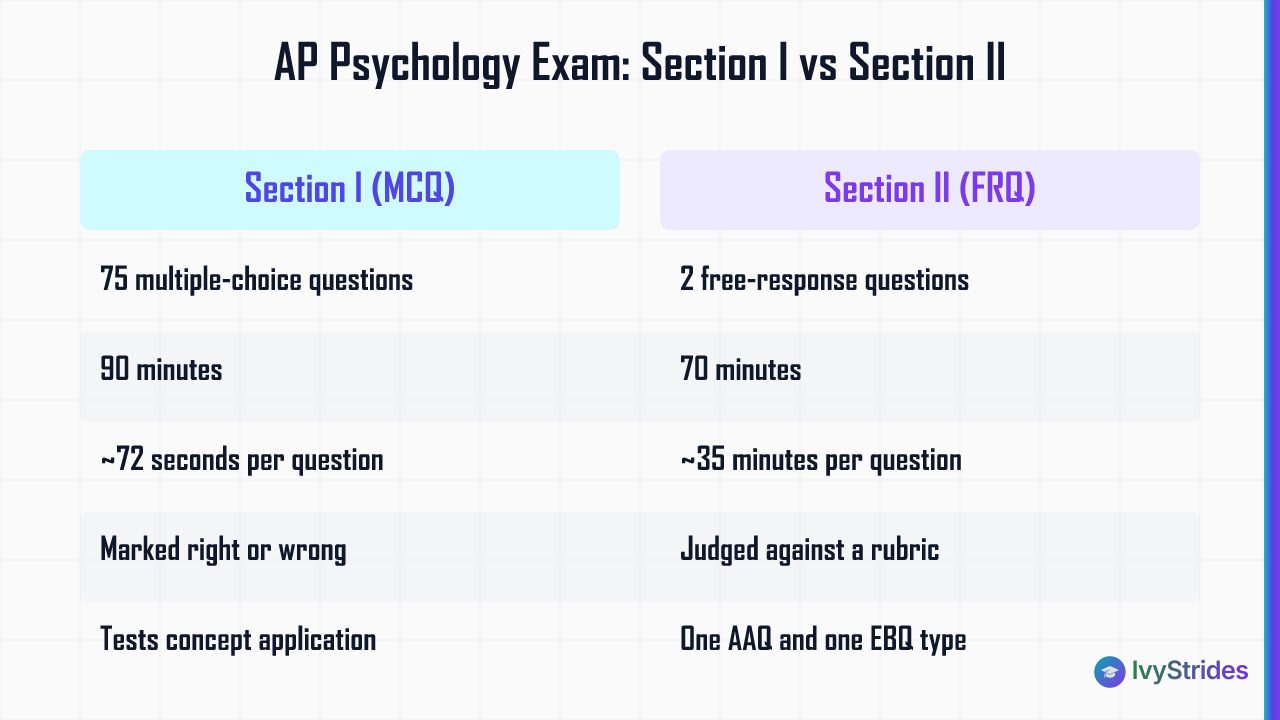
Both sections are delivered digitally through the Bluebook app, the same platform the Digital SAT uses. College Board scores the exam on the AP score scale (1 to 5), a score of 5 being the highest, per the official AP Psychology assessment page.
Each multiple-choice question (MCQ) is marked right or wrong. Each free-response question (FRQ) is judged against a rubric. That is why the two sections reward completely different preparation.
| Section | Content | Time | Pace |
| Section I | 75 multiple-choice questions | 90 minutes | About 72 seconds per question |
| Section II | 2 free-response questions (one AAQ, one EBQ) | 70 minutes | About 35 minutes per question |
That 72-second pace matters more than it sounds. AP Psychology multiple-choice questions test concept application, not just recall, so you cannot freeze on a scenario question and burn three minutes deciding whether it is reinforcement or punishment.
The two FRQ types are different animals. If your practice only rehearses one, you are preparing for half the section.
One caution about the AP Psychology 2026 exam: it is a transition year, so material written for earlier administrations may describe a format that no longer exists. Verify the current format and any CED clarifications at the official AP Psychology assessment page and on AP Central. The exam sits in May 2026; confirm your exact date in your College Board account, because it drives the countdown.
Students who would rather learn this material inside a structured course than assemble it solo can look at IvyStrides' AP prep courses online. IvyStrides staffs AP Psychology with a per-subject specialist rather than one generalist covering every AP exam at once, because the free-response scoring on AP Psychology and on AP Calculus reward different skills entirely.
The Five AP Psychology Units: Which Ones to Study First and How Long to Spend on Each
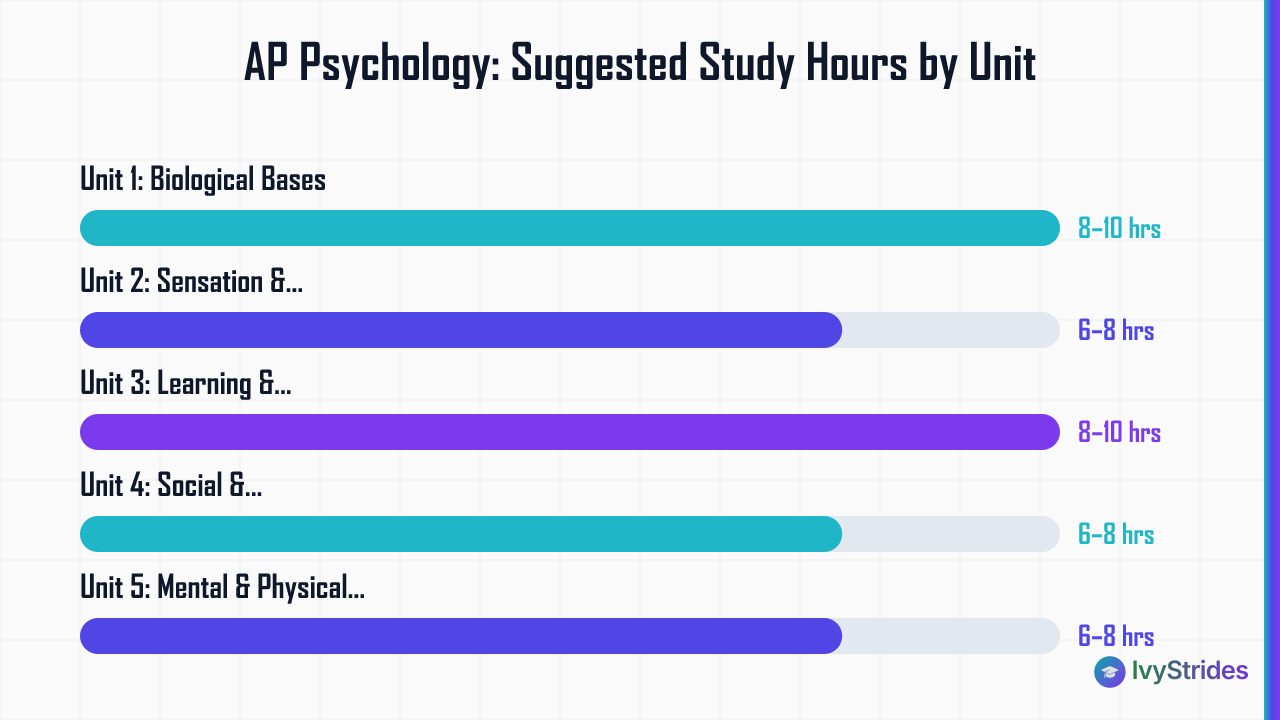
Not all five units pull the same weight on the MCQ section, and treating them equally is the fastest way to waste your hours. Per the College Board CED, Units 1 through 3 carry the heaviest MCQ weighting. Study them first, study them hardest.
| AP Psychology unit | What it covers | Suggested hours |
| Unit 1: Biological Bases of Behavior | Neurons, neurotransmitters, brain structures, endocrine system, genetics | 8 to 10 |
| Unit 2: Sensation and Perception | Sensory thresholds, transduction, Gestalt organization, depth cues | 6 to 8 |
| Unit 3: Learning and Cognition | Classical and operant conditioning, memory models, encoding and retrieval, bias | 8 to 10 |
| Unit 4: Social and Personality Psychology | Social influence, attribution, group behavior, personality theories | 6 to 8 |
| Unit 5: Mental and Physical Health | Psychological disorders, treatment approaches, stress and health | 6 to 8 |
Two notes on that table. AP Psychology Unit 1 (Biological Bases of Behavior) is the foundation: if your neuron vocabulary is shaky, everything downstream wobbles. Unit 3 is where the largest share of MCQ points lives.
Research methods and data interpretation are not a separate unit. They thread through all five. Experimental design, correlation versus causation, statistical reasoning, and ethics appear as a consistent MCQ category no matter which content unit a question sits in. Fold research-methods review into every unit rather than saving it for the end.
Add 6 to 8 hours for FRQ rubric practice and 4 to 6 hours for full-length practice exams. Total: roughly 40 to 60 hours across 8 to 12 weeks. Anyone promising a 5 on a weekend of cramming is selling you something.
If part of what's driving your prep is college credit, read our note on do online AP courses count for college credit before you assume a 4 or 5 will place you out of intro psych everywhere. Policies vary, and we'll come back to that.
Step 1: Take an AP Psychology Diagnostic Practice Exam Before You Open a Single Textbook
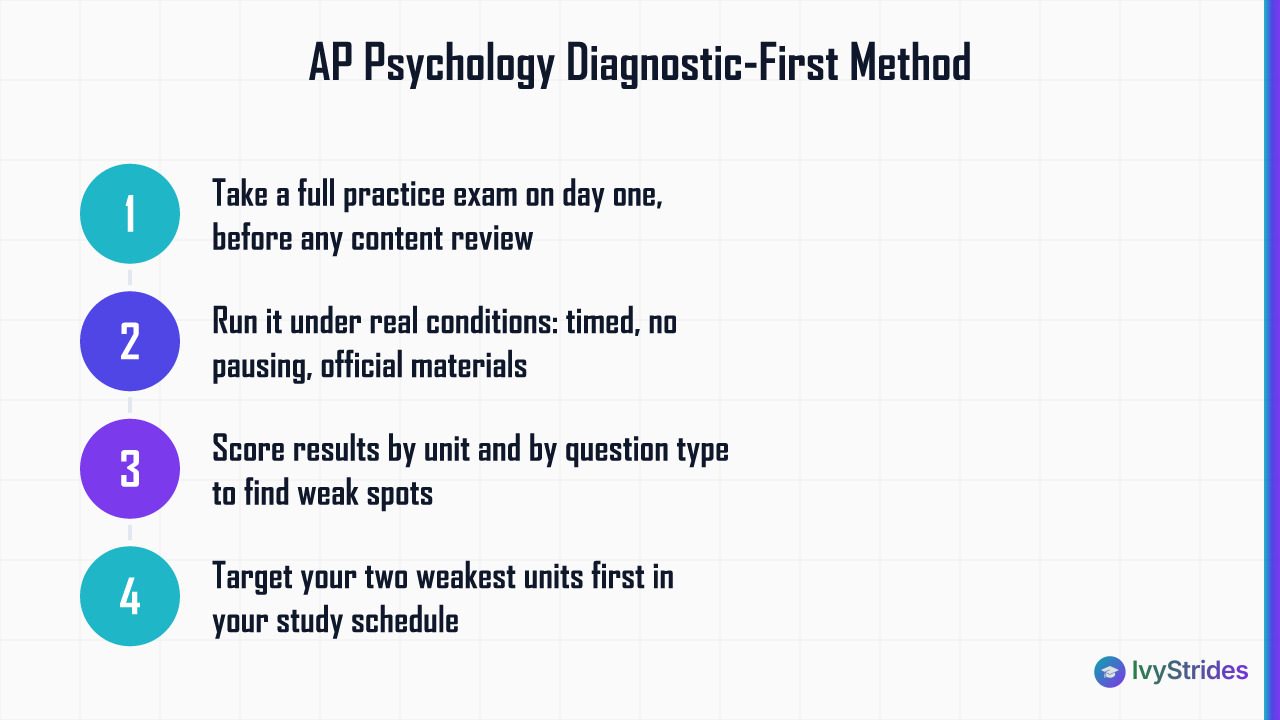
Sit a full AP Psychology practice exam on day one, before any content review. This is the first move in the IvyStrides diagnostic-first method, and every IvyStrides AP prep engagement starts with it, because the gap between a student's current score and their target determines which units earn the hours.
Run it under real conditions:
- 90 minutes for the 75 MCQs, 70 minutes for the two FRQs.
- Timed, no pausing. The point is an honest baseline, not a good feeling.
- Use official material: College Board publishes free AP Psychology practice exams and past FRQs with scoring guidelines at apstudents.collegeboard.org, and AP Classroom adds Progress Checks through your school account.
Then score it by unit and by question type. Which units bled points? Are you missing research-methods questions across the board? Are your FRQ answers vague or off-scenario? That analysis turns a generic study guide into your study schedule.
Skip this step and the usual thing happens: you open the textbook at Unit 1, grind through in order, and run out of time before reaching your real weak spots.
In our coaching with AP Psychology students, those who start with a diagnostic and target their two weakest units first typically improve practice exam scores by a full score band, for example a 3 to a 4, within four to six weeks. The diagnostic does not cost you time. It saves it.
Homeschooled students who need a full course rather than just exam prep can start with our overview of online AP for homeschoolers.
How to Actually Study AP Psychology: Active Recall, Spaced Repetition, and Timed MCQ Practice
Three methods move an AP Psychology score: active recall, spaced repetition, and timed MCQ practice. Everything else is passive review. Re-reading, re-watching, and highlighting build familiarity, not retrieval, and the exam tests retrieval.
| Method | What it fixes | How to run it |
| Active recall | Concept application, the skill most MCQs test | Close the notes and produce the answer from memory. Ask "can I apply operant conditioning to a scenario I have never seen?", not "does this look familiar?" |
| Spaced repetition | The vocabulary load across five units | 15 to 20 minutes of flashcard review, then pivot straight to application practice |
| Timed MCQ practice | Speed plus the research-methods questions hiding inside content units | The set size we use in our coaching: 15 to 20 questions on the clock at 72 seconds each, then review every miss |
A student who can define operant conditioning but cannot recognize it in a novel scenario will miss the application questions, and application questions are most of them.
Flashcard systems, including AP Psychology Quizlet decks, are genuinely useful for the vocabulary layer. Treat them as a tool, not the plan. Vocabulary that never gets applied to a scenario stays inert on exam day.
When you review AP Psychology MCQ practice sets, sort misses by unit rather than working through them in order. The pattern tells you where next week goes. Free official practice questions live at apstudents.collegeboard.org.
In our coaching with AP Psychology students, those who self-quiz on term application rather than re-reading tend to outperform the re-readers by roughly one score band on practice exams.
Not Sure Where Your AP Psychology Prep Stands Right Now?
Book a free 15-minute strategy call with an IvyStrides AP specialist. We will review your diagnostic results, identify your highest-leverage units, and map a realistic plan to your target score, whether the exam is 8 weeks away or 8 months away.
How to Write AP Psychology FRQs That Actually Earn Rubric Points (AAQ and EBQ Breakdown)
Write for the rubric, not for length. An AP Psychology FRQ awards a point for a named psychological concept applied correctly to the specific scenario, and for nothing else. Length earns nothing. Personal opinion earns nothing. That is the entire scoring logic, and it is where self-studiers leave the most points on the table, because they write essays when they should be writing for a rubric.
| Applied Analysis Question (AAQ) | Evidence-Based Question (EBQ) | |
| What you are given | A real-world scenario | A research study or data set |
| What you must do | Apply concepts to explain or predict behavior | Interpret findings through a psychological lens |
| Orientation | Application-forward | Research and data-forward |
| Scoring | Rubric points, awarded individually | Rubric points, awarded individually |
The Applied Analysis Question (AAQ) gives you a scenario and asks you to apply concepts to explain or predict the behavior in it. The Evidence-Based Question (EBQ) gives you a study or data set and asks you to interpret it through a psychological lens. Both are scored on a rubric, and partial credit is awarded point by point, so you want to hit as many discrete rubric points as you can rather than writing beautifully about one.
Look at the difference in one sentence. A vague answer like "the person learned from experience" earns zero points; it names no concept and applies nothing. A precise answer like "this is an example of operant conditioning because the behavior was reinforced by a positive stimulus, increasing the likelihood it repeats" earns the point: named concept, correct definition, applied to the scenario. Same idea, wildly different score. Write like the second one every time.
On timing, use the roughly 35-minutes-per-FRQ guide as a starting point, but don't pad. Once you've earned the available points, stop and move on. Extra paragraphs don't buy extra credit.
The single most efficient AP Psychology FRQ review activity: pull College Board's released FRQs and official scoring guidelines from apstudents.collegeboard.org, write your answer, then score yourself against the actual rubric.
Alternate the two types as you go. One round of AP Psychology AAQ practice, then one practice FRQ of the evidence-based kind, so neither format catches you cold in May.
Hunt for these three mistakes in your own writing:
- Vague generalities that name no psychological concept.
- Answers that ignore the specific scenario you were given.
- Long responses that never land a named concept.
If you want a specialist reading your FRQ drafts and marking them against the rubric the way a reader would, that's exactly what our AP prep courses are built to do.
Your 8-Week AP Psychology Self-Study Schedule (Week-by-Week Plan)
Here's a plan you can start this week. It assumes roughly 45 to 60 minutes of active study on school days and 90 to 120 minutes on weekends, which totals about 50 to 55 hours across eight weeks, comfortably inside the 40-to-60-hour range typical for a 5-targeting student.
| Weeks | Focus | What you finish with |
| 1 to 2 | Diagnostic exam, then Units 1 and 2 | A baseline scored by unit, vocabulary deck running |
| 3 to 4 | Unit 3, the heaviest content unit | First FRQ rubric-practice session on a released AAQ |
| 5 to 6 | Units 4 and 5 | Timed MCQ sets at least twice a week |
| 7 | Full-length timed practice exam | Self-scored MCQs, rubric-scored FRQs |
| 8 | Weakest remaining unit | One AAQ and one EBQ scored against the rubric |
Weeks 1 to 2. Take your full diagnostic exam first. Score it by unit. Then cover Unit 1 (Biological Bases of Behavior) and Unit 2 (Sensation and Perception), leaning into whichever the diagnostic flagged as weaker. Start a spaced-repetition vocabulary deck now and keep it running the whole eight weeks.
Weeks 3 to 4. Work through Unit 3 (Learning and Cognition), the heaviest content unit, and run your first FRQ rubric-practice session using a released AAQ and its scoring guidelines. Self-score honestly.
Weeks 5 to 6. Cover Unit 4 (Social and Personality Psychology) and Unit 5 (Mental and Physical Health). Layer in the timed MCQ sets described above, at least twice a week, reviewing every miss.
Week 7. Sit a full-length, timed practice exam. Self-score the MCQs and rubric-score both FRQs. This is your progress checkpoint against the diagnostic.
Week 8. Targeted review of your weakest remaining unit, plus a final round of FRQ practice, one AAQ and one EBQ, scored against the rubric.
Adjust to your calendar. With 12 or more weeks, spread Units 1 through 3 across three weeks each and add a second full practice exam around week 10. With fewer than 4 weeks, triage hard: prioritize Units 1 through 3 and FRQ rubric practice over trying to cover everything. In our coaching with AP Psychology students, those who complete at least two full timed practice exams before test day tend to score higher than those who only did unit-by-unit review. Two timed exams. Non-negotiable if you can manage it.
Self-studying more than one AP this cycle? The same diagnostic-first framework carries over; see our guide on how to self-study AP Statistics, Human Geography, or Environmental Science for a 5.
What Your AP Psychology Score Actually Means for College Admissions and Credit
The AP score scale runs 1 to 5, with 5 the top. A raw score of roughly 75 percent correct on the MCQ section, combined with strong FRQ rubric points, typically correlates with a score of 4 or 5, but the exact raw-to-scaled conversion is set by College Board after each administration and shifts year to year. Don't chase a magic percentage. Target about 80 percent or higher on your timed MCQ sets and aim to earn most of the available FRQ rubric points, then verify current scoring guidelines at apstudents.collegeboard.org.
For context on how attainable a 5 is: in recent administrations, roughly 20 to 25 percent of AP Psychology test-takers earn a 5, per College Board's published score distributions, which you should confirm against the current-year data at apstudents.collegeboard.org. It's reachable, and it's not a coin flip.
Now the caveat that matters most for the credit question. A 4 or 5 may qualify for introductory psychology credit at many colleges, but credit policies vary by institution and major, so check each college's AP credit chart before assuming placement. Some schools award credit for a 3, some require a 4 or 5, and some grant no credit for AP Psychology at all. The way to know is to read the specific college's AP credit policy, not a general rule.
On admissions: a strong AP score signals academic rigor and complements a well-crafted essay rather than replacing one. AP scores are one component of a full application, never a guarantee of admission on their own.
Test-optional policies do not erase the value either. A 5 can still support course placement and merit scholarship consideration even where scores are not required for admission.
For expert help on the essay side, our common app essay tutor coaching pairs naturally with AP prep. If you are weighing which APs to take, start with can you take AP classes online.
Is AP Psychology Hard? How It Compares to Other AP Exams
Straight answer: AP Psychology is widely considered one of the more accessible AP exams, and it consistently posts one of the higher rates of students scoring 3 or above; confirm the current pass rate at apstudents.collegeboard.org. It is not the hardest AP, and anyone who told you it was the toughest on the roster is mistaken.
But "accessible" is where students trip. The difficulty isn't conceptual depth. It's two other things.
First, the vocabulary load. The course carries hundreds of items of psychological terminology spread across five units, and it's the most common reason a student lands on a 3 instead of a 4 or 5. Students who call it AP Psych and assume the nickname implies an easy exam tend to meet this wall around week three. Skip the spaced repetition and the terms blur together on exam day. Second, the application-style MCQs. Recognizing which concept applies to a novel scenario is a different skill from reciting a definition, and passive review builds the second skill while leaving the first untrained.
In our coaching with AP Psychology students, those who underestimate the vocabulary load and skip spaced-repetition practice consistently score lower than their effort level would predict. They worked hard. They just worked in the wrong mode. Respect the roughly 40-to-60-hour commitment, study with active recall, and the "accessible" reputation works in your favor instead of lulling you into a 3.
If you're building a broader application and want a second set of expert eyes on the essay side too, our essay review service pairs naturally with AP prep.
When Self-Study Is Not Enough: How to Add Expert Support to Your AP Psychology Prep
Self-study works for a lot of students. For some, it stalls. Here are the honest signals that it's time to add support:
- Your AP Psychology practice exam scores are stuck at a 2 or 3 after several weeks of consistent work.
- Your FRQ rubric points stay low no matter how much you write, which usually means the problem is scoring logic rather than effort.
- You are inside four weeks of the exam and behind your schedule, with Units 1 through 3 not yet solid.
- You can define the psychological terminology but still miss the application questions on timed MCQ sets.
None of those mean you can't hit your target. They mean the solo approach has hit its ceiling.
Students who want structured instruction alongside self-study can explore IvyStrides' best online AP courses, where per-subject specialists teach each AP course rather than one generalist covering all subjects. That distinction is the whole point: one teacher who lives in AP Psychology, not one who's spread across a dozen exams.
The IvyStrides diagnostic-first method runs the same three steps on every AP engagement: sit a practice exam, pinpoint the units and question types driving the score gap, then build unit-weighted study hours around exactly those gaps. It is the same sequence laid out above, run with a specialist scoring your FRQs instead of you scoring your own.
In our coaching with AP Psychology students, those who add targeted FRQ coaching after a couple of weeks of self-study typically raise their FRQ rubric-point totals by roughly two to four points per FRQ within three to four sessions. FRQ scoring is learnable once someone shows you what a point looks like.
Read more about the method on our About page. You can also meet the tutors who coach each subject.
If you're juggling several exams, the same framework extends to other subjects; see how to self-study AP Statistics, Human Geography, or Environmental Science for a 5. Homeschooled students who need a formal course rather than exam prep alone can start with our overview of online AP for homeschoolers.
Frequently Asked Questions About Self-Studying AP Psychology
How do you get a 5 on AP Psychology?
Take a diagnostic exam first, then spend your hours on Units 1 through 3, which carry the heaviest MCQ weight. Drill vocabulary with spaced repetition and score your own FRQs against College Board's released rubrics. In our coaching we budget 40 to 60 hours across 8 to 12 weeks. Active recall beats re-reading at every stage.
What is the hardest AP Psychology unit?
There is no single hardest unit, but students most often lose points in Unit 1 (Biological Bases of Behavior) and Unit 3 (Learning and Cognition). Unit 1 is dense with neuron and neurotransmitter vocabulary that everything downstream depends on. Unit 3 carries the largest share of MCQ points, so mistakes there cost the most.
How do I self-study AP Psychology in less than two months?
With six to eight weeks, prioritize Units 1 through 3 because they carry the heaviest MCQ weight. Take a diagnostic in week one, spend roughly two weeks per priority unit, and reserve the final week for a full timed practice exam and FRQ rubric review. Aim for 45 to 60 minutes of active study per day.
How do you study for AP Psych in 2 weeks?
Two weeks is triage, not full preparation. Sit a timed practice exam on day one, then work only Units 1 and 3 plus FRQ rubric practice. Skip full content review entirely. Run daily vocabulary drills and one timed MCQ set. Expect this to defend a 3 or reach a 4, not to build a 5 from scratch.
What percent do you need for a 5 on AP Psychology?
Roughly 75 percent correct on the MCQ section, combined with strong FRQ rubric points, typically correlates with a 4 or 5. College Board sets the exact raw-to-scaled conversion after each administration, so it shifts year to year. Target 80 percent or higher on timed practice and verify current guidelines at apstudents.collegeboard.org.
Can you self-study AP Psychology with only Crash Course videos?
No. Video series are useful for a first pass at unfamiliar units, but they are passive intake, and the exam tests retrieval and concept application. Pair any video review with active recall, spaced vocabulary work, and timed MCQ sets from official College Board material, or the content will feel familiar and still not transfer.
What is the best AP Psychology prep book for 2026?
Start with College Board's free AP Classroom resources and released past exams. Among paid options, Barron's AP Psychology Premium 2026 is a widely used AP Psychology prep book for 2026 with content review plus practice exams.
The one criterion that matters when picking any AP Psychology study guide: does it reflect the current 2026 CED and the digital Bluebook format, including the AAQ and EBQ types? A book built for the old format will quietly teach you the wrong exam.
Where can I find free AP Psychology practice tests?
College Board publishes free AP Psychology practice exams and past FRQs with scoring guidelines at apstudents.collegeboard.org. AP Classroom adds Progress Checks and extra MCQ practice through your school's College Board account. These official materials are the highest-quality free resources available.
Are Quizlet decks good for AP Psychology?
They are good for one narrow job: building initial vocabulary familiarity. Flashcard review alone does not train the concept-application skill the MCQs actually test. Use AP Psychology Quizlet decks for 15 to 20 minutes, then pivot straight to timed MCQ practice that forces you to apply those terms to novel scenarios.
Score a 5 and it isn't luck. It's a diagnostic, a prioritized unit map, spaced vocabulary work, and enough FRQ rubric practice that you know exactly what a point looks like before you sit down in May. Start this week with the diagnostic. Everything else builds from there.
Ready to Move from a 3 to a 5 on AP Psychology?
IvyStrides AP specialists work 1-on-1 with students worldwide, starting from a diagnostic exam and building a personalized plan around your weakest units and FRQ gaps. Students and parents: book a free 15-minute call and leave with a concrete next step.