
AP vs A-levels: The Real Difference and Which One Is Right for You

On this page
- How AP and A-Level Structure Actually Differ
- How AP and A-Level Grading Actually Compare
- Which Is Harder, AP or A-Levels? The Honest Answer
- How US Colleges Read AP and A-Level Transcripts
- Which Path Fits Your Goals: AP or A-Levels?
- FAQ: AP vs A-Levels
- Which is harder, A-levels or AP?
- Is AP equal to A-levels?
- Does Harvard prefer IB or A-levels?
- Can I mix A-level and AP exams?
- Your Next Step on AP vs A-Levels
AP and A-levels are both rigorous advanced programs, built differently. AP is a US course-by-course qualification scored 1 to 5 by College Board. A-levels are a two-year British qualification in 3 to 4 subjects, graded A* to E. US colleges respect both as evidence of academic rigor.
The harder question, and the one that sends most students to a comparison page, is whether an A-level transcript reads as fairly as an AP one at a US university. It does. What differs is the signal each sends and whether that signal carries credit. This guide maps the differences across structure, grading, difficulty, and admissions weight so you can decide with facts, not forum opinion.
How AP and A-Level Structure Actually Differ
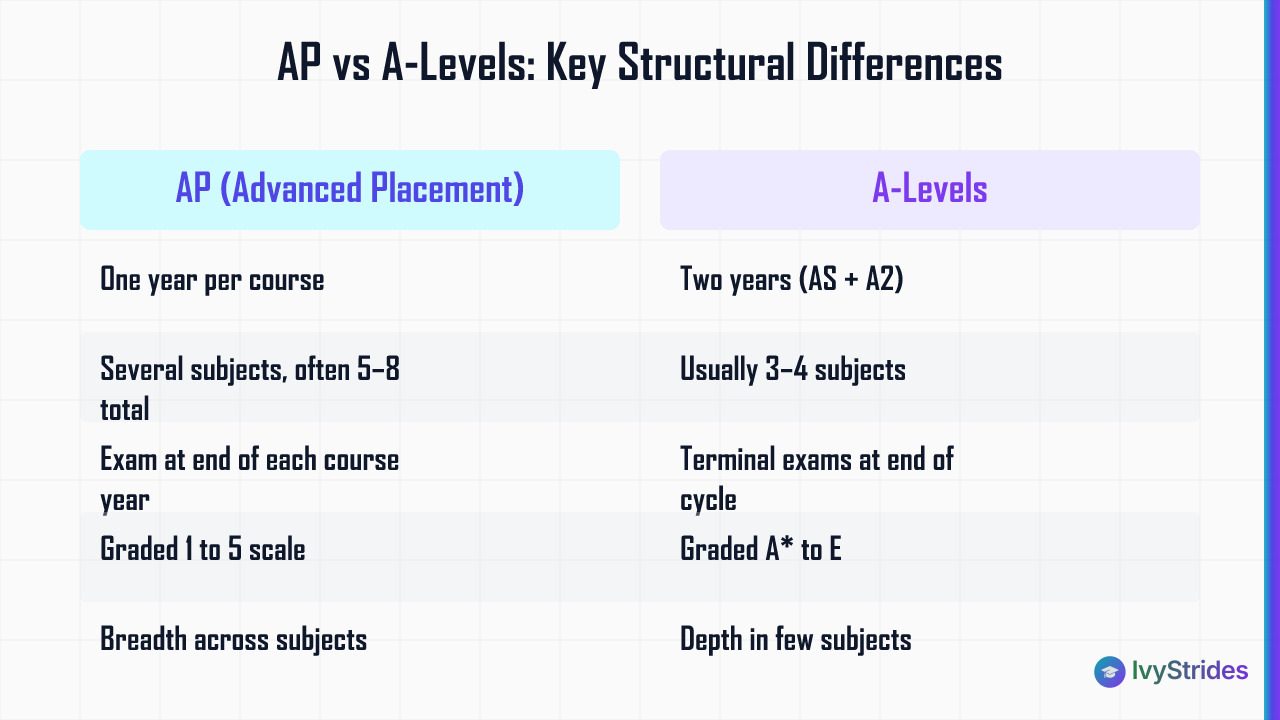
AP is a single-year, course-by-course program; A-levels run over two years in a handful of subjects. Advanced Placement, administered by College Board, lets a student take one AP course in one year, sit its exam in May, and move on. A-levels are the British Advanced Level qualification, studied across an AS-level year and an A2-level year, with subject specialization the whole point.
That two-year cycle changes how each is assessed. A-levels use terminal exams at the end of the second year, so almost everything rides on one exam window per subject. Each AP course ends in its own exam that same academic year, in a format that mixes multiple-choice and free-response sections and varies by subject, per College Board's AP Program.
Breadth versus depth is the structural heart of it. A-level students usually take 3 to 4 subjects and go deep. AP offers 38+ subjects, and a student can accumulate several across grades 9 through 12, going broad. Neither is better in the abstract; they signal different things. For students outside a US school who want to access these courses, our AP courses online walkthrough covers the logistics.
| Feature | AP (Advanced Placement) | A-Levels |
| Administered by | College Board | UK awarding bodies |
| Duration | One year per course | Two years (AS + A2) |
| Subjects taken | Several, often 5 to 8 total | Usually 3 to 4 |
| Assessment | Exam at end of each course year | Terminal exams at end of cycle |
| Grading | 1 to 5 scale | A* to E |
| Design | Breadth across subjects | Depth in few subjects |
| Availability | US schools and online worldwide | UK and international schools |
How AP and A-Level Grading Actually Compare
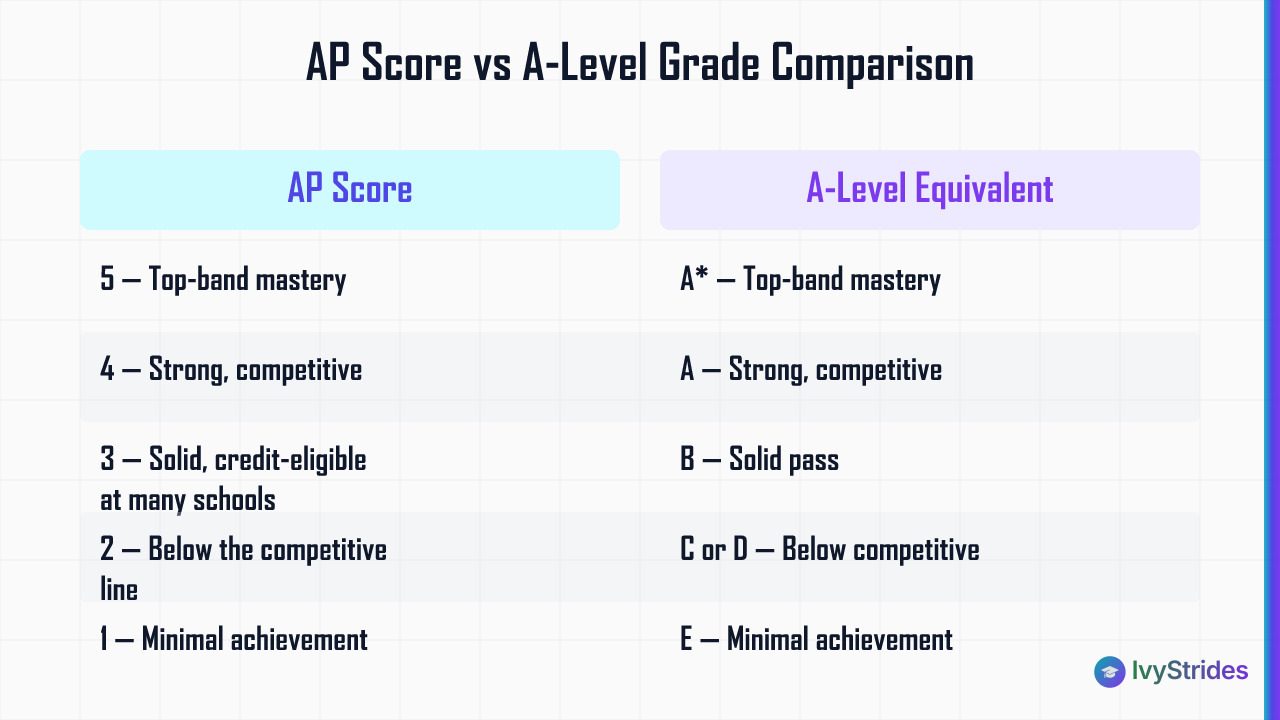
AP uses a 1 to 5 scoring scale; A-levels use A* to E, with U as ungraded. These are separate systems with no official conversion table between them. IvyStrides derives this figure from the inputs cited above. On the AP side, a score of 3 is the common college-credit threshold at many US institutions, while 4 and 5 are the competitive range selective colleges want to see, per College Board's AP Program.
The A-level scale, still built on the same breadth-versus-depth split from the structure above, runs A down through E. An A or A signals the top band of achievement. A B or C passes but reads as less competitive to a selective admissions office. There is no U-earns-credit story: U is ungraded, effectively a fail.
Credit is where AP does something A-levels don't. AP scores of 4 or 5 can earn college credit or advanced placement at many US institutions, though credit policies vary by school and subject. Our guide on whether do colleges accept AP credit covers how thresholds differ. A-levels carry no equivalent standardized credit-transfer mechanism at US colleges.
So how do admissions readers loosely map one to the other? No awarding body publishes this, so treat the table below as a working reference an admissions reader might apply, not an official conversion. The mapping draws on comparative admissions-context framing.
| AP Score | Approximate A-Level Equivalent | What It Signals to US Colleges |
| 5 | A* | Top-band mastery |
| 4 | A | Strong, competitive |
| 3 | B | Solid, credit-eligible at many schools |
| 2 | C or D | Below the competitive line |
| 1 | E | Minimal achievement |
Which Is Harder, AP or A-Levels? The Honest Answer
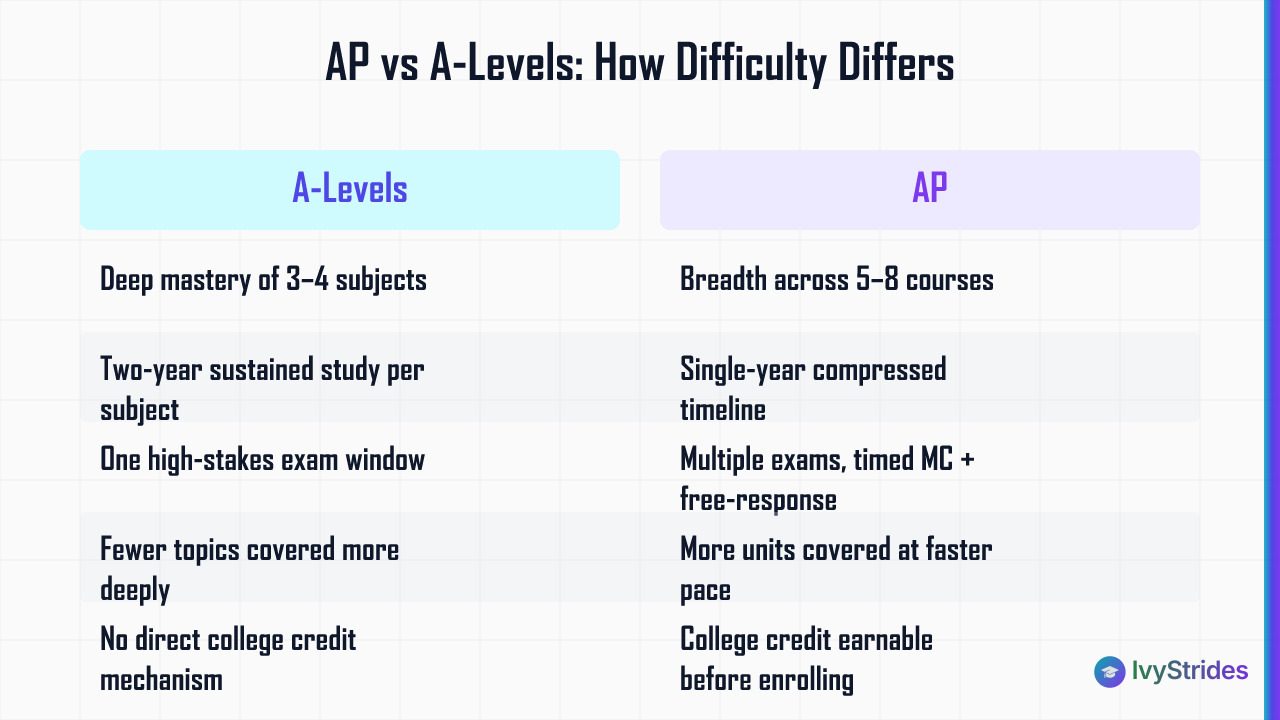
Neither AP nor A-levels is simply harder; they distribute difficulty differently. A-levels go deep in 3 to 4 subjects over two years, so the challenge is sustained mastery and one high-stakes exam window. AP spreads difficulty across more subjects, each compressed into a single year, so the challenge is managing breadth and exam technique under a tighter timeline.
Building on that credit-and-grading distinction, subject-level examples make the split concrete. AP Biology and A-level Biology cover heavily overlapping content, but A-level Biology goes deeper into fewer topics across two years, while AP Biology moves faster through more units in one, per comparative curriculum analysis. The same holds for AP Physics against A-level Physics: depth over time versus pace over one year.
Workload differs too. An A-level student juggles 3 to 4 subjects; an AP student may run 5 to 8 AP courses across high school, sometimes several at once. In our coaching with international students, those coming from A-level backgrounds often find AP exam technique, timed multiple-choice and structured free-response, needs specific preparation even when their content knowledge is already strong. Our guide on how many AP classes to take helps size that load.
| Scenario | Better Fit |
| In a British-curriculum school | A-levels, add AP later |
| In a US or international school with AP | AP |
| Want deep mastery of few subjects | A-levels |
| Want breadth across many disciplines | AP |
| Need college credit before enrolling | AP |
| Can choose freely, target selective US schools | Weigh depth vs breadth against your list |
How US Colleges Read AP and A-Level Transcripts
US colleges read both AP and A-level records as evidence of academic rigor, not as ranked tiers. AP scores sit alongside the course-rigor section of your transcript; strong scores of 4 and 5 mark the competitive range for selective schools, per College Board's AP Program. A-level grades are read holistically, with A* and A treated as the highest level of academic preparation.
No Ivy League school officially states a preference for AP over A-levels or the reverse. Admissions officers evaluate the rigor of whatever program your school offers.
That holistic reading, the same one that treats A* and A as top-band, is exactly why how your curriculum reads on a transcript is one piece of the admissions picture; a college counselor can map your AP or A-level record against your specific target schools. Our how many AP classes for Ivy League guide covers what selective colleges expect. does AP help with college admission answers the direct question.
Rigor survives test-optional. Even at test-optional schools, a strong AP or A-level record remains one of the clearest signals of academic readiness on the transcript, and test-optional policies themselves vary by school and year, per FairTest. Admissions outcomes still depend on the full application, not curriculum choice alone. To map your own record against a specific list, our college admissions counseling service does that work.
| Factor | AP | A-Levels |
| Rigor signal | Course-rigor section, scores 4 to 5 | Holistic, A* and A top-band |
| College credit | Possible at many schools | No standardized mechanism |
| Stated Ivy preference | None published | None published |
| Test-optional relevance | Still a rigor signal | Still a rigor signal |
| Reading method | Scores plus transcript | Holistic evaluation |
Which Path Fits Your Goals: AP or A-Levels?
Your school system decides most of the answer. If you are in a British-curriculum school, A-levels are your primary path, and AP exams are the supplement. If you are in a US or international school with AP access, AP is your primary path. If you can genuinely choose, weigh depth against breadth against your target college list.
Carrying forward that target-list logic, mixing the two is both possible and recognized. Students in A-level programs can register for AP exams independently through College Board, and AP exams are available to international students worldwide, per College Board's AP Program. In our coaching with students supplementing A-level study with AP exams, adding 2 to 3 AP exams in their strongest subjects typically strengthens the rigor signal on a US application without disrupting A-level preparation.
For students who decide AP is the right path, or who want to supplement their A-level studies with AP exams, IvyStrides offers AP courses online with per-subject specialists. Our AP for international and homeschool students guide covers access. AP courses online is the direct next step.
-
Confirm your baseline. Identify what your school offers and how many subjects you can realistically carry.
-
Match to your target schools. Check whether depth or credit matters more for your list.
-
Add strategically. If you sit A-levels, pick 2 to 3 AP subjects where your content is already strong.
FAQ: AP vs A-Levels
Which is harder, A-levels or AP?
Neither is simply harder. A-levels go deeper in 3 to 4 subjects over two years; AP covers more subjects, but each course runs one year. In our coaching, A-level students often find AP exam technique, timed multiple-choice and structured free-response, needs specific preparation even when their content knowledge is strong.
Is AP equal to A-levels?
They are not equivalent programs, but US colleges respect both as evidence of academic rigor. No official conversion table exists. Roughly, an A-level A* or A maps to an AP 5 or 4 in how admissions readers interpret them, though credit policies vary by college and subject.
Does Harvard prefer IB or A-levels?
Harvard does not publish a stated preference for any curriculum. Admissions officers evaluate the rigor of whatever program is available at your school. Strong A-level grades, A* and A, and strong AP scores, 4 and 5, are both read as evidence of top academic preparation.
Can I mix A-level and AP exams?
Yes. Students in A-level programs can register for AP exams independently through College Board. In our coaching with international students, adding 2 to 3 AP exams in your strongest subjects can strengthen the rigor signal on a US application without disrupting your A-level preparation.
Your Next Step on AP vs A-Levels
You now have the structural, grading, and admissions picture. The decision comes down to your school system and your target college list, not to a myth that one program outranks the other.
- If you are in a British-curriculum school, plan your 3 to 4 A-levels first, then consider 2 to 3 AP exams in your strongest subjects.
- If you have AP access, build a course load that shows both breadth and depth.
- Either way, verify credit policy with each target college directly, since it varies by school and subject.

Two decades teaching quantitative and verbal aptitude on standardized tests. Rare dual expertise across Math and Verbal — particularly effective for students with gaps on both sides. Senior AP Mentor for our Calculus and English tracks.