
Do Colleges Still Require the SAT in 2026? The Honest Test-Optional Landscape

On this page
- The Short Answer: Three Policy Categories, Not One Rule
- Test-Required, Test-Optional, and Test-Blind: What Each Policy Actually Means
- Test-Optional Does Not Mean Test-Irrelevant: The Real Risk Families Miss
- Can you go to college without taking the SAT?
- Should You Submit Your SAT Score to a Test-Optional School? A Decision Framework
- Is 1300 a good SAT score?
- Which Colleges Require the SAT or ACT in 2026? Key Categories
- If Your Score Is Not Where It Needs to Be: Realistic Prep Timelines
- SAT, ACT, or Both: Do Colleges Prefer One Over the Other?
- Frequently Asked Questions
- Can you get into college without taking the SAT?
- Is 700 a low SAT score?
- Are colleges going back to requiring the SAT?
- Do community colleges require the SAT?
- Is the SAT required to graduate high school?
- Do colleges accept the SAT or ACT, or do they prefer one?
- How do I send my SAT score to a college?
It depends on the college. For 2026 admissions, US colleges fall into three categories: test-required (you must submit SAT or ACT scores), test-optional (submission is your choice), and test-blind (scores are not considered even if sent). A growing number of selective universities, including MIT, Harvard, Yale, Stanford, and Dartmouth, have reinstated test requirements after the pandemic-era pause. Most four-year colleges remain test-optional, and community colleges almost never require the SAT.
Here's the part most families miss: at selective test-optional schools, the admitted students who did submit scores tended to score above the school's 75th percentile. That's why the rest of this article walks through how to read a school's published score data and build a submit-or-skip decision from there. For background on the current exam itself, see our SAT test 2026 format and dates guide.
The Short Answer: Three Policy Categories, Not One Rule
A college can sit in only one of three buckets for the 2026 admissions cycle.
Test-required means SAT or ACT scores are mandatory. No score, no complete application. MIT, Harvard, Yale, Stanford, Dartmouth, Purdue, and the University of Tennessee are all in this bucket for applicants entering fall 2025 and fall 2026. The score functions as a hard filter in the early stages of review.
Test-optional means submission is your choice. If you submit, the score is read and weighed; if you withhold, the application is reviewed without it. As of late 2025, FairTest tracks more than 1,800 four-year US colleges with active test-optional or test-blind policies, still the majority of accredited four-year institutions. This is the category most families confuse.
Test-blind (sometimes labeled "score-free") means the school will not consider your score even if you mail it. The University of California system is the most prominent example for in-state applicants. This is a small minority of schools.
The exam itself is the Digital SAT, the format administered by College Board since March 2024. It's scored 400-1600 across two adaptive sections, Reading and Writing and Math. For the score scale and percentile context that drives every decision in this article, see SAT score scale and percentiles.
Test-Required, Test-Optional, and Test-Blind: What Each Policy Actually Means
Definitions first, because the wrong mental model here costs families months of misdirected prep.
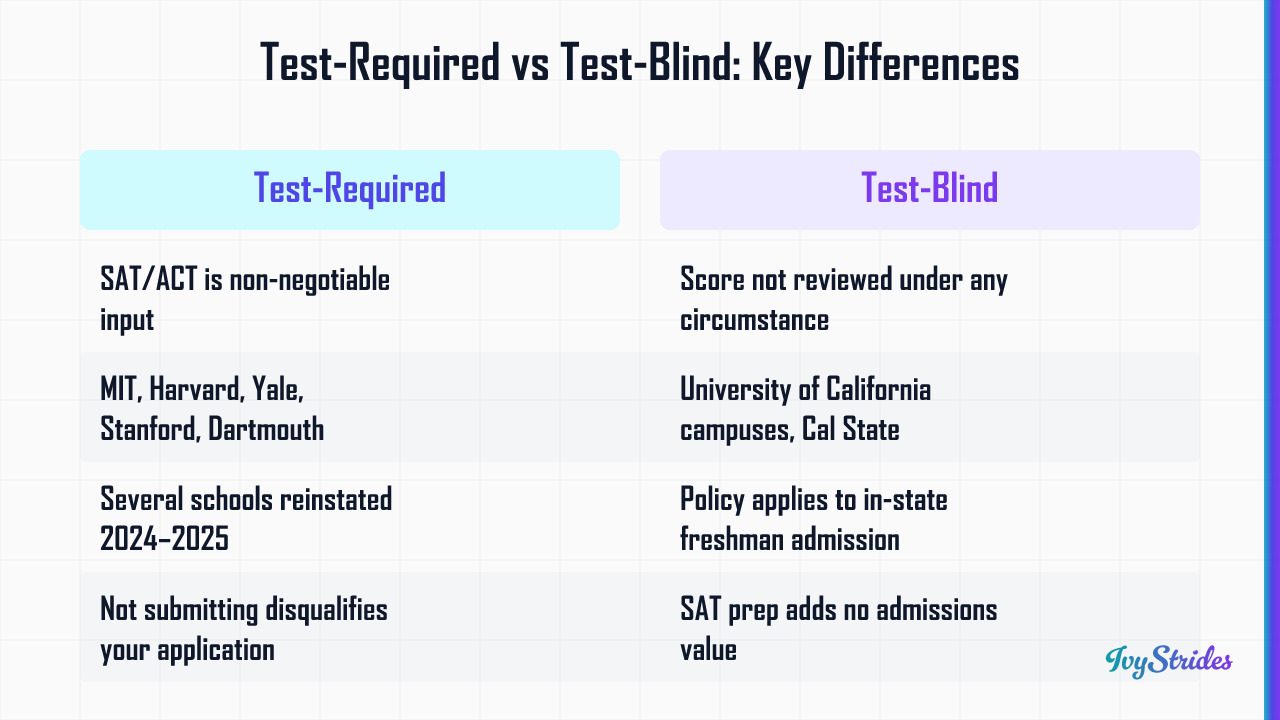
Test-required schools treat the SAT or ACT as a non-negotiable input. The list of high-profile test-required colleges for 2026 includes MIT, Harvard, Yale, Dartmouth, Stanford, Brown, Caltech, Georgetown, Purdue, the University of Tennessee, the University of Florida system, the University of Georgia, and the United States military service academies. MIT reinstated its requirement in 2022 and has held it; for the full picture there, see MIT SAT requirements. Yale, Harvard, and Brown reinstated requirements starting with applicants to the class of 2029 (entering fall 2025). Dartmouth announced its reinstatement in February 2024. Stanford reinstated for 2025-26 applicants.
Test-optional schools still read your score if you send one. This is the line families miss. "Optional" describes the submission decision, not the weight. At selective test-optional schools, a submitted score above the school's 75th percentile is a meaningful positive signal. A score below the 25th percentile is the one you typically withhold.
Test-blind schools will not look at your score under any circumstance. The University of California campuses are test-blind for in-state freshman admission. Cal State campuses operate under the same policy. If you're applying only to UC and CSU, SAT prep adds no admissions value, though a score may still help with course placement or specific scholarship competitions.
One caveat that matters for planning: test-optional is not a permanent designation. Schools have reverted policies between cycles. The reliable workflow is to check each target school's admissions page in the summer before you apply, then again in early fall. FairTest's tracker is a useful starting point; the school's own admissions page is the authoritative source.
Test-Optional Does Not Mean Test-Irrelevant: The Real Risk Families Miss
Look, this is the part most families get wrong, and it costs them.
When a selective school like Vanderbilt or Northwestern is test-optional, the published 25th-to-75th percentile range is calculated only from students who submitted scores. So when you read that Vanderbilt's middle 50% is roughly 1500-1560, that's the band among submitters, not the full admitted class. At highly selective test-optional schools, the majority of admitted students who submitted had scores above the school's 75th percentile.
In our coaching with students applying to schools in the 1450+ submitter-median band, those with scores above the 75th percentile almost always submitted; those below the 25th percentile almost always withheld. The middle band is where judgment, major, and the rest of the application carry the call.
Three factors push toward submitting even at a test-optional school:
-
Major competitiveness. For STEM majors at selective schools, in our coaching score submission rates among admitted students typically run higher than the school-wide average per NACAC's State of College Admission reports. A computer science applicant to a top-30 university is making a different bet than a humanities applicant to the same school.
-
Applicant pool depth. At schools admitting under 20% of applicants per their published Common Data Set Section C2 data, the strongest applications cluster tight. A strong score is a clear positive data point that helps you separate.
-
What a missing score signals. Admissions officers see whether a score was withheld. If your transcript and rigor are borderline, a missing score can prompt the question "what's the score they didn't send?" A solid score, even an unremarkable one, can close that question.
A junior we worked with last fall scored a 1380 and was applying to a school with a 25th-75th range of 1380-1520. Her instinct was to skip, she'd read three Reddit threads telling her not to submit anything under the 75th. We pulled the Common Data Set together, talked through her GPA (3.95 unweighted) and the rigor of her transcript, and submitted the score. The 1380 sat right at the 25th percentile, which at a school with that submitter median signals she belongs academically. Withholding would have raised the unanswered question.
For a deeper read on what counts as solid at your target tier, see good SAT score 2026.
Can you go to college without taking the SAT?
Yes. At test-optional and test-blind schools, you can apply with no score at all. Community colleges almost never require one. Many strong four-year publics and privates remain test-optional. The honest reframe: you can get into a college without an SAT. Whether you can get into your specific target college without one depends on that school's policy and the strength of the rest of your application, which is why the essays carry more weight when no score is in the file. If essays are doing that heavier lift, working with a common app essay tutor is one of the highest-use moves you can make.
A note for international applicants: many US colleges expect SAT or ACT from international students even when domestic students are test-optional. Verify each school's international applicant requirements directly; they're sometimes published on a separate page from the domestic policy.
Should You Submit Your SAT Score to a Test-Optional School? A Decision Framework
The submit-or-skip decision and the prep decision are linked: in our coaching, if your current score sits below a school's published 25th percentile per its Common Data Set Section C2, the question typically isn't whether to submit but whether you have enough time to move the score before your application deadline.
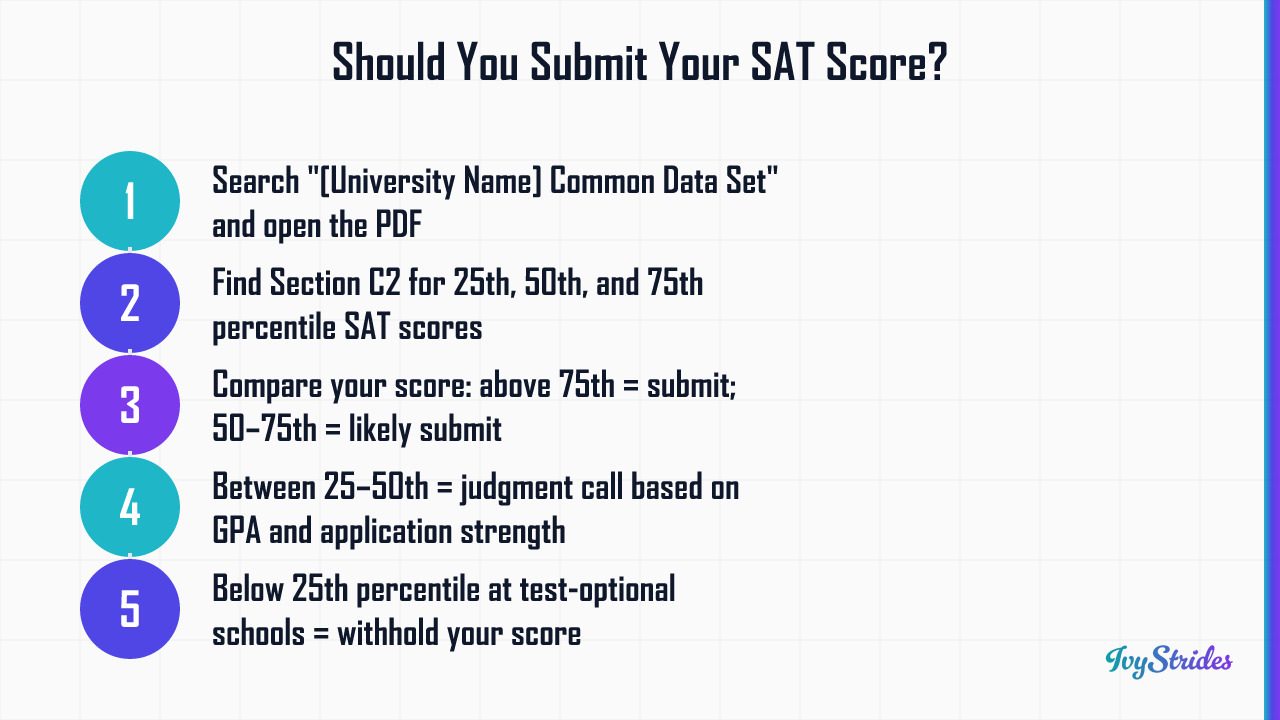
Every college that participates in the Common Data Set publishes its admitted class's 25th and 75th percentile SAT scores in Section C2, and that single table is the most reliable input for your submit decision. To find it, search "[University Name] Common Data Set" and download the most recent year's PDF. Go to Section C, subsection C9 (sometimes labeled C2 depending on the year's template). You'll see SAT total, SAT R&W, and SAT Math reported with the 25th, 50th, and 75th percentiles of enrolled freshmen.
Here's the rule we use in coaching, calibrated against thousands of submit-or-skip decisions:
Working from the published Common Data Set Section C2 percentiles, the decision typically maps as follows:
- At or above the 75th percentile: submit. Your score is a positive signal that lifts the application.
- Between the 50th and 75th percentile: submit at most schools. The score is neutral to mildly positive and signals you can handle the academic load.
- Between the 25th and 50th percentile: judgment call. Submit if the rest of your application is strong and you want to demonstrate consistency. Withhold if your GPA and rigor are already doing the work and the score would drag the average.
- Below the 25th percentile: at test-optional schools, withhold. A score below the 25th percentile is the one signal that almost never helps.
For SAT percentiles at the national level (a separate benchmark from any one school's range), see our score scale guide.
Is 1300 a good SAT score?
A 1300 sits at roughly the 86th percentile nationally per College Board score distributions, which is well above average. Whether it's worth submitting depends entirely on the school. At a school with a 25th-75th range of 1200-1400 (many strong state flagships and mid-tier privates), a 1300 sits near the median and is worth submitting. At a school with a range of 1450-1570 (Vanderbilt, Northwestern, Duke), a 1300 falls below the 25th percentile and should typically be withheld. For the full breakdown, see is 1300 a good SAT score.
One more variable: superscoring. Most schools, including most test-required ones, will take your highest R&W score from one sitting and your highest Math from another and combine them. That changes the math on whether to retest. College Board defines superscore on its SAT score reporting documentation. For students with a strong section and a weak section, a targeted retest on the weaker module can lift the superscore meaningfully. We cover the structured plan in our SAT prep overview.
Caveat: test-optional policies vary by school and year. Always verify on the school's official admissions page in the cycle you're applying.
Which Colleges Require the SAT or ACT in 2026? Key Categories
The reinstatement wave started in 2022 with MIT and picked up real momentum in 2024. Here's the current map by category.
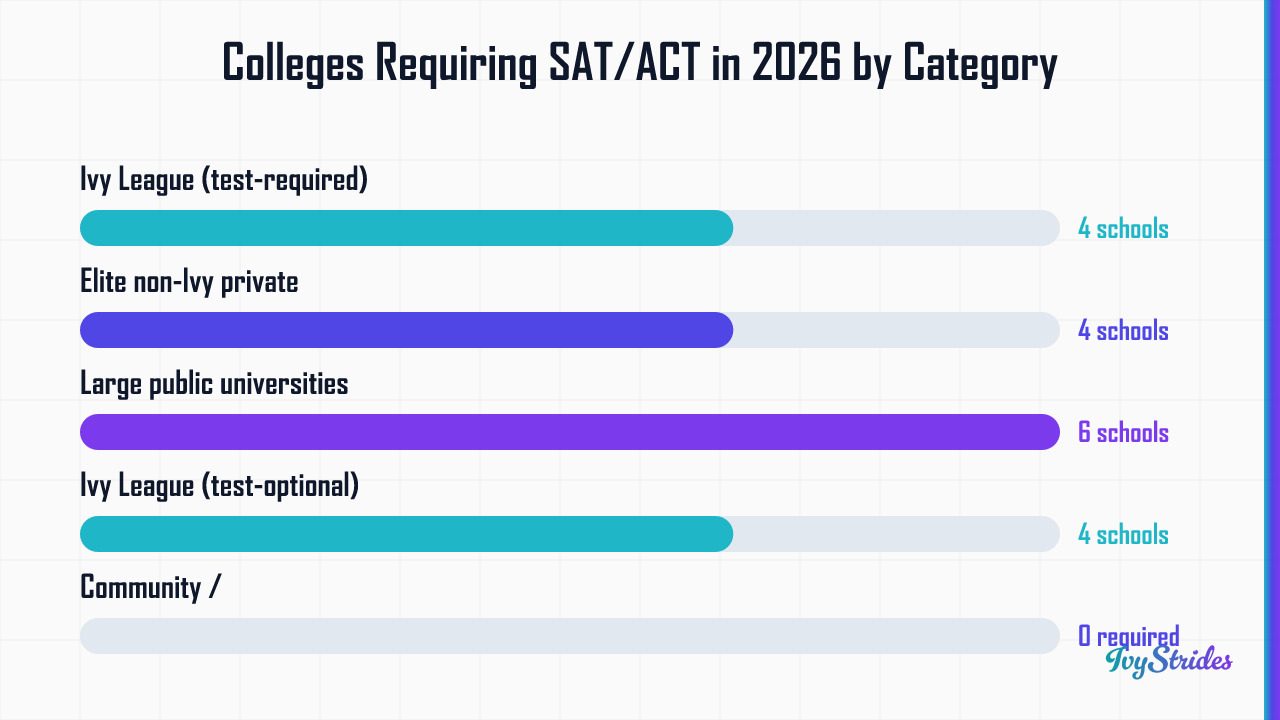
Ivy League and Ivy-adjacent (test-required for 2026):
Harvard reinstated requirements for the class of 2029 applicants (those who applied in 2024-25 for fall 2025 entry). Yale reinstated on the same timeline with a "test-flexible" framing that accepts SAT, ACT, AP, or IB scores. Brown reinstated requirements for the class of 2029. Dartmouth announced its reinstatement in February 2024. For Yale, Brown, Dartmouth, and Harvard, applicants entering fall 2026 must submit. Princeton, Columbia, Cornell, and Penn remain test-optional as of the most recent published policies, though that may change; for the latest on one of them, see UPenn SAT requirements 2026.
Elite non-Ivy private universities (test-required for 2026):
MIT, Caltech (which announced a return to requiring scores starting with the fall 2025 cycle), Stanford, and Georgetown. For Stanford specifically, see Stanford SAT requirements.
Large public universities with active test requirements:
Purdue, University of Tennessee, University of Florida, University of Georgia, Georgia Tech, and Florida State. The University of California system sits in the opposite category: test-blind.
Community colleges and open-enrollment institutions:
The SAT is generally not required for admission. Most use placement tests (such as Accuplacer) to determine course readiness. If your only application targets are community colleges, SAT prep isn't a required investment for admission, though a strong score can sometimes waive placement testing or unlock honors program eligibility.
High school graduation:
No US state requires the SAT to graduate high school. Some states (including Colorado, Illinois, and Michigan) administer the SAT as a free school-day exam to all juniors, but the score isn't a graduation condition.
For applicants targeting the highest-selectivity tier, the score band matters more than the average. For context on what scores compete at Ivy admissions specifically, see is a 1500 SAT score good for Ivy League.
One firm caveat: this list shifts. Verify each school's policy directly on its admissions page before you finalize your application strategy. BigFuture's college search tool (bigfuture.collegeboard.org) lets you filter by test policy, which is useful for first-pass list-building but isn't a substitute for checking the school's own page.
If Your Score Is Not Where It Needs to Be: Realistic Prep Timelines
If your target school is test-required, or if you're aiming to submit at a test-optional school where your current score is below the school's published 75th percentile per its Common Data Set, the next question is how much movement is typically realistic in your timeline.
Start with a real diagnostic. The official College Board Bluebook practice tests are the only fully accurate Digital SAT simulators; take one full-length test under timed conditions before anything else. Our official SAT practice tests library is built around these score-band diagnostics.
In our coaching, typical hour-counts by score band look like this:
- Starting 1100-1200, targeting 1300-1400: in our coaching, typically 60-100 hours of focused practice across 10-16 weeks. Most movement comes from closing 2-3 concentrated skill gaps (often algebra fluency on Math, and inference and main-idea on R&W).
- Starting 1300-1400, targeting 1450+: 40-80 hours across 8-14 weeks, heavily weighted toward the weaker section's Module 2 question types.
- Starting 1450+, targeting 1550+: 30-60 hours focused on the highest-difficulty question types, error pattern analysis, and pacing.
In our coaching with students in the 1100-1200 score band, a full diagnostic consistently reveals 2-3 concentrated skill gaps in either R&W or Math that, when addressed with section-specialist work, account for the majority of score movement. The typical gain across a full diagnostic-driven program in our 1-on-1 work is 200+ points.
The Digital SAT's adaptive structure is part of what makes section-specialist work pay off. Each section has two modules. Module 2 difficulty is set by Module 1 performance. Students who lock in Module 1 accuracy unlock the harder Module 2, where higher scaled scores live. For the full mechanics of how this affects your final score, see how the Digital SAT is scored.
If you have under 5 weeks before test day, a structured plan matters more than total hours. Start with the 30-Day SAT Study Plan 2026. For students who need a custom plan calibrated to a specific weakness pattern, our 1-on-1 SAT prep applies the diagnostic-driven methodology to your specific score band.
Caveat: these hour-counts are typical ranges in our coaching, not guarantees. They depend on starting score, hours invested per week, and consistency week to week.
SAT, ACT, or Both: Do Colleges Prefer One Over the Other?
Every test-required college in the US accepts either the SAT or ACT interchangeably. No major four-year college requires both. No school we've seen gives a preference to one exam over the other on the merits.
So how do you choose? Take a timed diagnostic on each, score them, and convert to a common scale. Some students score meaningfully higher on one format. The ACT's Science section and faster pacing favor certain test-takers; the Digital SAT's adaptive structure and longer per-question time favor others. The decision should be driven by diagnostic results, not assumption.
A few practical notes: the Digital SAT is the only US SAT format as of March 2024. The ACT recently restructured to make the Science section optional and shorten the test for some test dates, but the core composite structure remains. Some schools superscore the SAT but not the ACT, or vice versa; check each target school's superscore policy on its admissions page.
Taking both exams isn't usually worth the time unless your diagnostic scores are close and you want maximum optionality. Pick one, prep it deeply, and submit your strongest result. If you're registering for the first time, see SAT test registration 2026. For budget planning around exam fees and waivers, see SAT fees and waivers 2025-26.
Frequently Asked Questions
Can you get into college without taking the SAT?
Yes, at test-optional and test-blind schools, which represent the majority of US four-year colleges. At test-required schools such as MIT, Harvard, Yale, and Stanford, you must submit SAT or ACT scores. Community colleges and open-enrollment institutions almost never require the SAT. The right answer depends entirely on your target school list.
Is 700 a low SAT score?
The SAT is scored on a 400-1600 scale, so a 700 total is well below average. The national mean score is approximately 1010-1020 per College Board data. A 700 falls below the 10th percentile nationally and below the 25th percentile at virtually every four-year college. Students at this score band benefit most from a full diagnostic to identify the highest-use skill gaps before retesting; see the SAT score scale 2026 for full context.
Are colleges going back to requiring the SAT?
Yes, a significant number of selective colleges have reinstated requirements since 2024. Harvard, Yale, Dartmouth, Brown, Caltech, MIT, and Stanford are among the most prominent examples. The trend isn't universal: most US four-year colleges remain test-optional. Verify each target school's current policy directly on its admissions page, since policies can change between application cycles.
Do community colleges require the SAT?
Community colleges and open-enrollment institutions generally don't require the SAT for admission. Most use placement tests to determine which courses a student is ready for. If you're applying only to community college, SAT prep typically isn't necessary for admission, though a strong score can sometimes exempt you from remedial coursework or qualify you for honors programs and merit scholarships.
Is the SAT required to graduate high school?
No US state requires the SAT as a graduation requirement. Some states administer the SAT as a free school-day exam to all juniors, but passing it isn't a condition of receiving a diploma. The SAT is a college admissions tool, not a high school exit exam.
Do colleges accept the SAT or ACT, or do they prefer one?
All test-required colleges in the US accept either the SAT or ACT interchangeably. No major four-year college requires both. The choice between exams should be based on a diagnostic practice test for each, since some students score meaningfully higher on one format than the other.
How do I send my SAT score to a college?
You send official scores through your College Board account. You can include free score reports when you register or send them after results are released for a per-report fee. For step-by-step instructions, see how to send SAT scores to colleges.
The 2026 admissions landscape typically rewards families who treat the SAT decision as a school-specific question, not a yes-or-no question. Find each target school's policy, pull its Common Data Set Section C2, compare your score, and act on the data. If your score is below where it needs to be and you have time, prep. If it's above the published 75th percentile, submit and move on to the essays.

Kunal writes about Digital SAT and ACT strategy for the IvyStrides blog.