
How to Improve Your SAT Score on a Retake (2026 Playbook)
On this page
- Why Your Score Did Not Move the First Time (and What to Fix Now)
- Not Sure Why Your Score Stalled? Let's Find Out in 15 Minutes.
- Step 1: Set a Score Target and Check Your Superscore Situation
- Step 2: Take a Diagnostic Test Before You Study Anything
- Step 3: Build an Error Log That Actually Tells You Something
- Step 4: Apply Section-Specific Tactics for R&W and Math
- How Many Hours Does It Take to Improve Your SAT Score?
- What Is the Fastest Way to Improve Your SAT Score?
- Score-Band Playbooks: From 1100 to 1600
- When to Consider 1-on-1 Coaching for Your SAT Retake
- FAQ
- What score does a 70% correct rate give you on the SAT?
- Is a 1400 SAT score competitive for Harvard?
- How much can you realistically improve your SAT score by studying?
- Is it worth retaking the SAT if my target schools are test-optional?
- How do I improve my SAT score from 1300 to 1500?
- How to improve your SAT score from 1500 to 1600?
- Your Next Move
- Ready to Turn Your Retake into a Real Score Gain?
To raise your Digital SAT score on a retake, run four moves in order: take a full-length practice test in the Bluebook app under timed conditions, build an error log that names the exact question types you miss, spend most of your hours on those question types in your weaker section, and take at least two more timed practice tests before test day. In our coaching with students at the 1100-1350 band, 40-60 focused hours typically produces 150-200 points of gain. Students in the 1400-1500 band typically need 60-80 hours for a 50-100 point gain. Same process, different timeline.
Format and scoring details below reflect the Digital SAT (post-March 2024) as documented by the College Board. The rest of the article walks the four moves in order, breaks strategy down by score band, then answers the questions parents and students ask most.
Why Your Score Did Not Move the First Time (and What to Fix Now)
If you already studied and the score barely moved, one of three patterns is almost certainly the reason.
The first is passive review. You looked at wrong answers, read the explanation, thought "oh, right, I see it now," and moved on. That's not learning. That's recognition. Recognition disappears under timed pressure. Active review means categorizing the miss (what domain, what question type, what caused the error) and drilling that specific type until you can solve five in a row cold.
The second is studying content you already know. Students default to the topics they like, which are usually the topics they're already strong in. If you're scoring 1280 with 640 R&W and 640 Math, another twenty hours of general math review won't move you. Twenty hours on the two Math domains you actually miss most (usually Advanced Math and Geometry and Trigonometry at this band) will.
The third is ignoring how the adaptive test works. The Digital SAT routes every student into a second module based on Module 1 performance. If you struggle in Module 1, Module 2 is the easier variant and your section score ceiling drops to roughly 650. It doesn't matter how well you do in the easier Module 2. Your ceiling is already set. This is why front-half accuracy matters more than most students realize, and it's a diagnosis nobody catches from just glancing at a score report.
One more pattern: too few full-length timed practice tests. Doing question sets isn't the same as sitting for 2 hours 14 minutes with the exact section timing. Pacing errors only show up under real conditions. For the R&W-specific version of this problem, see why is my sat score not improving.
Not Sure Why Your Score Stalled? Let's Find Out in 15 Minutes.
Book a free strategy call with an IvyStrides SAT coach. We will review your diagnostic results, identify your highest-leverage weak spots, and give you a personalized retake plan, at no cost.
Step 1: Set a Score Target and Check Your Superscore Situation
Before you open a practice test, decide two things: what composite score you actually need, and whether your target colleges superscore.
The Digital SAT is scored on the 400-1600 composite scale, with each section (Reading and Writing, Math) scored 200-800, per the College Board. Percentile context matters here. A 1400 sits around the 94th-95th percentile nationally, which is strong at hundreds of good colleges. It's also below the 25th-percentile SAT cutoff at schools like Harvard (roughly 1580) and MIT (roughly 1570), based on those schools' recent Common Data Sets. If your target is Ivy-tier, your target score isn't "above average." It's above the school's 25th percentile at minimum, ideally near the 75th.
Before you decide which section to prioritize, check whether your target colleges superscore the SAT; if they do, you only need to beat your current best section score on one section, not both, which changes how you allocate study hours. Most selective colleges superscore, which means they take your highest R&W score across all sittings plus your highest Math score across all sittings and combine them. If you scored 680 R&W and 660 Math last time, and your target school superscores, the retake question becomes simple: which section has more upside for the hours you have? Usually that's the weaker section, but not always. A student close to a section ceiling (say, 720+) often has less headroom there than a student sitting at 660.
Test-optional policies vary by school and change year to year; check each college's current policy before deciding whether to submit a retake score. The FairTest tracker is a reasonable starting point, but always confirm on the school's own admissions page. Test-optional doesn't mean scores are ignored. A score above the 75th percentile still helps at a test-optional school. A score below the 25th percentile is generally better withheld.
For percentile context and what counts as a competitive score at different tiers of college, see what is a good SAT score in 2026. If you want a walkthrough of how we build individualized retake plans, our SAT prep overview covers the methodology.
Step 2: Take a Diagnostic Test Before You Study Anything

Photo by Andy Barbour on Pexels
Skipping the diagnostic is the single most common reason retake prep fails. You can't fix what you haven't measured.
The diagnostic must be a full-length Digital SAT taken in the Bluebook app under timed conditions: 2 hours 14 minutes total, 64 minutes for R&W (54 questions across two modules), 70 minutes for Math (44 questions across two modules). Anything less than a full-length in Bluebook doesn't replicate the adaptive routing, which means the score you get isn't representative and the data you pull is incomplete. College Board offers free official practice tests directly through Bluebook. Use those first.
Once you finish, pull three pieces of data:
-
Your section scores. This tells you which section carries more upside for the retake.
-
Your performance broken down by question domain. In R&W, that's Information and Ideas, Craft and Structure, Expression of Ideas, and Standard English Conventions. In Math, that's Algebra, Advanced Math, Problem-Solving and Data Analysis, and Geometry and Trigonometry.
-
Time patterns. Did you rush the last five questions of a module? Did you spend four minutes on a single hard question and lose time downstream?
That third piece almost nobody looks at. It's often the highest-use insight in the whole diagnostic.
For our walkthrough of Official SAT practice tests and how to use them across a prep window, we have a dedicated page. If you're still unclear on section timing and how the modules stack, how long is the SAT walks the full clock.
Step 3: Build an Error Log That Actually Tells You Something
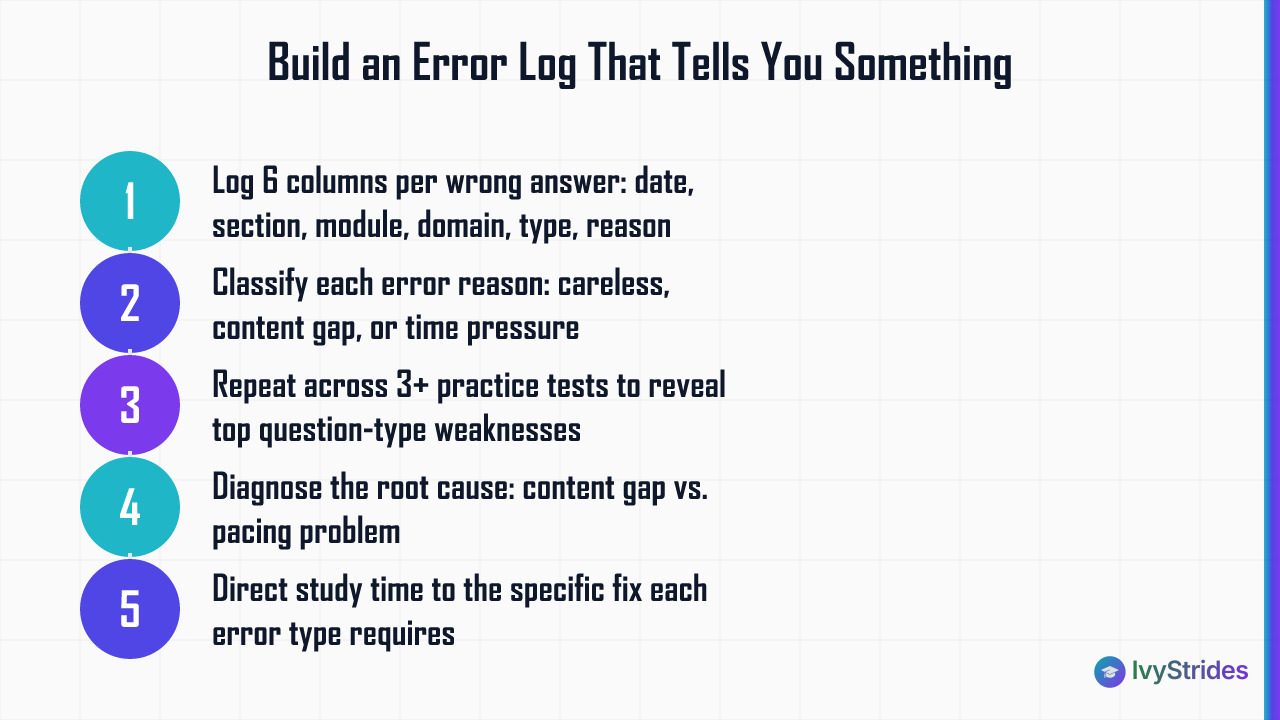
The fastest path to a higher score isn't more practice tests; it's a disciplined error log that turns every wrong answer into a named skill gap you can close before the next test date.
Here's the structure. For every wrong answer, log six columns: test date, section (R&W or Math), module (1 or 2), domain (one of the four per section), question type (transition question, main idea, linear system, data interpretation, and so on), and error reason. That last column is the whole point. Error reason is one of three things: careless error (you knew it, misread it), content gap (you didn't know how to solve it), or time pressure (you rushed or ran out of time).
Categorize wrong answers this way across your first two or three practice tests and a pattern emerges fast. In our coaching, students who maintain a structured error log across at least three practice tests identify their top two or three question-type weaknesses within two weeks. That's exactly where the bulk of targeted study time should go.
The reason this matters: content gaps and pacing problems require completely different fixes. A student who misses eight of ten Algebra questions has a content gap and needs domain-specific instruction. A student who misses three questions across domains in the last five minutes of a module has a pacing problem and needs timing drills, not more content review. Confuse the two and you waste your prep window.
For a downloadable version of the log we use with students, grab the sat mistake tracker. We also wrote a walkthrough on how the log directly produced 100+ point gains in specific student cases: SAT Mistake Tracker: the error-log method behind real 100+ point score jumps.
Step 4: Apply Section-Specific Tactics for R&W and Math
Because the Digital SAT routes you into an easier or harder Module 2 based on your Module 1 performance, your section score ceiling is partly set in the first 27 questions of each section, which makes early-question accuracy a strategic priority, not just a content one.
R&W tactics. The Reading and Writing section runs 54 questions in 64 minutes across two modules, per the College Board. That works out to roughly 1 minute 11 seconds per question. Transitions and rhetorical purpose questions inside the Expression of Ideas domain are high-frequency, high-use, and highly learnable, which makes them the best return on prep time in R&W. Read the question stem before the passage. On any question where the stem specifies what to look for (main purpose, function of the underlined portion, transition choice), knowing the target before you read the passage saves 15-20 seconds per question. Across 54 questions, that math adds up.
Module 1 accuracy is the gateway. A harder Module 2 is required to score above roughly 650 on the section. If you're aiming for a 700+ R&W score, missing four or five questions in Module 1 is the difference between accessing the harder variant and being capped.
Math tactics. The Math section is 44 questions in 70 minutes across two modules, or roughly 1 minute 35 seconds per question. The Desmos graphing calculator is built into Bluebook and available on every Math question. Use it. Linear equations, systems of equations, and quadratics in the Algebra and Advanced Math domains are the highest-frequency items on the test, and many of them are faster to solve by graphing in Desmos than by hand. That said, on quick arithmetic and simple substitution, going to Desmos wastes time. The judgment call: if the algebraic path takes more than 30 seconds to visualize, open Desmos.
Data interpretation questions in Problem-Solving and Data Analysis appear in nearly every form. They reward careful reading of the chart or table, not clever math. Slow down on the setup, speed up on the calculation.
Pacing across both sections. The Digital SAT doesn't penalize guessing. Every unanswered question is a guaranteed zero. A random guess has a 20-25% chance of being correct. Never leave anything blank. If you're running out of time in the last two minutes of a module, mark whatever letter you want on the remaining questions before you go back to work on the one you were stuck on. That habit alone typically adds 10-30 points.
For the full breakdown of Math content, see SAT Math topics for 2026. For R&W, our deep dive on how to improve your SAT reading score covers passage strategy in more detail. Students who plateau on Math specifically often benefit from working with a section-specialist Online SAT Math tutor rather than a generalist.
How Many Hours Does It Take to Improve Your SAT Score?
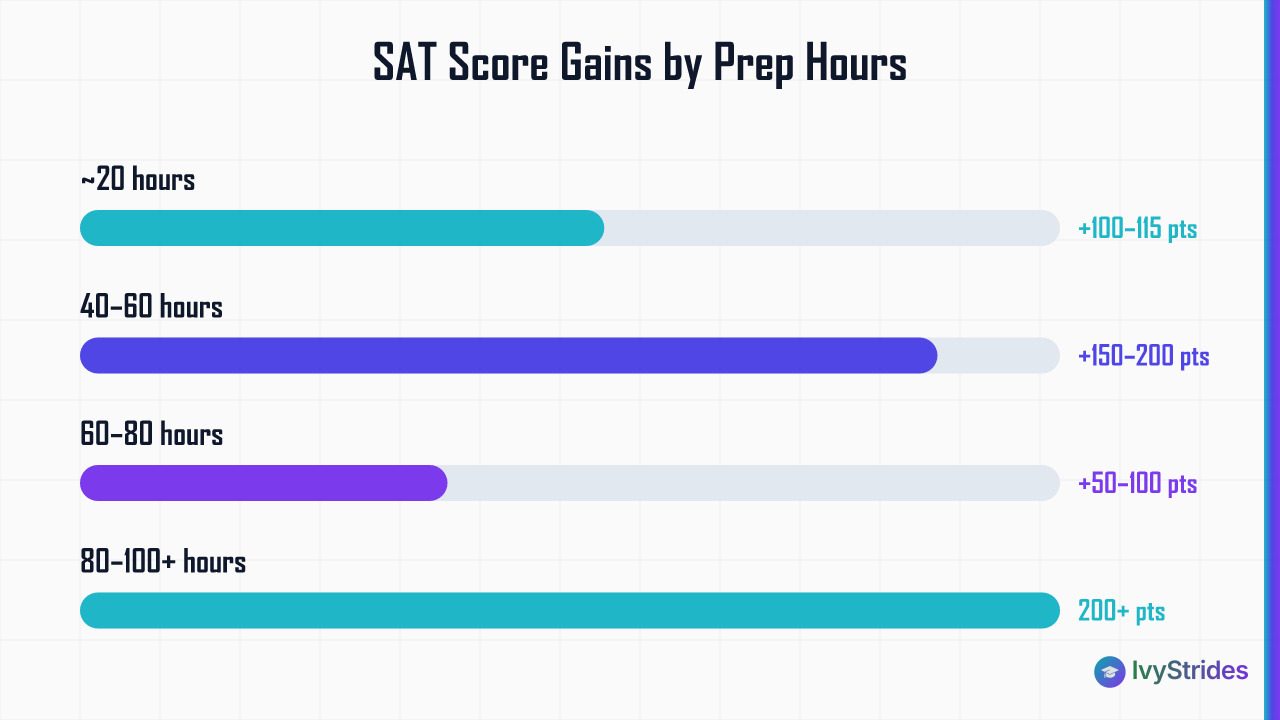
Hours and gains scale together, but not linearly. Here's what we typically see, broken down by starting band:
- Around 20 hours of focused, diagnostic-driven prep: typical gain of 100-115 points, most commonly for students in the 1100-1300 band.
- 40-60 hours: typical gain of 150-200 points for students in the 1100-1350 band. This is the sweet spot for most retake plans.
- 60-80 hours: typical gain of 50-100 points for students in the 1400-1500 band, where marginal improvement gets harder.
- 80-100+ hours: 200+ point gains typical for students completing a full structured program from a starting point below 1300, and where meaningful gains above 1500 usually live.
Notice what this means. Above 1500, hours-per-point roughly doubles. That's not because students get lazy. It's because you've already fixed the high-use weak spots and what remains are the hardest question types and near-perfect execution.
For a realistic prep window, plan on roughly 6-8 weeks minimum between diagnostic and retake. Any shorter and you won't fit in the 2-3 full-length timed practice tests you need to correctly gauge progress and adjust. Space those practice tests across the window (say, week 1, week 4, week 7), not all at the end. The point of the middle test is to update your error log and redirect your remaining hours.
For a week-by-week schedule, our 30-Day SAT Study Plan to boost your SAT score fast breaks down exactly what to do each day.
What Is the Fastest Way to Improve Your SAT Score?
Look, if your retake is in a week or two, you can't chase a 200-point gain. But you can typically capture 30-60 points if you focus on three specific things.
First, fix easy misses before you touch hard questions. If you're scoring 1200, questions at the 1100-1250 difficulty level are your highest-use targets. Not the hardest questions on the test. The ones you should have gotten. Go back through your last two practice tests, pull every wrong answer where your first reaction on review was "wait, that was easy, I just misread it," and drill that pattern. In our coaching, students who focus one week entirely on eliminating easy misses typically gain 30-60 points, especially if they also have pacing problems.
Second, eliminate blank answers. Every unanswered question is a zero. A random guess is roughly 20-25% likely to be correct. If you left even five questions blank on your last SAT, that's potentially 20-40 lost points on pure math. This is the single fastest fix on the test.
Third, stop time-bleeding on hard questions in Module 2. Spending four-plus minutes on one hard question costs you two or three easier questions later. That's a net score loss every time. Set a hard rule: if a question isn't moving after 90 seconds, mark it, guess, and move on. Come back if time allows.
Be honest with yourself about the ceiling here. One week of focused prep can typically move a score 30-60 points for students with clear pacing or easy-miss problems. It won't produce a 200-point gain. If that's what you need, you need weeks, not days.
For the week-before scenario in detail, see last-minute SAT tips. For the guessing math, we broke down the full case in should you guess on the SAT.
Score-Band Playbooks: From 1100 to 1600
Retake strategy changes materially by starting band. Same test, different limiting factor.
1100-1300 band. Content gaps are the primary limiter here. Students in this band typically have significant content gaps in at least two Math domains (most commonly Advanced Math and Geometry and Trigonometry) and struggle with Craft and Structure questions in R&W. The path to 1300-1400 is 40-60 hours of targeted content work, weighted toward whichever section has more gap. Don't try to master pacing before you master content. It won't stick.
1300-1450 band. Students here usually know the content but misapply it under time pressure or misread question-type requirements. Error-log analysis at this band typically reveals two or three recurring question-type errors that account for 60-70% of wrong answers. The playbook: identify those two or three types, drill them until you can solve five in a row cold, then run timed practice sections to build pacing. If this is your starting band, see is a 1300 a good SAT score for context on where a retake gets you.
1450-1550 band. Gains here require mastering the adaptive module routing. You must perform well enough in Module 1 to access the harder Module 2, then execute cleanly on the hard question types that appear only in that harder variant. This band typically requires 60-80 hours and close attention to the specific question types that appear only in the harder Module 2. Section-specialist coaching starts to pay off meaningfully at this level, because the tactics for the hard R&W variant are genuinely different from the tactics for the easier variant.
1550-1600 band. Gains of 30-50 points at this level require near-zero careless errors and the ability to solve the hardest 5-8 questions per section reliably. This is where section-specialist coaching has the highest marginal value. A student in this band without a Math specialist watching their work is usually leaving 20-40 points on the table from misdiagnosed content weaknesses. See is 1540 a good SAT score for context on how this band reads to admissions officers.
When to Consider 1-on-1 Coaching for Your SAT Retake
Self-study works for many students. It stops working when a few specific signals show up.
Three signals that indicate you've plateaued:
-
Your score hasn't moved more than 30 points across two full-length practice tests despite 20+ hours of study.
-
You can't clearly identify which two or three question types you miss most.
-
You're consistently running out of time in Module 2 across multiple practice tests.
Any one of these means the self-directed loop isn't closing the gap. Two or three of them together means you need a coach who can watch your work in real time.
Here's the part most students miss: the section-specialist model matters more than the tutor's raw score. An R&W specialist coaches only R&W. They know the exact passage structures and wrong-answer patterns in the harder Module 2 variant. A Math specialist knows which Advanced Math question types separate a 1400 from a 1500. A generalist tutor who claims to coach both sections is almost always weaker in one of them, and you'll feel it. IvyStrides' 1-on-1 SAT prep starts every student with a diagnostic practice test and builds the plan from that data, not from a generic curriculum. To see the coach roster and their score-band specializations first, meet our SAT coaches. For the bigger picture on how we coach the test differently, our about IvyStrides page lays out the approach.
FAQ
What score does a 70% correct rate give you on the SAT?
The SAT isn't graded as a percentage. Answering roughly 70% of questions correctly (approximately 68 of 98 total questions) typically produces a composite score in the 1200-1250 range, depending on which specific questions you answer correctly and how the adaptive module routing shakes out. The College Board uses a scaled scoring system on the 400-1600 range, not a raw percentage.
Is a 1400 SAT score competitive for Harvard?
A 1400 sits below Harvard's 25th-percentile SAT score, which is near 1580 based on recent Common Data Sets. Nationally a 1400 is a strong score (roughly the 94th-95th percentile) and competitive at many excellent universities, but it isn't a competitive SAT score for Harvard specifically. College admissions depend on the full application, so a 1400 combined with unusual strengths in essays, coursework, or extracurriculars isn't automatically a rejection at any school. It just isn't the score that puts Harvard in reach on its own.
How much can you realistically improve your SAT score by studying?
In our coaching, 20 hours of focused, diagnostic-driven practice typically gains 100-115 points. 40-60 hours typically produces 150-200 point gains for students in the 1100-1350 band. Gains above 1450 are harder and typically require 60-80+ hours with section-specialist coaching. The key variable isn't total hours. It's whether those hours are aimed at actual weak spots identified by an error log, rather than general re-studying of familiar content.
Is it worth retaking the SAT if my target schools are test-optional?
It depends on your current score relative to each school's middle 50% range. If your score is below the 50th percentile for a school, a strong retake score can meaningfully strengthen your application even at test-optional schools, because submitting a score above the 75th percentile is generally an advantage. A stronger SAT score matters most when it moves you above a college's 75th-percentile threshold; below that ceiling, the essay and course rigor carry significant weight alongside the score. Test-optional policies vary by school and change year to year, so confirm each college's current policy before submitting or withholding.
How do I improve my SAT score from 1300 to 1500?
A 200-point gain from 1300 to 1500 is achievable for students who commit 40-60 focused hours over 8-12 weeks. Start with a full-length diagnostic to identify the specific question types and domains driving the gap. Then run targeted content work on those areas, followed by at least two full-length timed practice tests before the retake. Most students in this band have a mix of Math content gaps (commonly Advanced Math) and R&W question-type errors (commonly Craft and Structure). See is a 1500 SAT score good for Ivy League admission for context on what a 1500 actually opens up.
How to improve your SAT score from 1500 to 1600?
This is the hardest band on the SAT. Students here typically need 60-80+ hours, section-specialist coaching, and the ability to solve the hardest 5-8 questions per section that appear only in the harder Module 2 variant. The primary limiters at this level are careless errors on medium-difficulty questions and inconsistent access to the harder Module 2. Students who pair a rising SAT score with strong AP exam results send a consistent academic-rigor signal across their entire application, which is the strategy IvyStrides coaches across both programs. A section-specialist coach who knows the exact question types in the hard Module 2 variant provides the highest marginal value at this score level.
Your Next Move
A better retake score isn't about studying harder. It's about studying the right things in the right order. Diagnostic first, error log second, targeted weakness work third, timed practice tests fourth. Follow that sequence, put in the hours your band requires, and the score moves.
Ready to Turn Your Retake into a Real Score Gain?
IvyStrides' section-specialist SAT coaches start every student with a diagnostic practice test and build a plan around your actual weak spots, not a generic curriculum. Students and parents worldwide book a free 15-minute strategy call to get a personalized roadmap.

Award-winning author (South Asian Book Award) and graduate of BITS Pilani and UCLA Luskin School of Public Affairs. Brings a published writer's eye to Common App essays and grammatical precision to SAT and ACT R&W instruction.