
Is AP a Certification? What You Actually Earn from AP (and What Colleges Really See)
On this page
- AP Is Not a Certification: What the Program Actually Awards
- The Three AP Scholar Award Tiers: Requirements at a Glance
- Does the AP Scholar Award Actually Matter to Colleges? An Honest Answer
- Beyond the Scholar Award: AP Capstone Diploma and AP with WE Service Recognition
- How to Position Yourself for the Highest AP Award Your Schedule Allows
- How AP Recognitions Fit Into Your Broader Admissions Strategy
- FAQ
- Is a score of 3 on an AP exam considered good, and does it count toward awards?
- How do you know if you earned an AP award, and when does it show up?
- Is the AP Scholar Award worth listing on college applications?
- What is the AP with WE Service Recognition and how is it different from the AP Scholar Award?
- Are AP exams harder than the SAT?
- How many AP exams do you need to take to be competitive at Ivy League schools?
- Where This Leaves You
AP isn't a certification. It's an academic program run by College Board that awards score-based recognitions to high school students. The main one is the AP Scholar Award, which comes in three tiers: AP Scholar (score of 3 or higher on three or more AP exams), AP Scholar with Honor (average score of at least 3.25 across all AP exams taken and scores of 3 or higher on four or more exams), and AP Scholar with Distinction (average of at least 3.5 and scores of 3 or higher on five or more exams). A separate credential, the AP Capstone Diploma, is available at participating schools.
Every threshold below is drawn from College Board's official awards and recognitions pages, linked throughout. The harder question, and the one this article really answers, is what colleges actually do with those recognitions when they read your file.

AP Is Not a Certification: What the Program Actually Awards
Terminology first. In the professional world, a certification is a credential you earn from a licensing body: CPA, PMP, and so on. The College Board AP Program is different. It's a set of college-level courses and standardized exams taken during high school. Scores range from 1 to 5. Awards are granted automatically based on those scores and appear on the official AP score report inside a student's College Board account.
There's no license, no expiration date, and no separate application. You don't "get certified" in AP Biology by scoring a 5. You earn a 5, that score sits on your AP score report, and colleges see it when your report is sent.
A quick disambiguation, because search results are messy: if you landed here looking for an accounts-payable credential or a technical-board exam from another country, this isn't that. This article is about the College Board Advanced Placement Program for U.S. and international high school students.
For students already enrolled in AP coursework and wondering how to pull more score out of the year, our ap courses online run per-subject with specialist teachers.
The Three AP Scholar Award Tiers: Requirements at a Glance
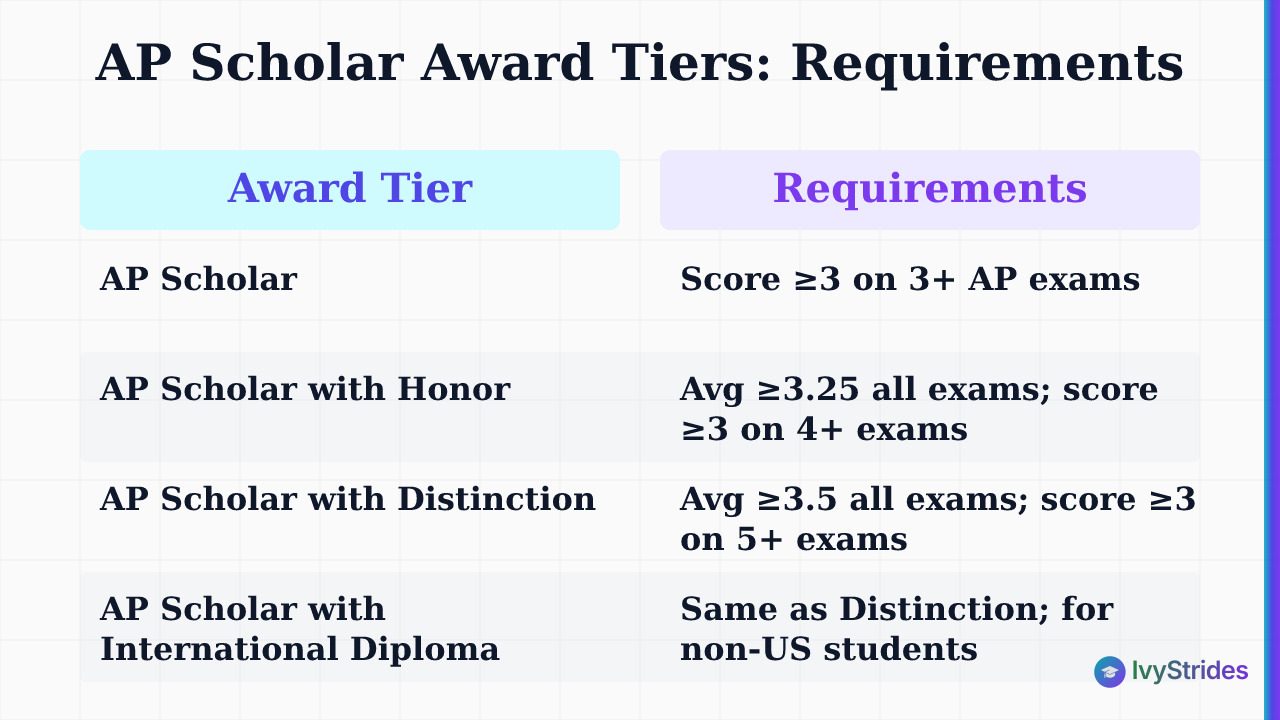
Scholar Awards are granted each fall after College Board finalizes May exam scoring. Students don't apply. If your scores clear the threshold, the award appears on your score report and you can print a certificate from the AP score portal at apstudents.collegeboard.org.
The exact requirements, direct from College Board:
- AP Scholar: score of 3 or higher on three or more AP exams.
- AP Scholar with Honor: average score of at least 3.25 on all AP exams taken, with scores of 3 or higher on four or more of those exams.
- AP Scholar with Distinction: average score of at least 3.5 on all AP exams taken, with scores of 3 or higher on five or more exams.
Two things worth noting. First, the average is calculated across every AP exam you've taken, not just the ones from the current year. A 2 you scored as a sophomore counts against your average when senior-year awards are calculated. Second, the score-of-3 threshold applies to the exam count, not the average. You can technically hit AP Scholar with Distinction with a mix of 3s, 4s, and 5s as long as the average lands at 3.5 or higher.
There's also the AP Scholar with International Diploma, awarded to students outside the United States who meet the AP Scholar with Distinction criteria on the same College Board scale. It appears on the AP score report the same way.
If you're also chasing the National Merit Scholarship, your PSAT Selection Index score operates on a parallel recognition track to AP Scholar Awards; our guide on how does National Merit work walks through both pathways side by side.
Does the AP Scholar Award Actually Matter to Colleges? An Honest Answer
Here's the part most students want to know and most blog posts dance around: is this award a real admissions signal, or a line nobody reads?
The honest answer depends on the tier and the school.
AP Scholar with Distinction carries real weight. Requiring a 3.5 average across every AP exam you've taken plus scores of 3 or higher on at least five exams means you can't fake it with one or two strong subjects. It signals genuine multi-subject college-level performance, which is exactly what selective admissions committees are trying to verify from a transcript. In our coaching with students applying to selective schools, AP Scholar with Distinction is a meaningful differentiator when paired with 4s and 5s on the underlying exams.
AP Scholar with Honor is a solid credential, especially for students who took four AP exams and scored well across them.
AP Scholar (the base tier, three exams at 3 or higher) is less differentiating at highly selective schools. It's accurate and appropriate to list, but if you're applying to schools where the admitted class averages roughly eight to twelve AP courses, three exams at a passing score isn't a distinguishing signal on its own.
Look, the bigger point is easy to miss: admissions officers at selective schools see your individual AP scores on the score report, not just the award label. A 5 on AP Physics C or AP Chemistry carries more admissions signal than the AP Scholar label on its own. The award is a summary. The underlying scores are the substance.
AP awards belong in the Honors section of the Common App, not the Activities section. List them accurately (AP Scholar with Distinction, 2025, for example) and let the underlying scores do the heavier work.
Two caveats you should hear directly. First, test-optional policies vary by school and year; check FairTest for current status. A strong AP Scholar recognition doesn't substitute for a competitive SAT or ACT score at test-requiring schools. If you're weighing how much testing still matters, our post on how much does the SAT matter for college admission walks through the current landscape. Second, admissions outcomes depend on the full application. If your AP story is strong, our essay review service helps students frame it in the supplementals.
Beyond the Scholar Award: AP Capstone Diploma and AP with WE Service Recognition
Two other AP recognitions exist, and both confuse students because they're structurally different from the Scholar Awards.
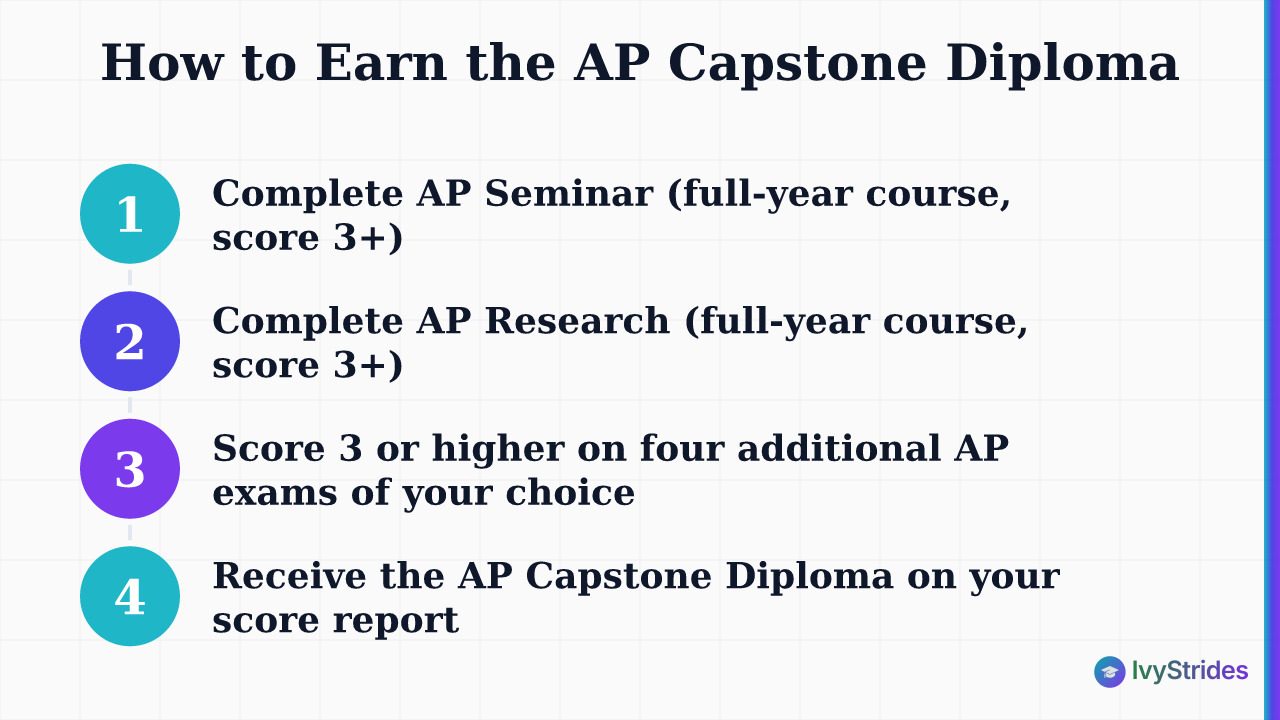
The AP Capstone Diploma is a curriculum-based credential, not a score-average threshold. To earn it, a student must:
-
Complete AP Seminar and AP Research (two full-year AP courses focused on research, argumentation, and academic writing) and score 3 or higher on both.
-
Score 3 or higher on four additional AP exams of the student's choosing.
Students who complete AP Seminar and AP Research but not the four additional exams earn the AP Seminar and Research Certificate instead. Full requirements are documented at College Board's AP Capstone page.
The catch: AP Capstone is only offered at schools that participate in the program. If your high school doesn't offer AP Seminar and AP Research, this credential isn't accessible to you, and that's not a mark against your application. Some colleges specifically flag AP Capstone as evidence of research and writing skills, which can matter for students applying to humanities-heavy or research-oriented programs.
The AP with WE Service Recognition combines an AP course with a service project completed through the WE Schools program. It appears on the AP score report alongside any Scholar Awards, and it isn't tied to a specific score threshold on the underlying AP exam. Like AP Capstone, it's only available at participating schools. If your school is a WE School and you're already taking APs, it's a modest but legitimate addition to the Honors section.
Both credentials sit alongside your Scholar Awards on the score report, not instead of them. If you're choosing which AP subjects to add for the Capstone's four-exam requirement, high-signal STEM options like AP Chemistry prep and AP Calculus AB tend to carry the strongest admissions signal.
How to Position Yourself for the Highest AP Award Your Schedule Allows
Now the practical part. Let's do the math.
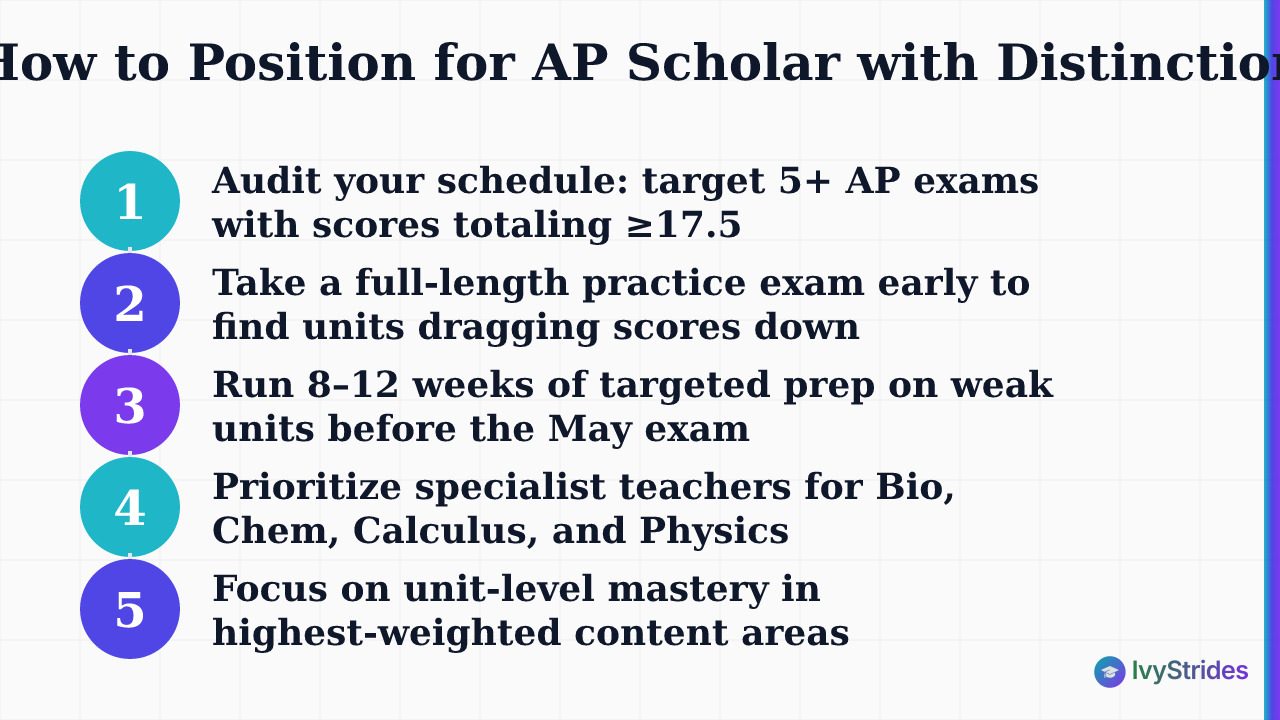
To earn AP Scholar with Distinction, a student taking five AP exams needs an average of 3.5 or higher. That means the five scores must total at least 17.5. Possible combinations: five 4s (average 4.0, easy clearance), four 4s and one 3 (average 3.8), three 4s and two 3s (average 3.6), or two 5s, one 4, and two 3s (average 3.8). A single 2 in the mix is brutal, though. Four 4s and one 2 gives you an average of 3.6 and clears the threshold, but three 4s, one 3, and one 2 gives you 3.2 and drops you to AP Scholar with Honor territory at best.
In our coaching with students targeting AP Scholar with Distinction, the most common gap is one or two subjects where the student scored a 2 instead of a 3, pulling the average below 3.5. This is almost always fixable with a diagnostic-driven prep cycle. A full-length practice exam early in the year identifies which units are dragging the score down, and roughly 8 to 12 weeks of targeted work on those units before the May exam is typically the most efficient path to a 3 or higher.
The subjects where a specialist teacher (not a generalist) tends to make the largest score difference in our coaching cohorts are AP Biology, AP Chemistry, AP Calculus AB/BC, and AP Physics. These are content-dense exams with distinct unit structures and free-response conventions that reward a teacher who runs the same course every year. General "AP tutors" who bounce across subjects rarely have the same depth on, say, AP Chemistry's electrochemistry unit or AP Calculus BC's parametric and polar functions.
Earning AP Scholar with Distinction requires a 3 or higher on at least five exams, which means your prep plan across subjects matters as much as your course selection; our ap prep courses are built around exactly that multi-subject strategy. If you're auditing your schedule now, AP Biology prep and AP Calculus AB/BC prep are two of the most common weak links we see. High-stakes subjects like AP Chemistry often determine whether the average score clears the 3.5 threshold.
Honestly, one caveat on the AP grading scale itself: roughly what percentage correct maps to a 5 varies by subject and year. On some exams a raw score in the mid-70s clears a 5; on others it's higher or lower. College Board sets the cut points annually, so no one can hand you a guaranteed percentage target. What you can control is unit-level mastery on the highest-weighted content areas.
How AP Recognitions Fit Into Your Broader Admissions Strategy
Zoom out. Where does the AP award sit in a full application?
On the Common App, AP awards are entered in the Honors section, not Activities. Format them as the award name, granting organization (College Board), and year. Admissions officers reading your file already see your AP course list on the transcript and your AP scores on the official score report, so the Honors entry is a summary, not a reveal.
AP scores and SAT scores are separate data points in an admissions file; a strong AP Scholar recognition doesn't substitute for a competitive SAT score at test-requiring schools. This is worth repeating because it's the single most common misconception we hear from families. Admissions officers use AP performance to verify course rigor and subject mastery. They use SAT or ACT scores to compare students on a standardized scale. The two do different jobs.
For students focused on the National Merit path in parallel, our guide on what PSAT score do you need for National Merit explains how the Selection Index works state by state. If you're wondering how to reference your AP subject cluster in a supplemental essay, the story behind why you chose those specific AP subjects can strengthen the writing; our guide on how to structure your personal statement covers how to weave academic achievement into a compelling narrative without turning it into a resume recitation.
Two final caveats:
- AP credit policies vary by college. A 4 on AP Language earns credit at one school and does nothing at another. Verify each target school's policy at College Board's AP credit search tool.
- Test-optional policies vary by school and year. Don't assume last cycle's policy applies to this cycle. Check FairTest or the school's admissions site directly.
In our coaching with students applying to Ivy-level schools, we recommend pairing AP Scholar with Distinction with a competitive SAT prep or ACT score rather than treating the AP award as a substitute for standardized testing. The strongest applications compound signals. They don't swap one for another.
FAQ
Is a score of 3 on an AP exam considered good, and does it count toward awards?
A 3 is the minimum passing score on the AP 1-5 scale and is the threshold required for all AP Scholar Award tiers. It counts toward AP Scholar Award eligibility and earns college credit at many schools, though selective universities typically prefer 4s or 5s. If you're aiming for AP Scholar with Distinction, a stack of multiple 3s alone won't clear the 3.5 average; you'll need at least a couple of 4s or 5s to balance the ledger.
How do you know if you earned an AP award, and when does it show up?
AP Scholar Awards are granted automatically each fall by College Board after May exam scores are finalized. Students don't apply. The award appears on the official AP score report in the student's College Board account, and students can view and print a certificate by signing in at apstudents.collegeboard.org. There's no separate mailed notification and no email badge; the score report is the record of truth.
Is the AP Scholar Award worth listing on college applications?
Yes, especially AP Scholar with Distinction and AP Scholar with Honor, because they signal multi-subject college-level performance with a quantifiable threshold. List them in the Honors section of the Common App. The base AP Scholar tier is less differentiating at highly selective schools but is still accurate and appropriate to include. In our coaching with students, we advise listing the award accurately and letting the underlying AP scores, which colleges also see, carry the heavier weight.
What is the AP with WE Service Recognition and how is it different from the AP Scholar Award?
The AP with WE Service Recognition combines AP coursework with a community-service project completed through the WE Schools program. It isn't a tier of the AP Scholar Award and doesn't require a specific AP score threshold; it requires participation in a qualifying WE Schools project alongside an AP course. It appears on the AP score report alongside any Scholar Awards a student has earned and is only available at schools that participate in WE Schools.
Are AP exams harder than the SAT?
They test different things, so a direct difficulty comparison isn't clean. AP exams are subject-specific and test deep content knowledge in a single discipline; AP Chemistry, for example, covers stoichiometry, thermodynamics, and electrochemistry across multiple free-response questions in a single sitting. The Digital SAT tests general reasoning across reading, writing, and math with adaptive modules and heavier pacing pressure. Most students find AP exams more content-intensive and the SAT more strategically demanding. Both reward deliberate preparation.
How many AP exams do you need to take to be competitive at Ivy League schools?
There's no official AP exam requirement at any Ivy League school. Based on publicly available Common Data Set information, admitted students at highly selective schools typically complete somewhere between eight and fourteen AP courses across high school, though the number varies significantly by school and by applicant profile. Quality and scores matter more than raw count. A student with five AP exams at 4s and 5s is generally stronger than one with ten at 2s and 3s, and admissions officers do account for AP availability at each high school.
Where This Leaves You
AP isn't a certification, but the recognitions it awards, particularly AP Scholar with Distinction and the AP Capstone Diploma, are real admissions signals when paired with strong individual scores and a rigorous transcript. The work now is to look at your current AP schedule, run the average, and decide whether one or two targeted subject-prep cycles could move you into the next tier before your applications go out.

Two decades teaching quantitative and verbal aptitude on standardized tests. Rare dual expertise across Math and Verbal — particularly effective for students with gaps on both sides. Senior AP Mentor for our Calculus and English tracks.