
Is Caltech Early Action Worth Giving Up MIT Early Action?
On this page
- What Caltech REA Restricts and What It Leaves Open
- Caltech REA Deadlines and Decision Timeline for Fall 2027
- Which Profile Makes Caltech REA the Right Call
- What Happens to Your MIT Application If You Choose Caltech REA
- FAQ: Caltech REA and the MIT Early Action Decision
- Does Caltech have restrictive Early Action?
- Does Caltech have a GPA cutoff?
- Does MIT reject Early Action?
- Your Next Step on the REA Decision
Caltech Restrictive Early Action is a non-binding early plan that bars Early Action and Early Decision at other colleges, with a few exceptions such as public universities, so it rules out MIT Early Action. For fall 2027 entry, both schools closed their early rounds on November 1, 2026, and both release early decisions in mid-December. MIT EA is non-restrictive, so it alone would not block Caltech Regular Decision, due January 4, 2027.
That asymmetry is the whole decision. If you applied early this fall, the live question is what a deferral or a Regular Decision file needs by January 4, 2027. If you are a junior planning next fall, the trade-off is only worth taking if Caltech is your clear first choice and your file can be ready by its early deadline.

What Caltech REA Restricts and What It Leaves Open
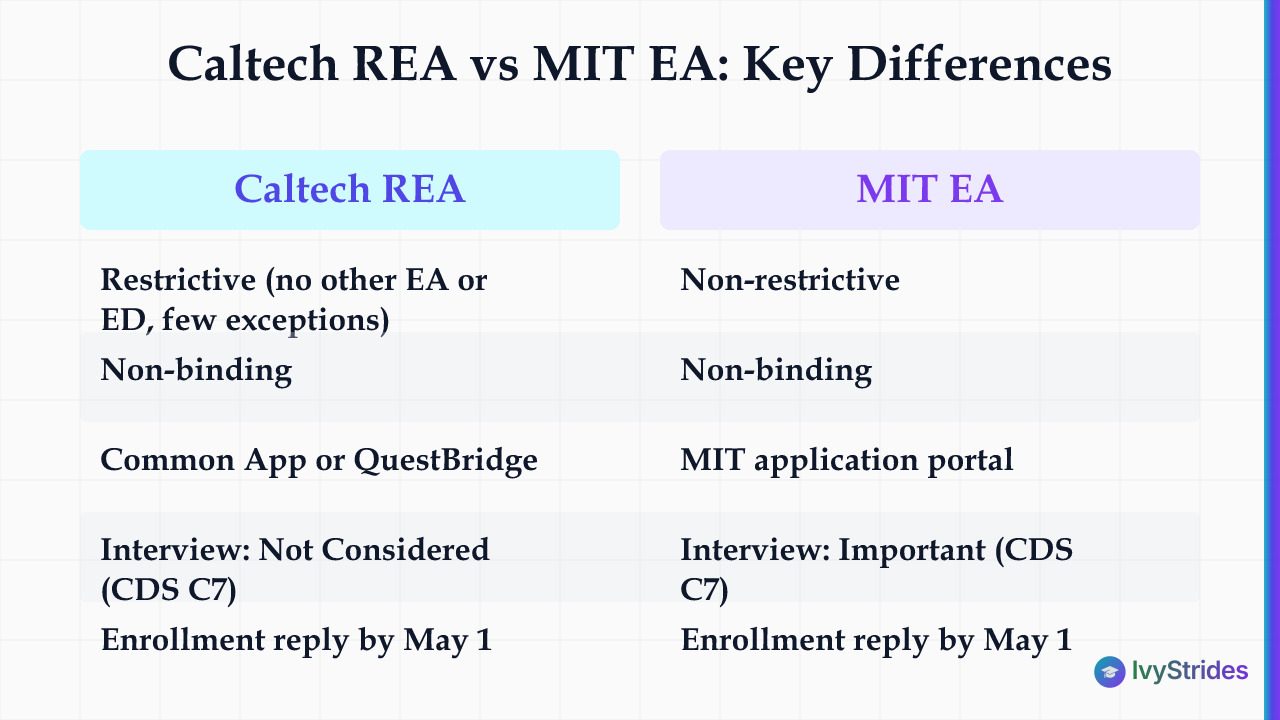
Caltech Restrictive Early Action is a non-binding early plan that bars Early Action and Early Decision at other institutions, with a short list of exceptions. Admitted students still have until May 1 to decide whether to enroll (Caltech Academic Catalog). The "restrictive" part is the catch: pick Caltech REA and you cannot file MIT EA, Stanford REA, or Harvard REA in the same cycle.
What REA leaves open matters just as much. Caltech's exceptions cover public institutions with a non-binding policy and a fall deadline, such as the University of California, plus non-binding rolling admissions, institutions outside the United States, and military academies (Caltech deadlines). MIT is a private university, so no exception on that list covers it, which is why MIT EA is out.
The MIT side is the opposite. MIT says its Early Action "isn't single-choice, binding, or anything like that," and when another school limits early applications, "MIT requires that you respect those rules" (MIT early vs regular). Filing MIT EA would not, by itself, cost you Caltech RD, but filing Caltech REA does cost you MIT EA. The restriction runs one direction.
Because MIT sees no strategic benefit in either round, choosing between the MIT Early Action deadline and deferral process and Regular Action is a timing question. Caltech takes the Common App or QuestBridge; MIT uses its own application portal. No interview factors into Caltech's read: its CDS C7 rates Interview as Not Considered, while MIT rates Interview as Important and offers alumni Educational Counselor interviews where available.
| Feature | Caltech REA | MIT EA |
| Restriction | Restrictive (no other EA or ED, with a few exceptions) | Non-restrictive |
| Binding? | Non-binding | Non-binding |
| Early application due | November 1, 2026 (closed) | November 1, 2026 (closed) |
| Decisions | Mid-December | Mid-December |
| Platform | Common App or QuestBridge | MIT application portal |
| Interview (CDS C7) | Not Considered | Important |
| Enrollment reply | May 1 | May 1 |
Caltech REA Deadlines and Decision Timeline for Fall 2027

Photo by Andy Barbour on Pexels
For fall 2027 entry, Caltech REA applications were due November 1, 2026, supporting materials closed November 6, and decisions arrive by mid-December (Caltech deadlines). MIT's Early Action round closed the same day and also releases decisions in mid-December.
A deferral from the REA round is not a rejection: your file moves into the Regular Decision pool, and a deferred student may apply to another school's Early Decision II program, withdrawing from Caltech if admitted there (Caltech Academic Catalog). Caltech's RD deadline is January 4, 2027, with materials due January 10 and decisions by mid-March. MIT's Regular Action deadline is the same January 4, with decisions in mid-March.
If you go the other way and file MIT EA, a deferral there triggers a February Updates and Notes (FUN) form where you submit midyear grades. MIT then reviews deferred applicants again without prejudice in Regular Action; students denied in Early Action cannot apply Regular Action.
Scores carry their own deadlines. Both schools are test-required for fall 2027. Caltech requires the SAT or ACT and prefers neither; REA applicants submit scores before November 30, 2026, and Regular Decision applicants before December 31, 2026 (Caltech standardized tests).
Caltech also sets aside the ACT composite and considers each subscore on its own, with the ACT writing and science subscores not required. That changes how you read your own result: with Caltech SAT and ACT score bands rather than cutoffs, a single section can carry more weight than a composite average would suggest.
| Milestone | Caltech REA | MIT EA |
| Early application due | Nov 1, 2026 (passed) | Nov 1, 2026 (passed) |
| Early testing before | Nov 30, 2026 | Nov 30, 2026 |
| Early decisions | Mid-December | Mid-December |
| Regular deadline | RD Jan 4, 2027 | RA Jan 4, 2027 |
| Regular testing before | Dec 31, 2026 | Dec 31, 2026 |
| Regular decisions | Mid-March | Mid-March |
Which Profile Makes Caltech REA the Right Call
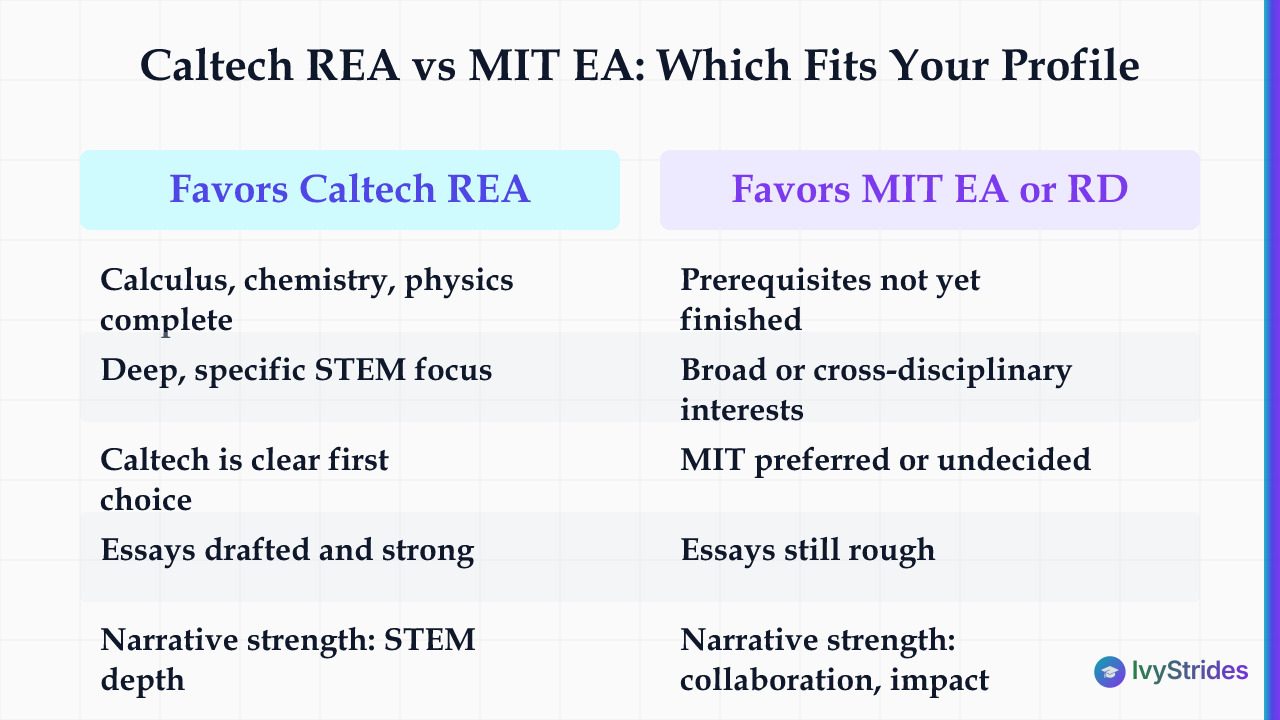
Caltech REA is the right call when your record already shows what Caltech reads first: mastery of calculus, chemistry, and physics inside a deep, specific STEM narrative. Caltech establishes academic readiness before anything else, then looks at how you handle hard work, setbacks, and collaboration (Caltech, how we review).
Caltech requires four years of math including one year of calculus, one year of physics, and one year of chemistry (academic requirements). It frames the review around three qualities: Capacity for Caltech Rigor, Scholarly Character, and Scientific Drive. Scientific Drive, in its own words, is depth of engagement, not a count of STEM activities. And it is explicit that "limited access to opportunities does not equate to limited capacity."
Watch the method, then try it: IvyStrides explains SAT and ACT question types on YouTube.
Faculty drive the review once readiness is clear. More than 20 faculty do full reads of the most competitive files, and every admitted student receives a positive review from a professor (faculty and the admissions process). Its CDS C7 rates five factors Very Important: Rigor of secondary school record, Standardized test scores, Application Essay, Recommendations, and Character/personal qualities (Caltech CDS 2025-26).
MIT reads the same transcript through a different lens. Its CDS C7 names exactly one Very Important factor: Character/personal qualities (MIT CDS 2025-26). MIT describes the match between applicant and Institute as what drives selection, including mission alignment, a collaborative spirit, initiative, risk-taking and resilience, and hands-on creativity (what MIT looks for).
So the signal is straightforward. A deep, specific STEM record with the three prerequisites locked in and essays ready favors Caltech REA. A broader humanities balance, or a collaborative-impact narrative stronger than raw STEM depth, favors saving the early slot and applying to both in the regular rounds. Because Caltech and MIT weigh the same application file so differently, the same student can be a stronger early fit at one of them.
For a junior weighing next fall's early round, IvyStrides college counseling sets a month-by-month plan through the deposit deadline, with the course map, testing recommendation, college list and a per-school submission audit.
| Signal | Favors REA | Favors MIT EA or RD for both |
| Calculus, chemistry, physics done | Yes | Not yet complete |
| STEM focus | Deep and specific | Broad, cross-disciplinary |
| Caltech vs MIT first choice | Caltech clearly | MIT or undecided |
| Essays ready by the early deadline | Drafted and strong | Still rough |
| Narrative strength | STEM depth | Collaboration, impact |
Nothing here guarantees admission. Caltech says that once readiness is shown, "admission is not determined simply by increasingly polished academic credentials," and outcomes depend on the full application, not the early round or any single factor.
What Happens to Your MIT Application If You Choose Caltech REA
If you pick Caltech REA, MIT EA is off the table, but MIT Regular Action remains fully available with no disadvantage. MIT's admissions office says "there is no strategic benefit to applying in one vs the other" (MIT early vs regular). The one thing REA costs you at MIT is a round MIT says carries no edge.
Since no edge is lost, the practical question is timing. MIT's Regular Action deadline is January 4, 2027, with decisions in mid-March (MIT deadlines and requirements), the same window as Caltech RD. For that deadline you write MIT's full set on its own form: four short-answer essays of roughly 100 to 200 words each, four short responses of 40 to 50 words, and only four activities. If Caltech defers you, MIT's short-answer essays for Regular Action come due the same day as Caltech's Regular Decision deadline.
At MIT, early action does not increase admission chances, so choosing Caltech REA sacrifices no MIT advantage. The real question stays which school is your clear first choice.
What to do from here:
-
If you filed Caltech REA, expect a decision by mid-December and keep MIT Regular Action ready for January 4, 2027.
-
If Caltech defers you, your file moves to Regular Decision; scores for that round go in before December 31, 2026.
-
If you applied to neither school early, both regular rounds close January 4, 2027.
-
If MIT EA defers you, submit the February FUN form with midyear grades.
-
If you are a junior, Caltech's REA deadline for fall 2027 entry was November 1, 2026; decide next fall's round on the signals above once Caltech posts its next dates.
For a junior who wants a faster answer elsewhere next fall, UT Austin early action is a public, non-binding round that fits Caltech's exception.
FAQ: Caltech REA and the MIT Early Action Decision
Does Caltech have restrictive Early Action?
Yes. Caltech's early plan is Restrictive Early Action, which is non-binding. For fall 2027 entry it closed November 1, 2026, with decisions in mid-December. REA blocks Early Action and Early Decision at other colleges, except public universities with non-binding fall deadlines, non-binding rolling admissions, schools outside the United States and a few others. Admitted students have until May 1 to decide whether to enroll.
Does Caltech have a GPA cutoff?
Caltech publishes no GPA cutoff. Its CDS C7 rates Rigor of secondary school record as Very Important and Academic GPA as Important, so the courses behind the number carry more weight than the number. A strong GPA earned across calculus, physics, and chemistry reads differently from the same GPA without those courses.
Does MIT reject Early Action?
MIT can deny, defer, or admit EA applicants. Its admissions office states that EA brings no strategic advantage over Regular Action, so a deferral is not a signal of a weak file. Deferred applicants are reviewed again in the Regular Action pool, with decisions in mid-March.
Your Next Step on the REA Decision
The call comes down to one question you can answer honestly: is Caltech your clear first choice, and can your file be ready by its early deadline? If both are yes, REA costs you nothing you value. If either is shaky, the regular rounds lose you no real advantage.
- Confirm calculus, chemistry, and physics are on your transcript.
- Get SAT or ACT scores in before December 31, 2026 for Caltech Regular Decision.
- Draft your STEM academic interest and Scholarly Character essays before you commit.
- If undecided, plan a dual Regular Decision strategy for the January 4, 2027 deadline.
College admissions insights on LinkedIn: follow IvyStrides for application guidance and counseling updates.

Rajesh is a technology leader, entrepreneur, and angel investor with 28+ years in Business & Technology Leadership and Product & Solution Engineering. He is passionate about education, mentoring, and driving digital transformation.